

Author archive
Speed Doesn’t Kill People; People Kill People (aka There Are No Bad Speeds, Just Bad Driving)
In the past fortnight, I’ve seen the results of two smashes on the open road, one at least of which left a driver with serious injuries. In one, a late-model SUV had been driving in a downpour and had rolled completely onto its side, collecting another vehicle in the process. In another – the more serious of the two, where I and my family were some of the first people on the scene and hung around with a bunch of others to help before the emergency services arrived – a fairly new Mini (probably a JCW Clubman ) had drifted across the centre line on the open road and gone straight into an older Mitsubishi campervan. Both cars were a real mess, although the driver of the campervan was in better shape and was able to walk away from the accident, albeit with a nasty bruise on the leg that made her limp and a few cuts from broken glass (I know this because I was the one who did the first aid check on her). The driver of the Mini was trapped under a caved-in windscreen and was screaming her head off (we found out later she had a badly broken arm and possibly some internal injuries). The campervan was in pieces and there was diesel (thank heavens it wasn’t the more inflammable petrol!) all over the road. It was traumatic enough for me and my family, who had been setting off for a quiet weekend away. It was worse for the two drivers concerned and their passengers.
 How do we get the road toll down? Is the answer to reduce the speed limit?
It’s a tough and controversial question. On the one hand, we’ve got all the cops and the safety experts telling us to keep our speed down, and spending tons of taxpayer money to get the message out there (as if we haven’t heard it since goodness knows when). On the other hand, we have better roads and cars with better safely systems, so is it really realistic to insist on a speed limit that was set back when you were lucky if a car had seatbelts in the rear seat?
Of course, the more cynical type of driver is going to note that the speed of a vehicle is something that is very easily detected by speed cameras and radar traps, and fining drivers in the name of safety is an easy way for the government to pick up a bit of extra money… which they will spend on marketing campaigns to tell us to slow down, etc. Of course they’re not going to change the speed limit when keeping us to it is such a good cash cow.
However, let’s leave the issue of fines and money aside and look at the actual issue.
The main reason why the powers that be focus on speed is not just because it’s something that’s easy to measure. It’s because of the physics. Anything travelling at a high speed will have a lot of kinetic energy that requires a lot of force to maintain in the face of friction, and when that object travelling at high speed stops, that energy has to go somewhere. In the case of a deliberate slow-down, friction will take up a lot of the energy (and, in the case of regenerative braking, turn it into electrical potential energy). In the case of a fast and unintended stop (i.e. a crash), all that energy is transferred all at once into not just the vehicle itself, what it’s hit and the road, but also what’s inside that vehicle.
If all is going well, the raw speed of a car is not a problem. If it were speed per se that killed, you’d expect that the German authorities would have noticed this by now and changed the rules about the limitless autobahns. According to a news report from last year, fatal accidents on German roads had reached an all-time low since it kicked itself back into gear after the war in the late 1950s. The number of accidents, however, has increased. The rate of fatal accidents has dropped dramatically since the 1970s in Germany, and they say that it’s thanks to better car safety design (the rivalry between German makers like Mercedes and Swedish companies like Volvo as to who’s got the best safety systems seems pretty intense), as well as things like insisting on seatbelts and motorbike helmets. A lower legal limit for blood alcohol also helped curb road deaths. The fact that cars have got faster and more powerful over this time and roared along the autobahns at 250 km/h as often as possible doesn’t seem to have played a role.
If things do go wrong, however, then the speed of a vehicle makes the consequences a lot worse. It’s a situation like you get with guns and pitbulls. A gun used responsibly in the right way by the right people is fun and is a useful device for removing pests or putting meat on the table. However, if someone loses their temper and goes on the rampage, a gun will do worse damage in the hands of a maniac than, say, a knife, chainsaw or wooden club. Pitbulls, Staffordshire Bull Terriers and Rottweilers can be soppy, affectionate and obedient animals when well trained, but if you mistrain or mistreat one (or make the mistake of attacking its owner), then they’ll do a lot more damage than a Chihuahua or a Labrador (which, in fact, are a lot more likely to bite people – they just don’t make headlines when they do, as they don’t cause much carnage). The same goes for speed. Staying in your lane and going along a deserted bit of open road at 120 km/hr or even higher is not going to be a problem. However, if you go around the corner way too fast for the conditions, try to do this sort of speed in heavy traffic, drift out of your lane into an oncoming vehicle, go over a patch of gravel or ice, or hit a roo (or any combination of the above), then the results are going to be a lot worse than if you had been going at, say, 50 km/h.
Those protesting gun control will argue that it’s not guns that kill people; it’s people who kill people. Similarly, owners of Rotties, Pibbles and Staffies will protest breed-related legislation by arguing that there are no bad dogs; there are only bad owners. It’s just the same with speed limits. It’s not speed that kills; it’s bad driving that kills. Bad driving, notice, not bad drivers. Even The Stig, Mario Andretti, Peter Brock and Mark Skaife have off moments, as they’re only human.
So what’s the answer to the problem of getting the road toll down? How are we going to prevent people getting injured the way that Mini driver was injured? There are no easy answers – it’s definitely not as simple as just saying that we need to keep the speed down. In fact, I’m going to have to devote more than one post to this topic and analysing all the factors. With the help of your comments, perhaps we’ll find the answers.
Reinventing The Wheel – Several Times
 They say that you shouldn’t try reinventing the wheel. But why shouldn’t you try to reinvent the wheel? After all, wheels have been reinvented several times over the course of history, and they’ve got better and better every time – something that most motorists of today should appreciate. Let’s face it: there are more wheels in your car than the ones that actually touch the tarmac.
Let’s go back to when the wheel was first invented, which, according to archaeologists, was about 3800–3500 BC. Before they had the wheel, the way that they hauled large loads about the place was to put it on a sled sort of thing. You can try this for yourself some time: compare pulling a large rock across grass straight and then put it on a plank or a piece of tin or something and see how much easier it is. They think that this is how they managed to build the Pyramids and Stonehenge, by the way.
During the sled years, they worked out that if you put rollers under a sled, it gets even easier to pull a load along. The only trouble with rollers is that someone has to take the ones that have just popped out the back of the load to the front of the load, and if you’re not quick enough, then everything comes to a standstill. Then some absolute genius had an idea: what if you could fix rollers permanently under a sled? That gave us the axle. Then another genius realised that if you have a larger round thing on the end of the roller, then the sled is off the ground completely and the load can be pulled much faster. Hey presto: wheels.

Solid wheels on an ox cart from China.
The wheels on early carts and vehicles weren’t made out of stone, which you might be picturing if you’ve seen the Flintstones. Stone wheels did exist, but these tended to be used for grinding grain rather than for transport. The early wheels were wooden, and tended to be made of several pieces of wood carefully shaped (tree trunks aren’t always perfectly round) and clamped around the axle in the middle. However, these wheels were really, really heavy. With a pair of oxen hitched to the front, a cart could go at about 3 km per hour, which is fine if what you need to do is to carry a large load, but for getting yourself from A to B, it was quicker to walk.
Enter the first reinvention of the wheel. Another unknown genius looked at the wheel and wondered how to reduce the weight to get better speed and greater efficiency (much like car designers do today). This genius realised that what you need is the roundness of the outside of the wheel, the bit in the middle that hold the axle and something in between to hold the outer circle to the inner circle. In other words, you need the rim, the hub and the spokes. This reduced the weight of the wheel dramatically, meaning that vehicles could go faster. The combination of hub, spoke and rim was also a lot more aesthetically pleasing, as anyone who has looked at the designs of alloy wheels knows. This may be why it just feels right to have alloy wheels on a sports car: somewhere deep down in the human psyche, we know that spoked wheels go faster.
And they certainly did go faster. After the spoked wheel was invented, it became more feasible to use horses to power the vehicle. Horses were to oxen what turbocharged petrol is to diesel. Diesel’s great at low speeds and for serious towing but for fast sporty stuff, you go for petrol. Where you’ve got speed, you’ve got to consider handling as well, especially if you want to corner tightly. This led to the development of the two-wheeled chariot – possibly the earliest example of a rear wheel drive? Most recorded uses and images of chariots were used in a battle context and no, they weren’t usually used in head-on charges, despite what you might see in the movies. That sort of manoeuvre would just lead to pile-ups. If you’ve got something that fast and easy to turn, it’s better strategy to use the chariot to come in from the side and either drop off infantry or else shoot from the chariot itself before pelting away like mad.

This model comes fitted with classy six-spoke wheels for improved speed and better handling…
It probably didn’t take too long after the invention of chariots for people to try racing them. It’s human nature when presented with something that moves fast to try to see who’s got the fastest. Chariot racing was as popular back then as motorsport is today. In Babylon, they enjoyed racing about on the asphalt – on the streets and on the top of the massive city walls (and yes, they did use actual real asphalt for road surfacing in Ancient Babylon).
There were two real problems with these lightweight chariot wheels. Firstly, the chariot sat right on top of the axle and there was no suspension system to even out the bumps, which must have made a fast dash extremely uncomfortable for the charioteer and the archer riding up with him (or her, in the case of the Celts). Leaf suspension is said to based on the technology of the bow and the Egyptians are said to have used it. The second problem was that round bits of wood chipped and broke really easily. This led to reinvention number two: tyres (or “tires”, which is believed to be a shortened form of “attire”, suggesting that a wheel needed to be properly dressed).
Early tyres weren’t the rubber air-filled things we know today. Instead, they were made of metal bands that contracted onto the rims as they cooled. This protected the rim but increased road noise like mad. It also made the jarring and jolting worse. They made attempts to soften the steel with leather, but this only went so far and leather wore out pretty quickly with heavy use.
Metal tyres were the norm for millennia. Solid rubber tyres were tried once rubber had been made more widespread. However, rubber was really, really bouncy, making the ride even worse (we don’t know how lucky we are with modern suspension and shock absorbers). It wasn’t until the mid- to late 1800s that first a Scotsman called Robert Thompson and then another Scotsman called Charles Dunlop independently had the idea of making a hollow tube of rubber and fitting that around the rim of a tyre, which softened the ride without too much bounce. Yes, that is Dunlop as in Dunlop tyres. This was reinvention of the wheel Number Three. Vulcanizing the rubber around the pneumatic tyre to make it tougher and more resistant to punctures was again invented independently by inventors on both sides of the Atlantic with more familiar names: Charles Goodyear and Thomas Hancock. One hundred years after the invention of the pneumatic tyre, Michelin developed radial tyres and put these straight away onto the cars made by the company they had just bought out, Citroën.

The Virtruvian mill, one of the earliest gearing systems.
In the meantime across the ages, wheels weren’t just being used for transport. Once the principle of the wheel and axle had been invented, it was used elsewhere. One of the key ways that wheels were used in the hot conditions of the Near East and the Mediterranean was to lift water out of rivers up and into the irrigation channels of gardens and fields; the other was to grind grain into flour for daily bread. The early versions, which needed something to turn the wheel vertically were a chore to turn – think treadmills. Somebody realised that if you fit teeth near the rim of the solid wheel that’s turning in the vertical plane, you can make a second wheel being turned in the horizontal plane with similar teeth move the first wheel around. In other words, they invented gears for irrigation systems and for grain mills, making this another reinvention of the wheel. Before long, they were playing around with gearing ratios – this was one of the things that Archimedes (yes, the one who ran through the streets naked shouting “Eureka!”) tinkered around with and refined.
Gears got really sophisticated over the centuries, especially for things like clockwork, but it wasn’t until the development of the internal combustion engine that these toothed wheels could be used for transport. You can’t have the wheels turning at a speed that would make the cart or coach run faster than the horses pulling it. It was Bertha Benz after her historic drive in the first motor car who had the idea of adding gears to the mechanism so a car could go uphill better. At long last, the two branches of wheel development had come together, giving us the vehicles we know today, more or less.
The Daftest Car Names
There seems to be a little rule out there somewhere that states that if something’s in a foreign language, it’s more sophisticated, more desirable and generally cooler. A number of cars and other vehicles available on the Australian market have names that fall into this category, such as the VW Amarok (Amarok means “Wolf”), the Porsche Carrera (Carrera means “Race) and the Alfa Romeo Mito (Mito means “Myth”). And a lot of them kind of work in the original language (even so we keep hearing that Pajero is the Spanish for “wanker”, although they were popular enough in some Latin American countries, nevertheless). Some don’t, like the Maserati Quattroporte, which sounds cool until you realise that “quattroporte” merely means “four doors” – it doesn’t get more uninspired than that.
Some cars intended for the Asian market also have a go at trying to use a cool foreign language, namely English, and fail. Badly. Some of them even made it onto the market over here, making you feel like a twit when you tried asking the salespeople for them. Here’s a selection of some of the ones that made me snigger in no particular order so you can get a chuckle out of them too. And maybe this might make you stop and think a little bit before you buy that shirt (or get that tattoo) with Chinese or Japanese characters you can’t understand just in case the reverse happens and you provide your Asian friends with something to laugh at in return.
- Great Wall Wingle
It’s not a bad little pickup really, in spite of a name that sounds like a cutesy term used by small children for boys’ private parts.
- Tang Hua Detroit Fish
The “Fish” part is understandable for a car that’s intended to be amphibious. But we just don’t get the “Detroit” part.

- Mitsubishi Lettuce
OK, we get the need to suggest the environment and sustainability, but naming a car after a really common salad ingredient doesn’t seem to work (though Mizuna and Rocket, which are commonly found in your typical mesclun salad would kind of work, as would Mesclun itself).
- Honda Life Dunk

- Mitsubishi Mini Active Urban Sandal

Do the Japanese car manufacturers cut out words they like the sound of and pull them at random out of a bag? Is there any other explanation as to how these cars got their names?
- Geely Rural Nanny
OK, this ute is designed for the country – hence Rural – and it will take care of you – like a Nanny – but the two together…

- Mazda Bongo Friendee
This is actually quite a reliable van and I used to own one – it made a great camper and trade vehicle. However, answering the question “So what sort of car do you drive?” was really cringe-inducing. At least it amused the kids.
- Honda That’s
That’s…. what???? This is a car guaranteed to drive the Grammar Police nuts.

- Toyota Deliboy
This van type-thing would work for making deliveries from the local deli store or doing similar courier work. But what if the person making the deliveries is a girl?
- Daihatsu Scat
OK, what’s a good name for a small 4×4 that suggests the great outdoors? How about one of the things that hunters use to track animals? Did nobody tell the makers that when you find animal “scat”, you have not found footprints but something smellier.
- Suzuki Every Scrum Joypop Turbo
We repeat the theory of cutting up random words and pulling them out at random.
- Isuzu Mysterious Utility Wizard, aka MU
“Mysterious Wizard” has a certain ring to it, although it’s a bit grandiose. But when you add in the “Utility” bit, it suggests a sorcerer who you can’t figure out a use for. As for the “MU” bit, do you pronounce this “Moo” like a cow, “Mew” like a cat or “Em You”? However, the weird name didn’t stop this being a reasonably popular and successful SUV, to the point that Isuzu have brought out a sequel in the form of the MUX (Mucks? Mooks? Em You Ex?).
- Mitsubishi 500 Mum Shall We Join Us?
Leaving aside the interesting philosophical question about why people would ask whether or not they would join themselves, what’s with the question mark? And the Mum?

- Daihatsu Naked Be-Pal
The “Naked” bit is bad enough on its own, but the “Be Pal” bit?
- Peugeot Tepee
We get the reference to Native American buffalo skin tents but anything with “Pee” in it is a disaster.
Any beautiful disasters – in any language – that we’ve missed? Or maybe all, folks!
What Did People Use Petroleum For Before The Internal Combustion Engine?
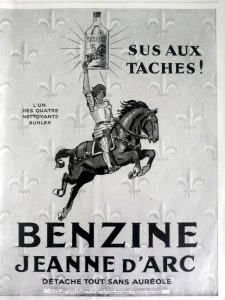
Vintage advertisement for benzine-based stain remover.
Petroleum is currently the backbone of the motoring industry, despite the push for alternate fuel sources such as biodiesel, electricity, ethanol, etc. Ever since Karl Benz first invented the internal combustion engine and fitted it to the horseless carriage, vehicles have run on petroleum of some type – apart from a brief period where Diesel engines ran on vegetable oil.
On Bertha Benz’s legendary first long-distance drive in her husband’s new invention, she ran out of fuel and had to stop and pick up more from the nearest pharmacy. It’s easy to just take in that sentence and think what a funny place a pharmacy is to pick up petrol until you stop and think about it: why was a chemist’s shop selling petrol? What on earth were people using it for before we had cars to put it in?
Petroleum has certainly been known for at least four millennia. The name comes from Ancient Greek: petra elaion, meaning “rock oil”, which distinguished it from other sorts of oil such as olive oil, sunflower seed oil and the like. The stuff was coming out of the ground all around the world, and quite a few ancient societies found a use for it.
The most useful form of petroleum back in the days BC (as in Before Cars as well as Before Christ) was bitumen, the sticky variety that we now use for making asphalt for road surfacing. Bitumen (also called pitch or tar) didn’t just stick to things; it was also waterproof. As it was a nice waterproof adhesive, it came in handy for all sorts of things, from sticking barbed heads onto harpoons through to use as mortar – the famously tough walls of the ancient city of Babylon (modern-day Iraq, 2which is still oil-rich) used bitumen as mortar. The Egyptians sometimes used it in the process of mummification, using it as a waterproofing agent. In fact, the word “mummy” is thought to derive from the Persian word for bitumen or petroleum, making mummies the very first petrolheads.
For the next thousand years, petroleum in the form of bitumen was mostly used for waterproofing ships, to the extent that sailors became known as “tars” because they tended to get covered with the stuff. In the 1800s, it was used to make road surface – before there were cars to run on them.
It was probably the Chinese who first had the idea of using petroleum as fuel. “Burning water” was used in the form of natural gas for lighting and heating in homes, and in about 340 AD, they had a rather sophisticated oil well drilling and piping system in place.
The bright idea of refining bitumen to something less sticky and messy first occurred in the Middle East (why are we not surprised?) at some point during the Middle Ages. A Persian alchemist and doctor called Muhammad ibn Zakariya al-Razi (aka Rhazes) wrote a description of how to distil rock oil using the same equipment the alchemists used for distilling essential oils. The end result was what we know today as kerosene, and it was a lot more flammable. Kerosene was used for lamps and in heaters, especially as it was a lot cleaner than coal. It was also used in military applications. Naphtha (one of the other early names for petroleum products) was possibly one of the mystery ingredients in Greek fire.
 Kerosene and the like really took off during the Age of Coal and the Industrial Revolution, as they were by-products of the coke-refining industry. About this time, scientists started tinkering around with various ways to refine crude oil into products like paraffin and benzene and benzine. Benzene and benzine are not named after Karl and Bertha Benz the way that diesel fuel is named after Rudolf Diesel. These words are actually derived from “benzoin” and benzene was given its official name by yet another German scientist in the early 1800s. The similarity between the surname Benz and the name of the petrol product is pure coincidence – really!
The petrol product (ligroin) that Bertha Benz picked up at the pharmacy was probably sold as a solvent, like the ad in the picture up the top. This was one of the most common household uses of bottled refined petroleum. Petrol is still very good as a solvent and can bust grease like few other things, so it was popular as a stain remover and a laundry product. It might have ponged a bit and you had to be careful with matches, but it was nice and handy, and meant you could get that candle-grease off your suit without putting the whole thing through the wash. Other uses for benzene that sound downright bizarre to us today included getting the caffeine out of coffee to make decaf and aftershave. REALLY don’t try this one at home, even if you love the smell of petrol, as we now know that petrol products are carcinogenic and you should keep them well away from your skin, etc.
It was the widespread use of petroleum-based products such as paraffin in the 1800s that made the demand for whale oil drop dramatically. This happened just in time to stop whales being hunted to extinction. Using petrol was the green thing to do and helped to Save The Whales. Now that whales have been saved and are thriving, cutting down on the use of fossil fuels is the main focus of a lot of environmental groups. Irony just doesn’t seem to cover it.
 Level 2, 9 Help Street