

Author archive
Chrysler, BMW and Kia Join The Police Fleet
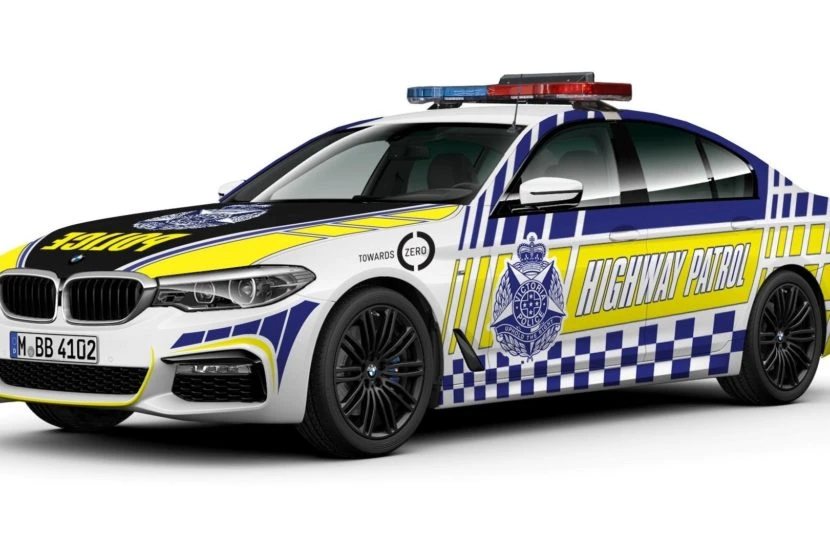
BMW 530d – confirmed as part of the Victoria Police fleet.
I don’t know if they were actually putting bets on it anywhere (although I wouldn’t be surprised) but when Holden and Ford Australia closed their factory doors, the big question for a lot of us who are interested in motoring and car news was what the cops were going to drive for their regular patrol and pursuit cars. You see, up until the closure of Ford and Holden’s factories on these shores, the cops, being a wing of the government and hence keen on supporting local industry, drove Ford Falcons and Holden Commodores, to the point that wary drivers who like to push the limits a wee bit went on high alert at the mere sight of a white Dunny-Door (aka Commodore) in the distance. As a matter of fact, the boys and girls in blue were required to drive locally built vehicles.
But the rule that says the cops had to drive locally built vehicles was scrapped. Then the fun of the guessing game started. There were all sorts of speculations going on. Would we get the hot-looking new Kia Stinger on the roads in police livery? The more obscure Genesis G8 from Korea? Or something else?
The speculations have now ended, and the police departments of various states have made their choices. Here’s the list of vehicles that will be a welcome sight if you’ve picked up the phone to report a burglary… or an unwelcome sight in the rear view mirror if it’s got the disco lights going and you know you’ve been driving naughtily.
Chrysler 300 SRT: OK, one of the reasons why they picked this one is possibly because it’s made by Fiat Chrysler Automobiles Australia, which still has a humming factory. The other reasons are because it’s got a feisty 6.4-L naturally aspirated V8 engine (350 kW and 637 Nm) with a very snappy 0–100 sprint time (4.5 seconds). It’s also a nice, big sedan with lots of room for all the gear that cops need (and space for arrested suspects in the rear where they can’t kick the driver through the back of the seat). The NSW Police announced in December 2017 that they’d be kitting out a bunch of these (the exact number is unknown but it’s probably got three digits) as patrol and pursuit vehicles. The downside is that it’s a thirsty brute.

BMW 530d: The Victorian Police confirmed that they’d be getting at least some examples of the diesel-powered German mid-sized sedans for the highway patrol fleet, with 80 confirmed for about now. While the Beemer is a shade less powerful than the Chrysler (we need a nickname for Chrysler – any suggestions?), it’s possible to get these straight from the factory with the police pack ready installed. Cops all through Europe drive the 5-series sedan so it’s proved its worth in fighting crime. In fact, BMW is one of the few manufacturers that actually have vehicles rolling off the factory lines ready to go on patrol duty. Apparently, they take out some of the luxurious bells and whistles that you get in the everyday civilian versions and replace them with the gadgets that a modern police force needs. The BMW 530d – at least the civilian version – is powered by a 3-litre V6 turbodiesel delivering 195 kW of power and 620 Nm.
Kia Sorento: South Australia Police confirmed in January that they’d be getting some of these popular Korean SUVs and giving them a try-out. Apparently, the safety record of the Sorento was one of the more appealing features motivating this choice, as the Sorento came through crash testing with very high marks. The seven-seater’s got lots of room (great for K-9 teams) although it’s not as peppy as the Chrysler and the Beemer, with the 2.2-litre 4 cylinder turbodiesel delivering 147 kW and 441 Nm. They say that the brakes are going to get an upgrade for patrol purposes because the cops are pretty hard on the old braking systems.
Kia Stinger: The very hot-looking new sedan has been spotted in the livery of the Queensland Police force. Apparently, it wasn’t just the nippy 2-litre 4-cylinder turbocharged engine (182 kW and 353 Nm) that made it attractive: it’s also great braking and cooling systems that passed the rather punishing tests that the Powers That Be put them through (a Ford Mustang from overseas failed these tests and was bumped off the shortlist). The fact that the Stinger looks great and is a newly unveiled model is also likely to help with police liaison activities with schools and the like.
It’s still early days and some of the vehicles are just being trialled for active duty in various states, and there are a few others that might be used, such as overseas-built Commodores. However, out of the list of what’s been confirmed, which of these vehicles would be the one that gets your heart racing the most, whether it’s the vehicle that appeals most to your inner small kid who hero-worships the cops, or the one you’d least like to see bearing down on you with the disco lights going?
The Pros and Cons of Driverless Cars
In any discussion of road safety and keeping crash-related deaths down, you’re always going to come back to the human factor. Most times, people doing silly things are what cause crashes, whether the silly thing is misjudging the speed to take a corner at in the wet, reading a text message while driving and not noticing that the car is drifting, or getting behind the wheel when a bit tiddly. Is the answer then to eliminate the human factor altogether and adopt driverless cars, much in the same way that aircraft have adopted autopilot systems?
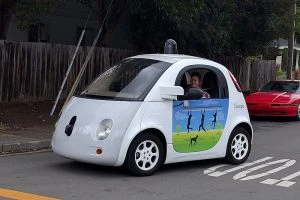
What Google’s driverless car looks like.
There are tons of reasons why driverless cars (aka autonomous cars, self-driving cars and autonomous cars) could be a good idea, and just as many reasons why they’re not.
Arguments in favour of driverless cars include the following:
- Robots and computer systems don’t get tired, drunk or distracted.
- Computer systems can calculate the perfect speed to negotiate corners.
- Autonomous cars automatically detect if they’re drifting out of a lane and correct it instantly (some cars do this already even if they’re driven by a real live human being).
- In theory, computer systems don’t make mistakes, slip or get careless.
What we hoped driverless cars would look like.
In short, a driverless car eliminates the human factor. After all, the proverb “to err is human” has been around since before cars were invented. Computerised systems aren’t subject to the limitations of being human and fallible.
However, a modern twist on the old proverb says that although to err may be human, to really mess things up, use a computer. This brings us neatly to the arguments against driverless cars:
- All new software systems are prone to teething troubles, glitches and bugs when first released. This is mildly annoying on your office computer but could be fatal at worst and expensive at best in a car.
- We all know that electronics seem to develop a mind of their own and do weird things that we don’t expect them to unless we’re super-geeks.
- Artificial intelligence can’t cope with really busy situations. Busy car parks and places where pedestrians and cars share the road are particularly confusing for autonomous car systems. Just think of all the ways that people indicate “After you,” in these situations – a wave of the hand(s) that can be big or small or just about any direction, a quick jerk of the head, a smile, mouthing the words… Then you’ve got all those “You idiot!” gestures. A human recognises these instantly; computers often struggle.
- Weather can affect the sensors, especially extreme weather such as snow or heavy rain where you really need to take care.
- Autonomous systems need very detailed up-to-date maps so they “know” the right speed for corners and the best routes. This means continual updates are needed – hello, big data bills! And what happens when something’s changed unexpectedly on the road surface, such as oil spills, debris from a crash or gravel?
- Computers can be hacked and jammed, sometimes remotely. Anybody seen Fast and Furious 8 where this happens? (Yes, I know it’s fiction but who hasn’t had problems with viruses or experienced remote access in a desktop. It’s plausible!)
- People may come to rely on automatic systems so much that they might not know how to react properly if the computer systems fail (and we all know that computers crash now and again).
- Avoiding collisions with large animals on rural roads is harder than you think. Take the example of Volvo : their system worked fine on Swedish wildlife like caribou and elk, but when they tried it out Down Under, the system didn’t recognise kangaroos as large animals to be avoided.
- Autonomous systems probably can’t tell the difference between a dead hedgehog in the middle of the road (which you don’t mind hitting) and Mother Duck waiting for ducklings (which you want to stop for).
- Taxi drivers and chauffeurs would be out of a job.
There are also a ton of ethical and moral issues involved with driverless cars. If a driverless car does crash and kill someone, who’s responsible? The “driver” or the manufacturer of the computer systems and software? How will a computer make decisions in the case of an unavoidable crash. For example, if the algorithm is set to minimise the amount of harm or damage caused and kill the fewest people, and it detects that it’s going to hit a bus on a bridge, will it decide that the “best” option is to go off the bridge, because that will only kill the occupants of the driverless car rather than possibly all the occupants of the bus (just stop and imagine what that would be like for the driver for a moment… and what if that bus is actually empty?).
What’s more, we all know that horrible things like car bombings and jerks ramming crowds on purpose are bad enough, but at least the driver puts him/herself at some risk. What’s to stop a terrorist loading up a driverless car up with explosives and setting the vehicle to go all by itself?
On a lighter note, a lot of people simply enjoy driving. If we want a system that allows us to sit back and relax while we get to work that also cuts down on the need for parking spaces and reduces congestion, this already exists and it’s called “public transport” or at least “car pooling”. But that still includes the human factor…
At the moment, fully driverless cars where the person in the front seat can more or less go to sleep or bury his/her head in the daily news aren’t allowed on our roads. At the moment, even the most automated systems still require a driver who’s alert and ready to take over if things get hairy, much like what happens in aircraft. But who knows which way things will go in the future?
Driven To Distraction
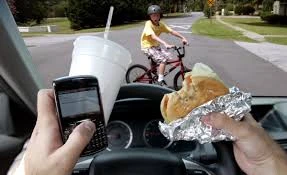
OK, so they’re cracking down on people using cellphones in cars as well as cracking down on high speeds and breaking the speed limit. Here, you’ve got to admit that there’s some justification for doing this. After all, if someone’s got their eyes and fingers all over the phone, he or she is paying less attention to the road ahead and what their vehicle’s doing.
On the surface, it seems so simple. The thinking works something like this: although vehicles and roads are being designed to be safer, crash rates aren’t improving and we’re still seeing heaps of fatal and serious accidents on our roads. At the same time, mobile phones – to say nothing of smartphones – have stopped being the plaything of rich businesspeople and are now essentials for everybody over the age of 13 or so. People can’t seem to leave their phones alone and we’ve all seen people driving badly while talking on the phone. (Mr Grey Toyota who didn’t give way to me while coming out of the supermarket carpark, forcing me to jam on the brakes to avoid hitting you when I had the right of way, I’m thinking about you! I saw you with your phone on your ear the whole time.)
However, maybe it’s not quite so simple as merely having people trying to do two things at once and pay attention to a conversation while driving. After all, people have talked to other people while driving without having accidents for ages. Receiving messages from the dispatchers and other patrol cars via radio has never made the police bad drivers – just think of all the telecommunication gadgetry they’ve had in their vehicles for decades. Truckies and bus drivers have also had a long history of using CB radios to chat while driving – I’m sure we’ve all got memories of riding in a bus where the driver spent most of the time talking into a handset and somehow making sense of what sounded like “worple smooshle burble wop ha ha ha” from the passenger seats. When you stop to think about it, there isn’t really any difference between someone talking on a mobile phone and someone talking on a CB radio handset. So why weren’t/aren’t they considered to be safety hazards?
“Oh, it’s younger drivers and those young people on their phones.” Not necessarily. If you look around you, you can see as many older folk chatting on the phone while driving, so it’s not just a case of Kids These Days. (Mr Grey Toyota, I’m still thinking about you.)
“But modern smartphones make you take your eyes off the road.” This is certainly true. Anything that gets your eyes off the road is going to make you less aware of what’s going on around you. However, even this isn’t anything new. Before we all had navigation systems built into our cars or Google Maps on our phones, we had paper-based maps. In fact, I’ve still got them, and it can be fun to see who gets there first: the navigator with the paper map or the other navigator in the back seat with the phone. Paper maps, whether they came in the form of specially printed books or a scribble on the back of an envelope with a few landmarks and road names noted, were often read or glanced at by drivers while in transit. This usually involved spreading said map out on the steering wheel, glancing down, looking up again and so on. Nobody really blamed them for crashes the way they blame cellphones.
Even real live people called passengers having a conversation can be distracting. One of the things that most of us parents have had to teach our kids is that Mummy/Daddy can’t look at the picture you did at school right now because he/she is driving. It can be a hard concept for a kid to grasp but they do get it – eventually.
If you listen hard enough to the safety gurus, if you do anything other than keep your mind on your driving, keep both hands on the wheel and keep your eyes on the road ahead, you’re guaranteed to crash. Now, they do have a point. We do need to focus on what we’re doing and concentrate on driving. However, we all know that continually concentrating on one thing and one thing only for long periods is extremely draining and increases fatigue. And we’re all human and notice things in and outside the car. This, dear friends, is why advertising companies spend heaps on roadside billboards. They know that you’ll read them while driving.
On the topic of losing concentration and advertising billboards, there have been a few studies into the effect of billboards on road safety. It seems that yes, those advertising hoardings are distracting drivers and contributing to advertisements. The worst offenders, it seems, are big billboards, digital billboards that display different messages every few seconds, and billboards featuring sexy models. There have been a number of cases from around the world, mostly to do with lingerie ads, where big billboards featuring airbrushed models in lacy knickers and bras have had to be taken down because of a noticeable increase in traffic accidents happening after the billboard goes up. This is another argument, alongside public decency, sexualisation and objectification of women, for not having sexy billboards all over the show. But we don’t seem to have people complaining about that as much as they do about cellphones in cars.
Now that you’ve all pulled your minds out of the gutter and stopped feeling disappointed that I didn’t provide an example (I actually want you to read this article and I’m against sexploitation)… back to the debate over whether cellphones contribute to accidents.
There is a side to cellphones, smartphones, mobile phones – whatever you want to call them – that you didn’t get with other forms of distraction, which is an argument in favour of switching them off when you’re driving and being tough on them. This is the effect of conditioning. Like Pavlov’s dog, we’re trained to respond instantly, almost without thinking, when we hear our ringtones or alerts or notifications going off. It rings – we reach for it. Trying to ignore it sometimes makes us feel anxious – it could be important! It could be a message from my son/daughter/mum/dad/wife/husband etc. saying they’re in trouble and need help now. Nine times out of ten, it isn’t urgent, but we still react instantly just in case. And it’s a hard habit to break. We just HAVE to see who’s calling or texting. And that’s where the problem for road safety kicks in. We reach for the phone (distraction #1) and see who it is (distraction #2) then read the text (distraction #3). By the time we’ve done all that, anything could have happened on the road. It’s this sort of distraction that seems to be the only explanation behind a nasty accident I witnessed recently, when a Mini crossed the centre line on a perfectly straight open road and went into a campervan.
It’s this last factor that makes the difference, in my opinion. You can ignore the paper map (or pull over to memorize it, then focus on the road), you can use the CB radio with one hand while keeping eyes fully on the road and you can tell insensitively talkative passengers to shut up. But because we’ve become conditioned to respond instantly to ringing phones, they’re harder to ignore. Responding has become something of an instinct.
But you can break that habit. It is possible. You can even train yourself when you’re not driving. Try counting to ten or twenty before picking up if you hear a notification go off. Nobody’s going to die if you want a few seconds. You won’t get fired and you won’t miss out. In fact, if we refuse to do things Right Now Instantly, we’d probably make steps towards reducing stress levels as well as helping make the roads a safer place.
Come on – do your bit and put the phone down when you’re driving – including you, Mr Grey Toyota!
Is The Speed Limit Outdated?
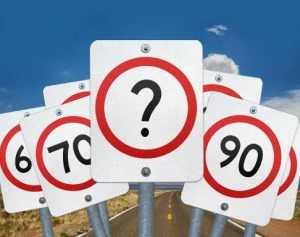 It’s been argued that because today’s cars and today’s roads are better and safer than they used to be, the old speed limits ought to be raised to reflect this. After all, they’ve got a limit of 130 km/h in some bits of Northern Territory (which, incidentally, came in about 10 years ago after having no speed restriction at all – road safety was cited as the reason for introducing limits). Why shouldn’t the rest of the country get a higher speed limit?
We’ve probably all experienced the situation when road signs seem hopelessly out of date when approaching a corner that has one of those advisory speed limits. You know the ones – those yellow signs with a number that usually accompany a curvy arrow indicating a bend in the road ahead. The number is supposed to be the speed at which you can safely go around the corner. However, in practice, we know that you don’t really actually HAVE to go at 55 km/h around a corner that’s marked 55. If your tires are in good nick and if there isn’t anything nasty on the roads (oil, water, gravel, ice, etc.) and if your car has reasonably good handling, then you can go around the corner at a somewhat higher speed. Not the full open road limit, of course – if you kept sailing around the corner at 100 km/h, you probably would come to grief and end up in the ditch. But you don’t need to slow down to 55 km/h.
A lot of us treat those advisory speed signs as a sort of index giving an idea of how tight the corner coming up, kind of like a stationary rally navigator. A recommendation of 65 or 55 (on the open road where the speed limit’s 100 km/h) means that it’s a reasonably gentle bend, 45 means it’s a bit sharper, and so on all the way down to advisory signs reading 25 or even 15, which means you need to get ready for a hairpin turn and certainly need to slow down to negotiate it (but probably not all the way to 15 km/h). After all, the camber of the road and the car features like stability control, traction control and the like all help to keep the car on the road. Cars and roads are designed better these days.
We all know the recommended speeds for corners with advisory signs (known as “design speeds”) are well below the actual speed you can get around said corners comfortably and safely. Are the open road speeds similarly outdated?
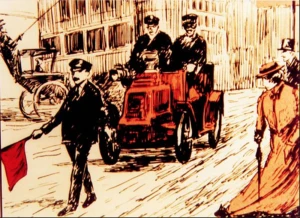
We’ve come a long way since these days – but do we need to go further?
The only trouble with the proposal to increase the open road speed limit to reflect the capabilities of new cars is that not every car on the road is a nice shiny new Mercedes or Volvo with all the latest safety features. There are plenty of people driving beloved old classics, people driving ancient old bangers for budget reasons and those driving cars that aren’t in the category of old bangers but are still over 10 years old and don’t have all the latest whizz-but-not-bang active safety features. The open road speed limit still applies to these drivers as well as to those with new cars. And these older cars may not be able to handle the corners the way that newer ones can.
What’s more, some road users aren’t cars. Trucks, bikes, motorbikes, farm tractors and horses are legitimate road users that one encounters out in the countryside. You’re not going to find a pushbike, a horse or a farm tractor going anywhere near even the existing road speed limit, and the greater the mismatch between the speed of your car and the (lack of) speed of what’s in front of you leads to greater frustration, increased impatience and an increased likelihood of taking stupid risks. And we know that although higher speeds are fine when everybody does what they’re supposed to, if things go wrong, they make the consequences worse.
We also need to remember that the cornering design speeds and the like are often designed with heavy trucks (including road trains) in mind. These need more space and a lower speed to negotiate corners for obvious reasons. Because these vehicles are very important for trade and the economy, all the government-funded researchers into road design, etc. spend quite a lot of time considering the needs of trucks.
The other thing is that even with a higher speed limit, you still need to slow down to go around a corner. If they do decide to put up the speed limit, I doubt they’ll go and fix all the advisory signs to reflect the new speed limits for cost reasons. They probably won’t add new ones either. (Possibly it’s this cost factor (plus the fact that they could lose out on some speeding fines) that stops The Powers That Be from raising the speed limit.) This means that if you’re cruising along at 130 km/h and spot a sign telling you that there’s a bend with a rating of 55 (OK, a design speed of 55 km/h), you’ve got less time to slow down to the right speed, which means that you have to brake harder… and that’s probably going to be tougher on your car and/or create a few extra risks. You do know that you’re supposed to brake on the straight approaching the corner, don’t you?
The other issue is that the speed limit (and the speed at which we all go around corners) is safe when conditions are good, i.e. when the light, road surface, traffic conditions, vehicle conditions and road surface. If it’s rainy, if it’s dark, if the sun’s at a horrible angle shining right in your eyes, if there’s gravel on the road, if bitumen has bled onto the road surface thanks to a bout of extra hot weather, if there’s ice on the road… it’s not safe to go full speed. To paraphrase The Stig, if the road surface is shiny for any reason, slow down.
There’s one other argument against raising the speed limit: what I’ll have to call the larrikin factor. No matter what the speed limit is, having any limit whatsoever will irritate a certain type of driver who doesn’t want to be told what to do. She/he (I’m going to stick my neck out here and make the generalization that it’s more likely to be “he”) doesn’t want their freedom curtailed at all, and any speed limit – even if it was 150 km/h – feels like an imposition. There will always be those who push the limits, no matter what those limits are. It’s a bit like the drinking age or age limits at night clubs: no matter what the age barrier is, we all know that there will be people sneaking in underage… and nobody really wants 13-year-olds in the nightclub, so it’s best to keep the age limit at 18 so the underage sneakers-in are going to be 16 or 17. The same goes for the speed limit. Some speeds really are stupid on public roads and places where the unexpected can happen, and if you raise the speed limit, there will still be idiots who go at these ludicrous speeds. And if you raised the limit to 120 km/h, there would be people who whinged about this being too slow and how it ought to be 140… Where are you going to stop?
So what’s the answer? Should we raise the speed limit? Here’s my personal take on the topic:
- Definitely raise the speed limit on long straight stretches of open road. I’ve driven along these being good and going at the legal limit, and it felt like crawling.
- Keep the limit on the rest of the open roads where it is. However, there should be tolerance so the cops don’t jump all over you if you stray 5–10 km/h over the limit. After all, we don’t all have cruise control, and we are supposed to keep our eyes on the road rather than glued to the speedo.
- Remember that the speed limit is a limit, not a target. If the conditions don’t permit it, don’t try to go at the full limit.
As for roads around town – well, that’s another story!
 Level 2, 9 Help Street