

Author archive
Just What Is On That Alfa Romeo Logo?
 Automotive manufacturers’ logos come in a range of styles, ranging from the simple (e.g. the stylized signature of the founder for Ford or the three diamonds of Mitsubishi – which means something like “three diamonds” in Japanese) through to more complicated designs (think of the helmet and lion of HSV, the double dragon of Ssangyong or the Pleiades constellation of Subaru). One of the more complicated designs that is deliberately reminiscent – and in fact borrows from – the old heraldic logos is that of Alfa Romeo .
Alfa Romeo has been making classy cars for over 100 years now (the company was founded in 1910) and the logo has only changed subtly over the years (not counting the badges on models from the World War 2, era, which have minimal colour thanks to wartime restrictions). Various small elements and the word “Milano” have come and gone, but the fundamental logo has remained the same. You know the one: the circle with a design on both halves.
On the left-hand half, you have a red cross on a white field, also known as an English cross or even St George’s cross. It’s also known as the emblem of the Crusaders. You know the ones: the guys that got to be the heroes in most adventure stories set in the Middle Ages, starting from the Middle Ages themselves until a couple of decades ago. It’s also the official flag of Milan, which used to be the capital of Lombardy, an independent nation in its own right. In fact, Milan had the red cross on a white field long before the Crusades, as this was the symbol of the patron saint of Milan, St Ambrose (who was knocking around in the fourth century, long before some idiot decided that the Crusades were a good idea).
On the other half you have… what the heck? At first glance, it looks like a crowned snake with what is either a red triple-forked tongue or dragonish flames coming out of its mouth. On closer inspection, what’s in the snake’s mouth turns out to be human torso with arms raised. It looks as though the snake is eating that person. It’s more obvious in the post-2015 logo in the USA, which has been changed to white (green and white and a Slytherin serpent – how very Harry Potter). What is that all about? Dragons: fair enough; Ssangyong has them and they fall into the “cool dangerous animal” category that lots of car manufacturers and brand designers love to draw on. But why would you have a logo that shows someone being swallowed by a snake or a dragon?

The arms of the House of Visconti.
Alfa Romeo provides a brief explanation: this device, along with the red cross, was part of the coat of arms for the Duchy of Milan (Alfa Romeo was founded in Milan, in case you were wondering what the obsession with Milan was). This was the symbol of the House of Visconti, although the Visconti coat of arms has a blue and white crowned serpent and a flesh-coloured bloke in its mouth. This is presented along with the motto “Vipereos mores non violabo”, which can be roughly translated as “I will not violate the traditions of the serpent”, which really does sound like something JK Rowling made up. The serpent in question is known as the “biscione” and the human is described as either a child or (the even less PC version) a Saracen or Moor. The Saracens and Moors were the enemies of the House of Visconti at the time and they were practically sitting on the back doorstep of Milan, so the device acted as a kind of warning label: mess with us and we’ll devour you. A more colourful legend tells of one of the Visconti ancestors killing a man-eating snake/dragon, which kind of goes with the St George’s cross – that’s St George as in the guy who killed the dragon and rescued the princess (and was, ironically, Turkish).
 Another explanation that has been reported out there (possibly by Alfa Romeo themselves) is that the person is coming out of the snake rather than going in, kind of like Jonah coming out of the belly of the whale or something similar – all very Joseph Campbell and the Hero With A Thousand Faces and that sort of thing, where the Hero on his Journey goes into then returns from the underworld or the belly of the beast. Explanations of this type tend to use words like “ouroboros” and “chthonic” and then start to ramble on about various serpent figures in mythologies from around the world. What this has to do with cars or with the ancient Duchy of Milan, I’m not sure. Perhaps it’s because the experience of driving an Italian sports car makes you feel rejuvenated and reborn? Or maybe it’s simply the very understandable wish to disassociate this rather prestigious line of vehicles from the unpleasant combination of Crusader cross and something eating a Saracen (incidentally, the website for Alfa Romeo Middle East conspicuously lacks the coat of arms… I wonder why!)
Alfa Romeo also uses a green four-leafed clover on a white field, known as the quadrifoglio, which means “four-leafed clover”. This means exactly what you think it does: it’s a good luck charm and was adopted in the 1920s when an Alfa racing driver wanted to overcome his run of bad luck. The green and white livery and the serpentine associations might look like they inspired the Slytherin logo but this is probably coincidence: JK Rowling doesn’t drive a car.
For myself, I think I’m going to just enjoy the fact that a logo that was once carried by a knight mounted on horseback is now on the modern equivalent of a speedy warhorse, thanks to the Milanese origins of Alfa Romeo – and I’ll also enjoy the fantasy tale about the dragon-slayer. I’ll also enjoy getting behind the wheel of an Alfa when I get the chance.
The Story Of Diesel
 It’s something we hear about our think about just about every day, whether we drive a diesel-powered vehicle or a petrol-powered one. There you are, pulling up at the local bowser and you have to stop and do a quick check to make sure that you get the right one, diesel rather than petrol or vice versa. You probably don’t stop to think about the word diesel much or the history behind it.
Most of us think that diesel engines are called diesel engines because they run on diesel. After all, a petrol engine runs on petrol (which, for you word boffins out there, is short for petroleum, which is derived from the Latin petra oleum, translated “rock oil”). However, this isn’t the case. We call the fuel diesel because it was what went in a diesel engine, i.e. the sort of internal combustion engine invented by Herr Rudolf Diesel back in 1893. If you want to be picky, what we use is “diesel fuel” which we put into a diesel.
The story of the diesel engine starts back in the days of steam. Steam power, though a major breakthrough that transformed the world and took us into the era of machines rather than relying on muscle power, was pretty inefficient. You needed a lot of solid fuel to burn and you needed water that could be boiled to produce the steam, and you needed to build up a good head of steam to get the pressure needed to drive the locomotives, paddle steamers and machines. Steam was really inefficient – up to 90% of the potential energy was wasted – and it was pretty bulky (think about steam trains, which need a caboose or a built-in tender to carry the fuel and water). The hunt was on for something that could provide the same type of oomph and grunt but with less waste (and possibly less space).
In the 1890s, a young engineer named Rudolf Diesel came into the scene and started work on developing a more efficient engine. One of his earlier experiments involving a machine that used ammonia vapour caused a major explosion that nearly killed him and put him in hospital for several months. Nevertheless, in spite of the risks, Diesel carried on, and began investigating how best to use the Carnot Cycle. His interest was also sparked by the development of the internal combustion engine and the use of petroleum by fellow-German Karl Benz.
The Carnot Cycle is based on the First and Second Laws of Thermodynamics, which more or less state that heat is work and work is heat, and that heat won’t pass of its own accord from a cold object to a hotter object. This video gives a very catchy explanation of these laws:
The Carnot Cycle is a theoretical concept that involves heat energy coming from a furnace in one chamber to the working chamber, where the heat turns into work because heat causes gases and liquids to expand (it also causes solids to expand but not so dramatically). The remaining heat energy is soaked up by a cooling chamber. The principle is also used in refrigerators to get the cooling effect.
Diesel’s engine was based on the work of a few other inventors before him, as is the case with a lot of handy inventions. Diesel’s engine was the one that became most widespread and proved most popular, which is why we aren’t putting Niepce, Brayton, Stuart or Barton in our cars and trucks. In fact, we came very close to putting Stuart in our engines, as Herbert Ackroyd Stuart patented a compression ignition engine using similar principles a couple of years before Rudolph Diesel did.
The general principle of a Diesel engine is that it uses compressed hot air (air gets hotter when it’s compressed, which is why a bicycle pump feels hot when you’ve been using it for a while) to get the fuel in the internal combustion engine going. This is in contrast to a petrol engine (which we really ought to call an Otto engine, as it operates on the Otto Cycle rather than the Diesel Cycle), which used sparks of electricity to get the fuel and air mix going. Petrol engines compress the air-fuel mix a little bit – down to about 10% of its original size, but a diesel engine, the air is compressed a lot more tightly. More details of how it works would probably be better described in a post of its own, so we’ll save the complicated explanation for later.
Diesel fuel doesn’t need to be as refined as what goes into petrol engines, which is what makes diesel engines a bit more efficient than their equivalents that run on more refined petrol (makes you wonder why “petrolheads” are considered to be coarse and crude). The fuel is more energy-dense and it burns more completely – and it needs less lubrication, which means less friction, which is also more efficient.
Herr Diesel’s original idea was to have his engine run on something that wasn’t this fancy petroleum stuff, which was mostly used medicinally to treat headlice at that stage. The first prototype used petrol as we know it. Later models used the cheap fraction that now bears his name. Even later refinements ran on vegetable oil, with the grand idea that people could grow a source of fuel rather than mine or drill for it. One of the great mysteries of the story of diesel is why they switched to fossil fuels when the peanut oil that Diesel raved about worked so well. Now we’re all excited about biofuels and especially biodiesel once again… Was there some conspiracy at work?
However, how diesel engines came to run on fossil fuels rather than plant oil is not the only mystery about Rudolf Diesel. His death was also unexpected and mysterious. In late 1913, this German inventor was on his way by ship to the UK for a conference. One night, he headed off to his cabin and asked the stewards to wake him early in the morning. However, he vanished during the night, leaving his coat neatly folded beneath a railing. Ten days later, his body, recognisable only from the items in his pockets, was pulled from the sea.
How his body came to be found floating in the English Channel is a mystery. Perhaps the problems with his eyesight left over from his accident with the ammonia vapour explosion and a rough sea led to an accident. Perhaps he committed suicide, as a lot of the fortune his invention had earned him had gone into shares that devalued. Or perhaps foul play was at work. After all, in 1913, tensions were building between Diesel’s native Germany and the UK, where Diesel had planned to meet with engineers and designers for the Royal Navy. This was the era of the Anglo-German Naval Race, where the German and British navies were in an all-out arms race to get control of the economically important North Sea. When Diesel was making his ill-fated crossing, the Germans had the use of the more efficient diesel technology but the British had the formidable Dreadnought class of steam-powered battleships. The arms race was officially over, as Germany had agreed to tone things down in order to placate the British – who had alliances with the two other political powers that were at loggerheads with Germany. It’s perfectly possible that in spite of this and because of the political tension of the time, the idea of the firepower of the Dreadnought combined with the efficiency of the diesel engine was just too much for Kaiser Bill’s government…
Private Fleet Car(?) Review: Santa’s Sleigh
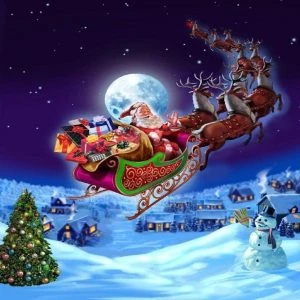
At this time of the year, one particular vehicle is commented on, illustrated and watched for (on Google’s Santa Tracker, for example). It has come to my attention that we haven’t reviewed this vehicle yet for Private Fleet. Unfortunately, it won’t be available through our car reviews page, as it’s an extremely limited edition vehicle and pricing information isn’t available. Nevertheless, because this is the Christmas edition of the Private Fleet blog, let us now present you with the official Private Fleet review of Santa’s Sleigh.
Make and Model: Santa Sleigh, Yuletide Saturnalia variant.
Years manufactured: First reviewed in 1821, then modified in 1823 by Clement Clarke Moore’s “Twas the Night Before Christmas”. Updated in 1939 to include Rudolph. Prior to this, Santa’s transportation of choice has included a white horse (possibly eight-legged). The sleigh concept was apparently imported from Finland – obviously some winter rally driving expertise went into the development of this vehicle.
Top speed: According to an article originally published in Spy magazine that worked out the physics of Santa’s Sleigh, the top speed required by Santa’s Sleigh is 650 miles per second, which is about 3000 times the speed of sound. As the sleigh operates silently without sonic booms, we suspect that the sleigh makes use of hyperspace and multiple dimensions to cover the necessary distance.
It is not known if any other vehicle can match this speed, although it was once given some stiff competition by Six White Boomers (snow white boomers) who raced Santa Claus through the blazing sun on his Australian run. It is thought that these may be used as his hot weather equivalent for Outback use.
Engine: The very best in German engineering, the Dasher-Dancer-Prancer-Vixen-Comet-Cupid-Donner-Blitzen-Rudolph unit is laid out in a V configuration. The actual power output of this unit is uncertain, as the power equation requires us to know the weight, which is unknown and also is linked to gravitational force acting on mass, and the sleigh may have anitgravity features. The power requirements of interdimensional or hyperspace physics are also uncertain. Torque is not applicable, as this refers to rotational acceleration; as a sleigh uses runners rather than wheels, the acceleration – which is considerable – is linear rather than rotational. The 0–100 km/h time is phenomenal and is probably measured in nanoseconds.
Fuel type: Runs exclusively on biofuels, mostly carrots, with refuelling stations provided along with milk and cookies (or mince pies and sherry, depending on the household) down many chimneys. Emissions are also environmentally friendly and while they contain some greenhouse gases in the form of methane, the majority can be used for compost or can be broken down by algae for biodiesel (as invented by Rudolf Diesel – a relative of the other Rudolph?). We presume that the compost is used to grow carrots, possibly enhanced by fairy dust and magic.
Seating: One main seat is provided for a driver, although smaller passenger seats may be installed for elf assistants. A pinhead may also be provided for angels to dance on, as angelic beings are multidimensional and multiple entities are thus able to occupy the same unit of space-time (so that’s how the interdimensional capacity of the sleigh is worked!).
Lights: Bioluminescence provides the main lighting system. Fairy dust and candles may also provide auxiliary lighting. The most notable feature of the lighting system is the Rudolph front fog light, a nose so bright and you could even say it glows. The Rudolph feature is illegal in most countries, which do not allow red lights on the front of vehicles. We can therefore assume that the North Polar road regulations are different from those of the rest of the world; the importance of red in the total ensemble also suggests this.
Off Road Ability: The off-road ability of Santa’s sleigh is second to none. Not only are sleighs and reindeer superbly suited to winter driving conditions without the need for snow chains, Santa’s Sleigh can go further off the road the most vehicles. According to the original reviewer, Clement, “when they meet with an obstacle, [they] mount to the sky”. Flight capacity is an essential feature of this vehicle, so ground clearance is, theoretically, infinite.
Cargo Capacity: The cargo capacity that is usually depicted as being located to the rear of the sleigh and is styled to resemble a sack probably also makes use of hyperspaces and interdimensionality. According to the Spy magazine review, Santa delivers to 378 million children (this figure doesn’t include Buddhist, Hindu or Muslim children, who have their own traditions and figures). Quick experimentation with a sturdy hiking sock and a couple of small beer bottles reveals that the typical stocking contains approximately 1 litre, giving the sleigh a cargo capacity of at least 378 million litres.
Safety Features: The braking system allows the sleigh to go to a complete standstill from Mach 3000 almost instantaneously. As the sleigh appears to use multiple dimensions and appears to be weightless, it is possible that an antigravity function is at work and the braking ability is achieved by suddenly switching this off so the force of gravity can slow the sleigh to a standstill. It is no wonder that the driver comes with side and front airbags installed.
Sound System: Similar to other wintertime forms of transportation involving animals with a bouncing gait, music is provided by small bells attached to the harness: jingle bells, jingle bells, jingle all the way.
Driver Assistance: Some navigation appears to be provided by the Rudolph package, which was specifically asked to guide the sleigh one foggy Christmas Eve. Stop-go functionality, off-road ability and possibly steering are completely voice activated:
More rapid than eagles his coursers they came,
And he whistled, and shouted, and called them by name!
“Now Dasher! Now, Dancer! Now, Prancer and Vixen!
On, Comet! On, Cupid! On, on Donner and Blitzen!
To the top of the porch! To the top of the wall!
Now dash away! Dash away! Dash away all!”
As dry leaves that before the wild hurricane fly,
When they meet with an obstacle, mount to the sky.
So up to the house-top the coursers they flew,
With the sleigh full of toys, and St Nicholas too.
The sleigh also seems to have automatic parking ability. Reindeer are capable of seeing light in ultraviolet spectrum that humans cannot see and each reindeer has a 310° field of vision; detecting signals in the remaining rear 50° degrees is handled by the ears, which are capable of tilting in any direction. Possibly, the elf assistants also provide rear sensor ability.
It is probably just as well that all these driver aids are provided, given the British, Irish and Australian trend of leaving alcoholic beverages out for the famous and presumably immortal driver. These units of alcohol are probably not off-set by the milk and cookies provide in the US. Even given the noted bodyweight of Santa Claus, the amount of alcohol would probably put him well over the legal limit in all countries, probably excepting the North Pole. However, as only one accident has been recorded involving Santa Claus (involving Elmo and Patsy’s grandma, who was reported to have been drinking too much egg-nog and to have forgotten her medication when she got run over by a reindeer), the sleigh operates at full speed and with perfect safe handling year after year, so the driver assistance and collision avoidance ability of the sleigh must be superb and flawless.
Have a safe Christmas and New Year season, everybody. And for goodness’ sake, leave the high speeds and driving under the influence to Santa. His vehicle is built handle it. Yours isn’t.
Are You Naughty Or Nice Behind The Wheel?
 Even if it’s a very, very long time since you believed in the white-bearded guy in the red suit who makes a list and checks it twice, you’re never too old to stop caring about whether you’re naughty or nice. Especially when you’re behind the wheel of a car.
There’s something about being enclosed in a bubble of metal and glass that makes you feel isolated and in your own little world where you don’t have to worry about others. However, this is an illusion or possibly a delusion. It’s not just that we can see you picking your nose or singing badly when you’ve stopped at the red lights. Even when you’re driving, good manners – being nice – are important. You certainly aren’t the only driver on the road.
It’s especially important to be polite to each other on the road at this time of year, and not because you want to be on Santa’s Nice list rather than the Naughty list. There tend to be more people on the roads for a number of reasons. There are those who are doing a Chris Rea and driving home for Christmas. There are those who are heading out Christmas shopping. It’s school holidays, so the Mums and Dads who haven’t knocked off for their Christmas break need to get kids over to Grandma’s or the babysitter’s place and then get to work… and Grandma/the babysitter decides that a trip to the park or the swimming pool complex or the movies is the best form of entertainment for that day. Those who are old enough to still have school holidays and are old enough to have a licence are also out and about on the roads. Add in hot summer temperatures and less-than-stellar air conditioning and you have a situation where tempers are likely to get a little frayed.
In this situation, relaxing and having good manners on the road will help us all get where we need to and want to go without straying into the road rage or stress zone.
Situation: You need to change lanes and a gap has suddenly opened up beside you.
Naughty Behaviour: Duck immediately into the next lane, after checking the blind spot over your shoulder (even checking it twice) and/or making the most of the blind spot assistance package in your nice new car.
Nice Behaviour: Indicating as you do that quick check before you change lanes. It isn’t hard, people!
Situation: You’re in a queue of traffic and notice a car at the exit from a car park waiting for a gap.
Naughty Behaviour: Keep on going, serene in the belief that the traffic lights will arrange for a gap for that person, and that the Give Way rules were invented for a reason.
Nice Behaviour: Slow down, let a gap open and wave the person waiting into the stream of traffic. It only costs you a few seconds. Incidentally, this is the sort of thing that driverless cars can’t cope with: they can’t handle the multitude of ways that people wave other drivers (and pedestrians and bikes) through into gaps.
If you are the person who has been let into the stream of traffic, acknowledge this with a wave and a smile. It’s polite to say thank you (someone ought to invent a thank you indicator).
Situation: Someone cuts into the gap in the lane in front of you without indicating, forcing you to step on the brakes (or activating the collision avoidance system).
Naughty Behaviour: Lean on the horn, shake fists, swear and pull fingers. Tailgate them.
Nice Behaviour: Do nothing except grumble a bit, then get on with your driving.
Situation: Someone with an L plate or even a P plate takes their time at a roundabout and doesn’t take a gap that you know was perfectly safe.
Naughty Behaviour: Honk at them, tailgate, shake fists, yell insults, etc.
Nice Behaviour: Be patient. The whole point of those L and P plates is to indicate to the rest of the world that this driver isn’t experienced and might not do things the way you would because it takes time to learn these things. Driving is kind of like handwriting and what we do for the first year or so tends to be a bit wonky. It’s also possible that the driver of that car has seen something that you, being further back in the stream of the traffic, haven’t, like an oncoming ambulance with the sirens and lights going. Or a line of baby ducks crossing the road.
Situation: The light has turned orange ahead of you.
Naughty Behaviour: Speed up so you can get through it safely.
Nice Behaviour: Slow down and stop, as long as you can do this safely. This is one of the basic road rules and the Naughty behaviour is Naughty in the eyes of the cops as well as your fellow drivers (and pedestrians).
Situation: You’re cruising a bit slower than the speed limit, possibly because you like to take it easy around the corners. The road straightens up and the car behind you gets close and looks like it could overtake you.
Naughty Behaviour: Speed up and go at the full open road limit so the other driver either has to give up on the idea of overtaking you or has to really floor it to get past you (some vehicles are better at doing this than others).
Nice Behaviour: Either keep on at your slightly slower cruising speed or else pull over to the side (if you can) to let the other driver overtake safely. It’s not a race, after all!
In all situations, the best things that you can do are the same things that you do with face-to-face interactions: say thank you (hand signal: wave), say sorry (hand signal: wave), be patient with other people and do unto others as you’d have them do to you.
 Level 2, 9 Help Street