

Private Fleet Car Review: 2019 Subaru Forester 2.5-i
Subaru‘s recently revamped Forester range has four trim levels. There is the 2.5i, 2.5i-L, the Premium recently reviewed, and the top of the range 2.5i-S. Subaru is on a winner with the revamp due to the room inside, the station wagon looks, and the excellent stand list of equipment. We reviewed the entry level 2.5-i version, priced at just over $38K drive-away, directly after the Premium.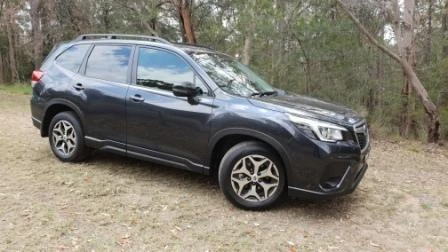 Mechanically the Foresters are identical. Subaru’s much vaunted Symmetrical All Wheel Drive partners with a 90% new 2.5-L petrol engine. Gone is the diesel and at the time of writing there is a hint of late 2019 for anything hybrid. All transmissions are CVTs and come with a very well sorted seven step Lineartronic programming. The engines are all the same and the 2.5-i was driven in a more urban based environment compared to the Premium. Consumption was never over 8.0L/100km with the final figure ticking off 7.9L/100km of standard unleaded from the 63L tank.
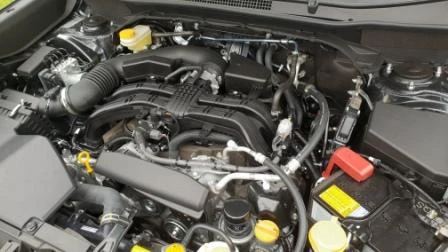 The X-Mode drive system is standard throughout the range. The X-Mode is a system that acts directly on engine power, all-wheel drive, torque sharing at each wheel and on the brakes.With X-Mode activated, traction control becomes more sensitive. The computer will then react faster in the event that a wheel loses adhesion. It will look at which wheel it will be best to transfer the power of the engine to get out of the most difficult situations. The downhill grip control (HDC) analyzes the situation and manages braking below a speed of 20 km / h. By applying wheel-to-wheel braking, the system will allow the driver to release the brake pedal and focus only on the best direction to take.
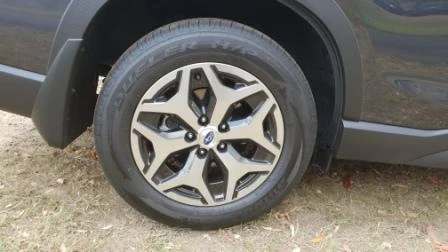 All Foresters ride on a well proven combination of McPherson struts and coil springs up front, with an independent double wishbone rear. The entry level 2.5-i felt slightly softer in tune than the Premium, with a sense of momentarily slower rebound and an ever so slightly plusher ride. But only marginally. The Tyre Pressure Monitoring System that is standard across the range also indicated the rears to be slightly less inflated that the front, oddly enough. The ride feel may have been down to the slightly different wheel and tyre combination, with 225/60/17s.
 Around town the Forester turned out to need a bit more of a poke of the fly-by-wire throttle to get going. In comparison to the country driven Premium, the low end of the rev range was found wanting, This contributed to the higher fuel consumption, as it does for any car driven purely in a suburban environment. There’s a sense of lag, almost like waiting for a large, single, turbo to spool up, before the CVT bites and gets the Forester underway.
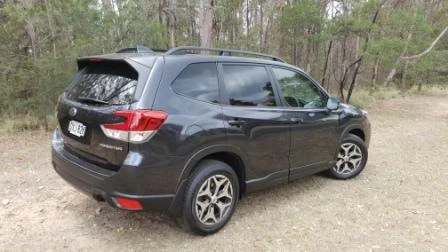 In traffic it’s a well balanced machine, with steering light but not fingertip twirly. It’s weighted just enough to need a small measure of push/pull, body roll in lane changing is minimal, but the tyres chosen from Bridgestone didn’t feel as if their wet weather grip was really up to the task either.
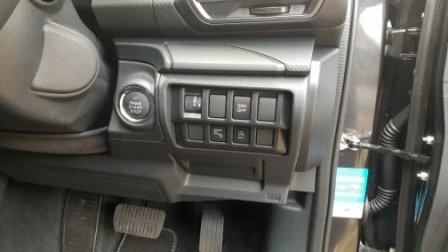 Each of the corners have an independent braking sensor, and the pedal is instantly responsive to the touch. It’s a confident and positive system, pulling up the Forester straight and true consistently. In conjunction with the EyeSight forward monitoring safety system and pedestrian calibrated Autonomous Emergency Braking, it’s a very safe feeling the Forester provides.
Naturally there are the mandated safety systems such as Brakeforce Distribution and Brake Assist, Traction Control and the Active Torque Vectoring. Subaru has fitted Swivelling Headlights to all models and that can be disabled. That’s part of the Vision Assist package which includes Blind Spot Monitor, Lane Change Assist, and Rear Cross Traffic Alert.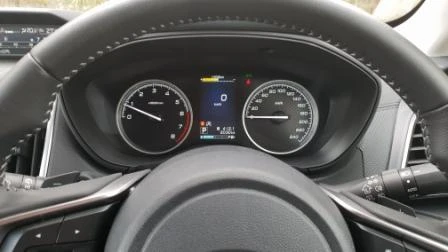 Instrumentation isn’t that different, being largely confined to the smaller 6.3 inch touchscreen in the dash, which is surrounded by high gloss piano black, and missing out on the Driver Monitoring System that the other three receive. That’s an infra-red scanner mounted in the upper centre dash binnacle that scans the driver’s face, looking for signs of inattention and tiredness.
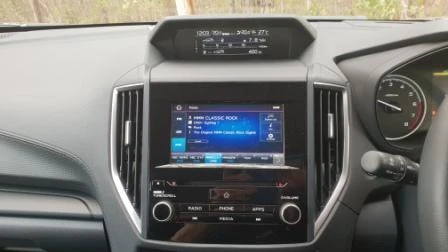 Interior trim is a bit more subdued than the Premium.There is less brightwork in the cabin but that’s balanced by the lighter shade of material used for the roof lining. It’s a shade somewhere between bone and cream, and enhances the otherwise austere look of the varying textures of black plastic. The seats are fully cloth covered, and have a interesting logo style pattern in the weave.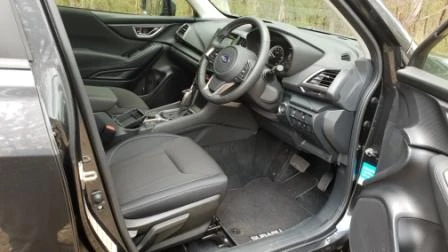
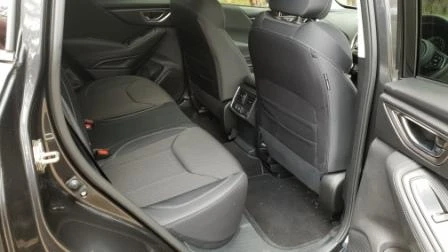 The extra interior room comes courtesy of the subtle pulling and stretching of the chassis and sheet metal. The boot opening has been increased by 134mm, cargo by 78L, and floor width by 58mm. Exterior styling also loses a bit of brightwork, particularly in the lower bumper surrounds for the driving lights.
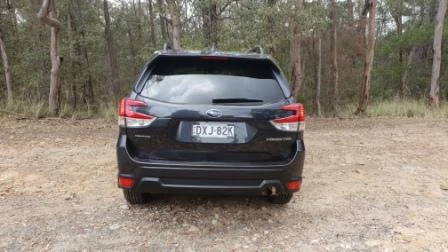
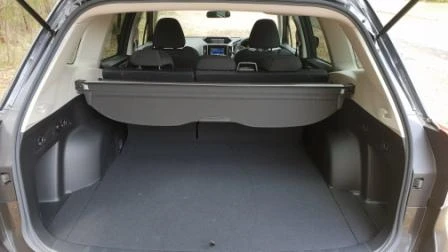 The tail gate is manually operated and houses Euro style “C” shaped lights previously embedded in the outer cluster. Polyurethane wheel arch covers and sill coverings provide both extra protection and a neutral colour to contrast the sheetmetal. Up front Subaru has given the Forester a bluffer, more upright, nose.
The Right Car For Your Dog Part One: The Legal Bits
 Come on, fellow pet owners: admit it. You’ve sometimes considered the needs of your furry friends (who you might refer to as your fur-kids) when purchasing a car. I’ve done it myself. I’ve said no to some lovely little numbers in the past simple because they weren’t compatible with our doggo. I haven’t gone so far as to sell a vehicle I already owned because it wasn’t dog-friendly – although I did do this for my children.
OK, now we’ve got that out in the open, so let’s talk about it. There you are: the time has come for a new set of wheels for whatever reason and you’re looking for a new car. You want to make sure that all of the family is happy, and this includes the four-legged members of the family. Meaning the dog, that is. Cats don’t always take too well to riding in cars – some do and some don’t, but dogs usually enjoy riding in cars. So what do you have to think of when choosing a car that’s compatible with your dog?
Private Fleet Car Review: 2019 Subaru Forester Premium
Subaru’s Forester is now up to its fourth generation and still manages to be a small to medium SUV that has the uncanny knack of not looking like a small to medium SUV. With a powertrain that is now exclusively a 2.5L petrol fed engine and Constantly Variable Transmission, spread over a four trim level range, the 2019 Forester starts at $33,490 plus on road costs for the 2.5i. The Premium tested is $38,490 plus on roads (Subaru is doing a driveaway price of $43,300 at the time of writing) and it’s shaping up to be a hidden bargain in a crowded landscape full of SUVs. The 2019 range has been given an extensive makeover inside and out, with even the engine 90% new. A Wheel Thing drives the new for 2019 Subaru Forester Premium.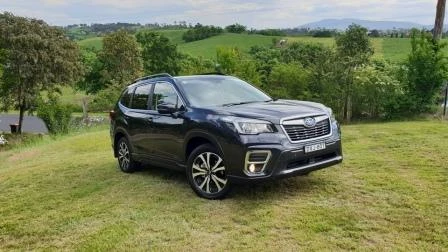 Subaru has loaded the Forester range with a good list of standard equipment across the range, and the Premium really lacks for little in this area. There are the standard electronic drivers aids, a few acronyms such as AVH, and a surprisingly possibly useful feature for those that do long country drives. By the way, AVH is Auto Vehicle Hold.
Power comes from a 2.5L petrol, as mentioned, as Subaru has dropped the diesel. However there are no current plans for a hybrid system. 136kW and 239Nm are the numbers for power and torque, with the rev points being 5800rpm and 4400rpm. The CVT from Subaru is one of the better sorted versions found and rarely did it feel out of sorts. A gentle throttle has the Premium moving away quietly and confidently. There’s then a more traditional auto feel as the CVT moves its way through the seven programmed rations, which are available for manual shifting via the gear selector or column paddles.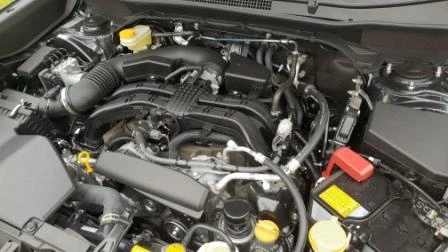 Heavier pressure on the alloy pedal send a signal through the fly by wire throttle and the Premium responds accordingly. There is a more typical CVT whir up the rev range, getting to around 3500rpm before settling momentarily. As the foot lifts or the sensors read that speed is where it needs to be, the revs drop off. The only time the CVT seems a bit off is coming up to a stop and throttle feedback seems to raise a shudder on the downshifts. It also gets uncertain, when cold, shifting between Park and Reverse, Park and Drive, or Reverse and Drive. In pretty much all driving situations otherwise, the combination of quietly throbbing 2.5L boxer four and a truly fine CVT does the job.
Doors Opening For New Racers Through Race Academy International
Fangio. Brabham. Schumacher. Senna. Webber. Johnson. Brock. Recognise a few names? They all have one thing in common and no, it’s not the massive talent they displayed in their prime. Each and every driver had training, and lots of it. Some race drivers try and try and try and get nowhere because their talent, as good as it may be, may not be good enough. The few, the lucky few, that do, have that extra special percent that has the right door open.
However, there is a new race door opening and it’s one that will still require talent. Race Academy International is a new operation and staffed by people that, collectively, have more racing experience in the blood than many of us can ever comprehend. Key to its success is the sheer spread of the instructors brought on board to help interested drivers open one of the four doors RAI has available. It’s a genuine, and real, driver’s academy, where scores are weighed up by the instructors after each applicant is put through a stringent series of tests.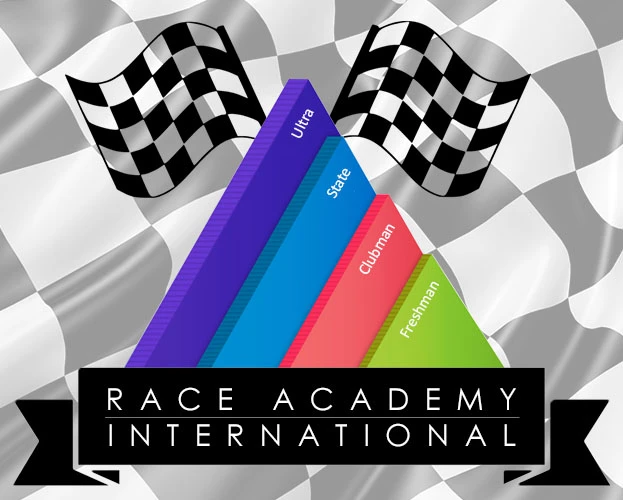 Door one is just $990 and the Freshman level will look at car setup, feedback to the instructors, reviewing and interpreting data, plus a full half day session at Sydney Motorsport Park which includes two 15 minute trackwork tests. Just to add extra spice, a problem solving session with an engineer during a data review will be conducted.
 Level 2, 9 Help Street