

Yellow Or Blue: The Question That Exposed Dangerous Drivers
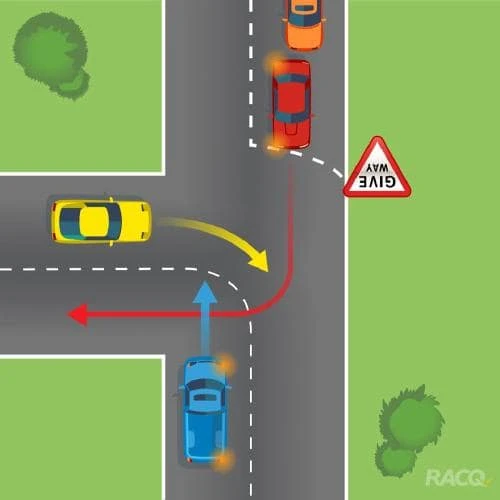 This picture, put into circulation by the Royal Automobile Club of Queensland, asked what really should have been a simple question to answer. Of the four cars pictured, which has the right of way?
Surprisingly, an overwhelming amount of respondents to the question, shared by us also, said the blue car. Straight away this raises an issue that should have the politicians and heads of traffic police investigating better driver education and training.
Car Review: 2019 Peugeot 3008 Allure.
Peugeot’s 2018 3008, an award winning vehicle, is a second generation, extensively reworked version of the 3008 and facelifts released originally in 2008, with the second generation from 2016. We test the 2019 spec Peugeot 3008 Allure, priced at just under $41K plus on road costs. Power is supplied by a torquey 1.6L petrol engine, with 1400 revs seeing 240Nm being available thanks to a low pressure turbo. With 6000 rpm on the tacho, peak power is 121kW. Transmission is a six speed DCT. Peugeot quotes combined fuel economy as 7.0 & 7.3L per 100 kilometres, with city cycle driving as 9.8L & 10.1L per 100 kilometres. The two figures are quoted due to the Grip Control being off or on. Grip Control is a choice of drive modes for differing surfaces, and activated via a dial in the forward centre console.
 The actual driving experience varies from slightly frustrating to a lot of fun. Frustrating because of the delay in engagement from park to reverse to Drive, to grin inducing pull from low revs as the 3008 Allure sets sail. The changes are crisp, swift, smooth, in hte transmission when under way and manually changing does sharpen them further.
The Allure is a stylish machine, with the underpinnings a new platform called EMP2 that allows a superb ride and handling package. Steering, for example, is razor sharp in its responsiveness off centre, with a quarter turn or so having the nose swing round quickly. At speed the variable ratio steering lightens up and there’s less effort required to work. The ride on the 18 inch alloys, with 225/55 Continentals as the rubber, is beautifully tuned and balanced. There’s a suppleness that’s rare to find in anything other than mid to high end luxury cars, with an initial give that is followed by a progressive compression that stops before the bump-stops in all but the heaviest push over larger speed-bumps.
The Right Car For Your Dog Part 2
 OK, in my previous post on this topic, I covered the legal stuff to do with taking dogs in cars. Now we get to the fun bit: what sort of vehicle suits your furry friend. Or friends, as the case may be.
When I first started thinking about matching dogs to cars, I just about wrote sedans (saloons) off from the start. After all, you don’t really want a dog on the back seat standing up where it can snuffle down the back of your neck while you’re driving. Nor do you want to have scratchy doggy paws on lovely Nappa leather seats, because that would wreck them (the seat upholstery, I mean, not the paws!). However, I remember taking the Staffordshire Bull Terrier we used to have (RIP, old fellow!) in a sedan without any trouble. He was quite happy curling up in the footwell for most trips and didn’t try to sit on people’s laps (unlike the current bitzer). During longer trips, we also put him in one of those doggy carrying crates that sat nicely between my two children in the back seat of the sedan we had back then (probably a Ford Fairmont), which had the added advantage of stopping them hitting each other during long trips. What’s more, if you do have a sedan with leather seats in your possession already when you acquire a new puppy, there’s no need to sell the car – you can put down a nice blanket or doggy bed for Fido to occupy during the trip.
Private Fleet Car Review: 2019 Suzuki Swift GL Navigator
Good things come in small packages is a phrase that’s been around forever, it seems. And never more was it an apt phrase for a car than it is for the Suzuki Swift. It’s under four metres in length, has a driveaway price of $16990, has just five gears in a manual transmission, a 1.2L engine, and 66kW. And it’s a helluva fun car to punt around. We test the 2019 Suzuki Swift GL Navigator.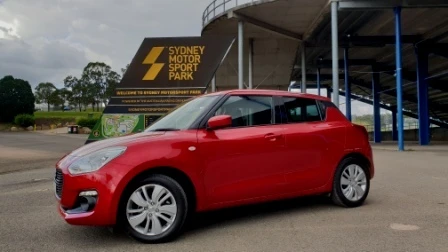 The range has been rationalised somewhat, with the Swift GL dropped and the once middle of the range Navigator now the entry level. Above that sits the Navigator with optional safety pack, GLX, and Swift Sport
The car reviewed has a five speed manual and it takes a bit of getting used to. Not because it’s a manual but because there is almost no spring pressure on the gate’s mechanism. It’s limp, weak, and almost void of any real feel through the changes. That’s matched by a clutch pedal feel of pretty much the same. There’s no weight (just like the car at 870kg dry), no real pressure required to push it down.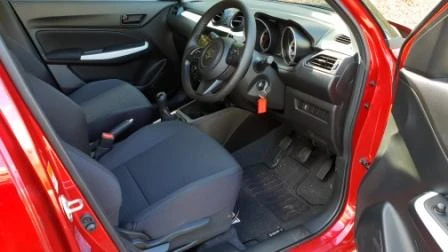 But once both are recognised for their foibles, they mesh quite well, and it really only took an hour or so to get the hang of how and where to utilise the pair in their movements. They also work well with the small engine. The 1.2L DualJet engine has just 120 torques and that comes at 4400 rpm. Simply put, it means that a bit of gear rowing is required, as is a bit of patience in regards to forward motion. The upside is economy, and Suzuki quotes around 4.5L/100km for the combined cycle. It needs to be economical as the fuel thimble holds just 37 litres. On our test the car, literally brand new at 11 kilometres on pick up, covered 300 kilometres on a half tank.
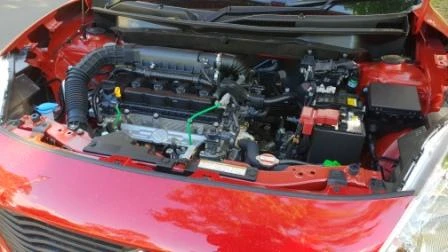 Acceleration is leisurely, at best, however once the engine reaches 3000rpm the characteristics change noticeably. There’s a change of note, urge, as it is, increases, and it feels as if it spins just a bit easier. The five speed sometimes feels as if an extra gear would be handy however considering fifth sees around 2000rpm at highway speeds, it wouldn’t have the required torque to take advantage of it.
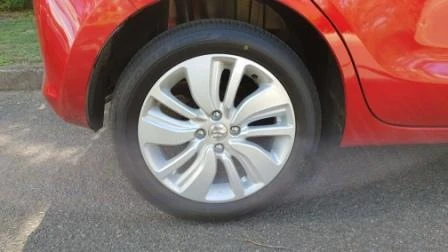 On coarse chip roads the lack of sound insulation isn’t just noticeable, it’s painful. The constant drone, and drumming, from the 185/55/16 rubber transmitted to the cabin via the MacPherson struts and torsion beam suspension, would drown out normal levels of conversation and radio, AM/FM only by the way. On the smoother blacktops it was naturally quieter and also ramped up the fun factor in the drive.
 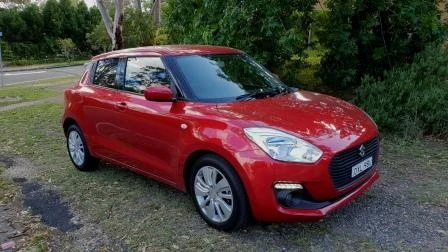 The comparatively big wheelbase, 2450mm, inside the tiny body length, 3840mm, means the Swift is very chuckable in corners, with an almost point and shoot handling style. The short travel suspension did mean some bumps crashed through, but the overall result is grin inducing…in the right hands.
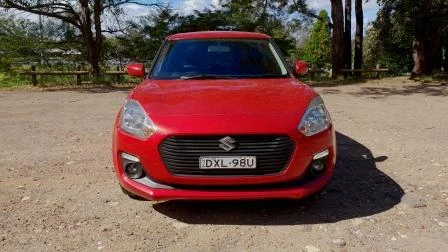
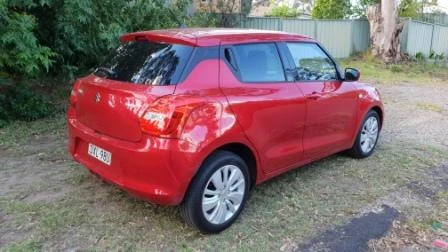 The Swift itself underwent a mild transformation externally over a year ago, with a look more akin to the Baleno thanks to pumped out tail lights and reshaped headlights. the fun factor is shown by the front end having a “smile” thanks to the horizontal lower grille and upturned corners. These house LED driving lights and bracket a wide hexagonal grille.
 Inside it’s basic, but functional. The dash’s upper section has the Euro inspired sweep from the curve of the windscreen through to the doors, and that’s mirrored in a curve closer to the binnacle that houses a simple pair of dials and a relatively underused monochrome info screen. It shows trip and fuel consumption, and that’s it. The touchscreen is simple to use, uncomplicated in its usage, and sits above traditional dial and slide aircon controls. The audio system is moderate in quality but does have Auxiliary/USB, Bluetooth and voice control, plus Android Auto and Apple CarPlay.
 Level 2, 9 Help Street