

Car Review: 2018MY Toyota Prado GXL
This Car Review Is About:
A vehicle from Toyota that I had not driven before. With such an extensive range of vehicles from Toyota, the Prado was the one that has eluded the review section. Unless if you count the FJ Cruiser, which was loosely based on the Prado. We tested the GXL spec Prado, the second level of four, with the model receiving a light freshen up in mid 2018 that changed one key feature….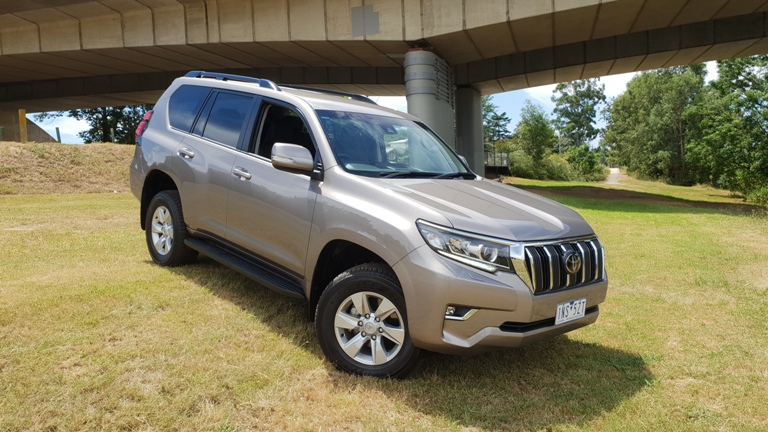 Under The Bonnet Is:
A diesel engine of 2.8L capacity. The 4.0L petrol V6 is long gone. Transmission is a choice of six speeds, with a manual or self shifter. It’s a permanent four wheel drive, with a simple choice of high or low range. The test vehicle has the auto, making great use of the 450Nm and 130kW. Toyota quotes a combined fuel consumption figure of 8.0L per 100 kilometres. Our mainly urban cycle finished on a reasonable 10.8L/100km. That’s from a 2,325kg plus fuel and cargo machine. Towing for the auto is rated up to 3,000kg braked, 2,500kg braked for the manual. On The Inside Is:
Clear evidence of a design that is some years old now. Seven seats aside, it’s the look and feel from the driver’s seat that tells the story of how easy it is to update an exterior, and not so for the inside. Plastics have a slightly tired look and feel, the centre dash stack has an outdated silver hue, and the overall design is a number of squares and rectangles, lacking the wraparound style now more commonly seen. The seats are of a smooth vinyl/leather look in the test car, with leather accented seats listed as optional for the GXL. Also optional (and fitted to the test car) are heated and vented facilities. These are operated via dials in the centre console.
 The centre stack is, aside from the silver hue, ergonomic in layout. The lower section has a soft touch lid that sits above the 4WD high and low range dial and the tabs for the centre and rear locking differentials. Up top is an eight inch touchscreen with AM/FM, no DAB for the GXL, and Bluetooth streaming. Satnav is standard. The driver’s dash dials are analogue in the GXL, and the centre 3.5 inch screen is typical Toyota.
 Centre and rear seats are comfortable enough and easily moved when required. Toyota goes with the best way to move the rear seats and that’s with the tried and proven pull strap system. The right hand side vertically hinged door provides easy access to the rear section but it’s also here that Prado suffers by not being a dedicated people mover. With the third row up storage is just 120L. With them folded it’s a more reasonable 480L, then 1833L with the centre row down. The rears eats also have their own aircon controls, making for a three zone system.
 On The Outside Is:
A strong family resemblance to the Land Cruiser is engineered in thanks to a smoother look. The front and rear design do away with the edges and, as a result, with a more smoother and rounded look, looks more like the Land Cruiser than before. The LED driving lights and slimline headlights also bring more of the family look. The biggest change to the design, one that seems almost invisible before the head slap is the removal of the tail gate mounted spare wheel. It’s now located under the rear seats, underneath the car itself. Aesthetically it looks better but it reduces the mass on the door and makes it easier to operate. The door itself has a horizontally hinged glass door for access if required.
 The overall Prado design hasn’t changed since the very first model. High riding, a blunt & bluff nose, a solid looking glasshouse, and a kink to the rear window & door line. Rubber is big as well, with Dunlop AT20 Grand Trek 265/60 tyres on classic 6 spoke 17 inch alloys.
 On The Road It’s:
Somewhat rubbery in the steering, but that seems to be more along the lines of allowing for off-road action. That 450Nm is between 1600 to 2400rpm for the auto, and makes for effortless driving in virtually all conditions. Off the line is a moment of hesitation, then the turbo kicks in and the torque does its job. Braking is responsive and needs to be with the bulk of the Prado. The pedal bites easily and is delicious in its feedback through the travel, amuch needed sensation and again related to the mass. There is some body roll at highway speeds and moving lane to lane, otherwise it’s minimal.
 Off road the Prado got to show off its much vaunted ability. And in no way did it develop in a driver any sense of disappointment thanks to the double wishbone front/4 link rear suspension. Up and down rocky, gravelly, muddy roads, though deep washaways and soft surfaces, the Prado’s legendary prowess was well and truly displayed.
  Put into low range, with diff locks and hill descent control engaged, it crawled liked a seasoned soldier through a tactical course. Grip was confident, assured, composed, with the slightly soft steering now showing why. With the front wheels moving around, it allows a more intuitive control when off road. And when engaging low range, it brings up on the driver’s dash a clinometer, showing side and fore and aft angles. Approach angles of 30.4 and 23.5 degrees make for largely easy access in and out.
 The Safety Systems Are:
Substantial. The automatic gets a hefty dose of safety. Under the name of Toyota Safety Sense the GXL has Lane Departure Alert, Pre-Collision Warning with pedestrian alert, auto high beam, and Active Cruise Control. The GXL has rear sensors but dips out on front sensors as standard. Rear Cross Traffic Alert and Blind Spot Monitor are also not on the GXL, but standard on VX and Kakadu.
And The Warranty Is:
Very good. Every new Toyota bought after January 1, 2019, has a standard five year warranty. Unlimited kilometres is part of the package and Toyota ups the ante by offering a full seven years if the Prado is serviced as per the vehicle’s logbook requirements. Servicing is $240 including GST for the first six services for three years or 60,000 kilometres. At The End Of The Drive.
The 2019 Toyota Prado GXL is a Toyota four wheel drive through and through. The off-road ability is undoubted, and on road it’s decent enough. Outside it’s benefiting from a stronger family resemblance to the 200 Series Land Cruiser but it’s inside that the packaging will benefit from an update.
Tesla Reveals V3 Superchargers
Fresh from the success of his Space-X mission to the ISS, Elon Musk‘s other love, Tesla, has released information on a change to their car charging system. Called V3 Supercharging, it brings a massive change in how Tesla cars are charged, and drastically lowers the charging time.
To be rolled out in the U.S. initially, V3 Supercharging moves to a different charging point, with a solitary charging cabinet, as Tesla puts it, with a 1 MW (megaWatt) capacity able to provide a new Model 3 Long Range car with up to 75 miles worth of range in just five minutes and the equivalent of one thousand miles of range in just an hour. The cabinets themselves will now provide one car with one power source, with the previous method a power-share model meaning if two cars were attached to the one charge cabinet, charge rates were slower. By providing a single stream, Tesla anticipates average charge times to drop to 15 minutes for a full charge.
Private Fleet Car Review: 2019 Suzuki Jimny
This Car Review Is About:
The new and reborn fourth version 2019 Suzuki Jimny. It’s a cubical machine, with styling hints aplenty from Jimnys before, comes with a reasonable range of tech, and a pile of charm that’ll fit in your pocket. Under The Bonnet Is:
A 1.5L petrol engine with variable valve timing. It gets grip through to the ground via a four speed auto with overdrive or a five speed manual. With peak power of 75kW @ 6,000rpm and peak torque of 130Nm @ 4,000rpm, the manual is the preferred transmission.
Fuel is fed to the small engine via a fuel thimble of 40-L. Consumption for the 1075kg/1090kg (tare weight) machine is rated, on the combined cycle, 6.4L/100km for the manual and 6.9L/100km for the self shifter.
Car Review: 2019 Renault Trafic Crew Life LCV
This Car Review Is About:
The 2019 Renault Trafic Crew Life LCV (light commercial vehicle). It’s a long wheelbase version with a dedicated passenger cabin. Renault have it, at the time of writing, at a stellar $47,990 driveaway. Under The Bonnet Is:
A surprisingly torquey twin-turbo 1.6L diesel. At just 1500rpm there is 340Nm, and peak power isn’t bad either. At 3500rpm there is 103kW, although by then it’s run out of puff. The transmission fitted to the review vehicle is a slick six speed manual, driving the front wheels, that’s geared to take advantage of the torque early on to get it under way. There is no auto option. Economy is rated as 6.2L/100km, and the final figure of over 420km for a quarter tank (80L volume) consumed speaks volumes. And that’s with a dry weight of 1,736 kilos.
On The Outside It’s:
A van. Yes, it’s stating the obvious but sometimes the obvious is all there is. From front and rear perspectives its virtually cubical. From a side profile the long wheelbase (3,498mm inside an overall 5,399mm)is readily apparent, as is the elegantly profiled nose, complete with bonnet. This makes accessing the engine easier and provides a higher measure of impact protection. Front overhang is 938mm, with a rear overhang of 968mm.
The body in white highlighted the tinted windows fitted to the left and right hand side sliding doors which aren’t remotely operable. The windows themselves house slightly tricky sliding windows, and pull down sun shades. Overall cargo is rated as six cubic metres for the standard LWB, four metres for the crew cab version.
The alloy wheels are 17 inches in diameter and are wrapped in commercial spec, yet very comfortable and grippy, rubber of 215/60 profile from Dunlop.
 Level 2, 9 Help Street