

New Cars Due Shortly
Four cool new motor cars to keep your eyes out for that will become available in Australia shortly are interesting because they aren’t all that expensive, they look great and they offer some neat engine power options.
Let’s kick off with the next generation Hyundai Sonata. Going up-market, the Sonata looks very stylish with its sleek ‘four-door coupe’ design. If you stop and think why car manufacturers still offer a sedan in their line-up when so many more sales are made with SUV styling, it seems that there is a niche sector that still prefers a sedan over any other vehicle shape. So, in order to capture the hearts of a stickler sedan-buyer, manufacturers are creating upmarket sedans instead of your bog-standard sedan to grab buyer’s attention.
Jaguar i-Pace Wins Major Award
Jaguar’s low slung all electric five door i-Pace has become Jaguar’s first car to win the European Car Of The Year award. It’s an award that is voted upon by sixty journalists from 23 countries. The award looks technical innovation, design, performance, efficiency and value for money.
To date, the i-Pace has found over 8,000 homes with around 75% of those in Europe. There’s obviously plenty of good reasons for the car to be so popular. The driveline, for example, delivers up to 294kW and 696Nm of torque, and with a pair of electric motors working together in a near perfect weight distribution, a zero to one hundred time of 4.8 seconds is just a flex of the right ankle away.
Road manners are Jaguar’s exacting standards. Torque Vectoring by Braking is standard in the i-Pace; it’s a system that delivers controlled independent braking on the individual inside front and rear wheels to add to the turning forces acting on the car. For the driver that wants to push the i-Pace even harder, an optional airbag suspension system can be fitted. This will drop the i-Pace by ten millimetres to help aerodynamic flow at speeds over 105 km/h.
Both of these are backed up by the Coventry firm’s Adaptive Dynamics monitoring system. At up to 500 times a second, the onboard system will read input from the throttle, the actual acceleration rate, braking, and the suspension to provide a best as possible ride and handling experience. Gone a little dirty? Then the All Surface Progress Control and Low Traction Launch systems will help out in low speed driving conditions.
BMW Says Diesel Do Just Fine For The X7.
BMW has released details of the soon to land in Australia X7. For the time being, power will come from only diesel engines, with petrol to follow later. It’ll be a two model range to start, with the BMW X7 xDrive30d starting from $119,900, and the BMW X7 M50d from $169,900. The BMW X7 xDrive30d will have a “TwinPower” twin-turbocharged inline six-cylinder diesel engine with variable turbine geometry. It’ll pack 195 kW of power and 620 Nm of torque, meaning that can reach 0-100km/h in just 7.0 seconds.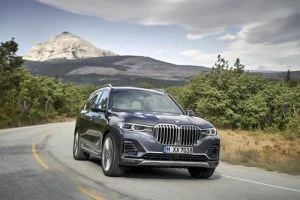 The X7 M50d goes up a notch, with an uprated TwinPower quad-turbocharged inline six-cylinder diesel engine with two variable-vane turbines and two conventional turbines. There’s a more than impressive 294kW and a startling 760 torques. 0 – 100 is a very decent 5.4 seconds. Both will power down via BMW’s eight speed Steptronic transmission.
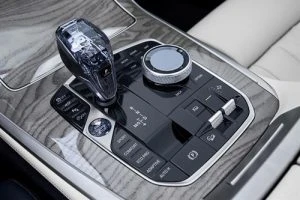 This has been recalibrated to feature a wider gear ratio spread. BMW’s much vaunted xDrive will be on board. xDrive is a smart drive system that varies drive torque split between front and rear wheels to optimise traction and power efficiency.
 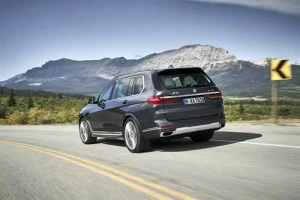 Both will also have, thanks to xDrive, a rear biased drive feel. BMW’s tuning house, M Sport, offers a differential on the rear axle to ensure a smooth power transfer in the BMW X7 M50d, maximising traction and ensuring optimum handling on all terrains. It’s available for the X30d as part of the xOffroad package.
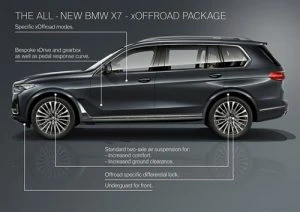 The BMW X7 xDrive30d will have 20-inch alloy light wheels as standard. The BMW X7 M50d has 22-inch M light alloy wheels for extreme road presence. Ride will come courtesy of a two-axle air suspension with automatic self-levelling. The system is smart enough that it can adjust the height of the car with the engine off and will go up or down by 40mm. There is some smart tech in the X7, it’s able to adjust the suspension for each individual wheel to achieve balance in an unevenly loaded car. More smarts come from Executive Drive Pro, and Integral Active Steering. Both will showcase exceptional cornering abilities and standout agility.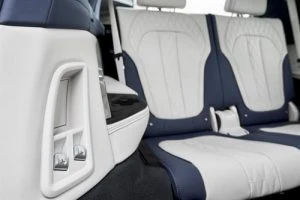
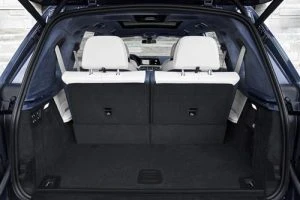 Seating is flexible, as anticipated. A 40/20/40 split for the second row seats is one option, a 60/40 split is also available. Standard cargo load is 326L, and that goes to 750L when the third row is flattened. All seats down offers up 2,120L, and a powered tailgate makes rear access easy, especially with the wave of a foot underneath the rear bumper.
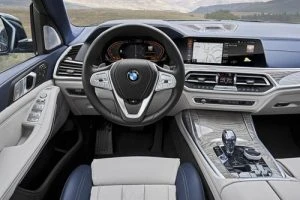 Extra luxury comes from a panoramic glass roof, aluminuim roof rails and aluminuim window surrounds, BMW Head Up Display, 3D camera system that shows a top down/360 degree, and a 12.3 inch dash display.
Head to BMW Australia for more details and to lodge your inquiry.
Car Review: 2019 Kia Carnival Platinum Petrol
This Car Review Is About:
The 2019 model year Kia Carnival Platinum with 3.3L V6 engine. It’s also available with a torquey 2.2L diesel. The car reviewed was priced at $60,290, plus $695 for premium paint, plus on road costs.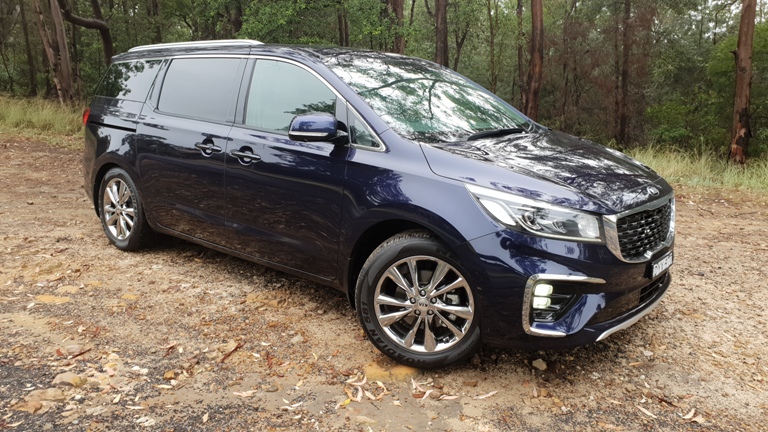 Under The Bonnet Is:
Kia’s well sorted and rorty 3.3L V6. It produces 206kW at 6,000rpm, and will twist out 336Nm at 5,200rpm. The diesel, in comparison, has 147kW, and 440Nm, with the latter on tap between 1,750rpm and 2,750rpm. Economy is rated as 10.8L of regular unleaded from the 80L tank for every 100 kilometres on the combined cycle. Urban and highway are 14.5L and 8.7L per 100 kilometres for the 2,094 kilogram machine before fuel and passengers. Towing is 2,000 kilos, braked. Transmission is also well sorted, with eight forward cogs. Although not quite as smooth overall as General Motors’ ripper nine speed, it’s not that far behind in overall refinement.
 On The Inside Is:
What a proper people mover should be all about. With the rise of faux people movers masquerading as SUVs, Kia’s Carnival shows them how it’s done. Two up front, three in the middle on sliding seats, and three in the rear, and still with room enough. Overall length of 5,115mm starts the party and continues with a 3,060mm wheelbase.
 Storage is 960L with all three rows of seats up, with 2,220L or 4,022L depending on second and third row seats being folded down. Access is via a powered tailgate or powered sliding doors, with the remote key fob opening and closing either. The rear and centre row seats aren’t quite as intuitively friendly to operate as some others, ditching a pullstrap style at the rear in favour of a more complicated handle pull and lift arrangement, with the centre a little more fussy in operation also.
 Front and second row seats are vented and heated, for good measure. Kia’s brochure doesn’t specifically mention head/leg/shoulder room, but there’s more than enough space for anyone not named Dwayne Johnson.
The seat material was a mix of black and light grey leather which matched the upper and lower trim colours. Rear and centre row seats have independent aircon controls and vents. Smart devices have 3 USB ports and 3 12V sockets from which to be charged from, however there is no separate wireless charge pad. Kia says there are ten cup holders, with two up front, in the centre, and two on the centre row seat back, with four more for the third row. The front and sliding doors have a bottle holder each. The centre console also has a link to the aircon system with a coolbox there.
 Level 2, 9 Help Street