

Isn't It Ioniq, Part 2.
Hyundai recently released details of upgrades to its electric and hybrid small car, the Ioniq. It’s available as a hybrid, a plug in hybrid, and full battery pack power system.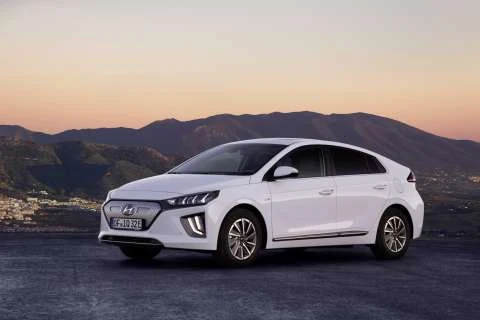
The fully electric version has had the battery capacity upgraded, which brings with it a range increase. It’s up from 28.0kWh to 38.3kWh, with a new mooted top range of 294km. Power and torque are rated as 100kW and 294Nm. The on-board charger has also been uprated, with an increase to 7.2kW from 6.6kW. This enable a charge to 80% from empty in approximately 54 minutes.
Ioniq Hybrid has been given a 32kW/170Nm permanent magnet motor for the rear axle, with partial power from a 1.56kWh made from a lithium-ion-polymer battery. The PHEV delivers 44.5kW, with peak torque of 170Nm. The battery pack is a 8.9kWh lithium-ion-polymer battery and backs up the 1.6L direct injection petrol engine. 103.6kW and 265Nm are the combined capacities, says Hyundai. Pure electric mode allows a top speed of 120kmh and up to 52km of battery only range. Transmission is a single speed for the Electric, a six speed dual clutch for the other two.
Eight Is Still Not Enough For BMW
BMW has released details of the forcthcoming 8 Series coupe and convertible as the brand continues to renew its extensive range. The 8 Series features the BMW M850i xDrive Coupe with an Australian price of $272,900, and the BMW M850i xDrive Convertible, priced at $281,900. Prices include LCT but not on-road charges.
Power comes from a 4.4L twin turbo V8. 390 is the number of kilowatts, and they’re found between 5,500rpm and 6,000rpm. But it’s the impressive 750Nm of torque that tells a better story. Maximum twist is available from 1,800rpm and goes all the way through to 4,600rpm. This will launch the 850i Coupe to 100kmh in 3.7 seconds, with the slightly heavier Convertible just 0.2seconds slower. The torque comes from the inside-vee location of the twin-scroll turbos, with that location providing a better, quicker, response time. Aiding the beast up front is an eight speed auto with ratios well spaced to take advantage of the liners power and torque delivery. Matched to a manual change option of paddle shifts, BMW fits their brilliant “ConnectedShift” system which reads the road ahead and pre-empts a driver’s change of gears and adjusts the transmission automatically to suit the oncoming road.
A very tech-laden feature in the 8 series is the BMW Live Cockpit Professional. It’s a hi-res and customisable 12.3-inch instrument cluster that sits behind the steering wheel, with a 10.25-inch Control Display mounted in the centre of the vehicle.
Additional BMW Live Cockpit Professional features include adaptive navigation, a 20gb hard drive, two USB ports for type A and type C connections, Bluetooth and wireless charging. A Head Up Display is included and at 16 per cent larger than before, provides the driver with valuable feedback, enhancing safety and the driving experience.
This configurable system includes details of vehicle speed, Speed Limit Info, Check Control messages, detailed route guidance information, driving assistance information, and infotainment lists. Shifting the Drive Experience Control switch to SPORT or SPORT+ brings additional information, with engine revolutions and a shift indicator displayed.
The BMW Operating System 7.0 connects the driver’s displays with the infotainment system, enabling the overlay of information from the Control Display onto the instrument cluster.
2020 RAV4 Ready To Roar.
If you’re not a fan of SUV style vehicles, best you stop and look away now. The Toyota RAV4, celebrating its 25th anniversary this year, is widely regarded as the original SUV. 2019 has the release of a vastly updated car and range to continue the legend.
The range will include, for the RAV4’s first time, a hybrid. There will be two petrol engines, four trim levels, and 2WD or AWD variants.
The Gx range is the entry level, with GXL, Cruiser, and a solitary, and new Edge trim spec.. Here’s how the pricing structure shakes down.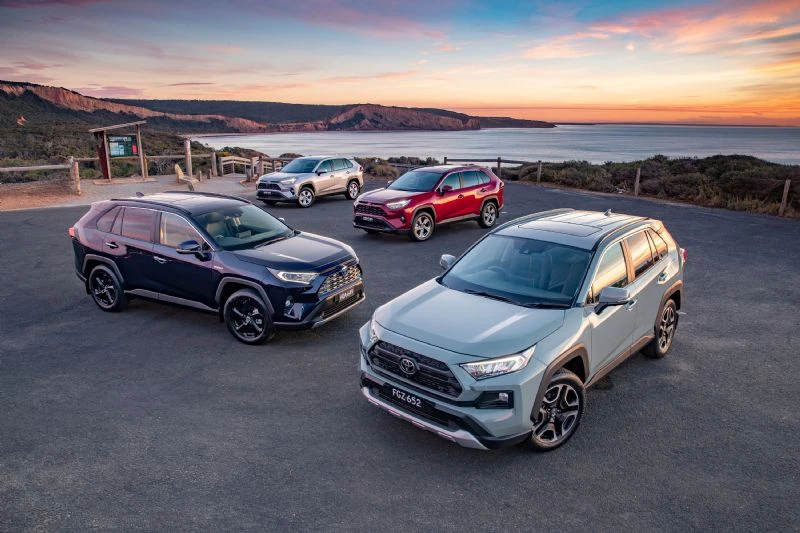
Car Review: 2019 SsangYong Musso Ultimate.
This Car Review Is About:
SsangYong continuing their Australian (and world wide) rebirth with the Musso. A four door ute, based on the Rexton SUV, the Musso is a two or four wheel drive machine. It’s reasonably well priced and reasonably well configured in the 4×4 Ultimate spec as tested at $39,990 driveaway. The range itself starts at $30,490 for the EX manual, $32,490 for the auto EX, and $35,990 for the ELX spec in auto.
Under The Bonnet Is:
A well mannered 2.2L diesel, and the aforementioned six speed auto. Peak torque is 400Nm and available from 1400rpm through to 2800rpm. Peak power is 133kW at a high for a diesel 4000rpm. Urban driving sees consumption hovering between 10.0 and 11.0 litres per 100km, and AWT finished on 10.7L/100km in a purely urban drive. Although the tank is 75-L, and dry weight is around 2060kg, that’s a hefty drink and needs work. Unlike the Rexton tested recently the Musso breathes better from a standing start, lacking the lag so woefully found in the Rexton. As a result the drive factor is immediately better, safer, more enjoyable. Transmission is a six speed auto and again, like the body and interior, pretty much what is found in the Rexton. This means mostly smooth changes, the occasional stutter depending on drive speed and throttle input, and the same on-the-fly drive modes as well, accessed via a cabin-mounted dial. It’s a package that will benefit from further development and refinement but is also pretty good straight out of the box.
 On The Outside It’s:
The nose and doors of the Musso before a somewhat truncated looking tray. Ostensibly it would be in competition with Ranger, HiLux, Colorado, D-Max, Triton, but also stands out as being the only ute from the three Korean car makers. The first and second sections of the Musso hint at the spaciousness outside, it’s the tray that “holds back” the Musso from really being in the same cargo space as the others. By no means though is it non-user friendly.
 Level 2, 9 Help Street