

Private Fleet Car Review: 2019 Hyundai Kona Highlander Electric
This Car Review Is About: Hyundai dipping a toe into the battery powered waters of electric cars. The Korean company has the Ioniq range of petrol/hybrid/battery, whereas the Kona has no hybrid option. With a range of around 460 kilometres, it’s more than suitable for daily running around in the urban environment, and so it proved during our week-long test.
What Does It Cost?: The range of Kona Electric starts at $59,999. That’s before government charges and dealership costs. The Highlander starts in the middle $60k range, and that puts it within the ballpark of the forthcoming Tesla Model 3. The car comes with a charge cable which plugs into a standard home power socket. For an extra couple of thousand Hyundai will supply an adapter box that gets installed at home. At a rate of around7.2kW per hour of charge, it trickle charges at a rate good enough to avoid range anxiety if plugged in overnight. In the week we drove it, it was topped up just twice. On The Outside Is: A car that is possibly overdone in styling to alert people to the fact it’s an electric car. The Tesla range, for the sake of inevitable comparisons, look like a normal set of cars outside, and have a distinctive yet still normal-ish look inside.
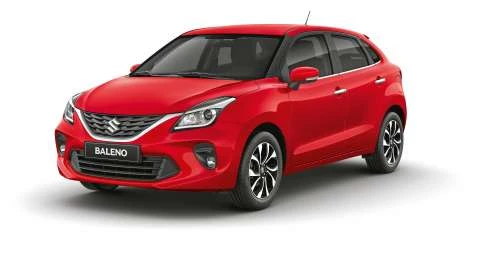
Say Hello To The New Baleno and Colorado.
Suzuki Australia has announced that the Baleno has been given an update and will be available in Australia late this year. The new look Baleno GL will be here from August and the Baleno GLX variant available for purchase from September 2019. Pricing will remain incredibly sharp, with the Baleno GL and with a manual transmission starting at $15,990, the auto just $1,000 more, and the auto only GLX at $18,990.
Mercedes Adds The GLB To The Range.
In a possible answer to a question that no one has asked, being “just how many SUVs does the world need?”, Mercedes-Benz has introduced the seven seater GLB. It slots into a gap moreso in the alphabet than in its range by being placed between the GLA and GLC.
Mercedes say it’s the first of their compact SUV range to be offered as a seven seater. However they’re also at pains to point out that the third row should NOT be occupied by anyone over the height of 1.68m. That’s logical as virtually every seven style vehicle simply doesn’t suit taller people.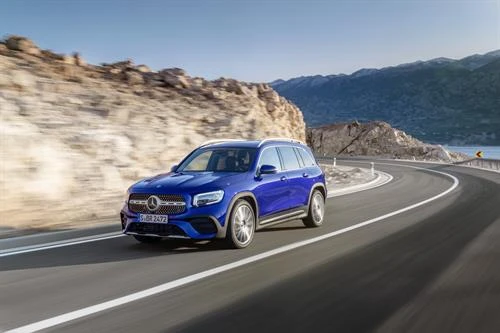 Power will comes from a pair of four cylinder petrol engines or a trio of diesels. A 1.33L petrol with 120kW/250Nm can be specified alongside a 2.0L with 165kW/350Nm. Economy is quoted as 6.2L/100km to 7.4L/100km, and emissions are rated as 142/169 grams per kilometre. Transmissions are a seven or eight speed auto. The pair will see 0-100 kmh times of 9.1 seconds and 6.9 seconds respectively.
Private Fleet Car Review: 2019 SsangYong Tivoli ELX
This Car Review Is About: SsangYong’s Tivoli. SsangYong is the quiet third of a three tier car making setup from Korea. Nestled well below Hyundai and Kia, SsangYong currently have a three model range, and the Tivoli is the entry level to the brand. The Tivoli itself is based on the Kia Soul and is badged as EX, ELX, and Ultimate.
The ELX is a solid mid-level competitor in a very crowded market. Being based on the quirky looking Soul isn’t a bad thing either. SsangYong’s designers have done a good job of hiding the relationship with a heavily reworked interior and exterior. There’s no hiding that steeply raked windscreen though.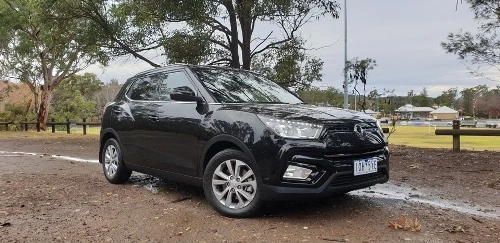 Power Comes From: Behind the bluff and upright schnozz that hides a diesel or petrol powerplant. Our test car had the 1.6L diesel, a slightly chattery but butter smooth item. There’s a huge 300Nm of torque on tap between 1,500rpm and 2,500rpm. Peak power is just 85kW and is available from 3,400rpm to 4,000rpm. The diesel comes in 2WD or AWD for the Ultimate, and is a six speed auto only for the oiler. Economy is, unsurprisingly, pretty good for the pert little five door. Urban driving is quoted as 7.4L/100km for the 2WD version. We saw a best of 7.6L/100km in the urban cycle. Combined is 5.5L/100km and that’s without the realms of possibility. Tank size compromises range though, at just 47-L.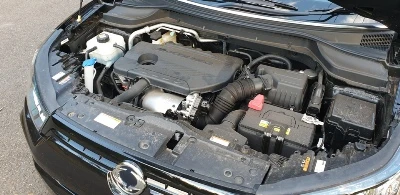
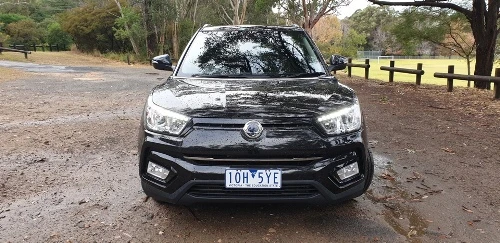 What’s It Cost?: The range starts at a miserly $22,990 driveaway for the EX, without premium paint. It’s $27,990 driveaway for the ELX diesel auto, with premium paint an extra $495. Outside one can choose six colours, the test car was Space Black. Inside there are three choices with black overall, brown (mocha coffee shade), and beige. The trim is on the seats and the doors.
What Does It Look Like?: Overall, the presence is restrained from the outside, innocuous even. The front end is very SsangYong family in look, with LED eyebrow driving lights in a swept back cluster design. The lower air intake surround is a horizontal “double Y” with black urethane underneath joining the front and rear. The tail end itself is a look that evokes the MINI Countryman’s styling and a bold C pillar joins the top to the bottom.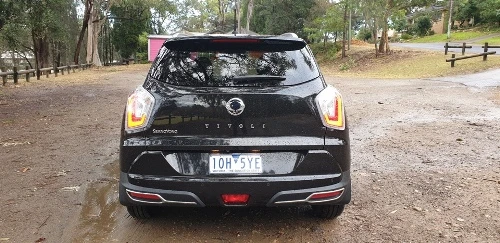 It’s compact in size to look at. Length is 4,202mm, height is 1,600mm with roof rails, and overall width is 1,798mm. What these numbers mean is good interior space for the 1,480kg (dry) Tivoli.
There’s some good looks inside too. The dash is the current Euro themed arch-type sweep from door top to door top and in the black-on-black it looks ok. The dash’s look is a mix of black textured plastics. There is a faux stitched look, a hood style binnacle, and piano black centre stack.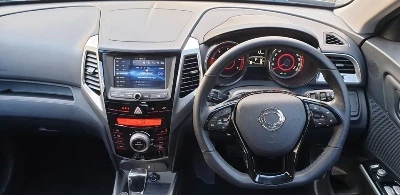 This holds the aircon controls which are soft-touch buttons. An old-school amber backlit display screen sits above a dominant fan speed dial. Unlike most other manufacturers, SsangYong haven’t gone down the path of a standalone touchscreen for the audio/satnav, with the Korean make staying with an embedded look here. Again there is no DAB and that peculiar predilection to have one radio station sound like a skipping record.
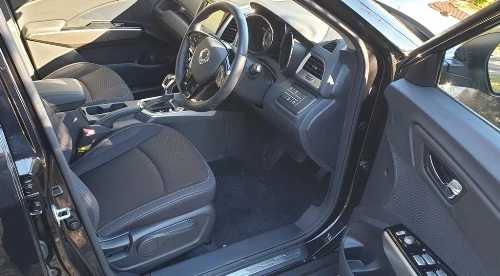 The driver faces a binnacle that has bright red backlit dials. These can be changed to five other backlights such as blue and yellow for that extra bit of personalisation. A monochrome centre screen shows wheel angle when parked. This is presumably to remind a driver which way they’re pointing when getting ready to move on.
Splashes of alloy look plastic add some colour to the black trimmed option. The seats are comfortable and not heated or vented in the ELX.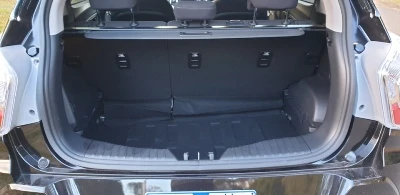
There’s the usual apps for the sound system, storage spaces front and rear, and a good amount of cargo space at the rear. There is a pair of 12V sockets, one up front and one for the rear.
Safety is high. AEB is standard, as are warning systems for forward collision and lane keeping. Australia doesn’t get the Euro spec traffic sign recognition system…yet.
 Level 2, 9 Help Street