

Author archive
Really Keen Young Drivers!
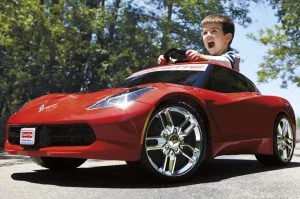
One of my brothers, when aged around 5, found the keys in the ignition of Dad and Mum’s car and proceeded to start the car up and drive off. That’s what you do with cars, isn’t it? Dad and Mum were having a rest in the house when this occurred, and thankfully Dad heard the engine and rushed outside to stop him before he got away!
But he’s not the only one. Just recently, in America (Where else!), two brothers aged five and two took off in their mother’s 2005 Ford Focus and headed off to their Grandfather’s place. Life at home must have been a little dull at the time. Putnam County Sheriff deputies believe the toddlers might have teamed up to work the pedals and steer the steering wheel. The end result was a crash in the ditch, quite a distance away from home. The car was wrecked almost 5 km down the road, the boys unhurt. Prior to the jaunt, the boys were playing outside the home when they found the car keys under the mat.
Another child (8 years old), and in America, recently drove his sister to McDonalds to buy some food from the drive through lane – paying for the food with his own piggy bank money. The police officer’s, family friends and grandparents then stopped him from driving any further.
A good reminder, if you own a car, is to keep the car locked up and the keys in a safe place out of reach of little fingers! If you don’t mind the kids playing in the car, then make sure the keys are hidden away.
If your kids love cars, give them a pedal car or electric car (kids size) to let their imaginations lead to healthy and safe outcomes. Another thing you can enjoy with young kids who like to drive is to take them off the road in a car and let them steer with you in control and in the driver’s seat. Who hasn’t let their kids drive up the driveway or around a paddock under supervision while seated on your knees in the driver’s seat?
Have any of you been in a situation where you (when under 10), your siblings or your own children have sought to drive off in your parent’s car when aged well under the driving age? Do share! These days, Google helps to teach us to drive, and I suppose any bright kid can learn off Google!
2015 Corolla vs 1998 Corolla
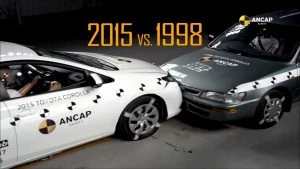
2015 Corolla vs 1998 Corolla
ANCAP crash testing has been around for some time, but every now and then a picture tells more than a thousand words. When a new car crashes into an old car, what will the outcome be? At the crash lab in West Sydney, two Toyota Corollas went head-to-head just to see what would happen. The difference between the two Corollas was that one was a 2015 model and the other a 1998 version. My goodness, what a mess, what a noise and what a telling story!
Usually a crash test involves a standardised honeycomb barrier and a car being catapulted into the stationery barrier in an offset impact. What was carried out recently at the ANCAP testing centre was at one end a 1998 Toyota Corolla was linked to a 2015 Toyota Corolla at the other end. They travelled towards each other at 64 km/h in a simulated off-set head on position, and after the flying mess, noise and smell settled after impact, there was a hush, a complete silence. People were shocked at the way the 1998 Corolla deformed so easily, while the 2015 Corolla absorbed the impact but kept its shape and integrity well – particularly around the A-pillar zone.
Had there been a driver in each vehicle, the one in the older Corolla would have had serious injuries that would be life threatening. The driver of the newer Corolla would likely have walked away with minor injuries.
Safety standards in modern cars has improved so much over recent years with the addition of multiple airbags at the front of the car, curtain airbags down the side of the car, pre-tensioning seat belts, stronger safety cages for occupants, accident avoidance systems and building the cars with newer types of metals and steel that are stronger. The design that goes into the modern cars for redistributing the forces of the impact in a crash around the cabin to protect those inside is an ever evolving entity. These modern additions to new cars hugely improve the chances occupants have in a high impact crash – just like what these two Corolla cars were put through.
There are still numerous older vehicles on our roads; maybe it’s a good time to think about upgrading your car to one that has more safety credentials. Making safety a priority and buying the safest car that you can afford might be a good place to start.
You can see the crash test here: https://www.youtube.com/watch?v=xidhx_f-ouU
The Sounds Of…
Much of the appeal of any new car – apart from factors like practicality and power – lies in the visual  and tactile arenas. We admire the sleek lines or the bold aggressive chunkiness. We smile at the bug-eyed appeal of round headlights, such as those on the VW Beetle, or appreciate the clever styling achieved with pretty daytime running lights – or the classic Ring of Fire tail lights of an HSV. Chrome, interior lighting packages, exterior paint colour… it’s all visual. The interior styling also tends to cater to our senses of touch and comfort (kinaesthetics) with leather-wrapped this and that, lumbar support, heated seats and the like. Even a car with powerful acceleration and superb handling around the corners appeals to our kinaesthetic – it’s a human thing to enjoy the sensation of G-forces during acceleration and cornering.
We don’t tend to give the sense of sound much thought when picking out a new vehicle or even when driving, apart from what the sound system’s like (number of speakers, location and quality of speakers, input type…). However, we use our sense of hearing quite a lot when we’re in and around cars, although we’re less aware of it.
The role of sound in motoring was brought home to me rather acutely when I had a very close encounter with a hybrid vehicle in the supermarket carpark the other evening. It was getting a bit dark and I was waiting for a stream of cars to go past so I could get back to the old faithful Nissan with my groceries. One car goes past, then the next, so I tune out for a bit; then, as I hear the sound of an engine trailing away to one side and no sound on the other side, I start to stride forwards… only to pull up sharply as the hybrid that was last in the line of cars crawls past. No damage was done, but this is something that we’re all going to have to look out for – literally look out for – as hybrids and electric vehicles become more common on our roads (and in the supermarket carpark).
As pedestrians and cyclists, we rely on our sense of hearing as an extra warning signal that something’s coming, especially when we can’t see down a driveway. I’m probably not the only one who had the mantra “Stop, Look and Listen” drummed in as part of road safety training and learning how to cross a road (along with Look Left, Look Right, Then Look Left Again). I’m certainly not the only one to get a bit jumpy about the safety aspects of how silent hybrids and electrics are: last year, the US National Highway Traffic Safety Administration legislated that quiet cars like these have to emit some sort of noise as a warning.
At the other end of the sound spectrum are the cars that you certainly can hear coming – like a former neighbour of mine with his 7-litre diesel Chevy. We all know the ones – the big bore exhausts, the V8 motors, the “muffler” that’s carefully tuned so the roar of the engine sounds just right. Now, these drivers are certainly aware of appealing to the sense of sound. Even if you’re not into big bore exhausts, most of us are not completely immune to the sound of a powerful engine doing its thing, even if we don’t quite go as far as former Top Gear presenter Jeremy Clarkson (the one we all loved to hate) doing a “Listen to it! Just listen to it!” rant. And just don’t get me started on the Dukes of Hazard sol-mi-do-do-do-re-mi-fa-sol-sol-sol-fa horns…
Somewhere in between these extremes comes the driver who is indeed highly tuned into the sounds the engine – and indeed the whole car – is making. Maybe you are that driver. This is the sort of person who drives passengers batty with a constant “What’s that noise? I can hear something rattling!” This gets followed by frantic groping around the interior of the car trying to find and eliminate the cause of said rattle, with the end result that the offending pair of sunglasses in the glovebox has to be wrapped up in a beanie to silence it. This is punctuated by complaints about Funny Noises made by the engine that are only apparent to the driver. To be fair, car manufacturers go out of their way to reduce the on-road noise heard in the cabin and the sound of the engine does get used by mechanics as a form of diagnosis.
On the whole, however, the sound of an engine tends to be a subconscious or subliminal feature. We may not even be aware of it until one day, we hear a particular engine note and become overwhelmed by a rush of nostalgia, suddenly reminded of the car our parents drove when we were little, or the first car we owned. We have those moments when our hearts skip a little beat as we hear one particular engine amid lots of others, like a familiar face in a crowd, and we know that someone special to us has arrived. And oh, the disappointment when we realise that what we heard was only another car of the same make and year… The sound of a car engine is something that affects us more deeply than we probably realise.
That’s my challenge to you this week: think about how your car sounds a bit more consciously (or mindfully, to use a buzz word). Are you a noise lover, a hypersensitive or do you like it quiet? Or do you have any suggestions about the sounds that hybrids and electrics ought to emit for safety purposes?
Will the X-Class be a Tradie Favourite?
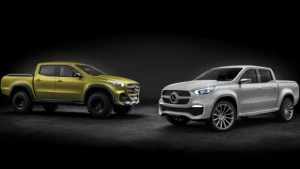
Mercedes Benz X-Class Ute
I love utes – always have – and that’s why I’ve owned my current Navara for nearly six years. It’s not brand spanking new but let’s just say it’s been a workhorse in the garden and beyond, and it has been really well looked after. Longevity is what this Nissan Navara D21 is all about; it just keeps going without anything major needing to be done. Could longevity and practicality be the key highly sort after characteristics of what a great ute should be? If you happen to be a Tradie, then these features have to be playing on your mind when you buy a new ute for work.
Toyota Hilux, Ford Falcon, Holden Rodeo and Nissan Navara are big names wheeled about amongst Tradies who have worked the hard yards with typically these utes being commonly their favoured working companions. These are the guys that know which utes last the distance, so when a new ute like the Mercedes Benz X-Class is about to make a glamourous entrance on the big stage, will it fly high or sink? The coming years will reveal whether the new X-Class will still be made mention of around smoko tables on builder’s sites, landscaper’s gardens and farmer’s markets.
No doubt, Mercedes-Benz will have done their homework. Their current new vehicles are known for being classy luxury sedans, wagons, coupes, and in more recent years, SUVs. So with the addition of the new X-Class Ute, we should be seeing plenty of luxury – particularly in the X-Class interior. Mercedes Benz V-Class vans have been around for some time now, too, and they have been pretty solid workhorses.
The new X-Class range of vehicles are expected to arrive in Australia from 2018, with the exact launch dates, specifications and pricing to be announced closer to the time. Having shown off the concept at various motor shows, the X-Class lines look sleeker than most utes I’ve seen – except for the likes of the Falcon and Commodore utes. The new X-Class ute isn’t really in the Falcon and Commodore ute class, however, and with its fulltime AWD and serious off-road capabilities the X-Class can be taken into serious off-road terrain. Sleek but aggressive and intimidating are words that come to my mind to describe the solid and bold X-Class looks.
Interestingly, the new X-Class for Australasia will be built at a Nissan plant in Barcelona, Spain in a marriage with Renault and Nissan. The X-Class will be built using the new Navara platform; however the engines, all-wheel drive systems and interiors will all come from other Mercedes-Benz sources like the C-Class and V-Class range. The top X-Class model will be powered by a very powerful V6 diesel engine which will be mated to a Mercedes-Benz’ 4MATIC permanent all-wheel drive system. The AWD system will combine an electronic traction system, a transfer case with reduction gear, and two differential locks for the serious off-road expedition. This powerful drive system in combination with a tough ladder-frame chassis will result in the X-Class achieving payloads of more than 1.1 tonnes, and a towing capacity of up to 3.5 tonnes.
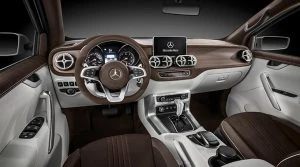
Mercedes-Benz Concept X-Class Interior
Volker Mornhinweg, the head of Mercedes-Benz Vans, says “Our future X-Class will be a pickup that knows no compromise. Ladder-type frame, high-torque six cylinder engine, and permanent all-wheel drive are compulsory for us. As an added value, we will bring safety, comfort, agility and expressive design – in other words, everything that distinguishes vehicles bearing the Mercedes star.”
Did you know that in Australia, Argentina and New Zealand more than 14 per cent of new vehicle registrations are for a one-tonne ute! No wonder we’re seeing the likes of Mercedes and VW getting stuck into a slice of the pie, too.
 Level 2, 9 Help Street