

Author archive
Why You Need To Keep Left
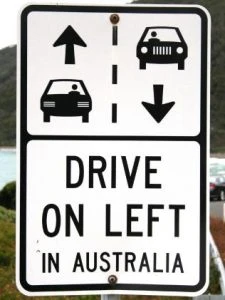 … Because you’ll be killed in a head-on smash, that’s why.
OK, let’s clarify a few things here. Obviously, all of us need to drive on the road so that we don’t bump into other drivers. When Car A is travelling north at 65 km/h on a road and Car B is travelling southwards at 85 km/h and the road is – whoops, channelled the old-fashioned maths books there for a moment – anyway, how do they keep from bumping into one another? Very simply, in Australia, we have agreed to keep to the left.
So why the left? Why not the right? In Australia, we can put this down to our colonial heritage. We were colonised by the UK, which is why you’re reading this in English, so all that happened is that they imported their road rules along with the roads.
OK, so why do the Brits drive on the left-hand side of the road?
As a matter of fact, it wasn’t just the Brits who drove on the left-hand side of the road back in the horse and carriage days. According to one source, everybody used to drive on the left once upon a time. The reasons for this went back to the Romans (like the standard gauge on railway tracks) and possibly even earlier than this. This is because of two facts about human beings: (1) the majority are right-handed and (2) we have belligerent tendencies. Anyone approaching you head-on could be an enemy or at least a potential jerk who doesn’t know how to drive his/her oxcart properly, and you might need to defend yourself and/or teach the jerk a lesson. Road rage is nothing new. In fact, it pre-dates roads, as one Egyptian tomb painting illustrates: it shows two boatmen having a punch up (with one spouting hieroglyphics that were translated as “Take that, you f***er!”) after having rammed each other on the Nile. Anyway, if you’re right-handed and want to have your sword hand on the side nearest the potential oncoming enemy, you kept left. This applied even to foot traffic – and was made official law for tourists pilgrims according to a Papal Edict in the 1300s.
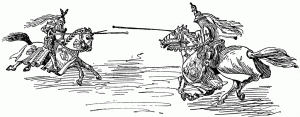
If you’ve ever seen jousting in one of those historical re-enactment displays, you’ll see the origins of the “keep left” principle in action. If you’re a knight, you keep your lance tucked firmly under yourright arm and then keep left in the lists so the lance hits the other guy, not your own horse’s head. It’s common sense.
We also mount horses and bikes from the left so our right hands do the balancing or take our weight (or hang onto the saddle in case the horse decides to take off while you’re halfway through the proceedings). To make things easy getting on and off, you want to do this from the kerb, so you keep on the side nearest the kerb. Even today, look at the tilt on the kickstand on a modern motorbike: it leans left so that the majority of bikers can get on and off comfortably (question: are there left-handed motorbikes that lean the other way? Must ask my left-handed biker brother-in-law.)
So why on earth did people start to keep right in some parts of the world? The person to blame is supposedly Napoleon. According to some accounts, he may have been left-handed, so he insisted on doing things the left-handed way. Alternatively, it may have just been the tendency of nutty dictators to make their armies walk in a funny way just because (think of Nazi Germany or North Korea). A more boring theory puts it down to the habit of driving large teams of horses which meant that the driver had to sit on the left with the whip in his left hand (though don’t ask me why this was necessary). And, thanks to the French Revolution, nuts to any Papal Edicts that had been knocking around since the Middle Ages!

Drive on zat side of ze road!
Anyway, the habit of driving on the right started in France and spread, along with French manners and Napoleon’s empire, around large chunks of Europe. It also became the habit in the US, partly because one of the generals in the War of Independence was French (General Lafayette) and partly because they didn’t want to do things like the Brits did, and the Brits had defiantly refused to change the good old-fashioned habit just because Napoleon had said to. I say, old chap, we won’t do that!
As an aside, the French and the Americans deciding to do things the opposite of the Brits, whom they hated, was also responsible for the “pink for girls, blue for boys” thing. Posh Brits wanting to dress their offspring in gender-distinct colours picked pink for boys, as this was considered a strong, bold colour that was a baby version of military red; blue was already associated with the Virgin Mary and was considered softer, gentler and more soothing. The French, however, had their soldiers in blue uniforms and, sacré bleu, were going to reflect this in their baby clothes; thanks to the Revolution when they all officially became athiests/agnostics, who cares about Mary? The Yanks also hated the Redcoats, so they ditched pink for boys as well.
Anyway, I digress. The French and the Americans decided to do things their way and introduce keeping right. Those sharing a continent with them often ended up following suit and because they’d spent time under Napoleon’s possibly left thumb. As the use of the motorcar spread, those sharing continents with them also made the shift from left to right to avoid cross-border carnage and also because they wanted posh American cars.
However, those of us with our own motoring industries in countries where the border is the beach kept to the old traditions, mostly because we don’t have the cross-border muddles and we produced our own posh cars, thank you. The UK, Australia, New Zealand and Japan all drive on the left. So does India, probably because of the lengthy period of British colonialization. Around one-third of the world still keeps left.
However, according to some road safety experts, keeping left versus keeping right isn’t as inconsequential and trivial as, say, the colours you use to show whether Bubs is a boy or a girl. The majority of the population is still right-handed and right-eyed, so it makes sense to have your dominant hand on the wheel actually controlling the direction of the car while the non-dominant hand moves the gears, and to have your dominant eye getting the best view of the traffic.
There has actually been a study, carried out in the late 1960s by a chap called J.J Leeming (who was a Brit – which may have biased his results), which suggests that when you take all other factors into account, the road accident rate is slightly higher in countries that drive on the right compared with those that drive on the left, thanks to the handedness factor. I have attempted to find out whether these results, originally published in a wee book called Road Accidents: Prevent or Punish? have been verified, but Google Scholar doesn’t seem to reveal any that directly compare accident rates in left-side countries versus right-side countries controlling for other factors. Any civil engineering grad students out there looking for a good thesis topic who want to do this?
And there you have it: keeping left is possibly the oldest road safety rule known to humanity. Keeping left isn’t fighting the natural preferences of the majority (sorry, lefties!). So make sure you do it!
How Will The Police Force Replace Their Fords and Holdens?
We all know that the Holden Commodore has been an Aussie icon on the roads for quite a few years now. We’ve also all seen Holden Commodores tricked out as police cars… sometimes a bit too close for comfort and sometimes as a very welcome sight indeed. If you are both sharp-eyed and lead-footed, then the sight and shape of any white Commodore of a certain age is enough to get you easing up on the accelerator and slowing down; the shape is burned into your brain like the shape of a hawk is burned into the brain of a chicken (yes, chickens actually do have brains).
It also appears that the red lion vs blue oval rivalry might be alive and well in the police force, as all the points above also apply to Ford Falcons, including the bit about the shape being burned into the brains of the lead-footed.
However, the doors of the Holden factory are closing. So are Ford’s, which means that if our police force wants to have a vehicle fleet that’s up to date, they need to look for another company. Naturally, car manufacturers around the globe have been eyeing up the contract of providing our police cars… and not just for the honour of the job but also for the very big bucks this sort of contract would entail.
So what are our boys and girls in blue going to be driving?
Rumours are flying thick and fast. Browsing through the Australian Federal Police and the NSW police websites don’t exactly yield a lot of information about what the new vehicle is going to be – it’s all kept very, very quiet. However, the rumour mill has popped up a couple of possibilities that could very well be in the running for what we’ll see on the roads sporting the disco lights and with the word POLICE proudly emblazoned on the side (hopefully not pulling up your driveway when you hadn’t dialled 000).
It’s not easy being a cop car. A cop car has to have great handling and plenty of power and torque for quick responses. It shouldn’t look ridiculous and it should have enough space for all the gadgetry that a modern cop needs. (Question: how come talking on the phone is considered distracting to the common or garden driver but communicating with dispatchers and other units while driving isn’t distracting to a cop?) A cop car also needs to have enough space to transport the newly arrested naughty people where they can’t be a problem to the driver, and possibly enough space to carry a K-9 officer. It also shouldn’t cost the earth to purchase or maintain, so that rules out all the fancy wheels used by the police in the United Arab Emirates. We’re paying enough tax without that sort of expense!
The rumour mill has ground out a few possibilities for what’s going to be the replacement for the Fords and Holdens. One very likely contender at the moment is the Chrysler 300 SRT . One of these V8-engined sedans was spotted wearing the NSW Police livery back in May.
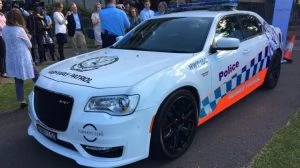
However, FCA Australia (the official name of Chrysler Australia) haven’t exactly been trumpeting the winning of the contract all over their website the way you think they would do if they had sealed the contract. There are other possibilities still in the running:
Volvo XC60 SUVs, which provide a bit of off-road capacity plus Volvo’s legendary safety standards, have also been spotted with the disco lights fitted. Volvo does police cars for other countries, so it’s got a proven track record in this area.
The Kia Stinger is another hot contender and certainly has a beautifully appropriate name – what else would you use in a police sting operation other than a Stinger? This new release V6 sedan isn’t the only offering put up for consideration by Kia, with the Sorento SUV being in the running. The Kias are hot contenders because as well as offering plenty of bang, they don’t require quite as many bucks as some of the luxury European contenders, such as the BMW 5-series.
Another South Korean in the running is the Hyundai Sonata Active , a number of which have recently been added to the Queensland police fleet, although the rumour mill has it that these needed a few tweaks to the brakes and tyres (and possibly some other tweaks they’re not telling the general public about).
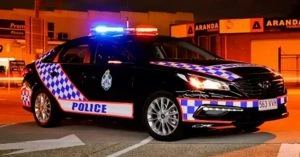
Up until now, the general policy was to use locally made cars as much as possible. However, now that the local factories have gone belly up, it’s quite possible that instead of just getting one or two main marques serving as the police fleet in most states, we’re going to see a range of decent mid-range sedans, station wagons and SUVs in police livery. Which will make it a problem for the leadfooted among us who have conditioned themselves to react to the shape of a certain model: you’ll never be able to pick a patrol from a distance…
So that’s their game!
Car Manufacturer Global Sales Q1-17
The first half of 2017 has seen a number of new and interesting models coming onto the market by various car manufacturers. It’s interesting to view, globally, how each car manufacturer’s sales has been tracking in the first few months of 2017. According to JATO Dynamics figures, the big winner during the first quarter of 2017 has been the Renault-Nissan Alliance group recording huge growth in sales around the world.
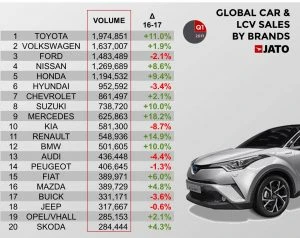
It’s obvious, when you look at the results that Toyota, having sold 1.974 million car and LCV units, still remains at the top while growing at a rate of 11%. Honda, in fifth position, also shows itself growing nicely overall. Mercedes and Renault show the greatest growth for the quarter with 18.2% and 14.9%, respectively. Mercedes-Benz is the fastest growing brand in the top-20 and the biggest luxury brand worldwide. BMW and Suzuki have also gained greatly in sales over this period with 10% growth apiece.
Where there is market growth there will also be market shrinking, and for Ford, Hyundai, Kia, Audi, Peugeot, Buick and Jeep, their sales in the first quarter of 2017 have taken a dive.
In detail, according to JATO results, there are some key vehicles being sold in various segments.
City Cars
The top five city cars being sold around the world are the: Hyundai i10, Honda N-Box, Fiat 500, Fiat Panda, Suzuki Alto
Sub Compacts
The top five sub compact cars being sold around the world are the: VW Polo, Suzuki Swift, Ford Fiesta, Renault Clio, Toyota Yaris
Compacts
The top five compact cars being sold around the world are the: Toyota Corolla, VW Golf, Honda Civic, Ford Focus, Hyundai Elantra
Mid-size
The top five mid-size cars being sold around the world are the: Toyota Camry, Mercedes Benz C-Class, Honda Accord, VW Passat, BMW 3 Series
Executive
The top five executive cars being sold around the world are the: Mercedes Benz E-Class, BMW 5 Series, Audi A6, Hyundai Grandeur, Buick Lacrosse
Luxury
The top five mid-size cars being sold around the world are the: Mercedes Benz S-Class, Cadillac XTS, BMW 7 Series, Bentley Continental, Cadillac CT6
SUV
The top five SUV vehicles being sold around the world are the: Nissan X-Trail, Honda CR-V, VW Tiguan, Toyota RAV4, Honda HR-V
MPV
The top five MPV vehicles being sold around the world are the: Hongguang, Honda Jazz, Xiaokang, Baojun 730, Nissan Note
Sport
The top five Sport vehicles being sold around the world are the: Ford Mustang, Dodge Challenger, Camaro, Mazda MX-5, Porsche 911
Pickup/Ute
The top five Pickup/Ute vehicles being sold around the world are the: Ford F-Series, Dodge Ram, Chevrolet Silverado, Toyota Hilux, Nissan Navara
The greatest market sector growth, unsurprisingly, has been seen in the SUV market.
Car Recall Over Dodgy Airbags
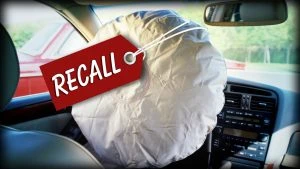
It’s good to get important safety information out there, particularly when some of the cars on our roads could be really quite unsafe. Recently, there has been a Takata airbags recall due to some faulty airbag systems placed in certain modern cars of specific makes and models.
A US authority investigated for underlying faults present in airbag systems. They had information that certain airbags had had a problem with the airbag inflators. In order to confirm the fault was at large, they had a research and engineering firm Battelle perform testing on some airbags by test airbag inflators in their lab. The results were quite alarming and showed that in Takata airbags there were airbag inflators that had deteriorated with age and, when they were deployed, the inflators exploded and shattered the casing material. If there did happen to be an occupant behind one of these airbags in a car accident, then the hurtling material, set off like a grenade, would strike the seat occupants head and chest areas causing severe injury and in some cases death.
The airbag inflators contain ammonium nitrate propellants which can become volatile as they age when exposed to changing temperatures, humidity and moisture. This volatility can cause them to explode and thrust shrapnel into both drivers and passengers inside the vehicle. The flying debris has been known to puncture people’s eyes, face, neck and chest. Faulty Takata airbags have also been linked to 18 deaths globally.
The results in the testing drove the car manufacturers (who had used Takata airbag systems in their cars) to reacall the vehicles to fix the problem. This has been the biggest car recall in history, and there has been a waiting list for the replacement airbag. A further investigation has also shown that some of the manufacturers have replaced the old airbag systems with similar systems that will end up with the same problem as they age, so the new device might not be a permanent fix. Not a very bright thing to do!
Choice investigators have said that millions of cars still have faulty airbags, and they want the car industry to do more to raise public awareness. They also state that a number of car manufacturers — including BMW, Toyota, Mazda, Lexus and Subaru —have been replacing the airbags with like-for-like devices as a temporary fix – ultimately not fixing the problem.
Tom Godfrey, a spokesman for Choice, said that “Refitting vehicles with the same dangerous airbags still leaves people driving ticking time-bombs.”
If you think your car could be one of the 2.1 million Australian vehicles recalled, Product Safety Australia says that you should contact your local dealership or your manufacturer and find out if your car needs to have the airbags replaced.
At the time of writing, the list below names the makes and models of the known cars to be at risk of the fault. This list is updated as new makes and models are recalled, so you can look up www.productsafety.gov.au for further details.
| Make | Year |
| BMW 3 Series E46 | 1999 – 2006 |
| BMW 5 Series E39, 3 Series E46, X5 E53 | 2002 – 2005 |
| BMW 5 series E39, 3 Series E46, X5 E53 | Check PRA No. |
| Chrysler 300(LE/LX) | 2005 – 2012 |
| Chrysler 300C | 2005 – 2010 |
| Dodge RAM | 2004 – 2010 |
| Ferrari 458, California, FF | 2008 – 2011 |
| Ford Mustang | 2006 – 2014 |
| Honda Accord/CRV | 2001 – 2002 |
| Honda Civic | 2001 |
| Honda Accord | 2001 – 2002 |
| Honda Civic, CR-V, Jazz | 2001 – 2003 |
| Honda Jazz | 2004 |
| Honda Accord, CR-V, Civic, Jazz | 2003 – 2004 |
| Honda Accord Euro, CR-V, Civic, Jazz | 2002 – 2009 |
| Honda Jazz, CR-V | 2005 – 2007 |
| Honda MDX, Accord | 2001 – 2006 |
| Honda City, CR-V, Insight, Jazz | 2006 – 2012 |
| Honda City, CR-V, Insight, Jazz | 2011 – 2014 |
| Honda Civic, Legend, Jazz | 2006 – 2012 |
| Honda Accord Euro, City, CR-V, Jazz, Insight | 2007 – 2011 |
| Honda Legend, Odyssey, Accord, MDX | 2003 – 2011 |
| Honda Civic, Accord | 2006 – 2011 |
| Jeep Wrangler JK | 2007 – 2012 |
| Lexus SC430 | 2000 – 2003 |
| Lexus IS 250, IS 250C, 350, IS F | 2005 – 2011 |
| Lexus IS 250, IS 350, IS 250C, IS-F, LFA | 2011 – 2012 |
| Mazda 2, B Series, BT-50 | 2006 – 2011 |
| Mazda 2, RX-8 | 2003 – 2014 |
| Mazda 6 | 2002 – 2003 |
| Mazda 6, RX-8 | 2002 – 2004 |
| Mazda 6 | 2002 – 2004 |
| Mazda 6 | 2006 – 2009 |
| Mazda 6, RX-8, B2500 ute/cab chassis, B2600 ute/cab chassis, BT-50 | 2002 – 2011 |
| Mitsubishi GA & GB i-MiEV | 2010 – 2011 |
| Mitsubishi Lancer | 2003 – 2008 |
| Mitsubishi ML & MN Triton | 2007 – 2014 |
| Mitsubishi Pajero NS, NT, NW, NX | 2007 – 2016 |
| Mitsubishi Pajero NS & NT | 2006 – 2009 |
| Nissan N16 Pulsar, Y61 Patrol | 2001 |
| Nissan N16 Pulsar, Y61 Patrol | Check PRA No. |
| Nissan N16 Pulsar, Y61 Patrol, D22 Navara, T30 X-Trail | 2000 – 2004 |
| Nissan N16 Pulsar, D22 Navara, Y61 Patrol, T30 X-Trail, A33 maxima | 2001 – 2003 |
| Nissan N16 Pulsar, D22 Navara, Y61 Patrol, T30 X-Trail, J31 maxima | 2003 |
| Nissan N16 Pulsar, D22 Navara, Y61 Patrol, T30 X-Trail, J31 maxima | 2004 – 2007 |
| Nissan D22 Navara, T30 X-Trail, J31 Maxima | 2007 – 2008 |
| Nissan D22 Navara, Y61 Patrol | 2009 – 2012 |
| Nissan D40 Navara | 2008 – 2014 |
| Nissan Tiida | 2006 – 2012 |
| Peformax Silverado, Sierra, Mustang | 2007 – 2008 |
| Subaru Impreza | 2004 – 2007 |
| Subaru Impreza, Forester | 2008 – 2009 |
| Subaru Tribeca, Liberty, Outback | 2004 – 2009 |
| Toyota Corolla, Avensis Verso | 2000 – 2004 |
| Toyota Echo, Rav 4 | 2002 – 2003 |
| Toyota Corolla, Avensis Verso, Yaris | 2003 – 2007 |
| Toyota Corolla, Yaris, Avensis Verso | 2006 – 2011 |
| Toyota Corolla, Yaris & Rukus | 2010 – 2012 |
| Toyota Avensis Verso, Yaris | 2007 – 2008 |
| Toyota Echo, Rav 4 | 2003 – 2005 |
| Toyota Echo, Rav 4 | 2002 – 2003 |
 Level 2, 9 Help Street