

Private Fleet Car Review: 2016 MY17 Subaru Levorg GT & GT-S
Subaru has gone back to the future for the 2017 MY (model year) Levorg. It’s a name from the past applied to a modern mix of turbo charging, boxer engine, all wheel drive. Available in GT and GT-S spec with manufacturer’s pricing of $42990 and $48890 plus ORC (plus an optional Spec B configuration package from $52890 plus ORC), A Wheel Thing drives the Subaru GT Levorg and Levorg GT-S. First impressions are of from the front. Looks like a WRX, complete with angular headlights, low set indicators, LED backlit DRLs surrounding the headlights and air intake in the bonnet looking like a whale shark skimming plankton. At the rear it’s a blend of Forester and Outback and a slightly heavy looking bumper, dragging the rear visually close to the tarmac whilst the roofline tapers gracefully downwards. Front and rear bumpers on the GT are not fitted with parking sensors however.
 In profile, there’s tidy looking 18 inch alloys wrapped in 225/45 Dunlop rubber for the Levorg, in full alloy for the GT and black painted machined alloys on the GT-S. There’s an odd choice of exterior styling for the window trim, with a sole strip of chrome on the lower window line whilst the rest is blacked out. The GT-S follows a similar styling theme and it’s not entirely cohesive in look. Personal choice would be to have all blacked or all chromed. There’s a bit of aero design in the rear flanks, with a crease from the rear door handles to smooth air flow.
 It’s elegantly packaged overall, with a balanced proportion in look, with a total length of 4690 mm giving the Levorg a low and slinky look thanks to the 1490 mm height. An overall width of 1780 mm makes interior space cosy, with enough room on the rear pew for two passengers comfortably but a tad tight for three. Dry weight is 1538 kilograms.
 Inside it’s standard Subaru in the GT; cloth covered manually adjusted front seats, the GT-S goes leather with blue piping plus heating up front with two memory seats, sunroof and heated wing mirrors. There’s the triple screen display in dash and console, dash dials limned in a brilliant aquamarine, push button Start/Stop and a surprise.
 A Wheel Thing has long bemoaned the seeming wacky choice of lighting the button that says Dual for the aircon but it’s lit when actually only operating as a single zone. This has finally been rectified. Huzzah! For portable device charging and music playing there’s USB and Aux up front and a USB port for the rear seat passengers.
 The GT misses out on some of the touchscreen features the GT-S gets; satnav, for example, is not fitted and also dips out on Blind Spot Detection, Lane Change Assist and Rear Cross Traffic Alerts. There is a reverse camera and you’ll still get the side/front/curtain and knee airbags plus the mandatory assortment of electronic driver aids and that marvelous Eyesight forward collision avoidance system. Safety rating, as a result, is five stars.
 Subaru’s made sure the Eyesight system is easy to use. There’s a tab on the steering wheel to adjust how far ahead the system scans for traffic and will beep stridently when it senses an object plus will apply braking force if the computers deems the human component is not reacting fast enough. It’s a brilliant system but sometimes a tad fussy when sensing stationary objects. At least the alarm keeps the driver on their toes. The GT-S adds a visual element by fitting a series of red LEDs in the dash where one might find a HUD.
The tiller also has the SI Drive buttons; these offer three driving modes, with the more user friendly being the Sports, the in between mode ahead of Intelligent. This sharpens throttle response and engages the Lineratronic CVT noticeably quicker and imbues the transmission with a more traditional auto change feel. Sports Sharp (S#) takes it a step further; the dash shows the gear ratios, not just D, and further improves the gear change feel. It’s also this mode that the paddle shifts become relevant, as there’s now eight preset gear points to play with, and makes this gear perhaps not the one for most.
Tesla Looks Further Towards The Future.
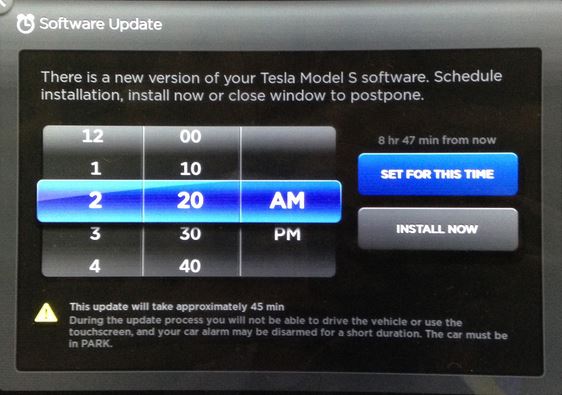
Tesla has announced a new, over the air, software upgrade, for the Model S and Model X. This brings a new, redesigned, User Interface (UI) to the massive touchscreen. With the upgrade due in Australia sometime from October 2016, here’s what Tesla Australia had to say:
 Tesla makes the only cars on the road that continue to get safer, smarter, and more capable over time, thanks to free, over-the-air software updates. While traditional cars have static features, a Tesla is more akin to a smartphone, adding new functionality and enhancements throughout the life of the car.
- Voice commands initiate with a single tap
- Feedback in the form of a transcript now appears on the instrument panel to confirm your command
- Visual tips remind you what commands are available

- Search for destinations with a single touch or voice command
- Zoom adjusts based on location to display what you need to see most
- Navigate to home or work with a single swipe
- When at home, swipe the navigation button down in the Maps app and navigation will automatically route you to work. When away from home, swipe down and navigation will route back
- Autopilot has been tuned to be more responsive and smoother in stop-and-go traffic
- Enhanced safety requirement which disables Autosteer during trip when safety warnings are ignored
- Autosteer now navigates highway interchanges
- Redesigned Autopilot indicators
- Curve speed adaptation now uses fleet-learned roadway curvature
- Autopilot now controls for two cars ahead improving reaction time to otherwise-invisible heavy braking events
- Car offsets in lane when overtaking a slower vehicle driving close to its lane edge
Head to www.tesla.com for further information.
Car-Jacking 2016-Style: Can Your Car Be Hacked?
 Fact number one: more and more components of modern cars are controlled by electronics and computer systems. Fact number two: cars are one of the most significant items in the Internet Of Things, where things that aren’t computers and mobile phones go online and send info from A to B or receive information. Tons of new cars of the more connected type have the ability to run a diagnostic test, send the info to the maintenance people and send you a report (e.g. Ford’s SYNC Vehicle Health Report). You can also get apps to help you find where you parked your car if you are one of those who have a tendency to get forgetful in car parking buildings. Many cars are so connected that they’re probably the most mobile of mobile devices.
Fact number three: hackers exist. Scary stuff. You’ve got a car with all these electronically controlled safety devices (including steering correction and brake deployment), your car is connected to the internet and there are evil-minded folk out there who like to create a bit of havoc.
Q3 2016: Partnerships and Technology Signal the Beginning of a New Era
While some of the issues from earlier this year continue to hold the attention of the industry, partnerships and technology took on a large role this quarter following numerous developments.
 Level 2, 9 Help Street