

2017 Hyundai Veloster Street Turbo: Private Fleet Car Review
Hyundai’s quirky four door hatchback, the Veloster, has been given a limited edition model run of just 200 units. Painted Dazzling Blue Mica and given some cool looking black clad alloys, the Veloster Street Turbo spent a week with Private Fleet. With a starting price of $35750 plus on roads for a six speed manual version and $2500 for the seven speed dual clutch auto, the Veloster Street Turbo is off to a tough start. Using the outgoing Veloster SR Turbo + as a base ($34750 + ORCs), as Hyundai have realigned the Veloster into a two tier range, means that some extra equipment is required to justify the cost.
 Here’s what you get: push button Start/Stop, keyless entry, dusk sensing HID xenon headlights, LED running lights, tyre pressure monitoring, a seven inch navitainment touchscreen (but no RDS, Apple CarPlay/Android Auto or digital), leather appointed seating with colour coded inserts, colour coded plastic highlights on the door grips and centre console, blue seatbelts, branded door mats and Street badging on the fenders and the sweet looking Ray Grams Lights 18 inch alloys. Being based on the SR+ you’ll get steering wheel mounted phone controls, Bluetooth streaming, heated AND ventilated (huzzah!!!) front seats and a punchy eight speaker sound system.
 Up front is the same 150 kilowatt/265 Newton metre 1.6 force fed four. That’s connected to the aforementioned six speed manual and this, unlike the recently tested i30 SR, has a far better manual selector feel. There’s a proper sense of movement and placement, a satisfying “snick” to the gate and a real mechanical feel overall as opposed to the numbness experienced in the i30 SR.
 That torque is available between 1750 and 4500 revs, and compared to the last time Private Fleet and Veloster Turbo partnered up (Veloster Turbo review 2015) didn’t seem to move the car along as quickly. Perhaps it would be the manual versus the auto, it simply didn’t feel as wound up. Having said that, it still provided a tractable and useable driving style, with a smooth and fluid torque delivery.
 The ratios in the manual are closely stacked, meaning revs drop only minimally when changing, and also means you can keep the engine spinning and take advantage of the torque from 1750 onwards. It helps that the clutch has a decent pressure requirement to push and that the pickup point is appropriately mid travel. The combination allows a sporting aimed driver to bang through the gears and see 100 kmh reasonably quickly. Given that the car isn’t that heavy as well, at around 1400 kg, the overall fuel consumption figure of 7.9L/100 km was reasonable from the fifty litre tank.
 Inside, apart from the blue trim, the Veloster remains much the same. The design and look of the plastics is dating and not well, there’s sharp edges on the door grab handles however the deeply bolstered and very comfortable bucket seats make up for that. Being the oddity that it is in regards to entry and exit, the driver has slightly less issue in getting in and out thanks to the single door on the right hand side.
  Those using the left side, especially the rear door, will have to duck their head and slide across the centre rear seat mounted cup holders in order to fill the space behind the driver. Rear head room, thanks to the steeply raked roofline, is a touch tight for average sized humans, ok for kids but would be, erm, difficult to deal with for anyone of a bigger frame. There is, though, a 320 litre cargo space and a space saver spare to consider.
 There’s more refinement in the suspension, with a taut yet supple suspension combination providing a ride that errs on the side of sport but with just enough give to not rattle the fillings on smooth roads. Toss the Veloster Street onto anything else and expect a choppy, jiggly, teeth rattler. That initial level of sporting compliance disappears and there’s even some sideways skip when covering a corner with ripples or broken surface, even with the 225/40/18 Hankook rubber.
 Hyundai painfully continues with the three mode power steering and it’s rare that any one the modes (Comfort/Sport/Normal) tend to be on the money. Sport generally comes over too heavy, Comfort too light and well, just like the porridge, Normal is generally all you need for a reasonable facsimile of a communicative tiller setup.
At The End Of The Drive.
Given the dollars required, one could buy the Toyota 86/Subaru BRZ, a Renault Clio, or a Mazda MX-5 and have some seroes to spare. The Veloster’s aging interior is one thing, the exterior looks are another. The engine is usable but, in honesty, not the firecracker A Wheel Thing remembers. Their is a respectable five-year unlimited kilometre warranty, 12 months roadside assist, plus you’ll get a complimentary first service at 1500km. There’s also a lifetime service plan with scheduled services with prices ranging from $159 to $259 for the first three years or 45,000km. They’re due due every six months or 7500km.
There’s an undeniable appeal about the Veloster, however, with sales consistent and even a quarter of these two hundred already sold since release. More info can be found here: 2016 2017 Hyundai Veloster range and info
Tesla Takes The Next Step To Hands Free Driving.
It’s a topic that is cropping up more and more in conversation: will self driving cars become a reality? Nowadays the jury is leaning towards when, not if, and Tesla is at the front of the charge (no pun intended). Self-driving vehicles will play a crucial role in improving transportation safety and accelerating the world’s transition to a sustainable future. Full autonomy will enable a Tesla to be substantially safer than a human driver, lower the financial cost of transportation for those who own a car and provide low-cost on-demand mobility for those who do not.
As of mid October 2016, all Tesla vehicles produced in the factory – including Model 3 – will have the hardware needed for full self-driving capability at a safety level substantially greater than that of a human driver. Eight surround cameras provide 360 degree visibility around the car at up to 250 meters of range. Twelve updated ultrasonic sensors complement this vision, allowing for detection of both hard and soft objects at nearly twice the distance of the prior system. A forward-facing radar with enhanced processing (Tesla radar) provides additional data about the world on a redundant wavelength, capable of seeing through heavy rain, fog, dust and even the car ahead.
Blue Oval Blues: The Demise Of An Icon.
October 7, 2016, just before 10 am in Melbourne, Victoria. We knew it was coming, we tried to deny it was coming but, inexorably, it arrived. The final Australian built Ford was rolled off the assembly line and the factory fell silent.
91 years. Three million, eight hundred and fifty three thousand, four hundred and thirty seven Falcons later, the last being an blue XR8 Sprint (an homage to the nameplate from the late 1960s), it’s over. Prior to the Sprint, there was a white Territory and a blue XR6. These cars were sold at an auction, raising money for charity. The FG-X Falcon XR6 sold for $81500, the ute XR6 went for $81000 and the Titanium Territory was passed to its new owner for $68500. However, there were three cars that Ford built without ID plates, making them unsaleable and will be kept by Ford for display in their museum.
But there’s much more to Ford in Australia that the events of October, 2016. It’s not commonly known that Ford Australia was founded as an outpost of Ford Canada, a then separate part of Ford USA, as Henry Ford had granted manufacturing rights to Commonwealth countries, except for the UK, to Canadian investors. The very first cars built were assembled from CKD (complete knocked down) kits imported from Canada. These were built in a disused factory from June of 1925, just three months after Ford USA announced that Geelong would be the home of the Australian outpost. The car? The famous “Model T”.
Hyundai i30 SR: Private Fleet Car Review
Hyundai‘s i30 has quickly become a staple on Australian roads, taking the fight up to Ford’s Focus, Kia’s Cerato and Toyota’s Corolla. It’s an award winning car and for good reason, with a high quality level of fit and finish plus Australian tuning for the ride. Hyundai’s bundled everything into one package for the manual i30 SR and it comes out the other side holding its head up high. What a buyer will find in the near 1300 kilo SR is Hyundai’s non turboed Nu 2.0L gasoline direct injection engine, with peak power and torque of 124 kW and 201 Nm. Naturally, both come in at high revs, with 4700 of them needed to see peak torque. The transmisson is a six speed manual and it’s here, in the car provided, that something didn’t feel right. The gate mechanism is loose, sloppy, undefined, and changing from second to third to fourth and back feels as if the selector is moving up and down, not left to right to left.
 The clutch itself seemed initally quite soft and lacking in any real spring pressure, with a seemingly indeterminate pickup point on the travel, with the subsequent revving of the engine past where a normal pickup would bring them down telling the story. When it all gels, however, it’s smooth and usable, it just lacks a real presence.In amongst all this is a frugal powerplant, with a combined total, from the 50 litre tank, of just 7.0L per 100 kilometres. If you’re in freeway mode, 5.5L/100 km is what Hyundai quotes and around town is where a lighter foot may be needed, at 9.5L/100 km.
 The test car was painted Brilliant Red, matched by the Start/Stop button’s surround. Otherwise, the interior is standard i30, save for red additions and stitching to the seats, and alloy pedals. There’s a seven inch full colour navitainment touchscreen, sans RDS, a peculiarly Korean thing. There’s an impressive list of tech: Apple CarPlay is on board, as is Bluetooth audio, auto head lights, rain sensing wipers, dual zone climate control air conditioning, and auto windscreen defogging.
  There’s a reverse camera, hidden under the boot mounted badge that folds out and in. It’s a tad noisy and momentarily distracting. Behind the tail gate is 378 litres of usable cargo space, expanding to just over 1300 when the 60/40 split rear seats are folded.
 Outside there’s LED DRLs in the front, an SR badge on the rear along with two on the front flanks, gorgeous gunmetal grey tuning fork style alloys at 17 inches in diameter, shod in 225/45 Nexen rubber. It’s Hyundai’s fluidic design in profile with the headlights flowing back into the guards, bracketing the newish corporate grille that is a one piece design. It’s cohesive, good looking and suits the colour the test car was covered in.
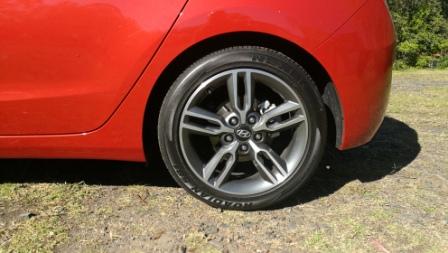 It also cuts a fine figure on the road. Hyundai’s engineered a wonderful road holding chassis, with tenacious grip, a beautifully weighted steering feel using the Normal mode (it feels too artificially heavy in Sports, too light in Comfort), a ride quality that balances front and rear in the way the SR rebounds from bumps and undulating roads, thanks to revalved dampers and retuned springs.
  Even on unsettled and broken surfaces, it ducks and weaves through them with aplomb, exhibiting a high level of body control. And although it’s a normally aspirated engine, there’s enough pluck in the powerplant to provide enough performance without seeming underpowered. Rev through the numbers and there’s a steady pull through the range without running out of puff at the top end.
At The End Of The Drive.
The SR raises the i30 above the entry level and sits comfortably below the Premium, offers a well thought out feature list and priced from $25590 plus ORCs it’s a good value package. On the road it’s a solid handler, with a willing enough engine, with the weakspot being the lacklustre gear selector. Work around that and the i30 SR stands out as a suitable alternative to the Japanese big sellers. Go here:Hyundai i30 SR for more info.
 Level 2, 9 Help Street