

Private Fleet Car Review: 2017 MY Kia Optima Si
Kia’s big mid sized car, or mid sized big car, the Optima, has proved to be a stayer in recent years. For 2017 Kia has streamlined the range, with it now compromising the Si and GT, with the latter now packing a turbo engine and replacing the Platinum nameplate. A Wheel Thing takes time with the entry level Kia Optima Si. There’s a good reason why the range is now just two: the Si gets crammed full of standard equipment found as options elsewhere. Apart from the standard, mandated, safety equipment such as ABS, airbags and the like, there’s Hill Start Assist, the flashing brake lights Emergency Stop Signal, parking sensors front & rear with dash display, rear view camera with guidelines, Lane Departure Warning, Autonomous Emergency Braking, auto headlights and with auto levelling. Straight up, that’s an impressive features list from a $38500 driveaway (no options or metallic paint) priced car.
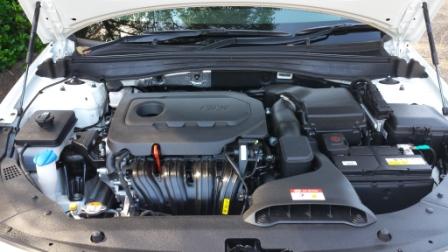 What you’ll get up front is Kia’s 2.4L, with 138 kilowatts and 241 torques at 4000 rpm put to the front wheels via a six speed auto. It’s an engine that needs a rev to get the 1540 kg car going and that’s reflected in the consumption. The combined figure is quoted as 8.3L/100 km on standard unleaded, with an urban figure of 12.0L. That’s simply too high in today’s eco aimed environment and has been the Optima’s weak spot since the current shape was released in 2013. Take it out on the freeway and expect just over 6.0L/100 km from the huge 70 litre tank.
 It weighs a bit because it IS a big car but not as much as similar sized competitors. It’s big car in length at 4855 mm, big car in width at 1860 mm but has a low 1465 mm to show why in profile it’s seen as slinky and sensuous. It’s a good sized wheelbase, too, at 2805 mm, which translates into plenty of internal space, including a huge 510 litre boot space that is more than adequate for a family shop or a holiday away.
 Design wise there’s subtle but crucial changes, keeping the Si’s looks fresh. It’s a more defined tiger nose grille, the LED lights in the lower quadrants of the intake inside the reprofiled bumper, the slimmer tail lights, extended boot lid, and the Continental rubber on the 17 inch alloys. A good looker? Absolutely. The test car came in Clear White, one of five colours available for the Si, with Silky Silver, Platinum Graphite, Gravity Blue and Temptation Red also available as an optionable cost (check with your dealer for pricing).
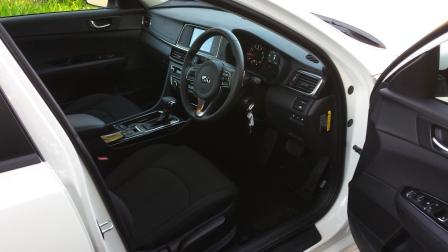 Inside it’s black cloth for the Si, on well sculpted, supportive and well bolstered, manually operated seats. For the Si, that’s the sole trim choice available. The driver and front seat passenger see a fluid, flowing, dash, with an ergonomically smart layout. The upper section, nearest the window, has a curve not unlike that seen in a premium British brand and the dash plastic has an almost leather look to the texture.
 Tabs have a soft feel and are of Kia’s semi matte finish. The overall effect is of quality and presence and wouldn’t be out of place in some more expensive Euro spec cars. And although the window line is high in proportion to the sides, there’s still plenty of all around vision. If you have portable devices or smartphones, there’s four 12 Volt sockets; two front and two for the rear seats, mounted at the rear of the centre console.
 Entertainment is courtesy of a 7 inch touchscreen with navigation, complete with USB/Auxiliary/Bluetooth streaming and a Speed Dependent Volume Control. It’s AM/FM only with limited RDS (Radio Data Service) capability, leaving the Si Optima behind some competitors. Sound quality in FM is good enough, however, with tuner sensitivity only rarely showing a dropout.
 Where the Si further shines is on the road. Think of the suspension tune as “sporting luxury”. Punted over a broken up tarmac surface at Sydney Motorsport Park, there’s plenty of absorption, compliance, plushness before firming up rapidly but not uncomfortably. Kia Australia works very closely with Kia’s headquarters to work on suspension tune for Australia and again that effort shows and pays off. Even being front wheel drive there’s barely a hint of that, with no torque steer yet an appreciable weight and heft to the steering feel. Speedbumps? Not a problem? Dive under brakes? Not enough to worry about. Dealing with undulations? C’mon, why ask!
 Pushed hard into a certain roundabout which has a direction of travel change of over 180 degrees, there was no understeer and the rear followed the front around without question. Nope, no tyre squeal either, before you ask. The electrically assisted steering is not overdone in how it works with the three steering modes, and the Motor Driven Power Steering Module is steering column mounted, allowing Kia to tune towars the more luxury side as opposed to the GT’s rack mounted setup.
It’s quiet, too, on the road, with the 2.4 litre engine only intruding slightly and that only when pressed hard. Wind and tyre noice are negligible at best and only mildly noticed at worst. Combined with the seating, you will emerge from a long drive without the subconscious stress outside noise brings in.
That New Car Smell
 The poet and writer Rudyard Kipling once said that “Smells are surer than sounds or sights to make your heartstrings crack,” and “”The first condition of understanding a foreign country is to smell it.” (the one who wrote the Jungle Books and tons of poetry that is rather neglected today, possibly because some of it’s too much fun for an English class). He would probably have sympathised with those who find the smell of a brand new car intoxicating.
Just what is that new car smell? Why does it press our buttons so much? And is it possible to bottle it so we can spray it in our old faithful Toyota Corollas so they smell like new machines? If we can, should we?
Preparing Your Teenager For Their Learner Licence Test
 A lot of parents look forward to the day when their teenager can finally drive him/herself. However, before you can enjoy the relative freedom of the P-plate days, you have to do through the L-plate stage – and the stage before the L-plates. You may already have a few ideas up your sleeve about whether you’re going to be the one to teach your teenager how do drive, whether you’re going to sign him/her up for professional driving lessons or whether you’re going to go for a combination of the two.
But what about the stage before that? How are you going to help your teenager prepare for that? They certainly do need your help preparing for this, as you’re the expert driver that they see driving on a daily basis (and don’t you just know it!). What’s more, this is usually a time of life for them when the homework from school increases like nothing else (Talk about stressful for them! I wouldn’t want to go back to my teen years).
Private Fleet Car Review: 2016 Audi A4 Avant Quattro S-Line
Long seen as a pioneer of all wheel drive vehicles, Audi’s Quattro system is possibly one of the best of its kind available. Couple it with a torquey turbocharged four, a mostly user friendly DSG transmission, and with Audi’s S-Line trim inside the wagon or Avant body, it’s an iron fist in a velvet glove. All up, it’s the Audi A4 Avant Quattro S-Line. Up front, behind the LED lit headlights, lies a 2.0L four cylinder turbocharged engine in an in-line configuration, fed on a diet of 95RON petrol. When prodded with the angry stick, the 1615 kilogram machine (thanks to a weight reducing aluminuiom chassis) will be hauled away to 100 kilometres per hour in just six seconds to a limited top speed of 250 kmh, seeing maximum torque of 370 nm (1600 to 4500 rpm) being applied via the seven speed dual clutch auto to all four wheels. Keep the foot buried and the tachometer on the full LCD dash screen will swing around to over 6000 rpm, delivering peak power of 185 kilowatts between 5000 to 6000 revs.
 Being the beast it can be, it’ll drink and drink hard when continually pushed. Consumption of the good fluid can be over 12.0 litres for every one hundred kilometres covered. However, it can also be docile, averaging around 7.0L per 100 km for normal around town work. Audi’s figures are 6.6L/100 km on the combined cycle for the Avant from a 58 litre tank.
Drivewise, punch the accelerator whilst on the freeway and the torque spread shrugs aside any opposition, watching the numbers change with alacrity. It’s a situation that well trained drivers will appreciate and understand. Should one wish to drive with a touch more verve and a little more zing, Audi has a drive mode selector, offering four options including Dynamic. This holds the gear shift point for longer, changes the engine’s ignition mapping to suit and provides the driver a more assertive driving experience. This would be ideal for an owner to take to a track day and find out the true limits of what this very capable machine can see. The downside to this is a lack of anything welcome stroking the ears. Although you can hear the engine working, it’s muted, lacking a real sense of buzz and excitement, whilst at the rear there’s a faint “phut, phut” as the transmission changes up.
 It’s a little too easy to confuse it at times; it’s not a fan of very low throttle applications such as those coming out from your driveaway, or in city traffic. The engine takes a moment too long to telegraph what it’s doing and the transmission furthers that lag. It’ll all too easily change down to an unwanted ratio on some downhill runs, especially at lower speeds required due to the road itself or traffic ahead, necessitating a flick of the paddle shift to get it to a more appropriate ratio. There was the occasional indecision in traffic and a clunk as the gearbox and AWD system talked to each other momentarily before reaching a decision on what to do.
 However, it’s as easy as breathing in regards to engaging the system. A rocker style gear selector is what Audi uses; foot on brake, press the Start/Stop button, pull lightly back for Drive or push forward for Reverse. Park is engaged by a push button at the top right and it couldn’t be more simple to use. Manual mode is simple tip to the right and rocking forward or back or using the paddle shifters.
 Being all wheel drive is one thing, but if the tyres aren’t up to the game, you’ll be hard pressed to fully appreciate what it does. Thankfully Audi has wrapped all four 19 inch wheels with rubber from Pirelli in a 245/35 profile. On the curvy, winding, roads A Wheel Thing uses every day, the Avant simply hunkers down, hands the driver a note saying “I’ve got this” and powers through as if Velcro, superglue and liquid nails have held the chassis to the rails it’s on. In one of the roundabouts near home, which to access the desired road requires a change of direction of over 180 degrees, there was no under or oversteer at all.
 The well weighted and pin sharp responsive steering had the Avant planted firmly, squarely, confidently, in this kind of situation and worked hand in glove with the sports suspension. Think of one of the hard erasers you had a school; squeeze it and there’s a touch of compression before it shops the squeeze. Close your eyes and imagine that’s the ride quality of the A4 Avant Quattro; firm but not hard, compliant enough to not dislodge the teeth but solid enough to let you know it’s just eaten a ripple in the road for breakfast. Helping with front end and overall chassis stability is the alloy strut tower brace.
 If there was a design quibble, it was something constantly mentioned by the junior members of A Wheel Thing: Daddy, why do the door handles open upwards? I don’t like it.
 Level 2, 9 Help Street