

Ford Mondeo Gets Freshened Up For 2017.
Ford Australia‘s large mid sizer, the Mondeo, gets a tickle for 2017, bringing fresh looks including a funky new colour, improved safety, and more tech. Let’s take a look at the car that saw a sales increase, year upon year, of 47% in 2016.
Profile.
The top of the ladder Titanium will be fitted with nineteen inch alloys, up from the eighteens fitted previously. They’ll be shod with Continental 235/40 rubber, providing a more sporting and assertive look to go along with the increaed ride and handling capabilities.
“An increase in wheel size provides Mondeo a sure-footed dynamic stance that matches the chassis’ outstanding roadholding,” said Todd Willing, the Ford Asia-Pacific Design Director. “The new wheels not only help the visual balance of Mondeo, but work in conjunction with the body’s elegant lines for a premium yet sporty appearance. It’s a slick combination.”
French Flavour
France is, perhaps, best known for the Tour de France, fine wines, cheeses, romance and nice comfortable, stylish cars. Did you know that French cars are hugely popular in Europe and are a major player in France’s economy? Producing around 1 million vehicles each year, France’s car manufacturing businesses employ over 75,000 people. The French know how to make cars with a unique and distinctive style. Many design awards have been given to both Peugeot and Citroen cars.
Citroen has a number of very classy vehicles. Providing both passenger vehicles and vans, Citroen has a model for most market segments. Kicking it all off is the Citroen DS3, a performance hatch with hot looks and a great engine. Featuring direct petrol injection and a turbocharger, the e-THP 160 motor develops a maximum power of 121 kW at 6000 rpm and 240 Nm of torque between 1400-and-4000 rpm. This is a similar size to a new Mini, providing loads of style inside and out, while being quite cheap to run and enjoyable to drive via a slick six-speed gearbox.
2017 Tesla Model X: A Private Fleet Car Review.
Being an independent reviewer and supplying content means relying on the good graces of companies to allow their cars to be reviewed. Tesla Australia is one of the companies that works with independent reviewers and I was privileged to spend a too quick 30 hours with the new Model X. It’s jampacked with technology and comes with a pricetag to suit. An immediately noticeable feature of the Model X is the strong family resemblance to the Model S. There’s a similarity to the profile, with the A pillar and window line providing a clear lineage. However, a major talking point of the Tesla Model X is the pair of upwards folding rear doors, known as “Falcon Wing”. What hasn’t been noised about is the tech that allows the doors to open in tight parking points. There’s sensors and cameras that will read the surrounding environment, with the cameras mounted discretely next to the rear wheels. The system works holistically and, when the doors begin their opening motions, will keep the doors from opening too wide or high. Maximum opening width is just twelve inches.
 The doors themselves are roof hinged, in the centre and have smoked glass, and will open outwardly slightly before commencing their vertical travel. The tailgate is powered, however the front doors, unexpectedly, are also powered. It’s here a surprise and delight feature comes into play. When walking up to the car (and ensuring the sedan shaped key fob is on you) the driver’s door will open in greeting. On a wet day this could be a godsend. The fob itself has a hidden button or two, on top and at the rear, which will open/close the tailgate and open/close all five doors. There’s even a spoiler that raises and lowers, ala Bugatti Veyron, hidden in the rear deck.
 Inside, the cabin is dominated by a touchscreen almost big enough to double as a TV. Sitting in a portrait orientation, this screen is the control centre of any Tesla car, offering information, accessing over the air updates (as was the case during the brief time it was with A Wheel Thing), accessing apps and the radio system and providing startling clarity when using Google Maps. Although given a demonstration by one of the wonderful staff at Tesla’s main Sydney location, the amount of info and how it all operates is somewhat overwhelming, even for a fairly technically literate person. The radio itself is only FM, no DAB, but has TuneIn to compensate. There’s something just a little bit awesome about being able to listen to bluegrass from Georgia in the U.S. or a dedicated Beatles station in Sweden. Audio quality itself is excellent, with the Mark Levinson speakers delivering real clarity, superb low down punch, and vocals that are clean and crisp.
 There’s a couple of nice touches to the interior. The seats are powered for rear and forward motion at the front, however the middle rows are also powered and have a setting which allows for them to power forward to a certain point to allow access to the second row rear seats. It’s diabolically simple in opertaion and makes utilising both the seats and the door access unbelievably simple. There’s also a huge sloping windscreen which provides a huge amount of forward and upward vision. Fear not, dear driver, you won’t fry like a piece of fresh bacon, for Tesla have embedded enough tint to block UV without losing the wondrous panoramic view. There’s even some tasteful looking carbon fibre trim added in.
 At the rear left quarter is the housing for the charging cable. Tesla provide an adaptor to suit standard household plugs along with, of course, those that choose to get a supercharger installed at home. Again, it’s just a touch fiddly to get the small hinged flap to open but the actual process of hooking up the cable and seeing a hidden LED glow green to indicate charging is relatively simple of itself.
It’s the drive that sells the Model S and the test car was fitted with the 100 kW/h dual engine package. Yes, “Ludicrous” Mode is on board, accessed via the touchscreen inside the car’s settings, and will help propel the Model S to 100 kph in just 3.8 seconds. There’s also sensational in gear acceleration, with a real punch and license losing potential from 70 kph upwards. It’s literally a feeling of being pushed back into the seat and watching the outside become a blur and allegedly will see the sprint from 70 to 105 in just 1.5 seconds. Yes. It’s that quick.
Hyundai Australia Reveals Pricing For Reinvented i30.
Whilst their Korean based brethren, Kia, get some eyeballs cast over the Stinger, Hyundai have quietly launched a revamped i30, with a striking Euro inspired exterior and reinvented interior. With a starting price of $20950, $500 LESS than the outgoing model, the Hyundai i30 range is both priced and packed with added value enough to really appeal to keen eyed buyers. The range will consist of five models; the entry level Active, SR, Elite, SR Premium and Premium. The Active will offer a choice of two engines, a 2.0L petrol with manual or auto transmissions and a punchy 1.6L diesel with the same engine combination.
The SR and SR Premium will be powered by a turbo petrol 1.6L with the Elite and Premium getting the 1.6L. Power and torque are thus: the 1.6L turbo petrol offers 150 kilowatts and 265 Nm of torque for both transmissions. The diesel gives 100 kW, 280 Nm for the manual and slightly more for the seven speed dual clutch auto, at 300 Nm. The standard 2.0L petrol presents 120 kW/203 Nm, with fuel economy almost lineball with the smaller petrol turbo at 7.3L/100 km & 7.4L/100 km (manual/auto), 7.5L/100 km for the 1.6L turbo and a country kilometre eating 4.5L & 4.7L per 100 km for the diesel manual and auto.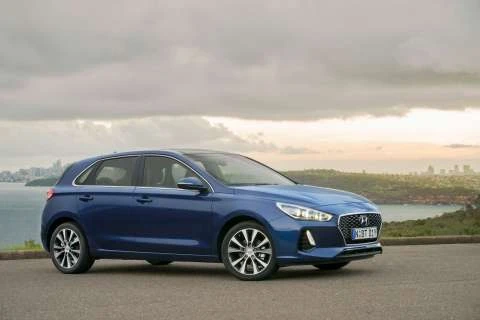 Pricing starts as mentioned, with the Active manual at $20950 (auto is $23250). What you’ll get for your dosh above the outgoing model is: dusk sensing headlights, LED running lights, 16 inch alloys, satnav on a eight inch screen, and more. The diesel versions come in at $23450 and $25950 for manual and self shifter.
 Level 2, 9 Help Street