

HSV SportsCat Ready To Pounce.
Four wheel drive four door utes are amongst the biggest sellers in the Aussie market but it’s not an easy job to make them look tough and ready for an all-in brawl. HSV somehow manages to pull that off with their warmed over version of the Colorado. Packing a 147kW/500Nm diesel (with auto transmission), the SportsCat is more than a “whack on a sticker pack” effort. It’s now into its Series2 offering and it looks the goods, visibly and underneath. It’s available in two spec levels, SportsCat V and SportsCat SV.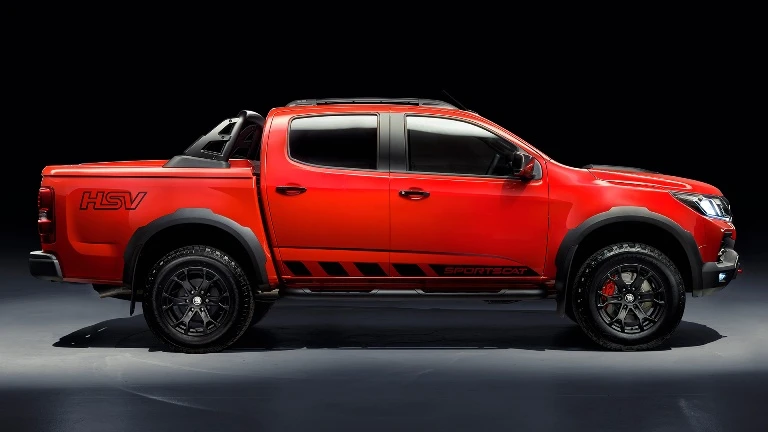
Engineered to pound the ground, and hard, SportsCat has uprated frontsprings, stiffened to cope with 110 Newtons per millimetre of impact stress. This translates to far less body roll and movement when getting serious or even taking it easy on the freeway. The rerated suspension also has the front raised by 25mm, increasing the travel available and increasing ground clearance. HSV also call upon SupaShock Suspension to help in the ride and handling.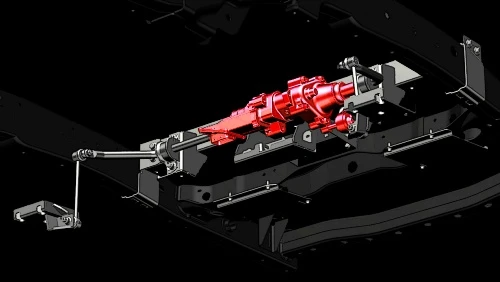
Connected to six-spoke 18 x 10 wheels wrapped in specially developed Cooper tyres, the dampers from SupaShock, available as factory fitted options, are larger diameter items. By reducing losses of response to friction they are more quickly able to adapt to the ever changing needs of on and off-road driving. Factor in a HSV engineered decoupling bar for the rear axle anti-roll bars, which increases stability at speed by controlling the roll attitude of the rear end, it activates when the SportsCat’s drive system is put into 4WD Low. It’s standard on the SportsCat SV and optionable on the SportsCat V.
Stopping power comes courtesy of the AP racing package. as fitted to the HSV GTS-R, it features four pistons callipers, 362mm x 32mm front rotors to haul down the big machine. These are standard on the SportsCat SV, optionable on the SportsCat V.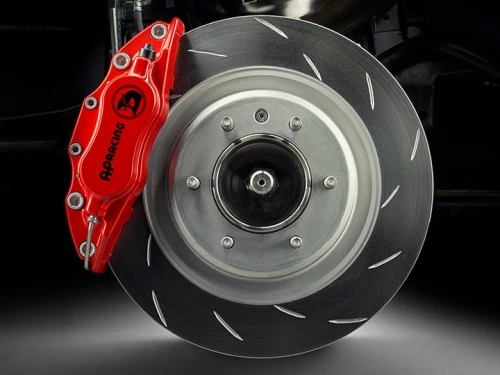
Inside and upfront, SportsCat features a reworked interior, including six position adjustable electric seats for driver and passenger. There is specific HSV trim on the dash, doors, and on the steering wheel. The seats are bespoke HSV, with embossed headrests, leather, and Windsor Suede. Outside HSV have a optionable sailplane for the roll-over bar.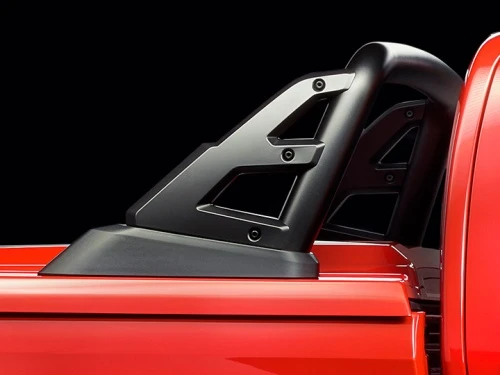
Tech and safety are in the form of Remote Start, Front and Rear Park Assist,Forward Collision Alert, Lane Departure Warning, and seven airbags including driver’s kneebag. Towing is rated as up to 3.5 tonnes. These are backed by a five year, unlimited kilometre warranty and roadside assist package.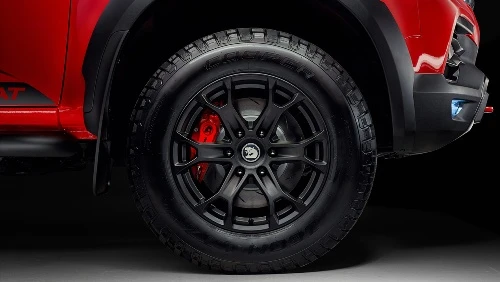
Private Fleet Car Review: 2019 Hyundai iLoad Crew Van Liftback.
This Car Review Is About: a vehicle that doubles nicely as a passenger and commercial transport vehicle. The Hyundai iLoad is the cargo transport version of the dedicated passenger van called iMax. It comes with or without the passenger configuration. Or, if you will, the iMax is the passenger version of the iLoad… What Does It Cost: At the time of writing, Hyundai were listing the iLoad Crew at just over $48K driveaway. That includes a five year warranty or 160,000 kilometres, free first service, and 12 months of roadside assist up front. There is a 15,000 kilometre/12 month service schedule.
Under The Bonnet Is: A 2.5L diesel and five speed auto for the iLoad Crew as tested. Peak torque is a whopping 441Nm however the PEAK figure is available through a very narrow rev band of 2,000 rpm through to 2,250rpm. There’s no lack of urge available under that 2,000rpm though. Economy is quoted as 8.8L per 100km for the combined cycle. On The Inside It’s: A comfortable place to be. The two rows of cloth covered seats are separated from the 2,215L of cargo space by a fairly rigid barrier but was still prone to a squeak or two. The front seats are a 2+1 configuration, with the centre section featuring a folding backrest that doubles as a tray and cup holder. The driver has a one touch powered window for Down only, and for up it needs to be held. The windows in the sliding doors for the rear passengers are fold out and not that far either.
 Instrumentation is basic but functional here. The driver has a fully analogue needle set of dials and a basic but again functional monochrome LCD screen in the centre. This shows trip, odometer, and expected range, but we didn’t see a litres per kilometre display though. Headlights have an Auto on switch, the tiller houses the basic audio and cruise controls, and the wiper controls on the left are just a fingertip away during the rainy season.
 The dash console itself has a split level storage on the passenger side, a small nook in the centre for USB and 3.5mm auxiliary, a small pull out drawer lower down and a 12V socket.
Hyundai's Tucson Refreshed And Updated.
Hyundai Australia has released details of the 2020 refresh for the Tucson range. There is a four trim level choice and that’s courtesy of the addition of the Active entry level model. Active X, Elite, and Highlander are the others. There are upgrades to the safety systems, exterior and interior updates, and minor changes to pricing.
Active and Active X can be specced with a six speed manual transmission and are priced at $29,290 and $32,290, or with a six speed auto will be $31,790 and $34,790 respectively. Power comes from a 2.0L petrol engine, and prices are before government and dealership charges. Tucson Elite dips out on the manual but can be ordered with the 2.0L and auto for $37,850.
Private Fleet Car Review: 2019 Kia Sorento GT-Line Diesel.
This Car Review Is About: A big, comfortable, and very well equipped vehicle from Kia. The top of the range Sorento GT-Line is a diesel powered seven seater that lacks for very little to appeal to those needing a SUV that isn’t intended to be an off-roader. The Sorento range is powered by either a 3.5L V6 or a 2.2L diesel. Under The Bonnet Is: A 2.2L diesel for the GT-Line. It’s a quiet chatterer thanks to a mix of refinement and noise insulation in the engine bay and under the aluminuim bonnet. 147kW is available at 3,800rpm, and a whopping 441Nm of torque on tap between 1,750 rpm and 2,750 rpm. It’s a great long distance hauler, with an easy, loping attitude thanks to a freeway speed ticking the engine over at around 1,500 rpm. Kia quote 6.1L/100km for the highway cycle and this was bettered, albeit by 0.1L/100km. Overall economy, driven mainly in the urban jungle, finished at 8.2L/100km, with Kia’s urban cycle quoted as 9.2L/100km. Transmission is an eight speed auto putting that power and torque down via the front wheels, with torque split to the rear on demand. There is also a diff-lock for the rare excursions into a bit of mud or dirt.
 What Does It Cost?: $58,990 plus on road costs and metallic paint. That’s just $595. Capped price servicing applies for the seven years of warranty, with a yearly service or 15,000 kilometres. the most expensive service is year 4 at $684. At the time of writing Kia are doing runout deals for the Sorento range.
 On The Inside It’s: A seven seater with the third row the delightfully simple pull-strap design. A gentle tug, a pull of the strap backwards to lift the seats, or a tug and gentle push to lower them, and it’s something nearly all makers now use. The centre row is bordering on ideal for three adults, it’s certainly fine for two growing children. The left seat is set up to be slid to allow entry for the rear seats, and both centre seats are sliding & folding. The driver has an eight way powered seat, with the front pews heated, vented, and the driver having a heated tiller. Leather seats are a bit cold to touch in the cooler climes however the heaters take the edge off, but the rate of heating could be improved for a more rapid response.
 The dash is typical Kia but starting to show its age in one area. Manufacturers have moved to the touchscreen being raised up in its own plinth. This is for safety as it’s closer to the driver’s eyeline and not looking downwards. The screen here is super clean, intuitive, and is DAB/Android Auto/Apple CarPlay compatible. The DAB tuner has the same issues as the other Kias tested recently, with inconsistent signal acquisition and dropout. The plastics in the Sorento are of an almost leather look and have a fine grained finish to them. Open the front doors and Sorento glows a soft red at night in the sills.
 The dash display itself lacks a HUD but the dial for the speed is fully digital. It also shows which drive mode the driver has selected from the four available: Smart, Eco, Normal, and Sport. A centre screen section shows info such as range, driving distance, trip meter and economy.
 Auto headlights, rain sensing wipers, auto-dimming rear vision mirror, rear camera and guidelines, plus 360 degree camera are part of the interior fitment and everything is precisely laid out, showing Kia is well on top of the human engagement part of interior design. The Sorento also comes with a full length glass roof.
 On the Outside: It’s refinement, refinement, refinement. Compared to a Sorento design of, say, a dozen years ago, it’s recognisable as part of the family but obviously a modern design in its own right. It’s a two box design, with a bonnet that dips towards the imposing Schreyer “Tiger Nose” grille, whilst the body behind the windscreen has a smooth silhouette with a slightly odd angle for the rear window/tailgate. The tail gate is powered, of course.
There are LED driving lights, LED tail lights, LED headlights and are self levelling. Kia calls them Dynamic Bending Lights. It’s a big vehicle with a physically imposing presence too. Length is 4,800mm, width is 1,890mm, height is 1,690mm with roof rails. Wheelbase is 2,780mm and virtually joined by the GT-Line’s sidesteps. But with just 185mm of ground clearance it’s certainly not anything other than a soft-roader. Wheels for the GT-Line Sorento are 19 inch alloys and wrapped in 235/55 rubber from Kumho. Thankfully Kia also fit a full sized spare here, not the restrictive space saver spare.
 What About Safety?: Kia load the GT-Line with the supreme pizza, free drink, and free delivery, it’s that packed. All Sorentos have the mandated electronic aids such as stability control, traction control, and the like. Kia also add the Euro inspired Emergency Stop Signal which flash the indicators when the brake pedal is pressed harder than normal. AEB and Forward Collision Warning is standard through the range as is Lane Keep Assist and Driver Attention Alert, which would, annoyingly, tell a driver to have a break after just thirty minutes of driving.
 Level 2, 9 Help Street