

Buy A New Car
2017 Mahindra XUV500 Auto: Private Fleet Car Review.
Mahindra is not a name known to many car drivers in Australia and for those that are aware of the brand, the mention of it elicits a range of responses, with most of them not entirely positive. That suggests the brand has a lot to do to both be more visible here and to overcome the negativity surrounding that. The company manufactures a number of different vehicles, predominantly of a workhourse utility style. However, there is an SUV in the range, called the XUV500, and until recently available only with a manual transmission, limiting its appeal somewhat. To that end, Mahindra has fitted a six speed auto, sourced from leading Japanese transmission maker, Aisin. Now available as a four level range, with 2WD and AWD for the manual and auto, the Mahindra XUV500 starts at $29900 and tops out at a reasonable $34900, with which Private Fleet spent the week.
 Tagged the W8, there’s a 2.2L diesel up front, with a rated fuel economy of 7.4L per 100 km on a combined cycle. Powerwise it delivers 103 kilowatts and a healthy 330 torques between 1600 to 2800 revs. The Aisin six speed has a good spread of ratios and is definitely worth the investment. It’s smooth in its shifting, with no discernable hesitation between ratios and also doesn’t hold a gear unneccesarily on descents. However, off the line the ratios also don’t do that torque any justice, as acceleration is not the car’s strong point. The 1915 kilogram kerb weight is no doubt a major contributor and also explains the plus ten litres per hundred consumption for the urban cycle.
The transmission itself has a manual change option and it’s here the list of “umm, why” for this car starts. Rather than offering a paddle shift setup, or a rocker motion for the selector, there’s a small rocker switch fitted to the selector’s knob. Although admittedly it’s not difficult to use, it’s counter intuitive and doesn’t exactly feel comfortable. Does it make the XUV500 any quicker? More on that, later. Another niggle is the shift from Drive back to Park, with the usual slide through the gate (it’s a jagged, not straight gateway here), requiring a momentary pause at Neutral in order to then go through Reverse to Park. Again, not a deal breaker but an ultimately pointless thing in the frustration it brings. On tarmac the XUV500 is reasonably tied down. The rear is softer, though, with more rebound than expected and it certainly doesn’t match the more taut feeling up front. Being a seven seater, perhaps Mahindra have gone a little too soft in the expectation there’ll be seven aboard every time the car goes out. Also, the steering is heavily weighted whilst under way but there’s a noticeable feeling of slackness, a sense of disconnection between the wheel and the mechanism itself. Tyres are from Bridgestone and are 235/65 on nicely styled 17 inch alloys. There’s more than a hint of tyre squeal from this lot, with a blocky, all road/all weather tread pattern and that high sidewall profile working together to create that.
 Inside, the Mahindra delights with a comfortable set of seats, albeit manual only at the front, and some interesting design cues. Of note, and one that won’t please all, is the decision to use a font not unlike that seen in the banner for the movie “Lethal Weapon” on the tabs. It’s somewhat out of place and frankly the size is too small. Otherwise, it’s cleanly laid out, has double redundancy (controls are duplicated on the touchscreen) and have a soft touch with just a hint of click underneath. The same applies to the audio controls on the steerer; soft with a bit of click. Rear leg room is surprisingly spacious and would be suitable for almost all styles of passengers.
 The dash plastic has a print style many would be unaccustomed to; again, not unattractive, just different. There’s a pair of gloveboxes in front of the passenger seat, with one looking as if it’s a cooler box. The level of the door was a few millimetres higher than the surrounds, but this was the only apparent misalignment of material inside. Being a seven seater, Mahindra has gone to great pains to simplify what some other makers make difficult: raising and lowering the rear seats. A simple lever action mechanism on the back of the seat is all it takes and is brilliant in its simplicity.
 Tech wise you get satnav, a seven inch touchscreen (as mentioned, but there’s a picture rather than a blankness as a background), curtain and side airbags, super bright LED interior lighting, door mounted safety lights, plus an AWD system that’s engaged at the push of a button. However, there’s no noticeable difference on tarmac and the only indication you get is a tiny glowing backlight on the tab itself. You do, however, get Hill Descent Control.
 Externally, the Mahindra design crew have taken inspiration from other companies. There’s hints of Mitsubishi Pajero, a touch of Toyota RAV4 and older Mitsubishi Outlander. There’s oversized wheel arch extensions that head north and intrude into the panels. At the rear the tail lights curl upwards into the rear quarters, meeting the swage line from the front. The headlights have a sinuous S-Curve embedded into the design and mirror the similar look embedded in the driving light structure. They bracket Mahindra’s signature grille design, which will not appeal to all, being a rather toothsome look. Also, you’ll get an unusual look for the door handles. Not unpleasant, just different.
 Back to that manual switch for changing gears; short answer is yes but it’s a qualified yes. There is a subtle but noticeable change in how the ‘box changes but it’d require a camera and someone with a stopwatch to accurately determine if acceleration is actually any quicker. There’s a seat of the pants feeling that it is, but…
 At The End Of the Drive.
First up, A Wheel Thing must say thank you to James Halliwell at Mahindra Automotive Australia for the opportunity to review the XUV500.
Looks wise, it’s a standout because of its unusual styling. It’s certainly not to everyone’s taste and perhaps it could be seen as a case of trying too hard to look different in order to be seen as different. Personally, a name change would be in order, as it’s a generic and also Road Runner and Wile E. Coyote Acme naming.
Where the car works is on road, as it should. This may read as stating the blindingly obvious, Sybil, however as an unknown, people will have certain expectations to be met. There’s little to question in the way the car rides; it’s compliant enough, needs a tightening at the rear to match the front but is predictable in its handling.
A diet wouldn’t be a bad idea, as people have an expectation that a diesel is economical.
Inside, it’s reasonable enough but could do with a lift in regards to the general presence. The font and size of that, as mentioned, for starters. A move towards a “traditional” manual option for the transmission in having a rocker motion for the lever, not a switch, is another. Electric seats are almost mandatory for a top of the range vehicle yet not seen here.
The touchscreen itself was easy to use but, again, the use of something such as a picture, which looked like a field of flowers, just didn’t quite gel with the overall presentation.
Outside, well here it’s a matter of personal choice and A Wheel Thing would like to see a scaling back of the overt attempt to make the XUV500 stand out. Again, it’s not unattractive, it’s just a little too different for comfort.
Where the car does win is in the price. 35K isn’t a bad ask and seems to adequately reflect the perception many stated of the vehicle.
For more information and to look at booking yourself a test drive, go here: Mahindra XUV500 SUV
2017 Hyundai Elantra SR Turbo: Private Fleet Car Review.
Take Hyundai’s 1.6 litre turbo four and wedge it under the slinky bonnet of the sweet looking Elantra, then allow the engineers to “play” with the suspension and you have the Hyundai Elantra SR Turbo. There’s a manual at $28990 and the auto at $31290, with both plus ORCs. A recent facelift has the Elantra looking lower and sportier than before, complete with longer looking rectangular styled HID Bi-xenon headlights backed up by a coupe style rear that hides a bigger than expected boot at 458 litres (seats up). There’s 17 inch wheels which look oddly too small for the Elantra even though the wheel wells are filled.
  The tail lights have the inserts now familiar to buyers of the brand and its sibling, Kia. There’s subtly integrated side skirts, extra chrome in the front bumper and handsome ten spoke alloys with 225/45 rubber to complete the picture. All up, it’s possibly the prettiest car in the Hyundai fleet.
 Inside, it’s a mix of “do like” and “badly needs an update”. Hyundai persists with the quaint and outdated notion that radio listeners don’t need extra information and, as a result, there’s no RDS or Radio Data Service available. Neither is DAB, nor has the seven inch screen been updated to a more modern look when on the radio screen, and now looks woefully outdated compared to the opposition. There’s also no satnav, to compound the situation further and just the driver’s window, instead of all four, is one touch up and down. The rest of the dash and console design are familiarly Hyundai and here an extra splash of colour or black chrome would not have gone astray. Nor does the grey coloured faux carbon fibre sit entirely comfortably in the cabin.
 However, Hyundai have added a sports style tiller with a flat botton, well integrated audio and information controls, a subtle red stripe at the bottom of the wheel, paddle shifters and red stitching in the leather, with red leather available as a $295 option and sunroof. Ancilliary controls such as those for the climate control are clearly laid out, easy to use and to read. To offset the perceived lack of what might be seen as basics in a chart topping car, such as adaptive cruise control and autonomous emergency braking, there’s front and rear sensors, blind spot detection with visual and audible warnings, cross traffic alert and lane change assist plus a knee airbag along with the other six.
 Although the screen looks bland and there’s no DAB, there are Android Auto and Apple CarPlay to be had. The seats are electric, supple and comfortable, supportive and gripping the body well, a necessity due to the European handling prowess of the Elantra SR Turbo sedan. The rear seats are less so, to a point, but there’s no shortage of rear leg room, thanks to the 2700 mm wheelbase. There’s 906 mm on offer, backing up the more than handy 1073 mm at the front.
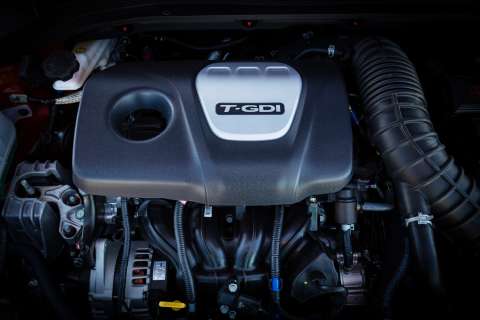 The Gamma 1.6L engine has a twin scroll turbo, outputting 150 kilowatts at 6000 rpm but the strength of the engine is the 265 Nm available between 1500 – 4500 rpm. The test car was fitted with a seven speed DCT or Dual Clutch Transmission, and a manual is also available. The auto exhibits many of the traits that mark a DCT, being creep just off idle, a slight hesitation from standstill before engagement and an exhilarating bang/bang/bang through the gears when the engine’s ability is exploited. Exploit, if you will, but consider around town Hyundai says 9.5L per 100 kilometres from the fifty litre tank for consumption.
Under light throttle, the seven speed auto sometimes dithers, with characteristic DCT prevaricating; press a little harder and the changes sharpen up, with a quicker response. Harder still and changes are slick, more urgent, virtally unnoticed to those inside apart from a flick of the tacho and a crisp “phut, phut” from the twin tip exhaust. There’s an instant answer to any question the right foot asks when underway and that 3000 rpm rev range of torque makes magic on the road.
There’s also magic underneath, with perhaps one of the best handling packages going in the class and price point Hyundai have positioned the Elantra SR Turbo in. It’s taut and crisp, yet forgiving. Tight, yes, yet an astounding amount of compliance without any feeling of isolating the driver from the feedback the chassis offers is felt. You could run over a five cent piece and be able to read what year it was made, such is the tactility of the system. Hit a car park speedbump and the rebound is instant and instantly damped out. On long sweeping corners, the SR Turbo is flat, composed, but will wiggle sideways momentarily when a rippled or broken surface is crossed. That 458 litres of boot space is only slightly compromised by the shift to a proper independent rear end, instead of the normal torsion beam rear, with a space saver spare instead of a full sizer. It’s matched by a well weighted and surprisingly not over assisted steering system, fettled by Australian engineers. There’s plenty of feedback and response from the front, with a direct response to driver input. It’s only in tightening radius corners where a hint of understeer creeps in.
 Warranty wise, Hyundai have given the Elantra SR Turbo the standard five years/unlimited kilometre coverage and if you get your vehicle serviced by Hyundai you’ll be rewarded with ten years free road side assist. The car is also covered by a lifetime capped-price service campaign, with maintenance due every 12 months or 10,000 kilometres, whichever occurs first. The average cost per visit over 60 months/50,000km is just $295.
At The End Of The Drive.
Hyundai has a true winner here thanks to the dashing good looks and Euro style handling the Elantra SR Turbo’s been given. The punch of the engine and the fluidity of the DCT make driving a delight, but they’d come to nought if it weren’t for the Aussie fettled suspension. It’s a looker outside, needs a freshen up inside, has just enough tech to entice and isn’t uncomfortably priced. Check out the link and book yourself a test drive here: 2017 Hyundai Elantra SR Turbo
2016 Holden Insignia VXR: Private Fleet Car Review
 Holden’s manufacturing will cease in 2017 and to ease into the transition period Holden will increase the number of cars it will import. One of those is a true bahn stormer, the potent and stylish (Opel) Holden Insignia VXR V6 turbo, released in 2015.
It’s an eyecatcher, the Insignia VXR. Lithe, curvy, assertive, bigger than it looks at 4830 mm in length, with flanks that have a distinctive scallop and with the test colour coated in a metallic grey-green, it would reflect light at different angles. There’s huge 20 inch diameter grey painted alloys wrapped in Pirelli P-Zero rubber that provide superglue road holding and an outstanding all wheel drive system that transfers torque on demand to where it’s needed and a sophisticated electronic limited slip diff at the rear.  All of these are mated to a sensational twin scroll turbo V6. It’s “just” 2.8L in capacity however delivers 239 kilowatts and an outstanding 435 torques. Both come at 5250 but the engine delivers somewhere around 90 percent of that peak from around 2000. It’s tractable, flexible, unbelievably potent and sees triple digits from a standing start in under six seconds.
 Adding to the firepower is the three mode drive system. You can choose from Touring, Sports, or VXR. Think a small ham and pineapple pizza, a large Supreme, and a family meal with free drinks and delivery thrown in. Touring has a slightly softer ride quality although you’re not left in any doubts as to the potential underneath. Sports firms up the FlexRide suspension and changes the settings in the gearbox, holding gears a little longer and allowing the driver to further explore the ability of the engine. Even the steering firms up, feeling tighter and requiring more effort to move the wheel.
Under normal driving the transmission is fluid if sometimes reticent to change when you feel it should. Stoke the fire and it becomes a totally different beast. Crisp, sharp changes are on tap, matching the rasp from the exhaust as the electronic tacho rises and falls in unison. Select Sport or VXR and the eight inch LCD screen also changes, offering up a range of information and a somewhat gimmicky looking g-force display. You do, though, get a screen where that is minimised and housed inside a silver themed speedomoeter. It’s visually impressive and sharp looking. Inside the Insignia is a welcoming and snug set of seats for the driver and front passenger. You have to lower yourself down into them but once in they’re supportive and wrap around the body. The rear seats are less so and are somewhat compromised in regards to leg room. Thankfully, Opel has fitted the seats with eight way power adjustment and both heating and venting, a godsend in Sydney’s late year variable weather. There’s some chromed trim in the front, which does add some visual class but unfortunately also reflected sunlight directly into the driver’s eyes.
 The dash design itself mirrors that found in Jaguar, with a swooping curve from door to door and around the base of the windscreen. The door grabhandles mirror that design, to a point, but feel somewhat too far back in the door ergonomically. The tiller has a chunky feel to it, with a soft touch texture and houses all of the now commonplace controls, plus has a pair of paddles fitted to the rear. Sadly, the texture here is of a lesser quality than the rest of the cabin. Also a touch questionable is the touch required to adjust the aircon temperature, requiring sometimes a stab or three in order for a finger to register, meaning the eyes aren’t focused on the road. The General’s MyLink system is on board, with DAB radio (bliss) and housed in a clean and uncluttered console. There’s Pandora and phone projection via Apple CarPlay. The voice command system makes for a high technology presence and for safer driving.
 When the Insignia VXR is on the road and everything is warmed up and ready to play, one can be assured assured that a most excellent driving experience is waiting to be delivered. Rolling acceleration is stupendous, ride quality of the 2737 mm wheelbase only jiggly on the most unsettled of surfaces such as the gravel ring road surrounding Sydney Motorsport Park, belying the 35 series profile of the tyres. Otherwise it’s well damped, following undulations and curves as if glued to the road and imparting a feeling of real confidence as you punch out of corners. All this while the electronics work faithfully and unnoticed in the background. What isn’t unnoticed is that powerplant and exhaust. Built in Australia, there’s a leonine roar when pushed, a rumble with a fine metallic edge on idle. You’ll pay at the pump though, with a 70 litre tank only swallowing 98 RON and consumption equivalent to a dockside pub full of workers after Friday knockoff.
To back up the performance capability, there’s Brembo brakes up front and vented & drilled discs brakes. The brakes will haul up the 1800 kilo machine time and again but there’s just a tad too much dead pedal to start with and lacks real feedback. There’s collision avoidance radar, blind spot warnings, adaptive cruise control plus auto emergency braking. Up front, there’s the standard LED driving lights but you’ll get adaptive lighting that adjusts to your speed plus auto high beam on and off.
 Holden offers a standard three year or 100,000 kilometre warranty plus Lifetime Capped Price Servicing to boot. Speaking of boots, there’s a capcious 500 litres available behind the 60/40 splitfold seats. To put that into perspective, that’s more than the Commodore.
 At The End Of The Drive.
The Holden Insignia VXR is a rare beast in that it’s a performance sedan, a big car, not a V8, offers outstanding grip levels and a beautiful ride, all wrapped in a pretty and stylish body. It’s also a car that seems to have slipped under the radar of buyers, with a low recognition level shown by the amount of swivelling heads on pedestrians.  Priced at not much over $50K, it’s a hidden performance bargain and one that would be even more enjoyable if the Insignia was found to be sans a couple of hundred kilos. There’s a high level of tech onboard, unusual at the price point as well, but the real attraction for a driver that thrives on sheer back bending ability is that firecracker engine up front.
For a comprehensive look at the Holden Insignia VXR, go here: Holden Insignia Information

Private Fleet Car Review: 2016 Holden Commodore SS-V Redline
 It’s a quirk of automotive manufacturing that makers leave their best ’til last. Ford recently unveiled their Sprint Falcons, in both turbo six and supercharged V8 guise. In late 2015, Holden released the series 2 update for the VF Commodore range. Not unexpected was the lack of any real change, with minor bodywork and some under the skin electrical modifications.
In the case of the SS-V Redline, the American sourced LS3 6.3L V8 was massaged slightly, with power bumped to 304 kilowatts at 6000 revs, while peak torque of 570 Newton metres arrives at 4400 rpm. Make no mistake, there’s plenty of urge below that number. Fuel consumption finished on 12.1L litres per 100 kilometres, with a solid combination of rural, suburban and highway driving undertaken. Driven gently and with no inclination to bury the welly (to hear that glorious V8 soundtrack), sub 12 litre figures were achieved. The bi-modal exhaust isn’t exceptionally tricky either; a light foot on the go pedal has the car gently burbling around, with a hint of what lurks underneath. Hit it hard, and the valves in the rear open up, emitting a thunder almost as if Thor’s hammer had come alive and spotted some evil it wished to vanquish. It’s deep, sonorous, gutteral and thoroughly bloody intoxicating in tunnels.
Inside, the SS-V remains unchanged, mostly, with the most notable change for trainspotters being slightly amended dash dials. There’s the charcoal coloured seats, complete with pointless fabric inserts down the centre, the same fabric covered slab of a dashboard, balanced by the off white colour of the pillars and sunroof fitted ceiling.
There’s the Holden MyLink navitainment system with Pandora and Stitcher apps, a Bose sound system with pretty decent quality (some high end audio makers just don’t sound right in some cars) and a sub menu to adjust settings, including the exhaust baffles for the bi-modal exhaust, allowing Aunty Mavis to tiptoe around town or utter a feral roar when the right slipper goes down. It’s underneath where the changes you feel but can’t see have been made. The car was fitted with 19 inch black painted alloys, with different width Bridgestone tyres front (235/40) to rear (275/35). Yes, that’s monstrous grip, but those tyres would come to naught unless the suspension worked hand in hand with them.
 The ride quality is superb. Low profile tyres on big wheels on an Aussie car normally spell three nights prone on a hospital bed with a sore back, however you’d be well and truly forgiven you were piloting a luxury German speed wagon.
Small bumps are flattened, larger ones smoothed, ripples and undulating roads are communicated to you with an air of indifference, as if the car has sniffed and said “I suppose I should tell you…”.
The steering ratio allows for fingertip precision and the power assistance allows for fingertip guidance, such is the balance and feedback.
 The size of the car certainly helps in the spread of weight across track and wheelbase (1593/1590 mm front/rear and 2915 mm) with the fluidity and stableness of the chassis making it an absolute delight and simple enough to drive around town for anyone with a license. Yep, even Aunty Mavis could drive it.
 It’s helped by that silky smooth torque delivery, delivered to the ground via a paddle shift equipped six speed auto. It’s a shame that the SS-V won’t see anything like a seven or eight speed auto before local manufacturing wraps up in late 2017. Under light throttle it slips through the ratios gently and without fuss, barely noticeable in all truth. Harder going simply changes the speed at which the next ratio is seen, with the same smoothness in change, accompanied by the flick ofthe tacho needle.
 There’s more safety equipment than before, so Aunty Mavis can be told of oncoming traffic from behind, with blind spot monitoring. Should her attention (and car) wander, Lane Departure Warning will bring her back to the straight and narrow, and if it’s raining there’s Remote Engine Start to get things warmed up inside. She can reverse safely thanks to the standard camera, or leave it all up to the car due to the auto parking system on board.
Parking sensors front and rear will let her know if the wall is too close and if she’s of the mind to look straight ahead, the HUD (head up display) will tell her what speed she’s doing, how many revs and even how much G-Force she’s getting through the long sweeping turns or tight corners the SS-V will do without so much as a blink. Traction Control and Stability Control programs are standard, just in case Aunty Mavis wants to get a bit frisky and see if she can match the sub five second time to 100 kmh that Holden quote for the 1800+ kilo machine.
If she’s nervous about her speed, the Brembo brakes (four piston callipers front and rear)will haul her and the SS-V down to manageable speeds safely, smoothly, and efficiently time and again, with the brake pedal telling her she’s got bite and plenty of it as soon as she lays the slipper on it. For the fashion conscious, Holden have fitted working bonnet vents into the aluminum bonnet; which although lightweight, did flap around somewhat on certain road surfaces. There’s a decent sized rear wing, at just the right height to block out, in the rear vision mirror, any following cars ergo plates and indicators. The VF2 update gave the car reprofiled bumpers front and rear as well.
 At just over 60K for the manual, with an extra 2K for the slushbox, people will question that ask for “just a Commodore”, yet the SS-V really is a greater car than the sum of its parts. It’s a big car, yes, (4964 mm in length, 1898 mm wide and stands 1474 mm tall) and offers rear seat passengers 1009 mm of legroom, plus a cargo volume of 495 litres. Weight is over 1800 kilograms, making the ride quality even more amazing to consider.
 Bearing in mind the donor car, built and engineered to deal with a wide variety of Australian road conditions, from flat tarmac to ripped up surfaces, from gravel to turf, the end result has provided possibly the best hi-po Holden badged car Australia has seen. It’s quick, it’s comfortable, it’s poised, it has a brutal personality when pushed yet is as dainty around town as Aunty Mavis needs it to be.
At The End of The Drive.
It’ll sip like a baby from a cup or drink like a sailor on their first night of shore leave but it’s never anything less than a truly brilliant car to drive and a startlingly sad reminder of what Australian car manufacturers could deliver. The Holden Commodore SS-V Redline is a true Australian muscle car.
Factor in a nine month/15000 kilometre service cycle and capped price servicing and there’s numbers Aunty Mavis can live with.
Head to Holden SS range 2016 for details and download a brochure.
 Level 2, 9 Help Street