

Buy A New Car
Get away from it all with the Ford Escape.
Ford’s forthcoming Escape brings that nameplate full circle, replacing the Kuga which replaced the Escape. It’s part of Ford’s global naming strategy but also brings a kit bag full of technology. Here’s the lowdown on the 2017 Escape. When compared with the current Ford Kuga model, the Escape will have a sharper recommended Manufacturer’s List Price (‘MLP’) of $28,490* for the entry level model, a new front-wheel drive 1.5-litre Trend model further heightening appeal. The Escape range offers families a suite of advanced Driver Assist Technologies (DAT). Seven airbags, Dynamic Stability Control, Rollover Mitigation, Reverse Camera and sensors will be standard on every Escape. SYNC® 3^ – Ford’s all-new communications and entertainment system – featuring faster performance, intuitive smartphone-like full-colour touchscreen with Apple CarPlay#, Android Auto# compatibility and embedded sat-nav is standard across the range.Key changes for Escape over the Ford Kuga include:
- Refreshed design inside and out for a distinctive look.
- Improved specification including paddle-shifters on auto Escape, building on the fun-to-drive ethos.
- Improved fuel economy for 2.0-litre models thanks to automatic start/stop as standard, reducing running costs.
- New FWD 1.5-litre Escape Trend fills the gap in Ford’s line-up, providing a variant that almost one-third of customers in this segment choose.
- Sharper starting MLP of $28,490.


The new Escape features Ford’s latest design language for a bold and sporty look that is shared with fellow Ford SUVs, including the global Ford Edge. A large upper trapezoidal two-bar grille and a smaller lower grille are flanked by sleek new headlamps incorporating Daytime Running Lights, complemented by stylish fog lamps.
Restyled taillights complete the sporty look, while a new range of 18- and 19-inch alloy wheel designs will appear on Trend and Titanium models. Two new colours, White Platinum (tri-coat) and Copper Pulse, will be offered throughout the range.
The Escape’s sculpted bonnet features a wider, uninterrupted central dome that not only serves to complement its sporty new looks, but also incorporates a structural design that more closely controls deformability and flexibility of the bonnet, developed to improve pedestrian protection in an accident. The bonnet and rear liftgate also have been re-engineered to help mitigate damage to more expensive-to-replace components following a collision.
The meticulously crafted interior has seen an upgrade in tactile quality, fit and finish, and has been refined to offer a more ergonomic, stylish and comfortable experience for occupants. The steering wheel and air-conditioning controls are even more intuitive, and feature fewer and more distinguishable buttons and switches, making the Escape’s cabin features easier to recognise and navigate. All automatic Escape models will feature paddle-shift functionality that enables drivers to manually select gears, adding to its fun-to-drive ethos. 
New convenience features also make Escape even more user-friendly; an electronic parking brake is effortless to operate and frees room for improved storage in the centre console. The second-row stadium seating boasts family-friendly packaging, with rear tray tables on the Titanium, as well as ISOFIX anchorage-points and rear air-vents on all models. It also offers up to 1603 litres of convenient cargo space with the stadium seating folded.
The Escape Trend is available with an optional Hands-Free Power Tailgate with Smart Keyless Entry that can be opened or closed with a swing of the foot beneath the rear bumper. The technology helps parents to easily access the new Escape’s boot when returning to their vehicle with shopping, pushchairs or toddlers. 
More equipment for less, with SYNC 3^ standard on all Escapes
The new Ford Escape will allow drivers to control audio, navigation and other functions plus connected smartphones using simple, more conversational voice commands with Ford’s new SYNC 3^ connectivity system. Ford has drawn on more than 22,000 comments and insights gained from research clinics and surveys to ensure the most customer-centric system to date.
By pushing a button and saying “I need a coffee,” Escape drivers can find nearby cafés, for instance, while simple voice commands can also guide them to petrol stations or car parks, train stations, airports and hotels. The system then guides the driver to the selected destination via the embedded navigation that’s standard across the Escape range. Voice search results are also enhanced by a better understanding of how consumers refer to businesses and points of interest. Drivers don’t have to know an exact name. They can search for “Sydney Airport” rather than using the official name “Sir Charles Kingsford Smith International Airport.” To finding a specific address, they can say, “Seventeen Thirty-five Sydney Road” instead of “One Seven Three Five Sydney Road.”
Escape drivers can operate SYNC® 3’’s 8.0-inch touchscreen – the largest in this class – in the same way that they use their smartphones. A new interface features larger, easier to operate buttons and enables pinch and swipe gestures for the first time.
Apple iPhone users can activate Apple CarPlay, the smarter, safer way to use your iPhone in the Escape, allowing drivers to make phone calls, access music, send and receive messages, obtain directions optimised for traffic conditions and more while they stay focused on the road. Android users can activate Android Auto.
Android Auto makes apps and services that drivers already know and love accessible in safer and seamless ways, including Google Search, Google Maps and Google Play.
SYNC 3 also delivers SYNC AppLink+ for customers, enabling voice-activation from the driver’s seat of a range of smartphone apps that now includes Spotify, AccuWeather and Pandora+.
Enhanced Driver Assist Technology
The latest Ford technologies and sophisticated body engineering help drivers see more clearly and enhance safety on the road for new Escape occupants and other road users.
Ford’s Adaptive Front Lighting System is available for the Escape and monitors ambient light conditions, automatically optimising visibility by adjusting the beam angle of the new bi-xenon headlights depending on the vehicle’s speed, steering angle and distance to an object in front. It features anti-glare capability, as well as country road, city street and also maneuvering beam-shaping abilities.
The Escape also offers advanced Ford Driver Assist Technologies, including an enhanced version of Ford’s optional Active City Stop collision avoidance system, which now operates at speeds of up to 50km/h, increased from 30km/h. Active City Stop uses sensors at the front of the vehicle to look for objects in the road ahead. If the system detects that the vehicle is approaching an object too quickly it pre-charges the brakes. If the driver still does not respond, the system reduces engine torque and automatically applies the brakes to help reduce the impact of collisions, or avoid them altogether.
Sophisticated technology for simpler parking
The new Ford Escape will make driving and parking simpler for customers. New Perpendicular Parking functionality enhances the semi-autonomous Active Park Assist technology. Using additional ultrasonic sensors, Perpendicular Parking at the push of a button helps enable drivers to locate parking spaces alongside other cars as well as parallel to the road, and steers the vehicle into them while the driver controls the accelerator and brake.
Driver Assistance Technology and features that further help new Escape drivers include:
- Cross Traffic Alert, which warns drivers reversing out of a parking space of vehicles detected that may soon be crossing behind them.
- Park-Out Assist that helps drivers as they exit a parallel parking space.
- Adaptive Cruise Control with Collision Warning and Brake Support, which is designed to detect a slow-moving vehicle in certain circumstances and adjust vehicle speed accordingly.
- Ford Intelligent All-Wheel Drive to optimise handling and traction.
- A Driver Alert System that’s designed to detect certain signs of fatigue and provides a warning in the instrument cluster.
- Torque Vectoring Control, which assists traction and cornering stability.
New Escape Trend
The Escape will introduce a fresh key model to the segment from Ford: the new front-wheel drive 1.5-litre Escape Trend. Capitalising on consumer demand for a high level of equipment, safety and technology in a family-friendly package with low fuel consumption, the Escape Trend comes with the proven 1.5-litre EcoBoost four-cylinder with start/stop technology as standard. This enables the Escape Trend to achieve an official 7.2L/100km1fuel economy figure while delivering a fun-to-drive 134kW/240Nm power and torque.
Driver engagement is further heightened with paddle-shifters on automatic models, in addition to 18-inch alloys, full-colour reversing camera via the 8.0-inch SYNC 3 touchscreen as well as sat-nav. Sat-nav is standard across the entire Escape range. The Trend also adds convenient features including privacy glass to keep its rear-seat occupants cool, automatic headlights and windscreen wipers.
The Escape Trend also offers an array of sophisticated options that aren’t offered by key rivals on mid-spec models. These include a Hands-free Power Tailgate with Smart Keyless Entry, and a Technology Pack that boasts features available only on competitor’s flagship models.
The revitalised line-up sees the family-friendly new Escape offered in a broader variety of models, reflecting the fragmentation of the SUV market in Australia, and Ford’s more than doubling of its SUV range since 2012.
The Escape joins the growing family of Ford SUVS, including the EcoSport and the locally-engineered, award-winning Everest in Ford dealerships, capitalising on Ford’s SUV heritage and expertise. In 2017, Ford will launch a five-seat Everest to further broaden its SUV range, capitalising on the $2 billion local investment over the past six years and ongoing innovation at Ford’s You Yangs, Victoria, Proving Ground as a hub for Asia-Pacific engineering and global development.
The New Ford Escape: model-by-model
New Ford Escape Ambiente
1.5L FWD 6-speed manual MLP $28,490
1.5L FWD 6-speed automatic MLP $29,990
1.5L AWD 6-speed automatic MLP $32,990
Standard Features
- SYNC® 3 with 8.0-inch capacitive touchscreen, Apple CarPlay and Android Auto
- Embedded satellite-navigation with Traffic Management Control (TMC)
- Dual-zone climate control with rear air vents
- AM/FM/DAB+ radio, six-speaker audio with USB input, Bluetooth streaming
- Reverse Camera and rear parking sensors
- Cruise Control with speed limiter
- Daytime running-lights
- Push-button start
- Front and rear fog-lamps
- Electronic Parking Brake
- SYNC® Emergency Assist
- Ford MyKey
New Ford Escape Trend
1.5L EcoBoost FWD 6-speed automatic MLP $32,990
2.0L EcoBoost AWD 6-speed automatic MLP $35,990
2.0L TDCi AWD 6-speed automatic MLP $38,490
Standard Features
As per Ambiente, plus:
- 18-inch alloy wheels
- Roof-rails in silver finish
- Privacy Glass
- Automatic rain-sensing windscreen wipers
- Automatic-dimming rear-vision mirror
- Automatic on/off headlights
- Follow-me home lighting
- Leather-wrap gear lever
New Ford Escape Titanium
2.0L EcoBoost AWD 6-speed automatic MLP $44,990
2.0L TDCi AWD 6-speed automatic MLP $47,490
Standard Features
As per Trend, plus:
- 19-inch alloy wheels
- Smart Keyless Entry
- Power folding mirrors with approach light Bi-Xenon HID headlights with auto levelling
- LED Daytime-running lights
- Adaptive Beam Shape and Dynamic bending headlights
- Leather upholstery
- Heated front-seating
- 10-way power-adjustable Driver’s seat
- Front parking sensors
- Enhanced Active Park Assist
- Panoramic glass roof
- Front and rear velour floor mats
- Hands-free power tailgate
- Multi-colour ambient lighting
- LED tail lights
- Nine-speaker audio
New Ford Escape: powertrains
1.5L (six-speed manual)
110kW@ 6000rpm
240Nm@ 1600-5000rpm
6.3L/100km (FWD)
Towing capacity: 1500(FWD); 1600kg (AWD)
1.5L (six-speed paddle-shift automatic)
134kW@ 6000rpm
240Nm@ 1600-5000rpm
7.2L/100km (FWD)
7.5L/100km (AWD)
Towing capacity: 1500kg in front wheel drive (FWD); 1600kg in all wheel drive (AWD)
2.0L (six-speed paddle-shift automatic)
178kW@ 5500rpm
345Nm@ 2000-4500rpm
8.6L/100km 1
Towing capacity: 1600kg
2.0L Diesel (six-speed paddle-shift automatic)
132kW@ 3500rpm
400Nm@ 2000-2500rpm
5.5L/100km (Trend)
Towing capacity: 1800kg
(With thanks to Ford Australia).
Toyota Ups The Safety For Corolla.
Toyota has further boosted the safety technology for its Corolla hatch with three new leading-edge technologies available across the range.
The package – pre-collision safety system with forward collision warning and autonomous emergency braking, lane departure alert and automatic high beam – is now standard equipment on the top-of-the range $30,0201 ZR hatch.
The pre-collision safety system, autonomous emergency braking, lane departure alert and automatic high beam are driver assist features only and should not be used as a substitute for safe driving practices. The driver remains responsible at all times for safe driving.
Designed to help the driver prevent or mitigate collisions in a wide range of traffic situations, this package is also available as a $7501 option on the other hatch grades, Ascent, Ascent Sport, SX and Hybrid.
The arrival of advanced safety features bring the Corolla hatch into line with its sedan sibling, which benefited from a recently introduced upgrade.
Corolla, which celebrates 50 years on the Australian market in 2017, has been Australia’s best-selling passenger car for the past four years and is the world’s best-selling nameplate.
Toyota’s pre-collision safety system relies on a windscreen-mounted camera and LIDAR (light detection and ranging) sensor to identify and calculate the distance to vehicles ahead.
When it detects an impact risk, it triggers audible and visual warnings and primes the brakes for extra stopping force. If the driver doesn’t take action, the system initiates autonomous emergency braking2 to reduce the vehicle’s closing speed.
Lane departure alert also uses the camera and LIDAR sensor to identify lane markings and trigger warnings. The system alerts the driver if the car begins to deviate from its lane without the turn signal being operated. LDA-equipped vehicles have a specific function button on the steering wheel.
Automatic high beam for the headlights detects when there is on-coming traffic or vehicles ahead and automatically switches between high and low beam for maximum illumination and vision in night-time driving.
Standard safety features across the Corolla Hatch range include seven airbags, whiplash-injury lessening front seats, vehicle stability and traction control, electronic brake-force distribution, brake assist and reversing camera.
Corolla hatches are offered with a petrol engine and the choice of six-speed manual gearbox or seven-speed sequential-shift continuously variable transmission (CVT), and as a petrol-electric hybrid with all-gear CVT.
Ascent and Ascent Sport grades are offered with both transmissions; SX and ZR has the automatic CVT exclusively. The manual SX grade has been discontinued.
Petrol hatch offers 103kW of power and 173Nm of torque from its 1.8-litre dual VVT-i engine, with combined-cycle fuel economy of 6.1 litres/100km3 for CVT models and 6.7 litres/100km3 for manual models.
Corolla Hybrid has maximum combined output from its two power sources of 100kW and combined-cycle economy of 4.1 litres/100km. Naturally, these figures will depend on your driving style and depends on driving conditions.
The Corolla hatch range is covered by Toyota Service Advantage capped-price servicing at $140 per service. This is the maximum payable for standard scheduled logbook servicing (normal operating conditions) until first of 3 years or 60,000km (whichever occurs first) (up to the first 6 services). Excludes Government & Rental vehicles. Contact your Toyota Dealer or go to toyota.com.au/advantage for other exclusions, eligibility and full details.
COROLLA HATCH PRICES (Not including government and deal charges, are manufacturer’s list price)
Ascent (manual): $20,190
Ascent Sport (manual): $21,210
SX (CVT): $26,000
ZR (CVT): $30,020
Options:
CVT (Ascent, Ascent Sport): $2,040
Safety pack (all except ZR): $750
Satellite navigation (Ascent Sport): $1,000
Panoramic roof (ZR): $1,530
Premium paint: $450
(With thanks to Toyota)
2017 Holden Colorado LTZ: A Private Fleet Car Review.
As Holden, the Australian arm of global giant General Motors, winds down in respect to local manufacturing, there’ll be a simultaneous increase in the vehicles being sourced from outside the island continent. The Colorado, a name with a definitive nod to the Americas, is and has been for some years, one of those vehicles. There’s a three model range, built around the cab chassis, space cab and crew cab, with various trim levels and a mix of two and four wheel drive. We normally spends a week with a car, however due to the Christmas break for 2016, had the Holden Colorado LTZ with 2.8L Duramax diesel for just under three. This included a return trip to the cheese capital of south eastern Australia, Bega, via both the coastal and inland routes.
Immediately noticeable is the sheer size of the Colorado; at five point three metres long, it offers plenty of leg room for humans in both front and rear cabin sections (1072 mm front, 872 mm in the rear) thanks to a huge 3096 mm wheelbase and 1800 mm overall height, enough shoulder room for three adults in reasonable comfort in the rear with 1472 mm, and a good sized tray complete with a simple to operate tonneau cover. The test car was coated in dirt and scratch highlighting metallic black. A redesigned front end graces the 2017 spec models, removing the droopy eye look that tied the Colorado to the Malibu and, to a lesser extent, the Commodore. A smaller headlight cluster raises the nose visually, with the heavier two bar grille also replaced with a simpler, slimmer, and more elegant design. Slimline LED daytime running lights complete the picture. From the rear and in profile, there’s little to differentiate between this and the previous, excepting the sensors front and rear.
 Inside, it’s a mix of standard Holden switchgear, reasonably comfortable seats (the powered fronts could use more side support and can be optioned for heating in the LTZ but, stupidly, not cooling), some questionable locations for a couple of essential pull tabs, an eight inch MyLink touchscreen (models below have seven inches) of good design with Android and Apple Carplay, a multifunction monochrome driver’s display, and, surprisingly, a forward collision alert system. Holden’s website says there’s DAB fitted as well. Rear seat passengers get their own 12V socket and you can count on Bluetooth streaming for sounds. There’s even pressure equalising windows, in that they drop automatically when you open the door and raise by themselves when closing.
 Up front is the Isuzu sourced 2.8 litre Duramax diesel, coupled to a wide ratio six speed auto and electronic four wheel drive system. That’s operated via a centre console mounted dial. When bolted to the auto, there’s a peak torque figure of 500. That’s reduced to 440 Nm when the six speed manual is added in and both figures come in at just 2000 rpm. Peak power is a healthy 147 kilowatts and that’s at 3600 revs.
 After something close to 1700 kilometres of driving, the economy was 8.8 litres of dinosaur juice being consumed for every 100 kilometres covered, with Holden quoting one litre below that for the combined cycle from the 76 litre tank. That’s some good figures to look at, given the 2100+ kg weight of the LTZ before you insert people and cargo.
The engine itself, in highway cruise mode, was barely audible, with a light throttle bringing in a light chatter. Under acceleration from stand still, or for overtaking, then that chatter became a cacophony. Those wide ratios don’t make for easy overtaking quickly, with the long sweeping or straight country highway sections needing a fair measure of forward planning. If you’re towing (up to 3500 kilos) or have loaded the tray (1000 kilograms), you can expect more load noise and, naturally, a higher consumption figure
Adding to the occasional pucker factor of passing was the lack of real brake feel. There’s discs up front, drums at the rear, and a pedal that failed to instill confidence due to the lack of bite and comparative need for long travel. The all surface tyres, with a high sidewall, were grippy enough on dry tarmac and wet river sand, but also didn’t feel confident on wet tarmac, particularly in one emergency stop situation. The Colorado was taken through a short stretch of river to test both the four wheel drive and the wading depth capability of 600 mm. With a simple wrist flick, the dial is moved from 2WD to 4WD, and it’s noticeable in the drive train immediately. Eased into the softer shore sand than then gently but consistently run, the two combined to cover the twenty or so metres easily, with the 28 and 22 degree approach and departure angles allowing ease of entry and exit.
Match this up against a vastly improved ride quality, however, and the Colorado delights. Gone is the twitchy, jiggly ride, replaced by a firmer yet still compliant handling package, thanks to re-rated leaf springs at the rear and a nicely tuned double wishbone front. The 265/60/18 rubber from Bridgestone adds to the comfortable flow the vehicle has. Yes, it’s a touch floaty over the rear yet even that was easily controlled thanks to the addition of luggage. On the sweeping curves of the highway south of Narooma, and on the picturesque Snowy Mountains Highway, this extra stability became evident and allowed for more finesse to be applied to the driving style. On downhill runs, a system called Grade Braking comes into play, dropping the gearbox down a ratio or two, and it becomes a fine mix between the foot playing the brake pedal and accelerator.
Handling is predictable, with a well weighted steering set up. Although somewhat vague on centre, it does tighten up considerably and provides good feedback to the driver. It’s not a system that likes being hustled though, preferring the driver to communicate a direction change gently but will begrudgingly accede to a sudden change of direction request.  Once you’ve had some time behind the wheel, you’ll get a feel for how the system responds to your input and will be able to judge for yourself just how communicative it can be when required. Turning circle is a smaller than expected 12.3 metres. Acceleration is the same. Although there’s more than an abundance of torque, the ratios in the ‘box don’t translate to rapidity off the line, but will give some urge mid range at highway speeds. Ideal for long overtakes on a country road, for example.
 Naturally you’ll get Holden’s standard three year/100,000 kilometre warranty, plus lifetime capped servicing, 12 months roadside assist and Holden’s new 24 Hour test service when you’re in the market for a new car such as the Colorado.
At The End Of The Drive.
The Colorado has tough competition in the form of Ranger, Navara, Triton, and Toyota’s seemingly unstoppable HiLux. Looks are well and truly in the eye of the beholder and the 2017 Colorado’s facelift brings it back into play over the previous model, in our opinion. The onboard range of features and tech, the carlike ride quality, and the roomy interior bring the vehicle well and truly into the ring. The Colorado is now a stand-up contender in the family four door ute stakes.
Go here for further information on the 2017 Holden Colorado range
2017 Volvo V40 D4 Inscription Polestar Enhanced: Private Fleet Car Review.
 Volvo are advertising that they one of the fastest growing luxury car makers. There is no doubt at all that they are well and truly on the march upwards when it comes to their luxury aspirations and they’re also bringing along their Polestar compatriots for the ride. But how does the Volvo V40 D4 Inscription with Polestar enhancements work?
When one thinks of a luxury car, they’ll think of features, comfort, and perhaps the word “cossetting”. They may even tie that word to the ride quality and handling, where one may “waft” along, with the road seemingly endlessly flat and without bumps.
This is not what the V40 D4 Inscription Polestar Enhanced delivers. It rides on wonderful looking 19 inch alloys, shod with superb Pirelli 235/35 rubber. Herein lies the problem. 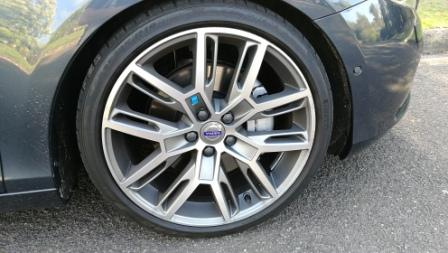 Combine ultra low profile tyres with sporting suspension (Polestar adds bespoke coils and shocks) and the result is a rock hard ride that magnifies every crevice and expands every pebble. Harsh is one word that can be used. Comfort can not, nor can cossetting. Then there’s the steering rack ratio; it’s en pointe when out on the road, but try a three point turn and it feels as if there’s something blocking the rack either side.
Outside it’s nearly standard V40, a five door hatch and a reasonable 4369 mm long, bar the Polestar supplied alloys and two winglets mounted just where the hatch’s hinge is. There’s Volvo’s signature “Hammer of Thor” headlights, a nicely sculpted profile, dual exhausts sitting under a sharply sloped rear and bracketed by two tail light structures that will catch the eye of following motorists.
 The car itself was painted in a metallic grey, a colour that melded perfectly into the roads around Sydney during storms. Volvo fit a Polestar diffuser at the rear, the alloys and roof spoilers, and go gloss black with the wing mirror covers.
Under the pedestrian friendly snout lies Volvo’s diesel 2.0L four, with 140 kilowatts and a stonking 400 torques on tap. That’s available from 1750 through to 2500 revs and there’s plenty available once you pass the higher number. Although it hesitates for a moment for the engine to spin around to 2000 and beyond, it comes on strongly enough below 1750 for the front driven wheels to imitate a canary.  Once the traction control steps in, the front Pirellis hook up and then allow the eight speed Geartronic auto to do its thing, and do its thing it does nicely. Those eight speeds contribute to the claimed 4.5L/100 kilometres (combined) from the generous 62 litre tank; A Wheel Thing saw a best of 6.2 in mainly residential style driving. They’ll also whisk you to 100 kph in just over seven seconds on the way to a claimed top speed of 210. Emissions? 118g/kilometre.
Light throttle input has the setup slurring through, albeit with more than a hint of change. Crack the throttle and there’s some decent acceleration, a muted diesel thrum from the front and the LCD screen flicks away with a smoother change underneath. Silky smooth it is and allows the driver to pick and choose also, thanks to paddle shifts and the Sports mode manual change. Good? And then some. It really is one of the better changers out there, especially dealing with a torquey 2.0L diesel.
Inside it’s standard looking V40, complete with floating centre console, the LCD dash, leather covered seats (lacking cooling but had heating), storage trays to the left and right of the rear seats, a somewhat tightish rear leg room thanks to the compact dimensions of the V40, with Polestar adding the door sills, gear knob and sports pedals to the interior. 
 Although it’s a comfortable enough environment, it is starting to show its age. Also, the multitude of buttons on the console coupled with the screen’s layout are fading as an area of attraction. The cargo space at 324 litres (smaller than Golf, A3, and A Class) barely coped with a week’s shop but there is the ever present folding rear seats.
 Airbags? Seven, sir, including kneebag for the driver. Other safety? Emergency brake lights, sir, with hazard flash. Anything else? Auto headlights and auto wipers, sir, plus reverse camera and parking assist. Bendy headlights? Does Sir NEED to ask?
 It’s typical safety first with the V40, with a bewildering array of acronyms stating the comprehensive list of features on board. DSTC, WHIPS, EBA and EBD are in there or, in longer form: Dynamic Stability & Traction Control, WHIplash Protection System, Electronic Brake Assist and Electronic Brake Distribution. There’s also fitted to the test car the Driver Support Pack and Convenience Pack, comprising BLIS, DAS, ACCCW, VGA, Keyless Entry and Drive with PCC. Confused? BLind spot Information System, Driver Alert System, Adaptive Cruise Control with Collision Warning, Volvo Guard Alarm, and Personal Car Communicator. Got it? Good. The Convenience Pack also incldes the heated seats (but no cooling for hot markets like Australia) and comes at a cost of $1500, on top of the $4K for the Driver Spport Pack. The Polsetar Performance Pack is a lick under $10K, taking the list priced car as tested from $44990 to $60472.50.
Being a diesel, the mid range pull of the D4 is stupendous. At freeway speeds, the tacho on the LED screen is showing around 1600 revs, just below peak torque. “Sink the slipper” and you’ll see the revs climb right along with the numbers that spell “license losing”, very quickly. The chassis is fitted with anti-dive and anti-squat componentry and my, don’t they work well! It’s flat on the road, flat enough to make a pancake stop and doff a hat in admiration. Although heavily weighted at low speeds, the steering talks back to you, answering the questions you put to it and responds adroitly at speed. Together the chassis and engine deliver a totally dynamic package.
At The End Of The Drive.
Bar the dating interior and lack of turning circle, there’s not a lot to dislike in the Volvo V40 D4 Inscription with Polestar’s extras. Except the ride. Compliance is not a word that that sits inside this car’s dictionary and when you can count how many ripples there are on the face of a coin you’ve just run over, then the luxury part of the equation is missing.
The range starts from $36k and with this test car asking $60K, a fair ask, it’s a fair question to ask, this one: is it worth it? If you like a hard ride, a smallish cargo area, but need something that pulls like a train, then this is your car. Here is where you can find more information:http://www.volvocars.com/au/cars/new-models/v40
 Level 2, 9 Help Street