

Buy A New Car
2016 Kia Carnival Platinum petrol: Private Fleet Car Review.
The people mover…movement…is alive and well here in Australia. Kia’s Carnival has been part of it for some time and the current model that stems from 2015 is regarded as one of the best around. Private Fleet takes on the Kia Carnival Platinum petrol engined edition. Kia’s design team have done the remarkable; they have taken a box and made it not only attractive, but pretty. Although it looks like a box with a snout in profile, there’s enough subtle curves to have you thinking it’s smooth, rounded, not fat and edgy.
 The design of the tail lights goes a long way to helping that perception, with gently smoothed off edges, the now familiar neon light look at night that Kia has for them, plus the swooping eagle eye headlight and LED driving lights (which give a seriously bad arsed impression from a distance), with the Platinum getting halogen glode lights in each front corner.
 Kia’s pulled out the stops with the tech; on the keyfob and in two other locations, there’s buttons for there’s remote powered sliding doors. Yes, powered sliding doors. In an overhead position in the cockpit, ala an aircraft, and in the column where the leading edge of the doors meet the cabin are where the buttons lay and they genuinely make entry and exit so much easier. There did appear to be a glitch, in that when the doors were opening before the car started, they would then close upon ignition being engaged. It goes without saying that the rear door is also powered.
 Driving wise there’s Blind Spot Detection, Forward Collision Avoidance, Lane Departure Warning System, Lane Change Assist, Rear Cross Traffic Alert, Hill Start Assist Control plus there’s LED cabin lighting, Blutooth music streaming, Smart Cruise Control, DVD player (dash only, oddly, as there’s no glass roof to stop a roof mounted screen) and tri-zone aircon, with the front being dual and with separate controls for the rest of the vehicle. Toss in a 360 degree camera system and an LED rear cabin light that doubles as a torch and it’s clear just how smartly thought out this family oriented vehicle is.
 Motorvation comes from Kia’s 3.3L V6 petrol. It’s a pokey beast, with 206 kilowatts at 6000 revs but peak torque of 336 Nm is at 5200 rpm. Although the engine has torque aplenty below in order to get the two tonne machine up and running, it also means that consumption suffers because of the need for a heavier than neccessary right foot. Consumption around town is a tick below 16 litres of dino juice per 100 kilometres from the huge 80L tank…Consider, as well, a 2000 kilogram towing capacity.
 Kia fitted 19 inch chrome plated alloys, which complemented the deep metallic black paint on the test vehicle ideally, with 235/55 rubber. Although seemingly a lowish profile, there was enough give in the sidewalls and a touch of extra compliance in the suspension to provide a welcomed plush ride. Body roll was negligible and there was more than enough grip but a touch of understeer in turns, perhaps more to do with the steering rack ratio. On certain road bumps that provide an ideal suspension test, the Carnival refused to bottom out and pogoed only briefly before settling and continuing to waft along.
There’s enough grunt through the front wheels for the Carnival to “chirp” when vigourously launched, even on dry tarmac. Bearing mind its weight, there’s plenty of stopping power, too, with 320 mm vented discs up front and 324 mm solids at the rear. The overall feel of the braking system is fantastic, with plenty of feel and a beautifully weighted pedal, shading its sibling, the Sorento Platinum. Acceleration with a full load? Not leisurely but not rapid and watch the tank drain if you continually fang it.
 Sitting on a massive 3060 mm wheelbase, it comes as no surprise that there’s more than enough interior room. It’s a full house eight seater, with tilt and slide centre and second row rear seats. Cargo is considerable; even with all seats up there’s 960 L and 2220 L with the third row folded. Kia says there’s a mammoth 4022 litres with the rear seats folded and the centre row centre section removed.
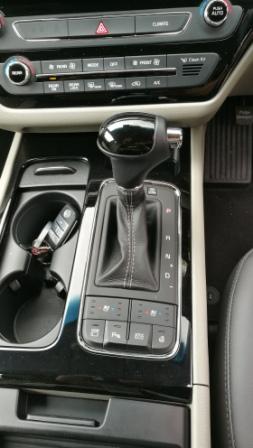
 Staying with the interior, it’s the high quality we’ve come to expect from Korea, with a pleasing colour mix inside of grey over beige, subtle variations in the texture of the plastics, 3 USB and 12V sockets, a seven inch colour dash display with mechanical dials, drink holders aplenty (ten!! cups and four bottles) although, oddly, a cooling vent in the glovebox but not, logically, in the uppermost storage which was big enough to hold a one litre or so bottle.
There was a huge centre console storage locker as well, which also could have been fitted with cooling. There’s eight way power adjustment for the driver and passenger seats, heating and ventilation (yay!!) PLUS a heated steering wheel…unfortunately, the insert in the wheel itself holds heat from the sun so driving gloves may be an option in some parts of Australia.
Satnav and infotainment is accessed via an eight inch touchscreen; the system itself is user friendly and includes adjustments for the sound system. This one sounded far better than the diesel Carnival reviewed twelve months ago.
At The End Of The Drive.
The Kia Carnival Platinum tested was priced at $63304 driveaway, with the metallic paint paint a $695 option. The range starts at just over $45700. As an option to SUV’s, it stands up admirably. In fact, it is, perhaps, the most complete family car that isn’t a SUV that you can buy. Given the Carnival won drive.com.au’s 2015 People Mover of the Year and has garnered accolades here and overseas, combined with the driving experience, the look and feel, the feature list, the incredibly flexible and capacious interior, and Kia’s unrivalled seven year warranty, put the Carnival Platinum firmly into your list of cars to consider.
Go here: Kia Carnival range for your information on the brilliant alternative to SUV’s.
2016 Peugeot 508 Active: Private Fleet Car Review.
It was a chalk and cheese moment to hop out of the razor sharp 308 GTi five door hatch and drop into the four door saloon that is the 508 Active. Here’s why. It’s a big car, the 508, at 4830 mm long. However, the wheelbase isn’t that much bigger, at 2817 mm (the GTi is 2620) meaning there’s a bit of overhang. It’s powered by a four cylinder turboed petrol, with 121 kW and 240 Nm of torque. The Active weighs 1410 kilos, meaning the torque is already up against it in regards to moving the 508. The six speed auto is ok, it’s not the smoothest nor the roughest auto around. Using the paddle shifts to have it drop down a gear during hill descents was required, as the transmissions held third or fourth without human intervention.
 The 508 also suffers from an accelerator pedal that feels as if nothing happens for the first inch or so of downwards travel and then suddenly enages all of the kilowatts available, rather than smoothly counting by the numbers. It has the disconcerting effect of lurching the 508 forward with an appreciable time frame between pressing and motion also apparent. When paused at an intersection this can make all the difference between a safe passage and a pucker moment.
  There’s Stop/Start tech on board, with the button to disable this in the 508 oddly hidden in the driver’s right knee area…Actual acceleration is smooth once over that hump, with a linear delivery as the 508 sees the ton in 8.9 seconds. For all that, you’ll expect consumption of under 5.0 litres per 100 km for the highway from the large 72L tank. Around town, Peugeot quotes 7.5L/100 km.
 The brakes have nowhere near the grip expected nor does the pedal have the response. Again, there’s appreciable travel before any sense of bite exists and retardation begins. Even the steering is numb and wooly, with a less than communicative feel to it. The 508’s nose consistently ran wide in T-Junction turns, indicating the ratio for steering isn’t quite ideal.
 This was noted in traffic, with a softish feel, a spongy feel, and not a lot of feedback. The ride on the 17 inch alloys, with 215/55 Michelin rubber (of course!), is soft, with no leaning towarsd a sporting style, however the damping is finely tuned so there’s no ongoing wallowing once through a series of road ripples.
 Although it’s the entry level model, with the Allure and GT being both diesel powered, there’s a fair swag of kit on board. Naturally there’s airbags all around, collapsible steering column and brake pedal, cruise control, speed sensitive power steering, rear sensors (no front on the Active), reverse camera, and heated exterior mirrors. There’s even a rear window sunblind, clipped manually to two anchor points in the roof. It misses out on Blind Spot Alert, Hill Start Assist, electric parking brake and four zone climate control.
 As mentioned, it’s a big car. There’s an 11.9 metre turning circle thanks to the 2817 mm wheelbase, a tidy 1828 mm width (sans mirrors) and stands 1456 mm high. Boot space is huge, at 497 litres, rising to over 1530 litres when the rear seats are lowered. Peugeot’s “claw” tail lights are a standout, bracketing a somewhat too narrow boot load lip, and there’s nicely integrated LED driving lights up front.
 At The End Of The Drive.
In a way, the 508 suffers from being in the same family as the 308 GTi. Compared back to back after experiencing the lightning fast in response, punchy as a Cassius Clay, five door hatch, the big sedan comes up short in the important of driving a car. The driving part. Yes, there’s a good array of standard features in the sole petrol powered entry in the three tier range but the lack of overall road manners brings the 508’s shortcomings into sharp focus.
To make up your own mind, click here: 2016 Peugeot 508 range
Private Fleet Car Review: 2016 Peugeot 308 GTi
Hot Hatch. Two words that belong to some, are linked to many, but come from just one. Peugeot. The latest iteration of a hot hatch from the French car maker is the 308 GTi. Take a sweetly curved five door hatchback body, insert a grunty 1.6 litre turbo and bolt in a slick shifting six speed manual and there’s the basis of what is one of the most complete cars of its kind going.  Peugeot have two GTi versions available, the full house 200 kilowatt (GTi 270) or slightly less manic 184 kilowatt engine (GTi 250). Torque is a level headed 330 Nm spread across nearly 3000 revs. There’s a 53 litre tank on board, however, which makes the quoted 8.1L/100 km around town equte to something like 650 kilometres in range if drivien to achieve that number. Combined it’s 6.0L/100 and for holidaying call it 5.0L/100.
 These merge to provide a seamless mix of acceleration and driveability, aided by one of the best balanced clutch and gear selectors you can find. There’s plenty of pressure on the pedal, yet not so much that you need a leg of a body builder. The pickup point for the engagement of the gear is roughly mid travel but is balanced so it’s progressive from top to bottom, so there’s feedback all the way. The selector itself has just enough heft, enough spring pressure, to tell the driver there’s something alive there. It’s not loose or floppy nor is it rigid and inflexible or tough that strong arming the change is needed. It’ll ratchet through, a satisfying snick accompanying the movement and, importantly, the gate is so well defined that a racing change gets you to the next slot every time.
 Peugeot quotes 6.2 and 6.0 seconds for the run to 100 kmh, depending on the engine spec. When given space to do so, the GTi eyeballs the horizon, tells the driver not to blink and then launches the 1200 kilo mass as if a solid rocket booster has been lit. That fluid combination of clutch and gear shift work so wonderfully well as first becomes second becomes third. There’s an enthralling, engaging note from the front and a rasp from the twin exhaust. Hit the Sports button and that changes, with a wider note that adds a harder edge to the sound. It’s a bit of trickery as that extra sensation is fed into the cabin via the sound system…
 The ride of the GTi is superb; again, Peugeot have found that balance between tight and taut as the car holds on to every ripple and curve in the road without sending messages of warning to the driver. Imagine riding a push bike over mildly unsettled surfaces and having the wheels roll over everything without any bumps banging and crashing through. Having said that, although the GTi is forgiving, it doesn’t tolerate rutted surfaces or broken tarmac.
  The dampers don’t respond quickly enough and the 308 gets skatey, wriggly as opposed to the flat and normally limpet like grip otherwise exhibited. The 235/35/19 rubber and alloys go a long way to helping that ride and handling mix in the GTi 270 or 225/40/18s on the GTi 250.
The steering is razor sharp, responding to the slightest movement of the smallish steering wheel. Given the average steering stetup is geared towards understeer, it’s a pleasant surprise and defines the market the GTi is looking for. A 2620 mm wheelbase inside the overall 4253 mm length aids the nimbleness of the car. The brakes are the same. So quick is the response to the lightest touch on the brake pedal, it is almost an unreal feeling and defies expectation. There’s a real and instant feeling of slowing, rather than a soft press and a half inch of travel before there’s a semblance of bite. Here, the GTi lets you know straight away that the brakes from Brembo are engaged and that the harder you press the quicker you’ll stop or that if wish just a touch of slowing, a gentle touch is all that’s needed. the GTi 250 gets 330 x 30 mm discs up front, 268 x 12 at the rear. The GTi 270 takes it up a notch, gaining 380 x 32 for the front with the rear staying at 268 x 12.
 Inside it’s sports seats, a dash that glows red when Sports is selected, touchscreen and Bluetooth tech, a somewhat tame looking colour scheme that belies the ability of the engine. The seats are a measured mix of leather and charcoal cloth with brightwork in the cabin provided by chrome look surrounds for the centre console, binnacle and air vents. The tiller is a combination of vented leather look and non vented, with a red stripe sewn in to mark the twelve o’clock position. You’ll be protected by curtain, side and front airbags, side impact absorbing material in the doors, a collapsible steering column and pretensioning seatbelts.
 For comfort and cargo there’s auto windows all round, reverse camera, chromatic (auto dimming) rear vision mirror, parking sensors front and rear plus the driver gets an information screen when Sports is selected. For those that choose to buy the five door hatch and carry a little person or two around, there’s ISOFIX mounts for two. A pair of 12V sockets are in place front and rear also.
 There’s a handy 470 litres of cargo with seats up, increasing to over 1300L when all seats are lowered. Design wise outside it’s a sedate look, with LED driving lights, “claw” tail lights and a GTi specific grille as standard. There’s bespoke sill inserts for the door jambs, a sports diffuser at the rear that houses the twin tipped exhaust and bespoke GTi badging.
At The End Of The Drive.
Mid November 2016 sees driveaway pricing for the GTi 250 at just under $50K. That’s a hefty ask as is the just sub $55K ask for the GTi 270. There’s an enticing eight year warranty for any 2015 model purchased to sweeten the deal though. As a car, the 308 GTi is an outstanding package, almost a complete driver’s car and that’s the strongest point the car makes. It’s a DRIVER’S car, involving the organic element of driving to a level unlike so many road cars. The rapidity of response, the level of response, the feeling of being the final component of a computer that makes it all just work when the final slot is filled and power is turned on brings the driver into play across all levels of ability the Peugeot 308 GTi has.
Drop by this link for more: Peugeot 308 GTi information
Tesla Extends Range And Lamborghini Goes Topless.
Tesla‘s commitment to its electric car supercharging network is getting further boost, with the announcement of a station to be installed at Heatherbrae‘s Motto Farm, near Newcastle on NSW’s central coast. It’s a popular spot, with cafe’, bar, motel and also well known for their award winning pies. Further north, near Erina and Lismore, is Macadamia Castle, in Knockrow.  This location is also well backed for driver enjoyment, with an animal park, cafe’ and a fine foods retail location. Both bays will have six recharging points and will assist Tesla drivers heading north from Sydney to Brisbane and those travelling in reverse direction. Tesla is not done with this route, as they intend to install more more recharge point at a yet to be disclosed location.
Tesla is also undertaking a build for those heading west between Melbourne and Adelaide. The regional town of Wendouree, near the historic gold mining town of Ballarat, will also receive a six bay recharging staion. To be sited at the main shopping centre, this offers drivers the chance to have some retail therapy whilst thirty minutes worth of charging adds 270 kilometres of range.
Tesla Australia says: Tesla Superchargers charge Model S in minutes instead of hours. If you have purchased and taken delivery of your Model S or Model X prior to April 2017 you can charge for free for the life of your vehicle. For any new vehicle delivered after April 2017, 400kWh of free Supercharging credits (roughly 1,600 kms) will be included annually so that all owners can continue to enjoy free Supercharging during travel. Beyond that, there will be a small fee to Supercharge which will be charged incrementally and cost less than the price of filling up a comparable gas car. All cars will continue to come standard with the onboard hardware required for Supercharging.
The ability to quick charge, allows easy long-distance travel long along well-travelled highways around the world. The Tesla Supercharger is substantially more powerful than any existing charging technology, providing up to 120 kilowatts of power and 270 km of range in 30 minutes.
Supercharger stations are strategically placed to allow owners to drive from station to station with minimal stops. Stations are located near amenities like roadside diners, cafes, and shopping centres so road trippers can stop for a quick meal and have their Model S charged by the time they’re done.
Since announcing the technology in late 2012, Tesla has deployed 734 Supercharger Stations and more than 4,605 Superchargers worldwide, making it the fastest-growing fast-charging network in the world. For all Supercharger locations, visit: http://www.teslamotors.com/en_AU/supercharger
 Lamborghini have announced the release of the drop top Huracán rear-wheel drive Spyder and to be priced at $429000 plus ORCs (on road costs). To distinguish the Spyder from its all wheel drive brethren, a redesigned front and rear will feature.
The 580 hp engine, mounted inside a car that weighs just 1509 kilograms, sends power to the rear axle via the Lamborghini Doppia Frizione (LDF) seven-speed dual clutch automatic transmission. Along with a 2.9 kilogram per horsepower to weight ratio, the Spyder will see a top speed of 319 kmh and pass the ton in just 3.6 seconds. The chassis is a hybrid of aluminuim and carbon fibre, with the suspension of coil springs and anti roll bars a modified mix for the two wheel drive. Also, the electronically assisted steering and optional Lamborghini Dynamic Steering (LDS) have been fettled for the two wheel drive convertible, and the Spyder is loaded with the Lamborghini Piattaforma Inerziale (LPI), the sensor system that Lamborghini places in the car’s centre of gravity and tracks the Spyder’s 3D movements.
 The roof itself will fold, at speeds of up to 50 kmh, in 17 seconds and is designed to be part of the balance the Spyder has. When the roof is down, two fins rise up to aid in air flow, feeding cooling air through to the 5.2 litre engine which is covered by a Spyder specific designed bonnet. The car also receives specially designed, for the rear wheel drive Spyder, 19 inch Pirelli PZero tyres, with braking provided by specially designed steel items and aluminuim brake disc pots. The redesigned front also features redesigned air intakes to redirect cooling air over those brakes plus increase front axle down pressure.
The rear-wheel drive Huracán Spyder goes on sale from January, 2017.
(Information provided by Heath Walker at Tesla Australia and Kelly Drew at Origin Agency)
 Level 2, 9 Help Street