

Buy A New Car
2017 Subaru Impreza Sedan and Hatch: A Private Fleet Car Comparison.
It’s called “the trickle down effect”, where technology and design filter through from the top to the entry level models. Such is the case with the slightly reskinned and revamped 2017 Subaru Impreza sedan and hatch, in L and S specification.
 It’s been pretty simple for Subaru; refine, improve, sell. And it’s worked, with the 2017 Subaru Impreza copping mild but noticeable sheetmetal changes, interior and specification upgrades, and subsequent exposure on road. For example, their hatch looks different to the sedan. No, not because one has four doors and the other five, there’s different approaches to the rear doors, with a taller look to the fixed window in the hatch.
 The fuel filler lid is closer to the tail lights in the hatch and the hatch had plastic inserts in the front bumper for what overseas markets get, washers for the headlamps. All of this in a length of 4625 mm in the sedan, 4460 mm for the hatch. Even height is slightly different, with the hatch 25 mm taller than the sedan.
 It’s also a smoother and somehow better looker than the previous version. There’s a redesign to the rear light cluster that tidies things up and at the front it’s…just better. Smoother, cleaner, less fussy, definitely easier on the eye. C shaped LEDs bracket (and mirror the tail lights) a chrome strip in the grille and sit nicely above halogen globe driving lights.
 Inside, it’s subtly different from the previous model, with a different look to the screens located in the centre and upper dash. Information for the upper section has been reformatted and is still accessible via the steering wheel’s buttons. The eight inch touchscreen is cleaner in layout, making it more driver (and passenger) friendly, and both Apple CarPlay and Android Auto are on board. The hatch in S spec has an array of buttons just above the driver’s right knee, which includes tyre pressure adjustment, blind spot warning, and SRH or Steering Responsive Headlights.


 The L sedan received charcoal and grey cloth pews, with the S spec running up to leather and heated (only, no ventilation, a must for the Aussie market) seats, with both test cars being given black and ivory trim. The S also gets rain sensing wipers, 8 way power seats, and satnav over the L specification, plus a glass roof. The sedan also gets a reasonable 460L boot, with the hatch starting at 345L before looking at 790L with seats down.


 All variants receive the 2.0L flat four, with 115 kilowatts @ 6000 rpm, and 196 torques @ 4000 rpm. Transmission options are simple. There aren’t any. You’ll get a CVT with seven programmed ratios and you’d be forgiven for wondering if that’s a good thing. The simple answer is yes. Subaru’s CVT setup works best with light to medium throttle from a standstill, as there’s instant grab from the system.
 A heavy right foot really makes no difference until you’re under way. It’s here the pair come alive, with that all paw footing and the CVT’s linear delivery of torque really combine to imbue a genuine sense of that technical word “oomph”. Brakes work efficiently too, with almost just the right amount of travel before bite and a lovely, well modulated, feel as you increae pressure which doesn’t leave the driver wondering if they’ll pull up in time.
 The S also picks up Active Torque Vectoring, which Subaru says: Subaru Active Torque Vectoring (ATV) applies light brake pressure to the inside front wheel as your Subaru car carves a corner, which pushes more power to the outside front wheel, reducing wheel spin and sharpening handling. It’s unnoticeable until you think about what it’s doing when you pile into corners and curves. It’s then that the handling aspect of the S shakes your hand and introduces itself to you.
 But by no measure does the L spec feel underprepared, as it rides just as nicely, with perhaps a touch more tautness across the yumps, lumps, and bumps found around Sydney’s highways and freeways. There’s the same rolling diameter to help, with the S getting Yokohama rubber at 225/40/18 whilst the rest of the field go down a size wheel wise, and up a size tyre wise, at 205/50/17 from Bridgestone.
 You’ll find that you’ll get good economy along the way, with Subaru quoting 7.2L per 100 kilometres on the combined cycle. Punch it around town, though, and potentially you’ll see north of 9.0L per 100 kilometres. That’s on the specified 91 RON from a smallish fifty litre tank.
Safety is ANCAP rated five stars, with front, curtain, side and knee airbags, along with ISOFIX child seat mouts, seat belt height ajusters for driver and passenger, and Subaru’s “Ring” safety cell. You’ll also receive the three year/unlimited kilometre warranty, three year capped price servicing, and twelve months roadside assistance.
At The End Of The Drive.
Subaru really don’t seem to be doing anything wrong at the moment. The Outback and Forester range are selling well, the BRZ is doing fine and the Liberty sedans seem to be more prevalent on the roads. There’s a new XV on the way and in between them all is the mainstay, the Impreza.
Both sedan and hatch, in 2017 guise, have raised the small to mid sized sedan and hatch bar even further. Under withering fire from the Focus, i30, Cerato, Astra and the perennial Corolla, the “other” Japanese car company continues to win hearts and adherents to the star flagged brand.
Naturally there’s a price to pay for these standout vehicles and you can talk to your local Subaru dealer to find that out or go here: Subaru Australia pricing
2017 Audi Q2 TDi: A Private Fleet Car Review
 With SUVs being so popular, it’s no surprise that the next chapter in the SUV story is the lifestyle SUV. Think the original SUV, the Toyota RAV4, bring it into the latter half of the second decade of the 21st century, and that’s the market.
Not surprisingly, Audi, known for their quick response to market change, have done so and enter, stage left, the Audi Q2, with a choice of 1.4L TFSI petrol or 2.0L diesel quattro. Audi says that their designers have: “created a unique polygonal design for the Q2 using sculpted geometric shapes for a stunning interplay of lines. The octagonal Singleframe grille, the three-dimensional taillights, and the polygonal side profile work in harmony to define its powerful character. With a higher-ground clearance, the Q2 is undeniably an SUV, from the elevated driving position to everyday versatility.”
 Ok. That means it’s a funky new design for an SUV. But what does that mean for passengers? Well, let’s take a step back and consider the exterior. The test car came clad in a “won’t lose me in the car park” yellow. Vegas Yellow, to be precise. If there’s a colour other than silver that will highlight those edges, it’s yellow. There’s a solid plastic C panel in a light gunmetal grey which can be be swapped for other colours, with that choice dependent on engine spec. With eleven exterior colours to pick from the Q2 allows the savvy buyer some choice, to say the least.
 In fact, the Q2 offers a list of optionable equipment that will give any indecisive person the jitters. There’s the punchy B&O audio system, wireless mobile phone charging, Head Up Display, a storage and luggage compartment package, and a cool looking LED interior light system in the console and dash.
  You can also include the Technik Package, which has an 8.3 inch touchscreen, two card readers and 10 GB hard drive storage plus more. The driver gets the “Virtual Cockpit” LCD screen, at just over 12 inches in width.
 It’s a surprisingly compact unit, with an overall length under 4.2 metres, at 4191 mm, yet rides on a 2601 mm wheelbase, meaning there’s a reasonable, if cozy, amount of interior space. That also means that front and rear overhang is minimal, with 828 mm and 762 mm respectively. It’s almost square in a front/rear look, with 1509 mm in height, 1794 mm total with, and with front and rear track just millimetres apart at 1547 mm and 1541 mm respectively. Rubber was Michelin 215/50, on the optionable 18 inch alloys fitted.
 Interior space has 1091 mm from the front seat squab to the roof and just 966 mm in the rear, meaning taller passengers may find themselves getting intimate with the upholstery, both above and to the back of the seats ahead. The interior itself is a mix of flat charcoal plastic; textured, almost carbon fibre along the dash and hides the LED mood lighting; to the flat bottomed steerer and the screen in the upper dash standing monolithically, almost like The Monolith from 2001: A Space Odyssey.
 Cargo space is smallish at 450 litres, plus it’s a highish boot floor, making both loading height and outright useability a compromise.
 It’ll motorvate along nicely, however, with the 2.0L diesel (in the test vehicle) providing a linear deliver of torques, 340 of them, between 1750 and 3000 rpm, rolling off nicely into the peak power figure of 110 kilowatts from 3500 to 4000 revs. The TSFI delivers the same power albeit at 5000 to 6000 rpm, with peak torque a not indecent 250 Nm across a slightly broader rev range, being 1500 to 3500. The diesel’s quattro system has drive predominantly at the front, as is common in these sorts of vehicles, sending torque rearward as the sensor system dictates. It’s seamless and invisible to the senses.
 Both will roll along quietly with the merest flex of the right ankle, and with both having such a linear delivery of torque, will see each of the seven ratios nicely used, especially when at speed and needing a good overtaking move. The diesel is muted but will transmit a warm thrum through to the cabin when under load. Stopping power is confident, with the brakes providing instant information, rather than feeling as if there’s travel before bite. The steering weights well in the hand, with it feeling as if there’s a variable ratio the further left or right you turn.
At The End Of The Drive.
The Audi Q2 starts at $41100 plus on roads for the 1.4 TSFI, with the diesel quattro a whopping $6800 more, with a driveaway price of a gnat’s nasty under $53500. However you will get the standard three year or unlimited kilometre warranty and twelve year warranty for body perforation protection. The diesel is a good enough drive but the Q2 suffers from a lack of interior room overall. At that, one would suspect that it would be bought by singles or couples and would rarely see a need to employ the rear seat for anything other than extra space for shopping, or a small dog.
2017 Audi Q2 is the place to go for more info.
2017 Subaru BRZ: A Private Fleet Car Review.
The joint venture between Subaru and Toyota to produce a low slung, two door, coupe has been a raging success, in the form of the Toyota 86 and the Subaru BRZ. On Subaru’s side, with the car being the sole entry in an otherwise all wheel drive family, it’s been a standout. 2017 saw the single trim level car receive a mild refresh. The car itself remains largely untouched; there’s a sole powerplant choice, being Subaru’s own horizontally opposed four cylinder, and a choice of six speed manual or six speed auto. There’s slight differences between peak power and torque, depending on which transmission you choose, with either 152 kW or 147 kW and 212 Nm or 205 Nm available. It’s the torque figure that makes for curious reading, as peak twist is on between 6400 rpm to either 6600 or 6800 rpm.
  The engine is a snob, too, preferring 98 RON inside the 50L tank. Economy is rated at 8.4L/100 km on the combined cycle, a figure pretty well matched in the week long drive.That torque figure also belies the sheer tractability of the BRZ. It’ll rev happily to the redline figures, emitting a raspy snort somewhat at odds with the note you’d expect from a the boxer four. The gearing is such that although the PEAK torque is well over 6000, there’s plenty enough below for the BRZ to use it and use it well enough to see a zero to one hundred time of 7.4 to 8.2 seconds. The short throw, snicky, gear lever aids in this, making each gear just that much more accessible to the torque. It kinda helps that there’s less than 1300 kilos (dry) to get moving…
 There’s no change to the excellent ride, progressive and communicate braking, and handling either, with the BRZ willing to cock a rear corner when pushed yet still provide a comfortable enough ride from the MacPherson strut front and double wishbone rear suspension across a variety of road surfaces. On western Sydney’s mix of freeway and highway and residential roads, the BRZ varied between ignoring the various surface imperfections to feeling mildly unsettled without losing composure. The steering rack is also “fast” with instant response and a tight turn to lock either side, making for a real connection between driver and car. There’s skinnyish 215/45/17 Michelin tyres which, when combined with some exuberant driving (legally, of course) will have the car’s rear end liven up, skip around, feel like it’s about to break loose, and brings a smile to a driver’s dial.
 Getting in and out is still an issue, one that is not avoidable due to the low height. The roof is just 1320 mm above the tarmac, with the driver pretty much in the middle of the 2570 mm wheelbase, aiding the weight distribution and handling. With an overall length of 4240 mm it’s not the longest car in the world but with that wheelbase leaving around just 700 mm either end, it’s a long and lowish profile to drink in with the eyes.
There’s a bonnet longer than a boring conversation, a roof with a flattened vee for aero before sloping down to the new LED tail lights (which match the LED driving lights up front in Subaru’s current C shape ethos) and the stubby tail which hides the 218 litre cargo space and the space saver tyre.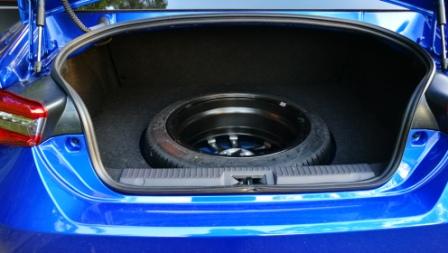 Inside…well, it’s a different story. There’s a mix of nice and not-so, with retro look tabs for the aircon, ill fitting soft touch material in the upper dash, a typical Toyota inspired blocky look to the actual dash fascia, mixed in with a simple to use yet effective touchscreen at 6.2 inches in size, backing up the 4.2 inch LCD screen embedded behind the speed and tacho dials. The sports seats are well bolstered, covered in grey and black material, and the driver gets alloy pedals for the sporting look. There’s auto self levelling headlights, steering wheel mounted Bluetooth audio controls, 2 12 volt sockets, and there’s a CD player also.
 No, there’s no room for adults behind the driver and passenger; it’s hard enough for the slide and tilt mechanism to cope with two children so adults genuinely have no hope. Even for a normal height driver, the gap between the front and rear seat makes it essentially unsafe to consider throwing anyone under 12 inches in height in the back. Although there’s the familiar (to anyone that’s had a two door car) pull strap to fold the upper seat section and slide the lower section forward, there’s just not enough leg room behind the two seats at all for genuine safety for the rear seat passengers.
 Warranty is Subaru’s standard three year/unlimited kilometre coverage, with 12 months road side assistance and the three year/60000 kilometre capped price servicing as well.
At The End Of The Drive.
Subaru lists the manual BRZ at $32990 plus ORCs, with the auto two thousand more. There’s a reasonable amount of standard equipment, enough to satisfy most in the hunt for a driver’s car and that’s the crux. It IS a driver’s car, especially with a manual transmission. It’s tightly sprung yet not so to be a teeth rattler. It’s snug inside and seriously not to be considered a family car…but you knew that, right?
For more details, head on over to here: 2017 Subaru BRZ
Hyundai and carsales Join To Clear Hail Damaged Stock.
Here at Private Fleet, we understand that shopping for a new car can be a minefield. There’s the sitting down and thinking about what kind of car you need: do I need a people mover, a sedan, a wagon? Will a diesel be better for me than the petrol? What about the servicing costs and what about the price?
Private Fleet is dedicated to helping YOU buy a new car and receiving the best price AND customer service that we can offer. But we also recognise that sometimes it’s a better thing to do by going outside the box in helping our customers find a bargain. A major competitor has something we think is pretty special, so in the interests of looking after you in finding a new car and knowing you’ll consider us for the NEXT car, we’d like to share this.
We understand that it’s highly unusual for a company such as ours do this and that we may lose a little bit of business to our competitor but that’s also why we think that sharing worthwhile news makes us stand out from the competition. We are here to help you buy YOUR next car.
carsales has signed an important commercial deal with Hyundai Australia to assist the car company sell over 3,000 cars that were damaged by the hailstorms that hammered Sydney in February and March of this year.
carsales has worked with Hyundai to enable the manufacturer to give substantial support to its dealers that have hail damaged stock that would otherwise be very difficult to sell.
Bargain hunters will be able to purchase ‘as new’ cars which have some hail damage at significant savings from 1st of May.
Through an exclusive agreement, carsales will host a Hail Sale clearance hub to help Hyundai clear the discounted hail-damaged stock.
The Hail Sale will be in the form of a dedicated clearance centre landing page on the carsales website. All hail-damaged Hyundais will be aggregated within the bespoke clearance centre with Hyundai display ads directing prospects onto the carsales site rather than the Hyundai corporate website which will enable a frictionless experience for consumers.
Hyundai’s website and other owned channels will also link through to Hail Sale to ensure the deal receives maximum exposure in order to deliver the best commercial results for both parties.
Agostino Giramondo, Sales & Strategy Director at carsales said: “This is the first time Hyundai has promoted a Hail Sale with such a large quantity of affected stock. It also marks the first time carsales has run a campaign of this nature with a mass manufacturer and demonstrates our commitment to collaborating with car manufacturers. We worked closely with the team at Hyundai to ensure their primary goal was met. This solution is all about selling cars in a contextual environment. It serves as a good reminder that the best solutions for manufacturers are on carsales.”
The hail-damaged Hyundais have only suffered minor cosmetic damage, which makes the Hail Sale an excellent opportunity for consumers to score a great deal. The vast majority of cars will have minimal kilometres and still benefit from Hyundai’s five year unlimited kilometre warranty – excluding panel and paint.
All Hyundai models will be available on the Hail Sale clearance hub, and the cars will be sold by Hyundai dealers around the country, giving all Australian consumers the opportunity to make significant savings on these cars.
Visit The Hyundai Hail Damage site for further information.
 Level 2, 9 Help Street