

Buy A New Car
2017 Toyota C-HR Koba: A Private Fleet Car Review.
 Toyota is responsible, some say to blame, for the SUV “craze”, after releasing the RAV4 in the mid 1990s. Just over twenty years later, Toyota has released what could be seen as the spiritual successor to the RAV4 if that car was to be released as a brand new car. A Wheel Thing looks at the edgy and funky Toyota C-HR.
C-HR stands for Coupe-High Rider. In profile there’s a distinct look of coupe, with a blunt nose, lonnnng headlights (950 mm thank you muchly), a steep arc to both front and rear glass, and a hidden rear door handle just visible. There’s a specific design ethos to the C-HR also, that of a diamond motif. There’s two massive crease lines that join front and rear, plunging sharply from the front and rear wheel arches, joining as a single line towards the bottom of the doors, and mirroring the angles seen from windscreen to roof to rear window. There’s black polyurethane at door’s bottom which echoes the roof line as well. It’s edgy, unusual, and in the eyes of the beholder for whether it works. It’s at the rear that you’ll see just who the C-HR is targeted at, if the name wasn’t enough to give it away. There’s more than a resemblance to a same segment vehicle from another Japanese maker, down to the hard, flat edged, tail light design. It’s busy, fussy, and with the strongly defined C shaped tail light design, just somewhat overdone and hides the supposed diamond look to the point it’s invisible. It also somehow manages to make the overall 1795 mm width look lost.
 What’s also lost is luggage space. With the rear seats up there’s a single person’s 377 litres, however that climbs to 1112L with flat rear seats. the rear seat passengers also have a compromided position; look left or right and you’re looking at the inside of the sharply angled rear door line. The seats are perched gher than the front’s by a considerable margin, leaving rear seat passengers looking over the shoulders of the front seats.
The Koba sits at the top of the five step C-HR range, which kicks off with a manual transmission and front wheel drive, 1.2L turbo four, and a price of $26990. Want a CVT? Add $2k. Want AWD? Add another two large. There’s also a 6.1 inch touchscreen, sans Apple CarPlay and Android Auto, active cruise control, and cloth seats. But wait, there’s more, with the Koba gettinging push button start, 18 inch alloys, heated (but no ventilation for the) front seats, cool looking LED front and rear lights, and a nifty aircon system Toyota calls Nano-E, which injects a bit of moisture into the air to stop skin drying out….
Inside it’s a move away from what could be seen as typical Toyota. Of note for A Wheel Thing is the dash design, a rarity in that there’s a hint of dash flowing into the doors rather than two ninety degree angles at each end. Fingerprint attracting piano black plastic contrasts with tactile charcoal grey plastics, a curvaceous and organic styling pleases a somewhat jaded eye and there’s plenty of all round vision. The Koba AWD also features leather appointed seats which are comfortable enough, supportive enough, and featured colour coded stitching in the trim. There’s reasonable room as well, considering the 4360 mm overall length. Above both driver and passenger is diamond motifs embossed into the material. Motorvation comes from a turbo four, a weensie 1.2L engine, and produces 85 kilowatts between 5200 to 5600 revs. It’s a good torque spread, between 1500 to 400, with 185 torques on tap. Acceleration? Leisurely is a word used often and perhaps overused but it applies perfectly here, especially with a car with a gross vehicle mass under two tonne.It’s also hamstrung somewhat by a CVT. No, it’s not a shocker, but no, it’s not responsive enough either. Off the line and punched hard, it’s typical CVT in that it feels like it’s not grabbing all of the drive on tap. It’s better when a gentle right foot is used and perhaps equal when under way and used for gentle, not rapid, overtaking.The transmission is fitted with seven “steps” which make only minimal difference when used in manual mode. There is also, naturally, a torque split system that’ll vary between front to all four on demand at up to fifty percent of the drive.
  That, at least, is seamless and unnoticeable.What does come out of this combo is pretty decent fuel economy. From the fifty litre tank, A Wheel Thing extracted nothing worse than 7.5L/100 on an urban cycle, just beating Toyota’s claim of 8.0L/100km. Around the highways and freeways there was 6.0L/100 km, not quite reaching the 5.6L/100 km Toyota says. Backing up that economy is a better than expected ride quality and handling package. The steering is well weighted, progressive in its transfer from straight to tightening radius to curves and twisty corners. It’s also en pointe in the city, with responsive levels from minimal input, making the C-HR quite manouevrable.
 Get the petite five door onto the freeway and there’s only tyre noise to hear and that’s dependent on the surface. Punt it into a normal corner and experience flatness, with even speedy cornering most unfazing the C-HR. It’s really only in slower corners, when torque is at the front, where a hint of understeer may be experienced and even with a delightfully progressive brake, there’s barely a hint of dive. All this means the C-HR delivers a good balance between supple, comfort, and sport.
Safety is a full package on the Koba; pre-tensioning seatbelts, blind spot alert, seven airbags, cross traffic alert, and hill start assist. That’s in addition to the three year or one hundred thousand kilometre warranty, with servicing every twelve months or fifteen thousand klicks. Want more? There’s also an impressive $195 per year for five years capped price service scheme.
At The End Of The Drive.
It’s an eyecatching design, to say the least. You can specify a black or white roof with selected colours at $450, and it’s not unattractive inside. It’s the 1.2L engine and CVT mix that pulls the package back and dulls the edge of the driving appeal. But it depends on the application of the right foot as to how the overall driving experience works for you. Toyota Australia website will tell you more and it’s worth booking a test drive if you think this is in your target to buy.
Ford Mondeo Gets Freshened Up For 2017.
Ford Australia‘s large mid sizer, the Mondeo, gets a tickle for 2017, bringing fresh looks including a funky new colour, improved safety, and more tech. Let’s take a look at the car that saw a sales increase, year upon year, of 47% in 2016.
Profile.
The top of the ladder Titanium will be fitted with nineteen inch alloys, up from the eighteens fitted previously. They’ll be shod with Continental 235/40 rubber, providing a more sporting and assertive look to go along with the increaed ride and handling capabilities.
“An increase in wheel size provides Mondeo a sure-footed dynamic stance that matches the chassis’ outstanding roadholding,” said Todd Willing, the Ford Asia-Pacific Design Director. “The new wheels not only help the visual balance of Mondeo, but work in conjunction with the body’s elegant lines for a premium yet sporty appearance. It’s a slick combination.”
The Mondeo Trend also receives its own bold new five-spoke alloy, tuned to compliment the Mondeo’s highly praised dynamics. These fresh alloys are 18-inches in diameter, replacing the Mondeo Trend’s previous 17-inch versions, and are fitted with a lower profile tyre measuring 235/45 on 8.0-inch wide wheels.
Buyers of the Mondeo Ambiente aren’t left out of the Mondeo makeover, with the Ambiente hatch now fitted with 17-inch alloy wheels as standard, to match the Ambiente wagon. Previously, the Ambiente hatch used 16-inch alloy wheels, an inch smaller in diameter than the Ambiente wagon, and with the upgrade for the hatch comes with the benefit of a 20mm-wider tyre, measuring 235mm, for a greater overall footprint. Said Willing: “This means that the Ambiente hatch hits that sweet-spot of being even better looking, yet with a wider tread area, sees an increase in roadholding for improved safety and drivability. It’s win-win.”
Colour my world: Mondeo’s new hue
The 2017 Ford Mondeo also brings consumers a new colour choice, Metalicious. Bolstering the bold new alloy wheel combinations, the expansion of the Mondeo’s colour palette underlines the premium design language that envelops the craftsmanship and practicality for Australian consumers.
“The new shade, ‘Metalicious,’ is a warm tinted clear-coat silver with a high degree of colour flip and sophistication that accentuates the beautiful forms of Mondeo,” said Willing. It brings the array of Mondeo colours available to consumers to nine, providing a strong spectrum from athletic to elegant, flattering the Mondeo’s lines while matching individual lifestyles and tastes of Australian consumers.
SYNC® 3is standard across the 2017 Ford Mondeo range. “Our customers are connected outside their vehicles, and Ford SYNC® 3will help them stay better connected while continuing to drive with their hands on the wheel and eyes on the road,” said Graeme Whickman Ford Australia’s President and CEO, . “Our leading local R&D investment also helps us stay better connected to Australian consumer needs, including SYNC® 3’s voice-recognition technology that understands Australian accents.”
SYNC® 3– Ford’s communications and entertainment system – features faster performance, conversational voice recognition with Australian accent-specific calibration, intuitive smartphone-like touchscreen and easier-to-understand graphical interface.
With a focus on technology, safety, craftsmanship and design, the 2017 Ford Mondeo uses sophisticated materials and production techniques to deliver greater strength and improved safety with reduced weight and enhanced sustainability.
An industry-first application of hydro-formed High Strength Steel is used to produce the A-pillars, B-pillars, and roof rails. A magnesium inner tailgate structure for the four- and five-door models delivers a weight-saving of approximately 40 percent compared to a traditional steel equivalent.
The Mondeo body structure features 61 percent high strength steel. Bake-hardened steel is used in the roof structure to reduce weight by a further 0.5kg. Further structural developments include:
- An anti-roll bar uniquely designed to limit transmission travel in a frontal impact, minimising steering rack movement
- Sill rocker panels made of martensitic boron steel for improved side impact protection
- Bumper crash cans optimised for energy absorption and harmonised with chassis rail characteristics
- A flanged front cowl design that allows for flex under impact to increase energy absorption
- An integrated rear underbody wheel-arch-to-rail connector that increases torsional stiffness by up to 25 percent compared with a traditional design.
Keep an eye on Ford Australia’s website
2017 Tesla Model X: A Private Fleet Car Review.
Being an independent reviewer and supplying content means relying on the good graces of companies to allow their cars to be reviewed. Tesla Australia is one of the companies that works with independent reviewers and I was privileged to spend a too quick 30 hours with the new Model X. It’s jampacked with technology and comes with a pricetag to suit. An immediately noticeable feature of the Model X is the strong family resemblance to the Model S. There’s a similarity to the profile, with the A pillar and window line providing a clear lineage. However, a major talking point of the Tesla Model X is the pair of upwards folding rear doors, known as “Falcon Wing”. What hasn’t been noised about is the tech that allows the doors to open in tight parking points. There’s sensors and cameras that will read the surrounding environment, with the cameras mounted discretely next to the rear wheels. The system works holistically and, when the doors begin their opening motions, will keep the doors from opening too wide or high. Maximum opening width is just twelve inches.
 The doors themselves are roof hinged, in the centre and have smoked glass, and will open outwardly slightly before commencing their vertical travel. The tailgate is powered, however the front doors, unexpectedly, are also powered. It’s here a surprise and delight feature comes into play. When walking up to the car (and ensuring the sedan shaped key fob is on you) the driver’s door will open in greeting. On a wet day this could be a godsend. The fob itself has a hidden button or two, on top and at the rear, which will open/close the tailgate and open/close all five doors. There’s even a spoiler that raises and lowers, ala Bugatti Veyron, hidden in the rear deck.
 Inside, the cabin is dominated by a touchscreen almost big enough to double as a TV. Sitting in a portrait orientation, this screen is the control centre of any Tesla car, offering information, accessing over the air updates (as was the case during the brief time it was with A Wheel Thing), accessing apps and the radio system and providing startling clarity when using Google Maps. Although given a demonstration by one of the wonderful staff at Tesla’s main Sydney location, the amount of info and how it all operates is somewhat overwhelming, even for a fairly technically literate person. The radio itself is only FM, no DAB, but has TuneIn to compensate. There’s something just a little bit awesome about being able to listen to bluegrass from Georgia in the U.S. or a dedicated Beatles station in Sweden. Audio quality itself is excellent, with the Mark Levinson speakers delivering real clarity, superb low down punch, and vocals that are clean and crisp.
 There’s a couple of nice touches to the interior. The seats are powered for rear and forward motion at the front, however the middle rows are also powered and have a setting which allows for them to power forward to a certain point to allow access to the second row rear seats. It’s diabolically simple in opertaion and makes utilising both the seats and the door access unbelievably simple. There’s also a huge sloping windscreen which provides a huge amount of forward and upward vision. Fear not, dear driver, you won’t fry like a piece of fresh bacon, for Tesla have embedded enough tint to block UV without losing the wondrous panoramic view. There’s even some tasteful looking carbon fibre trim added in.
 At the rear left quarter is the housing for the charging cable. Tesla provide an adaptor to suit standard household plugs along with, of course, those that choose to get a supercharger installed at home. Again, it’s just a touch fiddly to get the small hinged flap to open but the actual process of hooking up the cable and seeing a hidden LED glow green to indicate charging is relatively simple of itself.
It’s the drive that sells the Model S and the test car was fitted with the 100 kW/h dual engine package. Yes, “Ludicrous” Mode is on board, accessed via the touchscreen inside the car’s settings, and will help propel the Model S to 100 kph in just 3.8 seconds. There’s also sensational in gear acceleration, with a real punch and license losing potential from 70 kph upwards. It’s literally a feeling of being pushed back into the seat and watching the outside become a blur and allegedly will see the sprint from 70 to 105 in just 1.5 seconds. Yes. It’s that quick.
Here’s why: there’s a 375 kW engine driving the rear wheels, a 193 kW driving the front, which combine to produce a staggering 967 torques. Even though the Model X weighs a more than heft 2500 plus kilos, that torque is on tap instantly. Oh. That Ludicrous mode has an extra bite; press and hold the Ludicrous mode tab on the touchscreen and you’ll be rewarded with a Ludicrous+. BUT you’ll also only save maybe a tenth or two, because, you know, a sub four second 0-100 time that beats supercars like Lamborghini’s Huracan is so passe’…. Here we’ll pause for a moment and consider the battery options available. The 75 kWh powertrain will offer (with all battery packs under ideal conditions) up to 417 kilometres. The 90 kWh set will look at489 km. Punch it up to the 100D and Tesla quote a more than reasonable 565 kilometres. Order the supreme pizza, garlic bread, soft drink and free delivery for the P100D and that drops slightly to 542 kilometres. Then there’s seating. In standard trim, the Model X comes as a five seater. Six and seven seater configs are options.
 You’ll also get a surprisingly nimble, for the mass, vehicle. Being all wheel drive is one thing, but that means zippo if the vehicle doesn’t handle. There’s no problem here, even with those massive 22 inch finned alloys and low profile 255/35 Goodyear rubber hiding red painted and Tesla embossed brake calipers. It does help that the chassis has most of its mass down low, housing the batteries, yet the air suspension is tuned just finely enough to provide a ride that is both comfortable and compliant yet, somehow, imbues the weighty Model X with a sportiness that will appeal to any driver with an idea of how to utilise such a set up.
  The massive footprint thanks to the tyres and having them pushed out to each corner spreads the mass and really does make the Model X a genuine delight to drive. Oh, that air suspension? yes, it does raise and lower the vehicle, which at a standstill prompted some wide eyes and pointed fingers at traffic lights when trying it (showing off).
 The steering does lack a measure of feedback straight ahead but does have a tight rack ratio meaning input by the driver is felt straight away and has the Model X responding rapidly. Combined with a gear selector that looks great and requires minimal physical effort to move, it makes getting underway and enjoying the capabilities of the vehicle a doddle.
 Storage? Glad you asked. Being a design that couples the engines to the wheels directly, it allows the Tesla engineers to build in, somewhat like the read engined Volkswagens, frontal luggage space in what Tesla call a “frunk” or front trunk. There’s plenty behind the rear seats in a compartment and, of course, bottle and cup holders as well.
At The End Of The Drive.
It’s now time for the faint hearted to take a pill, find a nice quiet room, turn off the lights, and start singing “Soft Kitty”.
The driveaway price of the Tesla Model X as tested was $305809.00.
Why? Here’s why. The starting price is $201100, with that all wheel drive system included. The gorgeous blue metallic paint is $1450. The massive aero 22 inch wheels are a tear inducing $8000. The superb and super comfy black leather seats in a six seater configuration are, combined, $7950. No, that’s not a typo.
The carbon fibre trim inlay seems cheap in comparison at $1450. Thankfully the deck spoiler, Ludicrous mode, and the Tesla calipers come as part of the package. That awesome audio I mentioned? $3600. Air ride? Included. Hi amp charger upgrade? Hmmm….$2200. Even the autopilot upgrade system was a staggering $7300. With those and a couple of other inclusions (such as the Premium Equipment pack that self opens the door on approach) it came out at $242100 with GST inclusive.
Now here’s where some muttering and grumbling about taxes will be heard, and rightly so. GST applies here, so from that $242K price, there’s $22K in GST. BUT, on top of that, the Australian Government slugs a LCT or luxury car tax. How much? I’m glad you asked. Let’s say, for the sake of fact, $49972. Then there’s ANOTHER tax called stamp duty, a mere snip at $13705.
The end, drive away, price?
$305809.
For a driving enthusiast with that kind of coin, it’s a no brainer. You’d have an electric supercar in your driveway in a blink of an eye. For the rest of us? Lotto.
Go here 2017 Tesla Model X information to wish and dream.
Hyundai Australia Reveals Pricing For Reinvented i30.
Whilst their Korean based brethren, Kia, get some eyeballs cast over the Stinger, Hyundai have quietly launched a revamped i30, with a striking Euro inspired exterior and reinvented interior. With a starting price of $20950, $500 LESS than the outgoing model, the Hyundai i30 range is both priced and packed with added value enough to really appeal to keen eyed buyers. The range will consist of five models; the entry level Active, SR, Elite, SR Premium and Premium. The Active will offer a choice of two engines, a 2.0L petrol with manual or auto transmissions and a punchy 1.6L diesel with the same engine combination.
The SR and SR Premium will be powered by a turbo petrol 1.6L with the Elite and Premium getting the 1.6L. Power and torque are thus: the 1.6L turbo petrol offers 150 kilowatts and 265 Nm of torque for both transmissions. The diesel gives 100 kW, 280 Nm for the manual and slightly more for the seven speed dual clutch auto, at 300 Nm. The standard 2.0L petrol presents 120 kW/203 Nm, with fuel economy almost lineball with the smaller petrol turbo at 7.3L/100 km & 7.4L/100 km (manual/auto), 7.5L/100 km for the 1.6L turbo and a country kilometre eating 4.5L & 4.7L per 100 km for the diesel manual and auto.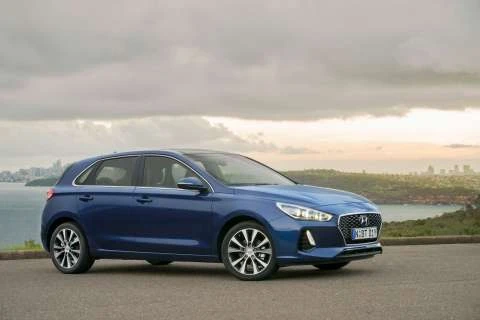 Pricing starts as mentioned, with the Active manual at $20950 (auto is $23250). What you’ll get for your dosh above the outgoing model is: dusk sensing headlights, LED running lights, 16 inch alloys, satnav on a eight inch screen, and more. The diesel versions come in at $23450 and $25950 for manual and self shifter.
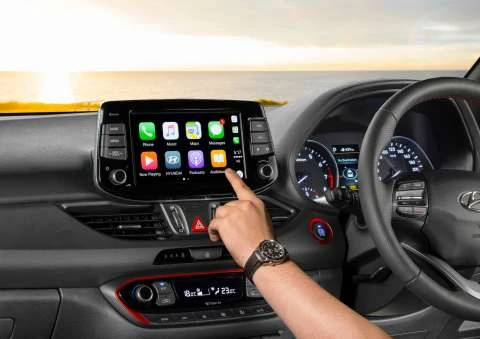
Moving up into the SR and SR Premium duo, you will pay $25950/$28950 (SR manual and auto) and $33950 for the SR Premium with auto only. The Elite and Premium round out the field with pricing of $28950 and $33950 for the diesel and auto combo. There’s $5000 of extra value in the SR and SR Premium, for just a small increase overall.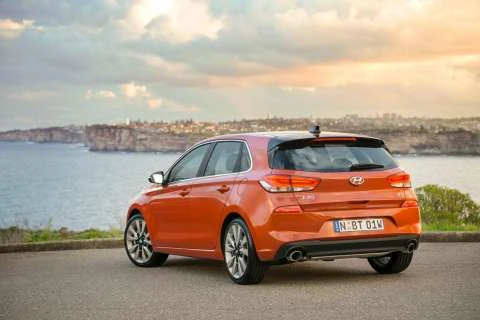 The SR will add in above the outgoing model: a multi-link rear suspension, Hyundai’s SmartSense safety package which includes (and will be available for the Active by year’s end) Emergency Braking/Driver Attention Alert/Lane Keep Assist and Smart Cruise Control (auto only), Blind Spot Alert and Rear Cross Traffic Alert, wireless phone charging on the Qi standard, eight inch satnav screen, Hill Start Assist, Tyre Pressure Monitoring 18 inch alloys wrapping around larger brakes discs, and an Electronic Parking Brake for the DCT.
  SR Premium sees LED headlights and indicators as well, along with (at last!) heating AND venting for the front seats, as does the Premium. The Elite gets leather trim, whilst SR gets a Sports Leather trim setup with metallic red trim inserts, red stitching and piping, and black headlining.
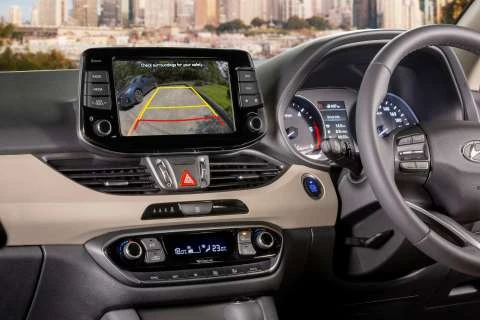
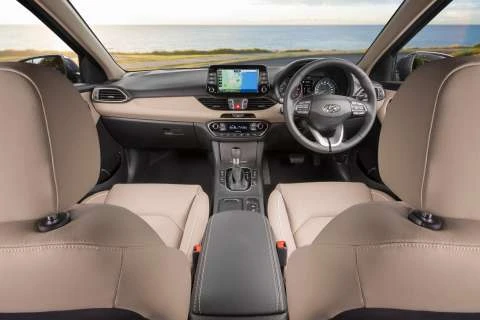 The eight inch touchscreen will be both Android Auto and Apple CarPlay compatible, with a DAB+ tuner, whilst safety comes up trumps with seven airbags and a maximum ANCAP five star rating. Apart from the Active, Smart Key entry is standard. Plus Hyundai will offer this: “With Hyundai iCare, the joy of buying a Hyundai will stretch well beyond the showroom.
  This leading customer care program offers a comprehensive suite of owner benefits including; Lifetime Service Plan, 5 Year Unlimited Km Warranty, complimentary Roadside Assist for 12 months on new vehicles, 1,500km complimentary first service, a dedicated Customer Care Centre, and myHyundai – an exclusive owner website. When servicing with Hyundai, customers will also receive a 10 Year Sat Nav Update Plan, a Roadside Support Plan for up to 10 years and more.”For further details, and to book a test drive, contact Hyundai Australia.
 Level 2, 9 Help Street