

Buy A New Car
Mercedes-Benz A-Class On The Way For 2019.
Mercedes-Benz is due to release an updated A-Class range before the end of the year and it’s set to receive a healthy boost with the introduction of the new A 250 4MATIC. Available for a limited time, the A 250 4MATIC arrives with the same generous levels of standard equipment as the A 200, but adds more power and all-wheel drive traction. The new A 250 4MATIC will be available from all authorised Mercedes-Benz dealerships in November 2018 and is priced from $49,500 (Manufacturer’s Retail List Price)
The M 260 four-cylinder engine in the new A 250 4MATIC is essentially a further development of the previous M 270. It will produce 165 kW of power and 350 Nm of torque. Combined with the standard 7G-DCT dual clutch transmission, the A 250 4MATIC is able to sprint from 0 to 100 km/h in just 6.2 seconds. Combined fuel consumption is 6.6L per 100 km.
The 4MATIC system has been developed further by Mercedes-Benz, and offers even more driving pleasure and efficiency. Using the DYNAMIC SELECT switch in the cabin, the driver is able to influence the 4MATIC characteristics more than before. 4MATIC components include the power take-off to the rear axle, which is integrated into the automated dual clutch transmission, and the rear axle differential with an integrated multi-plate clutch. This is no longer electro-hydraulically powered, but instead electro-mechanically.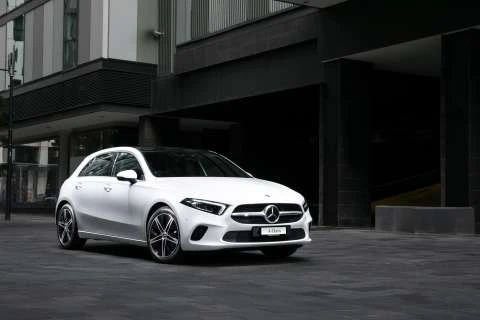
Drive torque distribution between the front and rear axles is fully variable so depending on the driving situation, 100 per cent of the drive torque can be directed to the front axle (e.g. when driving straight ahead with no increased slip at the front axle), or in borderline cases up to 50 per cent can be directed to the rear axle if the friction coefficient suddenly changes such as wet or snowy roads.
Using the DYNAMIC SELECT switch, the driver is able to influence the characteristics of 4MATIC even more than before. In the A-Class there are two characteristic curves available for clutch control. Models equipped with 4MATIC have a four-link rear suspension for enhanced ride and handling characteristics.
As with the A 200, the Mercedes-Benz A 250 4MATIC comes with 18-inch aero alloy wheels, the Mercedes-Benz MBUX multimedia system with widescreen cockpit (2 x 10.25-inch digital screens), TOUCHSCREEN Central Display with NTG 6 MB Navigation, standard LED headlights with Adaptive High Beam Assist, keyless start, and wireless charging fo compatible smartphones.
The A 250 4MATIC also arrives with a host of standard safety equipment such as nine air bags (front, pelvis side, and window bags for driver and front passenger, side bags for rear occupants and knee bag for driver), Active Brake Assist with semi-autonomous braking function, Active Parking Assist including PARKTRONIC, Active Lane Keep Assist, Blind Spot Assist with exit warning, Traffic Sign Assist and reversing camera. The exterior has also been refreshed and brings the 2019 A-Class into line with the majority of the passenger car range from the iconic German manufacturer.
Contact your local Mercedes-Benz dealer to organise a test drive when the vehicles hit the showrooms.
Private Fleet Car Review: 2019 Lexus RX-450h
Take a mid to large sized SUV, add a smattering of real leather, toss in a pinch of hybrid technology attached to a 3.5L V6, and pin on a badge that says L. Voila, it’s the 2019 Lexus RX-450h. It comes with a choice of non-hybrid or hybrid V6, a turbo 2.0L, and either five or seven seats. Private Fleet has the hybrid and showcased it at a superb location, Dryridge Estate, in the Megalong Valley, on the western fringes of the Blue Mountains.
 The RX 450h mates a pair of electric motors to the petrol engine. That’s good for 230 kW to power all four wheels on demand with a torque split system. Peak torque for the 2270 kilogram (dry) machine is a somewhat surprising 335Nm at a high 4600 rpm. It feels as if there should should be more though. Transmission is a CVT and for the most part it’s hard to pick it as being one. A dial in the centre console allows the driver to choose different drive modes, and picking Sports/Sports+ changes the left hand LCD dial in the driver’s binnacle from a hybrid information screen to a tachometer. And although it’s a heavy machine with a load on, at just under three tonnes, economy is very good. Lexus quotes a better than impressive 6.0L/100 kilometres on the combined cycle, a figure that we didn’t finish all that far away from in a real world, lifestyle, testing drive.

 The Lexus RX-450h, for the most part, was driven in the environment it’s most likely to be seen: around town. Here it copes admirably, with the comfortable interior featuring rear seat climate control, superbly padded real leather pews front and rear, powered rear seats, and a power tail gate. There’s a full length glass roof which was at odds with the junior members of the review team preferring the Toyota Kluger Grande’s sunroof and blu-ray player. The actual dash design is the somewhat heavy horizontal layer look that Lexus favours, with most switch-gear easily seen from the driver’s seat. The trip/odometer are hidden behind the right hand tiller spoke, and the Start/Stop button behind the left hand side. The trim in the RX-450h supplied was black and chocolate plastic, counterbalanced by cream leather with a distinctively different feel to machine made leather.
 There’s the traditional Lexus multi-function controller in the centre console that allows the front seat passengers to access an array of information such as the audio, climate control, and Lexus information, which requires a smartphone to be paired in order to deliver the info. This pops up on a 12.3 inch widescreen display high on the dash, ensuring it’s at eye level and provides a better measure of safety, rather than looking downwards. There is also a relatively bland looking HUD or Head Up Display. A Mark Levinson audio system with DVD-Audio capability and DAB tuner is installed, and it’s worth the time to set it up for your preferred style of audio. Unusually, a Time-Shift function is added, where a user can rewind live audio thanks to a small hard drive running streaming storage. All windows are one touch up/down, and a soft touch at that. There’s a better quality material for the windows themselves to run on, with an almost silent mechanism as a result. Wireless smartphone charging is gradually making its way into more cars and it’s here too, albeit hidden in an awkward forward position ahead of the cup holders.
 Ride and drive is a mixed bag. The steering can feel heavy when it’s just the front wheels being driven, but lightens in proportion as drive gets shunted rearward. Lateral stability is high with only the occasional rear end hop/skip over unsettled surfaces in corners. It’s the suspension that raises and eyebrow sometimes, with a feeling that the tune, although compliant, has the body feeling as if its moving around more than anticipated and this happens at the top of the suspension, almost like a mattress with a pole and springs supporting it at each corner.. There’s more pogoing than expected but does damp itself quickly enough.
Turn-in is easily controlled via throttle application. There’s little predisposition to a nose heavy attitude in corners but on the rare occasion there was a tendency to run wide, a gentle lift of the go-pedal would tuck the front back in before a judicious squeeze would have the car settle into the desired arc. The excellent brakes also help, with a brush of the pedal enough to feel the mass of the RX-450h respond in kind, and certainly assisted in the run out to the spectacular views from Dryridge Estate. Naturally they feed kinetic energy back into the hybrid system and it can be a little mesmerising watching the dash display with arrows feeding in and out of the various car driveline components..
 This small vineyard, Dryridge Estate, is at the southern end of the road leading from Blackheath, a small village on the way out to Lithgow and Bathurst as one drives from Sydney. Located on the escarpment of the massive Megalong Valley, a former sea canyon, the drive starts with a series of tight and downhill oriented turns through a fern lined and barely sunshine lit set turns that will test and delight the enthusiastic driver. That’s presuming one isn’t caught behind another driver that brakes every couple of seconds. They specialise in small and intimate gatherings, provide a wonderful variety of cheeses to sample, and of course their own produce. The fact that the background should entice car companies to host launches there is a bonus.
 Once at valley level the forest and ferns disappear, with a broad valley floor offering uninterrupted views of the canyon walls. It’s about a twenty minute drive from the highway to Dryridge, with a couple of kilometres worth of unsealed road taking you to the estate. Facing eastwards the estate then allows driver and passenger a chance to stop and drink in the stunning view. The RX-450h was neutral and easily controlled on the downhill run, with the brakes recharging the hybrid’s battery along the way. On the flat the V6 opens up and emits a throaty roar under acceleration, and the steering seems to loosen up, almost as if it realises that it’s time to relax and back off on assisting, yet keeps in touch with the driver.
 On the gravel that softer upper end travel comes into its own, with that absorption level flattening out the corrugations found on the way in and back out. Heading back to the highway brings with it a similar yet different feeling. Being front wheel drive oriented there’s a subtle shift in chassis feel thanks to the now uphill run. The nose is a little harder, tighter, as each flex of the right foot has the front tyres biting into the tarmac. The torque split feels more noticeable as it pushes the rear along into the turns uphill and makes for a more nimble and exhilarating package. The multi-purpose Dunlop SP Sport Maxx rubber provide a decent enough grip across both types of surfaces and at 235/55/20 provide a huge footprint too.


If there’s a signature for the Lexus range it’s the exterior design. It’s better than fair to say that Lexus has a unique styling ethic and it’s unlike any other luxury oriented maker. There’s a plethora of lines and angles and very few true curves outside of the wheel arch and behind the passenger doors. The sedan range, all of the SUVs, and even the Land Cruiser based big beastie have a strong family design ethic, particularly at the front end. There’s the distinctive hour glass grille, slimline tapered headlights, and in the RX there are a pair of triangular clusters holding the halogen driving lights. The overall presence is one of a standout on the roads.
At The End Of The Drive.
The Lexus range showcases and highlights a strong desire to take on and beat the Europeans and with possibly a better hybrid range, currently, does so. There’s little to dislike about the RX-450h on the inside as it’s a beautifully comfortable place to be in. Perhaps the only “downside” would be the full size glass roof rather than offering the blu-ray set up as found in the Kluger Grande. But there is that Mark Levinson DVD-audio system to compensate. Outside the exterior is a matter of choice. The drive itself is mostly one of beckoning towards those that enjoy the balance between sheer grunt and technology. The fuel economy is certainly a winner however AWT’s preference for how a fuel engine/battery system works is at odds with Toyota and Lexus’ way of doing it. The fuel engine cuts in far too early for AWT’s liking and the apparent lack of torque is a Mr Spock eyebrow raiser.
It’s a very good highway and freeway cruiser but also distinguished itself on the type of unsealed roads found in the lower mountains and elsewhere. This dual capability adds to the allure of the RX-450h, and with the hybrid economy pairing with the luxury interior, the combination add up to be a worthwhile consideration. Here is where you can find out more.
2019 Toyota Corolla ZR & SX Hybrid.
Toyota has given its evergreen Corolla a substantial makeover. Inside and out it’s a new car and there’s also been a slight change to the way the range is structured. There’s three hatches: Ascent Sport, SX, and ZR, with hybrid technology featuring strongly. Private Fleet drives the 2019 Toyota Corolla ZR Hybrid and 2019 Toyota Corolla SX Hybrid with the Ascent Sport to come.
 The cars come with either a 2.0L petrol engine, or in the hybrid’s case, a 1.8L petrol engine. Sole transmission choice is a 10-step CVT in the SX and ZR, the Ascent Sport does offer a six speed manual alongside the CVT. Pricing is competitive, with the range starting at $22,870 + ORC for the Ascent Sport manual and finishing at $31,870 + ORC for the ZR Hybrid. Premium paint is a $450 option and the Ascent Sport offers privacy glass and satnav at $1000. Service intervals are 12 months or 15,000 kilometres with a new capped price service program at just $175 per service.
 Toyota says the economy of the cars is improved; the ZR Hybrid is quoted as 4.2L/100km for the combined cycle, a figure not reached by AWT but nor far off it at 5.0L/100km overall. A 1400kg dry weight is a good starting point. The engine itself is an Atkinson Cycle design and produces 72Kw & 142Nm by itself. Alongside the battery system that has a 6.5Ah output, the combined power is 90kW and 163Nm. The transmission features a three mode choice: Eco, Sport, and Normal. The CVT itself when fitted to the 2.0L has an innovative feature and one that Toyota claims is a world first. A “launch gear mechanism” Direct Shift is engineered in, allowing the engine and gearbox to work together and provide a fixed first gear ratio. Once the car has reached a preprogrammed speed it reverts back to the steel belt CVT mechanism. It does sound noisy but isn’t a thrashy note, rather a sound of refinement and “I’m working here!” Underway it works seamlessly and silently in the background, with the only time it reappears being when the accelerator is given the hoof.
However I continue to have a slight beef with the EV, Electric Vehicle, mode that the Hybrid tech has in Toyota cars. Select EV, hit the accelerator, and it almost immediately switches into both EV and petrol assisted mode. Move away gently and it stays in EV mode until the lowly speed of 20km/h is reached and again the petrol engine kicks in. Having driven purely electric cars, plug-in hybrids, and normal (non plug-in) hybrids, I would prefer the battery system to be more gainfully employed and have the petrol engine’s assistance lessened. It does assist in charging the battery as the levels drop but in a free-flowing drive environment is should be doing this, not driving the front wheels along with the battery system. As a result the mooted fuel economy should be further improved. However the centre console located gear selector is PRNDB, with the B being a stronger regenerative braking assistance. This means that the kinetic energy from braking is also harnessed and returned to the battery.
 The three drive modes work well enough in the real world, with Sport providing a crisper throttle response, faster acceleration and better high speed response. The ten speeds can be accessed via steering column mounted paddle shifts in the non-hybrid cars. The hybrid system itself in the ZR and SX is displayed in regards to its interaction via LCD screens in the driver’s binnacle. The SX has a small full colour screen mounted to the right hand side with the ZR’s seven inch screen a full colour display that shows a bigger version of that available in the SX. This includes a drive mode display showing the battery driving the front wheels, the petrol engine driving and charging as well. These are access via a simple four way toggle switch on the left hand spoke of the tiller which itself has been redesigned and is a new three spoke look. The look of the bigger screen though is busy and perhaps somewhat overloaded with info. It then points the ZR towards a younger, more tech-savvy, audience, and moves it away from the traditional mature aged buying base of the Corolla. Even the SX, perhaps?
 Toyota have followed the Euro route with a high centre mounted touchscreen for audio, apps (including ToyotaLink), and navigation. It’s smart and logical with a higher eyeline not distracting the driver from what’s ahead. The ZR amps this up by offering a HUD or Head Up Display with plenty of info such as speed zones, and soothes the ears with DAB via a well balanced JBL sound system. A voice activation system has been added, as has Siri Eyes Free. There’s leather accented seats in the ZR, cloth in the SX and Ascent Sport, but no electrical adjustment across the range, an odd omission in the ZR. However the ZR does have heated front pews and a wireless smartphone charging pad (as does SX), albeit hidden away under a dash section that perhaps protrudes too far into the cabin, counterpointed by a 24mm lower line. The dash itself is less busy and angular than before, with a more integrated and smoother look. Although not powered the front seats are comfortable and have plenty of under-knee support. Keyless start and dual zone climate control are standard in the SX and ZR. There’s also a higher grade feel and look to the textiles inside the ZR.

 There’s ample rear leg room and shoulder/head room is more than adequate. Boot space is just about right for a weekly family shop, As usual Toyota’s ergonomics are well thought out in where a natural hand movement would go, except in the case of the door grips. They’re forward of where a natural reach would go and in AWT’s opinion too close to the door’s pivot point. Safety is high in the ZR, indeed across the range, with seven airbags as standard as is a rear view camera. Adaptive Cruise Control is on board for all three, with a minimum speed of 30km/h and operates across a range of three preset distances to the car ahead. PCS or Pre-Collision Safety is here and works in a day & night environment range. AEB or Autonomous Emergency Braking is part of this and the ZR also has Blind Sport Alert and Lane Keep Assist or, in Toyota speak, Lane Tracing. Cameras around the car measure the car’s position in relation to roadside markings and gently tug the car into position, along with uttering audible chirps to alert the driver. There’s also an active voice guidance safety system that’s integrated with the satnav, providing warnings such as school crossings and speed cameras.
 Underneath there’s been plenty of changes. It’s part of the Toyota New Generation Architecture, TNGA, with a 40mm lower, 30mm wider, and 40mm longer body that looks more assertive and confident. A 40mm longer wheelbase gives the 225/40/18 rubber on the ZR (205/55/16 for Ascent sport and SX) a more planted feel however there’s a lot of road noise from the Dunlop tyres on the ZR. The SX’s rear is far quieter. Ride quality has been improved by ditching the torsion beam rear and building in a multi-link system. McPherson struts have been a staple of the automotive industry for decades and Toyota have stayed with a tried and true setup here.
 Springs, dampers, mounting points, die-cast aluminuim frames and more have transformed the handling of the Corolla. Although the rear is a touch soft in AWT’s opinion the overall ride and handling is near nigh spot on. In low speed turns there is no understeer at all, the steering response at speed on the freeway and urban road system is intuitive, and the whole chassis is worthy of applause. There’s negligible float at any speed, turn in is assisted by an electronic “active cornering assist” system, and even the dreaded bump-thump from the shopping centre speed reducing devices is minimalised.

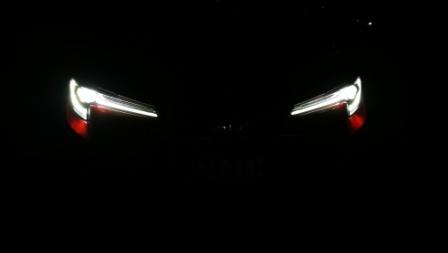
 The exterior has been well massaged, with the metal between the hatch and rear passenger doors changed to a more, for the want of a better word, natural look, for a hatch back, moving away from the previous triangular motif. The tail lights are freshened and sit underneath a fourteen degree sharper window. The window-line itself draws the eye to either end, and especially to the redesigned front end. There’s a lower cowl and a cropped front by fifteen millimetres that lend a more assertive look. Being a Hybrid the Toyota logo is limned in a cobalt blue, bracketed by even more slimline looking headlights and LED driving lights in a sharp, linear, look. There’s no spare tyre in the Hybrid, but there is in the standard petrol engined version. A tyre repair kit is added for the ZR Hybrid. The Ascent Sport gets either a full sized or space saver (Hybrid) and the SX is a space saver only. The rear also has an X subtly embedded into the design, with a line from each lower corner curving upwards and inwards, as are lines from the top edge of the rear lights.
 Eight colours are on offer to highlight the fresh, new, look to the world’s biggest selling car. There are solid, pearl, metallic and mica colours headlined by four new hues of metallic Volcanic Red and Peacock Black. In mica there are Eclectic Blue and Oxide Bronze. As well as the three new colours, Corolla hatch is also available in a premium Crystal Pearl along with Glacier White, Silver Pearl and Eclipse Black.
 At The End Of The Drive.
Spanning fifty years and more, the Corolla is a mainstay of markets around the world and continues to be a top ten and top five seller here in Australia. With the Hybrid tech making its way into the mainstream model range for Toyota, in this case Corolla, it opens it up to a new market but begs the question of what will happen to Prius…As a driving package the 2019 Toyota Corolla ZR Hybrid is trim, taut, and terrific. It’s responsive to minor steering inputs without going overboard, it’s composed and unflustered across a broad range of environments, and is “let down” by excessive road noise, a couple of design quibbles, and a slightly softer than expected rear end. However it’s a very competitive price range and price point for the ZR Hybrid, and if the bells and whistles of the ZR don’t appeal, the 2019 Toyota Corolla SX Hybrid, at $28,370 + ORCs may be a better and lighter wallet biter. All information can be found here for the 2019 Toyota Corolla range
Kia Australia Releases 2019 Cerato S, Cerato Sport, Cerato Sport+
 The evergreen Kia Cerato sedan has been given a pretty solid makeover, with the hatch due for its own tickle and release later this year, plus GT versions for both are said to be on their way. There’s also been a range realignment name-wise.. We have driven the Kia Cerato S, Cerato Sport, and Cerato Sport+.
The Cerato S sedan starts from $23,790 plus on roads, as tested. The review car was in Steel Grey, a pleasing shade and a $520 option. The Sport was $25,790 plus on roads, clad in a gorgeous Horizon Blue, and the Sport+in Snow White Pearl came in at $28,290, plus on roads, and paint. Servicing costs are for a fixed amount over Kia’s class leading seven year warranty, and top out at $2,869.00. There’s a good range of colours available but only one is classified as a non-premium colour… If you’re after a manual, you’ll find it in the Cerato S only. You’ll also find only a 2.0L injected four cylinder across the range, with six speeds, in both auto and manual guise, hanging off of the side for the engine. It’s a peak twist of 192Nm and power is 112kW. Rev points are 4000rpm and 6200rpm respectively and there’s a noticeable increase of oomph once 3000rpm is seen on the dial. As we drove the autos only, they’re pretty much all good in the transmission sense. It’s the engine that needs refining and smoothing. See 4000rpm on the tacho and there’s a noticeable harshness and noise. It’s a metallic keen that, although somewhat raucous, is really only ever apparent when a heavy right foot is used, thankfully. It’s otherwise quiet, pleasant even.
It’s here that the auto shines. Seamless shifting when left to its own devices, it delights in its smooth and unhurried nature. Tilt the gear selector right, it goes into Sport mode, and when rocked forward and back, the changes are sharp and crisp. Acceleration in all three is enhanced by using Sport mode as the changes suit the characteristics of the engine’s tune. That engine tune helps in economy too. Kia says it’s 7.4L per 100L from the 50L tank for a combined cycle and a still too high 10.2L/100km for the urban cycle. Driven in a mainly urban environment with engines all under 3000km of age, we averaged under 7.0L/100km across the three.
 Road handling from the three was similar yet in one car somewhat oddly different to the others. The Sport+ rides on the same tyre and rim size as the Sport. 225/45/17 is what’s bolted to each corner and the alloys look sensational. The S has steel wheels at 16 inches, with 205/55 rubber. The S and Sport are more akin in they ride than the Sport+, with the McPherson strut front and coupled torsion bar rear feeling tighter, tauter, and less composed in the Sport+. Long sweepers with minor corrugations had the rear step out, whereas the S and Sport were less inclined to deviate. In a straight line all three sat comfortably but the Sport+ was more the princess in the bed with the pea. Minor irregularities were magnified and enhanced in the Sport+, with just that little bit more unwanted pucker factor whilst sitting on its leather clad pews. Freeway rides are tied down, there’s little to no float, and road noise is minimal thanks to extra noise reduction materials plus NVH reduction engineering. Get funky in the tighter corners in the mountain roads and handling is predictable with steering nicely weighted. Boot it out of a corner and the steering loads up and there’s no tending towards lift-off understeer.


 The S and Sport have cloth seats, manual adjustment, and no heating. The Sport+ has heating, no venting, and no powered front seats, an odd omission for a top of the range car. In fact, there’s really not a whole lot of difference between the three in some areas. All have the drive mode choice of Eco/Comfort/Smart with Sport engaged as mentioned. All have AEB with Forward Collision Warning – Car Avoidance, with the Sport+ getting Pedestrian and Cyclist on top plus adaptive cruise. All three have Android Auto, Apple CarPlay, voice activation, and Digital radio via the eight inch screen, with the Sport+ having the same dropout issues as experienced in the Sorento. Climate control is in the Sport+, with “standard” aircon in the other two. The driver sees info via steering wheel mounted tabs on a 3.5 inch TFT screen between two standard analogue dials. Perhaps here a LCD screen for the dials would help add cachet and differentiate the the Sport+ further.
 All three have Blind Spot Detection as an option, as do they have Rear Cross Traffic Alert as an option. These are part of two safety packs available at a $1000 or $500 price point. All other safety systems such as Hill Start Assist are common. The Sport+ gets an electro-chromatic (dimming) rear vision mirror, LED daytime lights, push button start, centre console armrest that slides, and folding wing mirrors. It’s also the only one with an external boot release on the car. That sounds like nothing important but when you’re used to pressing a rubber tab on the boot and not using the key fob, it’s not a smart choice.
 What is a smart choice is the redesign outside and in. Kia’s gone with the Euro style touchscreen that stands proud of the centre dash and it looks good. There’s turbine style airvents and the Sport+ has more brightwork around these and in the cabin than the Sport and S. There’s a pair of 12V and USB ports up front, with one dedicated to charging and the other for the auxiliary audio access via the smartphone apps. Although the front screen has been moved backwards, there’s no decrease in head, shoulder, and leg room for the 4.6m long sedan. Boot space is, ahem, adequate, at 434L with a long and quite deep design, and the spare is a full sizer, albeit steel fabricated unit.
 Outside there’s been a major re-skin; the front screen has been moved by nearly twelve centimetres and the bonnet line has been raised. The headlight clusters flow backwards at the top into the guards, with a nod towards the Stinger in styling here. At the right angle, somewhere from the rear quarter, there’s more than a hint of a certain Japanese luxury brand too. Sport+ has LED driving lights in a Stinger like quad design around the main headlight. There’s angular vents at each front corner that house the indicators and the Sport and S have a pair of globe lit driving lights between. Rear end design has been revamped and there’s beautiful styling to the tail lights, flanks, rear window line, and an integrated lip in the boot lid itself. Reverse lights have been moved to a triangular housing in the lower corners, echoing the front and again harken to a Japanese brand. It’s a handsome and well balanced look overall.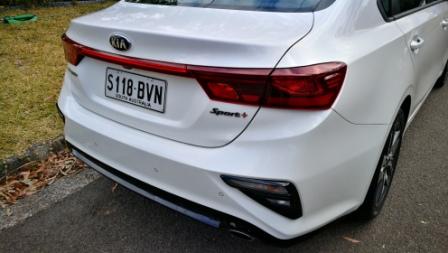

 Warranty is Kia’s standard seven years and there is 24/7 roadside assistance available as well.
At The End Of The Drive.
Kia’s growth curve is strong. Its building vehicles with a good feature set, with high quality, and quietly doing so with gusto. The Cerato sedan, the latest in a range of cars that DOESN’T include a four wheel drive capable ute, is commendable for both its very good looking sheetmetal and high levels of standard equipment. What initially looks like oversights in some areas is potentially a pointer towards what will come in the Kia Cerato GT. As it stands, though, a weak link is the engine. It doesn’t feel smooth, slick, and quiet enough at revs, and for a naturally aspirated 2.0L petrol engine nowadays, a peak power of 112kW really isn’t advertising friendly. It’d be nice if the torque was available at a lower figure or if there was more of it, but for the average buyer, the main concern would be the rare occasion they’d venture into plus 3000rpm territory.
Frugal is the word that stands out here too. So bundle a good looking sedan with good petrol usage in with sharp sub $30K pricing and that feature set, and Kia is kicking goals. Kia Australia’s Cerato for 2019 is available now.
 Level 2, 9 Help Street