

Author archive
It’s School Time!
 By now, all the schools around the country have re-started for the year, which means that a lot of us will have gone back to Mum’s Taxi and Dad’s Taxi duties again. For some of you, your teenager has finally got their provisional license and can drive him/herself to school.
This means that there are going to be a lot more cars buzzing around schools, especially at the start and end of the school day. Depending on where you live and what your school does, there may be school buses and shuttles involved as well. In short, there’s a ton of traffic in a small area, and vehicle traffic isn’t the only sort around, as there will also be kids on bikes, kids on scooters and lots of kids walking. In some cases, especially in rural and small-town schools, you can see other forms of transport being used – farm tractors, for example.
Nobody wants to make the news by being involved in a horrible accident involving school kids, so it’s probably about time that we thought about a few things we can do to make sure that our kids are safe as they go to and from school.
As a quick aside here, this is another area where autonomous cars are a real no-go. Autonomous cars work by predicting what ought to happen or what is likely to happen. Unfortunately, small children can be pretty unpredictable, especially when they’re all excited as they get out of school, and their erratic behaviour hasn’t been programmed into the control centre of an autonomous car. So I’m thankful that the typical Aussie Mum and Dad still drive cars the old-school way!
First of all, although the designated school zones – the ones marked with flashy lights, road markings and signs – are the real hot spots, the activity around schools during the pick-up and drop-off times spreads further afield, so don’t just keep alert for kids in the actual areas. The precautions apply for at least a block further than that during busy times.
There are three general guiding principles that will help you negotiate this part of the school run safely:
- Slow down.
- Expect the unexpected.
- Don’t get in other people’s way.
Slowing Down
Slowing down to 40 km/h is the law in designated school zones, and failing to do so will (at least in New South Wales) get you double demerit points if the cops catch you at it. The reason for this is simple: if you’re going slowly, you have more time to react and more time to stop when little Bella decides to rush across the road yelling “Mummy! Mummy! Guess what happened at school today!” or when the family dog who came along for the ride whizzes out of the car when little Charlie is putting his schoolbag in the boot. What’s more, if the worst comes to the worst and an accident happens, lower speeds mean less damage.
I know we’ve discussed speed limits and whether or not speed is what kills in other posts, but nobody in their right mind should want to go at screaming high speeds around a school, even if their car is capable of it. This is one place where the speed limits really do apply. In fact, around the busy schools in my area, I’d actually prefer to go even slower than the 40 km/h limit during the active hours. (The open road is another story.)
Expecting The Unexpected
Kids aren’t adults. They are immature. They are impulsive. They are still learning that the world does not revolve around them (and some people seem to never learn this lesson!). Some of them have been sitting down in school for the whole day and have serious ants in their pants. This means that they can do some weird things and they can move quite fast. We can drum the road safety message into them as much as possible, but there will be those moments when they forget it all and rush out into the road, or they’ll be so busy talking to friends that they don’t stop, look and listen. This means that you, as the adult who’s got a driver’s license to prove that you’re responsible, have to be the one on high alert, ready for anything. This means no phones, not even hands-free ones. It probably means switch the radio off and get rid of anything else that could distract you.
You may need to be extra careful if your car is an electric vehicle or a hybrid (which will be using the electric motor at school zone speeds). This is because a lot of EVs and hybrids are quieter than petrol and diesel engines, even if they have that little noise (which some older hybrids don’t have). This means that the Listen part of the old Stop, Look and Listen is a bit harder. Even adults can have near misses (that’s me with my hand up here) if they’ve looked one way, looked the other, thought it was clear and didn’t hear the oncoming hybrid/EV and started stepping out.
The flip side of this is that if you’re a parent, you should take a few steps to minimise the risk of your child running across the road. This usually means parking on the same side of the road as the school, which is what the official advice says. However, if everybody parks on the same side of the road as the school, the trail of parked cars will stretch well beyond the designated zone. This might mean that your child will have to cross a road to get to where you’re parked. It’s best if you get out of the car and walk to the school gate to collect Bella and Charlie (and the rest of the kids if you’re part of a carpool scheme).
You also need to make sure that you’re not the person doing unexpected things. This means no U-turns, no sudden manoeuvres, no three-point turns, etc. Plan your route so these aren’t necessary – and go around the block instead of doing U-turns, etc. The only sudden manoeuvre you’re allowed to make is hitting the brakes if you see a child about to go where they shouldn’t.
Staying Out Of The Way
You can see some people doing silly things around schools, and I’m not talking about the children this time. Yes, I know that you’re in a hurry. I know that you think your child is amazing and you love him/her to bits. I know that you’ve got to scream across town for soccer practice. However, there is no excuse for parking in the school bus zone, double-parking or parking really, really close to the school crossing point. It’s absolute chaos when every single Parent’s Taxi tries to park as close to the school gate as legally possible.
Congestion near schools during the busy times is a bit of a problem that councils and schools are trying hard to address because it can be chaos and an accident waiting to happen. My preference (at least when my kids were still at school and didn’t drive themselves) was to park a bit further away, then walk that extra block or so. After all, it won’t hurt you or your kids to walk a little!
In the case of picking up kids from secondary schools, you may have to park even further away, as a lot of the close parking spots are taken by the P-platers who drive themselves to school. High school kids, however, are usually a bit more streetwise and are less likely to suddenly rush into the road without looking, although there are times when they’ve got their earbuds in or when they’re madly catching up on social media…
I’d also strongly argue for other initiatives as well as a way of reducing congestion around schools. Setting up a carpool scheme with other parents who live near you is a popular option and it means that instead of four cars arriving with one child each, you get one car with four kids. Walking school buses and “Kiss and Ride” drop-off spots are other options. Of course, if you live within 2 km of the school, then walking to and from the school is an option (and it’s free!). You’ll need to walk with your child until he/she is old enough to have the street smarts to do it solo – and this is usually the age when they are embarrassed to be seen with parents, so that works out well.
If you haven’t got school aged children and you’re not doing the Parent’s Taxi run, then it’s best to plan your journey so that you don’t have to drive near a school during the busy hours. Go another way if you have to or make that trip at another time.
If we all do our bit, then our kids will stay safe as they go to and from school.
The Least Useful Bells And Whistles On Modern Cars
You really have to hand it to the car designers and developers. They really do a great job of putting out new models all the time and coming up with all sorts of new things. Some of these innovations are fantastic and useful – improved battery range in EVs, increased torque alongside better fuel economy in a diesel engine, and finding more places to stash airbag. Inside the car, you have delights like chilled storage compartments where you can put your secret stash of chocolate where it won’t melt on a hot day, and comforts like heated seats. Some of the innovations and nifty luxury features you find on cars today aren’t quite as useful.
Now, don’t get me wrong. I’m not knocking any of these things. In fact, I quite like a few of them, especially as I’m a major sucker for anything that involves sparkly lights and LED technology. It’s just that they’re kind of pointless and not really necessary. They definitely fall into the category of “nice to have” but if an otherwise decent new model didn’t have these features, it wouldn’t be a deal-breaker. Kind of like having a cool print on a ski jacket – it won’t keep you any warmer than a plain jacket but it looks nice.
So what are some features that you can find on modern vehicles that could be classified as “useless”? Here’s a selection…
- Colour Changeable Interior Lighting. This is one of the ones I actually quite like while admitting that it’s not really necessary to good or safe driving. LED technology can do all sorts of pretty things, and this is one of them. At the touch of a button, you can select a different shade for the lighting inside the cabin of the vehicle, either from a pre-set selection or a customisable shade. It’s quite fun but it’s not going to make you a safer or better driver unless you let fractious children play with it so they don’t bug you and whinge, causing a distraction.
 Illuminated Door Sills. Another example of LED technology being put to use, this involves a wee light, possibly showing a brand logo or badge, on the doorsill. Right where you put your grubby shoes.
- Lane Departure Warnings. Look, if you can’t tell you’re drifting to one side by, you know, looking out of the windscreen, you shouldn’t be behind the wheel. These sensors and warnings also have no way of telling if you’re carefully easing around the council mowing machine that’s bumbling along the grass verge, overtaking someone in the bicycle lane, avoiding a trail of debris or edging into a median strip – or if you’re really drifting out of your lane. Active lane departure correction is even worse…
 Integration with Social Media. You should not be checking Facebook, Twitter, Instagram, Snapchat or any other form of social media while behind the wheel. If merely texting is distracting and the cause of more than their fair share of accidents, then seeing someone’s loopy video share is worse. Checking your social media on a display screen at eye height is just as distracting and takes your eyes off the road just as much as a phone does. Are you really that hooked on your online presence and that full of FOMO that you can’t even stop while you’re driving? If it’s that bad, then just take the bus and use your phone or tablet. (I don’t count the ability to access your Spotify playlists while driving to be useless, by the way, which is probably the only thing that justifies this feature.)
- Paddle Shifters on Anything with CVT. The whole point of a CVT system is that it doesn’t have regular gears and doesn’t change from one to the other like your standard manual or auto transmission. What, then, do paddle shifters on a CVT actually do apart from looking cool and making you feel like a racing driver?
- Gesture Control for Audio. It’s very cool and sci-fi: you wave your hand or make a similar gesture and your audio system turns up the volume or turns it down. OK, it might be fractionally safer than reaching down to fiddle with a knob while driving. However, it will also respond to any hand motion in the sensor’s vicinity.
- Dinky Roof Rails. Roof rails are very useful if they are large enough to actually strap something like a kayak, skis or a ladder. If they’re teeny-weeny things, however, they’re just there to look sporty but don’t really do anything much.
- “Door Open” Alarms. I’ve got this on one of my Nissans and it’s a feature that’s been around for a while. The idea is that if you have the door open and the key in the ignition, the car beeps at you so you don’t lock your keys in by mistake. The trouble is that it keeps beeping if you leave the door ajar while refuelling or if you have to hop out to open a gate, driving passengers nuts. I don’t know how many times I’ve wanted to find that beeper and smash it!
 Images in Puddle Lamps. Puddle lamps in themselves are not useless, especially not in a Landrover or other 4×4 driven how they were originally intended to be driven (i.e. off road), as they help you see if you’re about to step out of the car into a pile of horse or cow crap. Even around town, it’s nice to see if you’re about to step out into a puddle while wearing your nice shoes. But is it really necessary to cast a shadow of the image of the car into the middle of the light? Cool, yes. Useful, no.
- Automatically Switching Off The Cabin Lights When The Door Opens. Now try and retrieve your cabin baggage by feel in the dark with the lights off, and hope you don’t miss your wallet. Honestly, the old-school system where the lights came on when the door opened was better, although it could lead to drained batteries if you left the door open too long… but a manual switch usually took care of that.
 Illuminated Door Sills. Another example of LED technology being put to use, this involves a wee light, possibly showing a brand logo or badge, on the doorsill. Right where you put your grubby shoes.
 Integration with Social Media. You should not be checking Facebook, Twitter, Instagram, Snapchat or any other form of social media while behind the wheel. If merely texting is distracting and the cause of more than their fair share of accidents, then seeing someone’s loopy video share is worse. Checking your social media on a display screen at eye height is just as distracting and takes your eyes off the road just as much as a phone does. Are you really that hooked on your online presence and that full of FOMO that you can’t even stop while you’re driving? If it’s that bad, then just take the bus and use your phone or tablet. (I don’t count the ability to access your Spotify playlists while driving to be useless, by the way, which is probably the only thing that justifies this feature.)
 Images in Puddle Lamps. Puddle lamps in themselves are not useless, especially not in a Landrover or other 4×4 driven how they were originally intended to be driven (i.e. off road), as they help you see if you’re about to step out of the car into a pile of horse or cow crap. Even around town, it’s nice to see if you’re about to step out into a puddle while wearing your nice shoes. But is it really necessary to cast a shadow of the image of the car into the middle of the light? Cool, yes. Useful, no.
There are some honourable mentions that could go on this list but they might possibly be useful. One is the ECO light, which comes on when you’re driving fuel-efficiently. As I could give the stereotypical Scotsman serious competition in the stinginess stakes, this one might help me save a few dollars here and there… not that I’d pay extra to have this feature! Night vision is the other one I’m unsure about. Yes, knowing that there’s a warm body somewhere on or near the road might be useful and help safety (as well as looking really cool) but in most cases, headlights will let you know about any obstacles – and night vision requires you to look at the dash display rather than the road.
I’m sure that there are other features found on modern cars that are cool and fun but not really useful – give us your top picks in the comments!
Home-Grown Zero-Carbon Hydrogen Technology
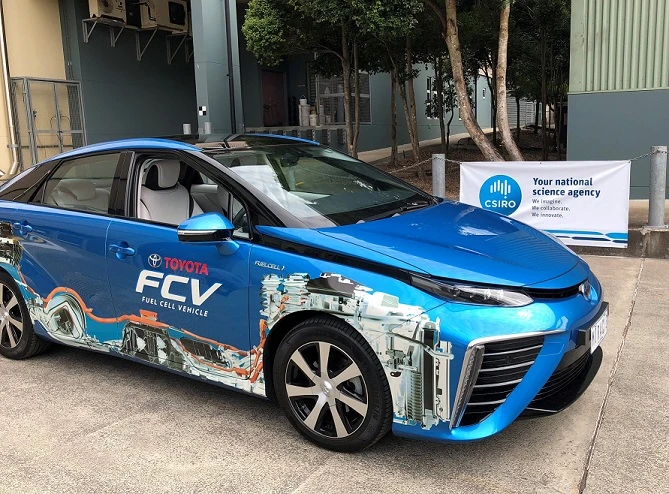
CSIRO’s Toyota Mirai HFC vehicle (image from CSIRO)
There are three possibilities when it comes to finding an alternative to the standard fossil fuels used in the majority of vehicles on the road. The first is a switch to biofuels (biodiesel, ethanol, etc.), the second is to go electric (the sexy new technology that’s mushrooming) and the third is hydrogen fuel cells or HFCs.
I discussed the basics of HFCs in my previous post. If you can’t remember or if you can’t be bothered hopping over to have a look, one of the points I raised was that most of the hydrogen gas used to power HFCs comes from natural gas, with methane (from sewage and effluent) coming in as the more sustainable second possibility. However, there’s another possible source of the hydrogen fuel that’s being worked on by our very own CSIRO researchers right here in Australia: ammonia.
Most of us are familiar with ammonia as the thing that makes floor cleaners (a) really cut through grease and (b) smell horrible. However, ammonia is also produced as a waste product by living cells and in humans, it quickly turns into urea and is excreted as urine. In fact, some of the pong associated with old-school long-drop dunnies comes from the urea in urine breaking back down into ammonia again (the rest of the smell comes from methane and some sulphur-based compounds, depending on what you’ve been eating).
Ammonia is chemically rendered as NH3, which should tell you straight away that there are three nice little hydrogen atoms just waiting to be turned into hydrogen gas; the leftover nitrogen is also a gas –and that’s one of the most common elements in the atmosphere (it makes up three-quarters of the earth’s atmosphere, in fact). Yes, ammonia in its pure form is a gas (the liquid stuff in household products is in the form of ammonium hydroxide or ammonia mixed with water). The fun here from the perspective of HFC technology consists of splitting the ammonia gas up into nitrogen gas and hydrogen gas, and then separating the two.
And this is precisely what the ammonia-to-hydrogen team at CSIRO have been working on. In August year, they made the big breakthrough by developing a membrane-based technology that will convert ammonia into hydrogen gas. The hydrogen gas can then be used by vehicles powered by HFC technology. The bit they’re all rubbing their hands with glee about is because up until now, one of the obstacles with getting HFC-powered motoring off the ground is that it’s hard to transport hydrogen gas from wherever it’s produced to the hydrogen equivalent of a bowser. However, ammonia is a lot easier to get from A to B. This means that with this home-grown technology, Australia will be able to export hydrogen (in the form of ammonia during transport) to the markets that want it.
Asia seems to be the hot spot for vehicles using HFC technology, with Toyota and Hyundai really getting behind the tech; European marques, on the other hand, seem to be concentrating on electric vehicles. In fact, Japan is eyeing up hydrogen as a source of energy for generating power for homes as well.
The question has to be asked where they’re going to get all this ammonia from. However, it’s possible to take nitrogen gas and water, then zap it with electrical current and turn it into ammonia – and it was an Australian researcher who came up with the tech to do this. It’s kind of like a fuel cell – which breaks down gas to produce electricity – but in reverse: using electricity to produce ammonia. The new Australian technology is considered to be an improvement over the traditional method of producing ammonia (which is needed for making the fertilizer that grows the food you eat), which takes hydrogen gas from fossil fuels and reacts it, spitting out a good deal of CO2 in the process. The new Aussie tech skips the bits involving carbon in any form, as it takes nitrogen from the atmosphere (N2) and water (H2O) and puts out NH3 and O2. O2 is oxygen – what we breathe.
The idea is that in the future, they’ll set up a plant or two in the middle of the outback where there’s lots of solar and wind energy available for generating electricity, pump in some H2O and get ammonia for export AND use in hydrogen cars thanks to the new membrane tech out the other end with zero carbon emissions. It could be asked where they’re going to get the water from in the middle of the Outback but I suppose that it’s not essential to use clean, fresh drinking water for the process, as it’s pretty easy to distil pure water out of wastewater. In fact, one has the very happy vision of a process that takes sewage from cities, whips out the ammonia, urea and methane already in there (bonus!), distils out the water for making more ammonia and exporting the lot; any solids can probably also be used for fertilizer.
It’s going to take a little while for all the systems to get into place. It’s still very early days for HFC vehicles but a start has been made and some of the hurdles have been overcome. A few HFC vehicles have made it onto these shores. The analysts say that it will probably take another decade or so until HFC cars become common on our roads but it’s likely to happen. Look what happened with electric vehicles, after all. Once they were really rare but now there’s charging points just about everywhere you look.
You can find more information here , here and here .
Hydrogen Fuel Cells – The Basic Facts
One of the more exciting vehicles that’s scheduled to come to Australia at some unspecified date in 2019 is the Hyundai Nexo – one of the vehicles recently awarded the Best in Class for all-round safety by Euro NCAP. This vehicle combines regular batteries with hydrogen fuel cell technology. Three vehicles made by major marques have been designed to run on HFCs: the aforementioned Hyundai Nexo, the Toyota Mirai and the Honda Clarity.
Hydrogen fuel cell technology is another option for overcoming our addiction to fossil fuels (the other two are biofuels and electricity). But what is hydrogen fuel cell technology and how does it work? Is it really that sustainable and/or environmentally friendly? Isn’t hydrogen explosive, so will a car running on hydrogen fuel cell technology really be safe?
OK, let’s start with the basics: how does it work?
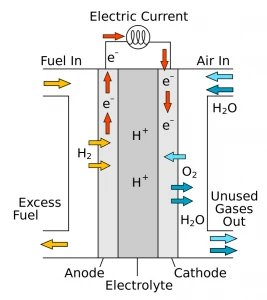
Diagram of a hydrogen fuel cell
A hydrogen fuel cell (let’s call it an HFC for short) is designed to generate electricity, so a vehicle that’s powered by HFC technology is technically an EV. A chemical reaction takes place in the cell and this gets a current going, thanks to the delicate balance between positive and negative ions (all chemistry is, ultimately, to do with electricity). How is this different from a battery? Well, a battery uses what’s stored inside it but an HFC needs a continual supply of fuel. Think of a battery as being like a lake, whereas the HFC is a stream or a river. The other thing that an HFC needs is something for the hydrogen fuel to react with as it passes through the cell itself, which consists of an anode, cathode and an electrolyte solution – and I don’t mean a fancy sports drink. One of the things that hydrogen reacts best with and is readily found in the atmosphere is good old oxygen.
Naturally, there’s always a waste product produced from the reaction that generates the charge. This waste product is dihydrogen monoxide. For those of you who haven’t heard of this, dihydrogen monoxide is a colourless, odourless compound that’s liquid at room temperature. In gas form, dihydrogen monoxide is a well-known and very common greenhouse gas, and it’s quite corrosive to a number of metals (it’s a major component of acid rain). It’s vital to the operation of nuclear-powered submarines and is widely used in industry as a solvent and coolant. Although it has been used as a form of torture, it’s highly addictive to humans and is responsible for hundreds of human deaths globally every year. Prolonged contact with dihydrogen monoxide in solid form causes severe tissue damage. You can find more information about this potentially dangerous substance here*: http://www.dhmo.org/facts.html
For the less alarmist of us, dihydrogen monoxide is, of course, H2O or good old water, like the stuff I’m sipping on right now on a hot summer day. Yes – that’s the main waste product produced by HFCs, which is why these are a bit of a hot topic in the world of environmental motoring.
OK, so air goes in one bit of the HFC, hydrogen gas goes in the other, and water and electrical power come out of it. The next question that one has to ask is where the hydrogen fuel comes from (this question always needs to be asked: what’s the source of the fossil fuel substitute?). The cheapest source of hydrogen gas as used on HFCs is natural gas, which is, unfortunately, a fossil fuel. So are some of the other sources of hydrogen gas. However, you can get it out of methane, which is the simplest type of hydrocarbon. Methane can be produced naturally by bacteria that live in the guts of certain animals, especially cows. Not sure how you can catch the methane from burping and farting cows for use in making hydrogen gas for HFCs. And, just in case you’re wondering, some humans (not all!) do produce methane when they fart. It’s down to the particular breed of bacteria in the gut (archaea if you want to be picky – they’re known as methanogens). They’re as common as muck – literally. So yes, there’s potential for hydrogen gas to be produced from natural sources – including from sewage. The other thing is that producing hydrogen gas from methane leaves carbon dioxide behind. But this has way less effect as a greenhouse gas than methane, so that’s a plus.
If you’re currently feeling that HFCs might not be quite as environmentally friendly after all and we all ought to drive straight EVs, then I encourage you to do a thorough investigation of how the electricity used to charge EVs comes from. It’s not always that carbon-neutral either. Heck, even a bicycle isn’t carbon-neutral because when you puff and pant more to push those pedals, you are breathing out more carbon dioxide than normal. All in all, HFCs are pretty darn good. The worst thing they chuck out as exhaust is water, and the hydrogen gas needed to power them can come from sustainable sources – very sustainable if you get it from animal manure and/or sewage, which also means that poop becomes a resource instead of a problem to get rid of. They’re doing this in Japan – and they’ve also managed to get the carbon bits of the methane to become calcium carbonate, which sequesters carbon and has all sorts of fun uses from a dietary supplement through to agricultural lime.
Another plus about HFCs is that they are a lot more efficient than combustion engines. A large chunk of the potential energy going in turns into the electrical energy that you want, which is then turned into kinetic (motion) energy by the motor so your car gets moving (or it turns into some other form, such as light energy for the headlights or sound energy for the stereo system). Some comes out in the form of heat. Combustion engines waste a lot of the potential energy in the form of heat (lots of it!) and noise (ditto).
The amount of electrical energy produced by a single HFC isn’t going to be very large, so inside any vehicle powered by hydrogen technology, there will be a stack of HFCs, which work together to produce the full amount of oomph you need. The fun part in designing a vehicle that runs on HFC technology involves ensuring that the stack has the oomph needed without being too heavy and working out where to put the tanks of hydrogen gas. However, this isn’t too hard.
The other problem with manufacturing HFC vehicles is that the catalyst inside the cells is expensive – platinum is common. This is probably one of the biggest barriers to the spread of the technology, along with the usual issue of nobody buying HFC vehicles because nobody’s got an easy place to get the gas from and nobody’s selling the gas because nobody’s buying HFC cars. They had the same issue with plug-in EVs too, remember, and we all know how that’s changed. However, last year, our very own CSIRO came up with some technology to get hydrogen fuel for HFC vehicles out of ammonia and they want to go crazy with this and use it all over the show. This is exciting stuff and probably deserves a post of its very own, so I’ll tell you more about that another day.
I feel in the need for some 1,3,7-trimethylxanthine theine combined with dihydrogen monoxide in solution with β-D-galactopyranosyl-(1→4)-D-glucose and calcium phosphate, also known as a cup of coffee, so it’s time for me to stop and to wish you safe and happy driving – hopefully without too much methane inside the cabin of your car on long journeys!
*Some people in the world have far, far too much time on their hands.
 Level 2, 9 Help Street