

Author archive
New South Wales and New Zealand: Spot The Difference

Thinking of heading across the ditch to New Zealand this winter for a spot of skiing or sightseeing, picking up a rental car so you can travel according to your own fancies? If you’re heading over from New South Wales, you’ll find that although a lot of things are the same when driving in New Zealand compared with back home, there are quite a few sneaky little differences that might trip you up. Most of the road rules and road signs will be familiar, but some aren’t and some are nonexistent. Here’s a handful of some differences you might notice:
Even in the middle of what passes for a city, there’s way less congestion. In the busiest parts of town during rush hour, you’ll get some congestion, but nothing like you’ll find in the middle of Sydney.
People don’t honk the horns half as much. OK, someone might honk if the driver at the front of the queue is naughtily on their phone or daydreaming and doesn’t notice that the light has turned green, but drivers seem more patient in, say, Christchurch than they are in Sydney and will jump on the horn a lot slower.
You don’t get handy “merge ahead” signs. Instead, you get Sign A in the diagram below. The idea is to “merge like a zip”, left-right-left-right, etc.
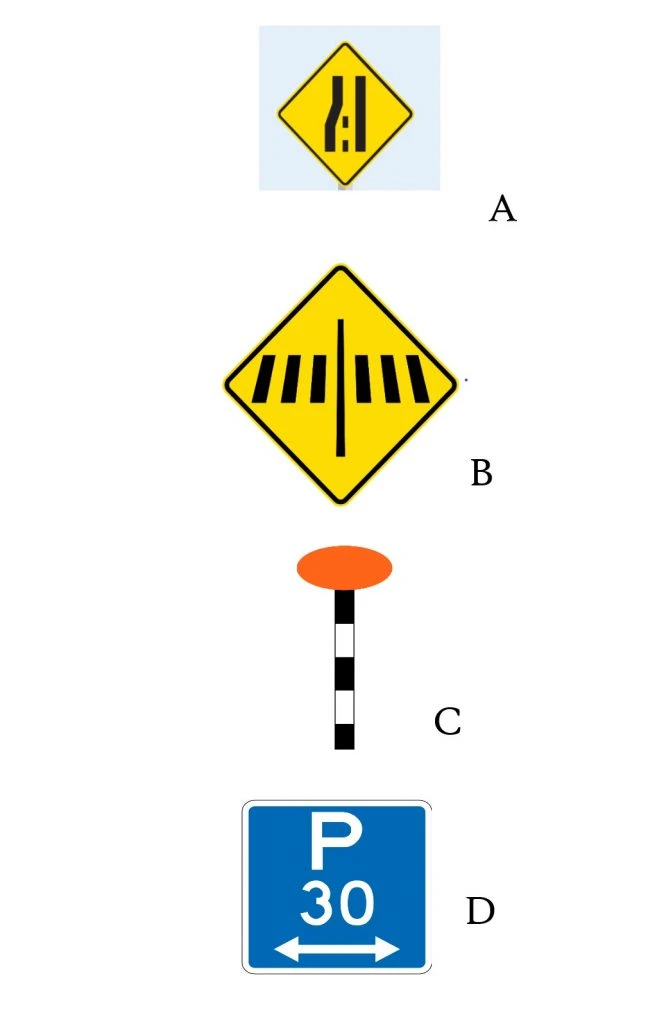
Pedestrian crossing (zebra crossing) signage is different. The familiar sign with the pair of walking legs isn’t on the zebra crossing itself, and you don’t get the zigzag road markings leading up to the crossing. Instead, you get the warning sign (Sign B), with an orange dot on a stripy pole on the crossing (Sign C).
Pedestrian refuge islands aren’t signed. This means that at any time a centre island divides two lanes of traffic, there could be a lurking pedestrian hoping to cross. Keep your eyes open (and the pedestrian will be doing the same). Refuge islands with designated cut-downs for pedestrians are common near roundabouts.
Parking limits are in minutes, not hours. If you got all excited about a sign saying “P5” or “P15”, believing that you’d be able to park there for 5 or 15 hours, I’m sorry to disappoint you. You’ve only got 5 or 15 minutes. If you’re lucky, you can find signs giving you 90, 120, 180 or 240 minutes of parking (if you look hard enough), meaning 1½ hours, 2 hours, 3 hours and 4 hours, respectively. Sign D is a typical example.
If you’re in an urban area, the speed limit is probably 50 km/h. There aren’t as many 60 km/h sections. Local traffic areas don’t exist, so assume that it’s 50 km/h unless told otherwise.
Even on the motorway, you won’t get to go 110 km/h legally. At the time of writing, the Kiwi Powers That Be are discussing the introduction of 110 km/h sections on some main motorways. However, this is still in the discussion stage, so if you head over this winter, you’ll have to keep your speed to a maximum of 100 km/h when in rural areas.
School zones don’t have the times handily displayed. If the signs are flashing, the reduced speed limit (either 30 or 40 km/h) applies; if they’re not flashing, the usual speed limit (usually 50 km/h) applies.
Speed cameras are sneaky. Permanent ones – and there are some – don’t have warning signage. There have been calls from lobby groups to introduce signs warning you that there are permanent speed cameras in position, but there aren’t any yet. You may, however, see some signs warning you about red light cameras. NZTA has taken to calling both speed cameras and red light cameras by the twee name of “safety cameras” but the majority of Kiwi think this is a cringeworthy attempt to not call a spade a ruddy spade. The NZTA Journey Planner website has a map showing you where the mobile ones are, so check this when you plan your journey (it’s a good idea to check it even if your right foot isn’t on the heavy side, as it will also tell you if roads have been closed or if there are major roadworks underway).
Witches’ hats everywhere. The roading contractors just LOVE witches’ hats and will put up heaps of them even weeks before the actual road works take place, and these will probably be the last thing they take away. They’ll also start appearing up to 1 km ahead of the road works (in rural areas). They’ll also put up insane numbers of the things. I have no idea what they’re thinking. Do they think that if there’s a car-sized gap in the middle of a long row of witches’ hats that I’m going to decide to cross the line? Incidentally, not many Kiwis will use the word “witches’ hat” but will call them a “road cone”. Near universities, you may spot some in unusual places, such as up trees.
Ferrari 2024 Le Mans: Two in a Row

That’s back-to-back for Ferrari at Lemans, having won last year and backing it up again just over the past weekend for 2024. If you look back over the list of winners at Le Mans, there have been numerous times that car marques have won twice in a row, even four or five times in a row, sometimes with the same driver. Only 14 seconds behind the Ferrari, Toyota was nipping at its heels the whole day, er… and night. It’s great to have a red car with the prancing horse back on top, Toyota having won 5 consecutive years running from 2018–2022.
So what makes the Ferrari 499P or Toyota GR010 Hybrid race car so fast? Great aerodynamics, strong reliability, excellent brakes, and epic performance. The Ferrari 499P uses a mid-to-rear internal combustion engine (ICE), as well as a front-mounted electric motor. These two powerplants combine to develop a maximum output of 500 kW to comply with the Le Mans race regulations of 29 Oct 2022. The front-mounted electric motor, rated at 200 kW, draws its necessary electric power from a Formula 1-derived 900 V battery that recharges during deceleration and braking. It provides power at speeds over 190 km/h. The hybrid power is linked and fed though to a seven-speed sequential transmission. The car was clocked just shy of 350 km/h, and the 0–100 km/h time takes about as much time as it does to complete this sentence!

Le Mans 2024 was the 92nd 24-Hour Le Mans endurance race, and the fourth round of the 2024 FIA World Endurance Championship. The race began on 15th June 2024 and ended 16th June 2024 at the Circuit de la Sarthe track in Le Mans, France, which, in its present configuration, is 13.626 km long, making it one of the longest circuits in the world. What makes this such an exciting event is that 85% of the lap time is spent on full throttle. This, of course, puts immense pressure on the engine and the drivetrain’s components, and only cars that can withstand this torrid test of reliability can make it through the race and perhaps even win. Brakes and suspension components also take a lot of abuse, as the race cars must slow from well over 300 km/h to around 100 km/h as quickly and as efficiently as possible to make it round the sharp corner at the village of Mulsanne.
Constant overnight rain created long periods where drivers were forced to drive with caution in the difficult conditions, thus having to limit their top speed at times. Ferrari were able to overcome the wet conditions at Le Mans 2024 to beat Toyota and win the 24-hour race, yet it was another Ferrari 499P that took out third place as well. It was as much a shout-out to the incredible skill of the drivers as it was to the marque. Porsche took out fourth position, coming just over a second behind Ferrari’s number 51 car, while Toyota’s number eight car finished an impressive fifth.

Campervan Conversions And #VanLife
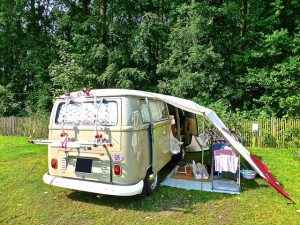
It’s perfectly possible to sleep in the back of most cars in a pinch, as long as the rear seats fold flat and you have a reasonable bit of padding underneath you and a pillow (speaking from experience here). However, I wouldn’t want to do it for more than a night or so in a row without very good reason. If you like to stay in campgrounds or in the middle of nowhere but don’t want to lug around a caravan, then possibly the answer is to build your own campervan, giving you more versatile motoring as well as the ability to take secure accommodation with you – and making it easier to find a park when you stop in to pick up supplies.
If you want to convert a vehicle to a campervan, you need to start with the right one. Vans are always popular and give you more floorspace and headroom in your mobile bedroom, but it’s also possible to convert a sizeable SUV or MPV.
Good vans for converting to a campervan include:
- Mercedes Sprinter (a popular choice for many enthusiasts)
- Ford Transit
- Fiat Ducato
- Toyota Hiace
- Hyundai iLoad
- VW Crafter
- VW Kombi – the classic retro campervan!

Good SUVs and MPVs for conversion are:
- Toyota 4Runner
- Toyota Estima
- Honda CRV
- Honda Odyssey
- Skoda Octavia
In fact, any decent-sized SUV or van or MPV can be converted into a campervan. Even some utes with a covered deck can be used as campervans. Some can even be converted into full legal motorhomes, as long as you meet the standards.
The simplest way to convert your vehicle into a campervan is simply to fold down the back seats, then toss in a mattress, a butane stove and some picnic plates, and you’re good to go. You may also be able to even remove the rear seats completely, although whether you can do and have a legally roadworthy vehicle will depend on which state you’re in.
Assuming that you can remove the rear seats permanently (or at least until your holiday’s over), then you can go one step further and build a bed platform, which will avoid the problem of weird niggly bumps under the mattress that will make you realize where that folk tale of the Princess and the Pea came from. The advantage of a bed platform is that you can store stuff under it (like your clothes and your cooking gear).
If you want more than a place to sleep and a place to stash clothes and food, then you can add all sorts of things. LED fairy lights and rechargeable batteries have made lighting a lot easier than it was when I was in my 20s, so don’t worry about installing fancy lights unless you’re super-keen. The upgrade that a lot of people like to go for is a loo of some sort; in fact, if you’re a New Zealander reading this, you have to have some sort of loo on board to get certification as a freedom camper. I’d add curtains as one upgrade, as cars and vans are usually built for visibility, which means that when you’re trying to sleep or get dressed inside the van, you’re still exposed to the outside world. Even if you are in the middle of nowhere and get changed in the dark, the light of the rising moon can still wake you up in the wee smalls (although an eye mask or a beanie pulled over your eyes can do the trick).
Ultimately, exactly what you want to put into your vehicle to convert it to a campervan will depend on what you want to do with it and how long you’re going to be doing it for. If you are currently without a permanent home and living the van life, like one of my nieces did, then something larger will make your life more comfortable. The big thing to remember, as with any DIY project, is to measure first and play around with squared paper (or a computer-aided design tool if you know how to use one) before you head down to Bunnings and start cutting up the timber.
To be legally classed as a motorhome in Australia, the vehicle has to be fitted with seats and a table, which need to be fixed (although fold-down tables are legit); storage (fixed), somewhere to cook (also fixed) and somewhere to sleep, which also – you guessed it – needs to be fixed. It also needs good ventilation and a fire extinguisher, and you need to stick with the weight restrictions for the class of vehicle. If you want to add anything fancy involving electricity, water or LPG gas, then this needs to be professionally installed and certified for your own safety as well as to meet the requirements. You can read the full requirements here.
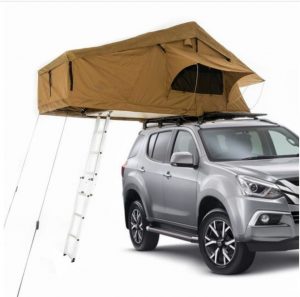
You can also take the easy option and simply add a rooftop camper to a ute or 4×4, which takes out a lot of the hassle of cutting, measuring and shocking the neighbours by what you say after hitting your thumb.
A Rally With A Difference that Makes A Difference

Bendigo to Pooncarie to Milparinka to Innaminka to Betoota to Isisford to Beylando Crossing and then to Townsville; now that sounds like an insane adventure! It’s an adventure just waiting for you to register, and it’s an adventure you could be on during 18th–26th October in spring 2024. Then there’s another one in autumn 2025. Are AWDs, 4WDs or any buses allowed on this rally? No, only vehicles with 2WD can be entered.
But that’s nuts! Yes, but it’s also a blast. These car rallies have been happening for quite some time now, and they were first brought into being by James Freeman. He is somewhat of a legend round these parts, as, sadly, James lost both of his parents to cancer just 12 months apart from each other. This was devastating and a really heavy burden for James to carry, as you can imagine, but James and his family nursed their parents through the last stages of their lives. In order to bounce back on top of things and to help him to make a difference, he carefully planned and instigated the first Shitbox Rally. The Shitbox Rally is a car rally that is all about having fun while raising money for cancer research.
Can I enter a new car that I buy from Private Fleet? No way! There is a $1,500 car value/budget rule, and it is the main rule that the Shitbox Rally organizers have stipulated. There are “penalties” for any cars not meeting the criteria! But yes, you can decorate your car. The crazier the decorations the better, and this is a big part of the rally’s fun. Just the bonnet and two front doors are needed for the rally sponsors’ and organiser’s stickers, so these are the areas you need to keep clear.
You do not have to have had a run in with cancer to enter the Shitbox Rally, but the truth is that many of the entrants have been affected by cancer in one way or another, whether it be from losing parents, family, or close friends from cancer; or people that they know of that have battled or are battling cancer. This car rally is all about raising awareness and money for the Cancer Council, but it is also about wanting to offer support and a friendly ear to those that have suffered or are suffering.
This sounds like my favourite sort of motorsport. This is not so much a race, but rather a challenge to achieve the unthinkable. That is to drive cars worth just $1,500 across Australia via some of its most formidable roads; and it’s all in the name of charity. I might see you there one day, as I line up in an old BYD Dolphin at the starting line of the mighty Shitbox Rally (at some point in the future, because these cars are brand new to the market at the time of writing). That might not go so well because I don’t think there’s many charging stations out there!
If you race me to the Shitbox Rally, then you’ll definitely have first bragging rights. What a blast!
Visit the official website at
https://www.shitboxrally.com.au/
 Level 2, 9 Help Street