

Author archive
Opening Windows Versus Air Conditioning
 When the weather gets hotter, it’s important to stay cool when you’re driving. However, these days, it’s important to consider fuel consumption as well and get the most out of what you’ve paid for – and what we’re going to talk about in today’s article applies to electric vehicles as well!
The two best choices for keeping cool inside the car are using the air conditioning system and the old-fashioned method of opening the windows (if you’re over a certain age, you’ll always try to pantomime cranking a handle to indicate opening a car window.). However, you may have heard people tossing around the idea that opening the window is less fuel efficient. Or you’ve heard that using the air conditioning increases fuel consumption. Which of these is true?
It is certainly true that running the air-conditioning puts extra demands on the engine and consumes more energy when it runs (and this is true of internal combustion engines, hybrids and electric vehicles). This means that when you ask the system for some nice icy-cool air to flow through the cabin and keep you fresh rather than hot and bothered, you increase your fuel consumption.
However, opening the windows affects the drag and aerodynamics of your car. When they design them and test them, designers try to get the drag as low as possible, and they study the way that air flows around the vehicle at speed (usually using wind tunnels as well as computer modelling). This is done to reduce the amount of friction affecting the car, because the more friction that needs to be overcome, the more energy will be required, which requires more fuel, etc. etc. All these tests assume that the exterior of the car is rigid. However, when the windows open, all bets are off and the equations go out the window (almost literally). The open window affect the flow of air, which is how opening the windows cools you down, but it also increases turbulence.
The big question is which is worse in terms of fuel efficiency. Sweltering in the heat just isn’t an option – that’s downright dangerous, especially given some of the temperatures reached in some parts of Australia during summer. So what does the fuel-efficiency-minded person do?
The windows versus air conditioning debate has been going on for some time. In fact, the popular TV show Mythbusters had a go at it. They got both guys driving around a track in similar SUVs, one with the windows down and one with the air conditioning on to see which one ran out of fuel first.
The one with the air conditioning did, which looked like that case should be closed, but it’s not as simple as all that. Firstly, the Mythbusters test wasn’t a strictly controlled one. Even two vehicles of the same make and model will perform differently, depending on a range of factors, including the condition of the engine and the inflation of the tyres. Secondly, the two presenters have different builds and probably have different driving styles, simply because they’re different human beings. To be a more rigorous scientific test, the only thing different should have been the choice between air con and windows open. In other words, the test should have been conducted with the same vehicle driven by the same person with exactly the same conditions – which possibly wouldn’t be the case if you only drove the car once with the air con on and windows up, then with the A/C off and the windows down, as the operating temperature of the engine (cold start vs. hot start) also affects the fuel efficiency. Lastly, one test isn’t enough in the world of science – one result could be just a one-off exception. The ideal is to run test after test after test and see what the general tendency is.
It also gets more complex than that. It turns out that the more aerodynamic a vehicle is to start with, the bigger the effect of drag will be. In other words, in a smooth, sleek sedan, the effect of opening the windows will be greater in terms of percentage than opening the windows on a big chunky 4×4.
To cap things off, speed also has an effect. This is because the faster you go, the more air resistance your vehicle encounters, so the drag increases, and they increase exponentially. This means that if you’re driving at 100 km/h, the effects of drag are four times greater than what you experience at 50 km/h.
The problem was put to a team of actual engineers who ran a proper scientifically rigorous test* to solve the problem. They used two vehicles, a 2009 Ford Explorer to represent the big SUVs and a 2009 Toyota Corolla to represent the sedans. They were tested in the lab and on the road at a variety of speeds and at idle. Here’s what they found:
- At 40–70 miles per hour (that’s 64.4–113 km/h), in both vehicles, turning the air conditioning up to the maximum (which is how they ran the tests) used more fuel than opening the windows.
- Above 70 miles per hour (113 km/h), the two cars behaved very differently.
- At 75 mph (121 km/h), in the Toyota Corolla, there was no difference between having the air con on and having the windows down.
- In the Toyota Corolla, at 80 mph and above (that’s 129 km/h – did they test this legally on an actual motorway or did they have their own circuit somewhere?), having the air conditioning on was more fuel efficient than opening the windows.
- In the Ford Explorer, having the windows down continued to be more fuel-efficient than using the air conditioning.
The study also tested the air conditioning at different settings other than full blast, but you have to pay to see those results!
Of course, not all cars are Toyota Corollas and Ford Explorers, and each has its own drag coefficient and intrinsic fuel efficiency. However, a good general rule of thumb is that if you’re travelling around town, windows down is more fuel efficient. In small sporty vehicles, using the air conditioning is best at open road speeds, but having the windows down is more efficient for big chunky ones.

Here, I will have to add that there are some other advantages of using the air conditioning rather than opening the windows. Firstly, if the outside air is already hotter than comfortable, you’ll only feel a small drop in temperature if you open the windows. It might not be enough to drop temperatures of 40° or more to a nice comfortable room temperature of 18°C. However, the air conditioning will really drop the temperature to this ideal level.
The other problem is that it isn’t just air that can get through the window when its open. Having half a swarm of bees going through the window isn’t the best for safe driving. Nor is having a wasp fly through the window a good idea. Worse still are stones flying up. I’m not making this one up. Last summer, when we were towing a caravan with the windows down and had pulled over to let someone pass, a stone flicked up, glanced off the wing mirror and flew through the open rear window and hit my adult daughter in the face. A freak accident, I know, but I know that from now on, both she and I will be using the air conditioning on the open road.
* Huff, S., West, B., and Thomas, J., “Effects of Air Conditioner Use on Real-World Fuel Economy,” SAE Technical Paper 2013-01-0551, 2013, https://doi.org/10.4271/2013-01-0551.
The Sound Of Silence
A vehicle with an internal combustion engine produces noise – to be precise, the engine produces noise. This is because when it’s working, the engine is continually producing controlled explosions that are used to power the vehicle. We’re all familiar with the different roars, growls and rumbles coming from different engines, with some enthusiasts being able to tell vehicles apart simply by their sounds – and some mechanics making their initial diagnoses on what the engine sounds like when it’s running. Quite a few of us have something of a fondness for different engine notes, especially those that produce low grumbling noises.
However, it’s a different story when it comes to EVs (here, we’re talking about battery electric vehicles or BEVs and hybrids when they’re running on their electric motor). Electricity makes no sound, so when an electric motor is running, there is very little noise produced. This could be though of as one of the advantages of an EV – and if you’ve tried to get some sleep when the local boy racers seem to be having a drag race on your street at 2:00 a.m., you’d probably agree. However, it can also be a disadvantage.
Pedestrians and cyclists rely on their sense of hearing a lot more than you think. Sound is often the first cue you get that a vehicle is approaching, and the sound also tells you whether it’s speeding up or slowing down, which way the vehicle is travelling and even how big it is. The art of using our ears to help us know when something’s coming is drummed into us ever since our first road safety lessons and the motto of Stop, Look and Listen.
Unfortunately, all this goes out of the window with EVs. When they’re going slowly (i.e., at below 18 km/h), they don’t make much sound at all and they’re practically silent, especially in, say, a busy supermarket carpark. At higher speeds, they aren’t so silent, as the sound of the tyres on the road (road noise) and the hiss and rush of air moving across the outside becomes a factor. Unfortunately, it’s in these low-speed environments that EVs and people are likely to come into conflict. And it can be quite dangerous.
 I know this by experience. I remember a few years back, I was coming out of a supermarket and was preparing to cross the bit where the cars move (you can’t really call it a road, but you know the bit I mean). I’d looked right and seen the road was clear, then looked left and seen that there were a few cars coming along. I looked right again and saw nothing coming on that side but saw a couple of cars as they went past and away from me. I didn’t hear anything coming from that side, so my brain told me that all the cars I had been waiting for had gone past, so I prepared to push my trolley forward. Peripheral vision kicked in just in time to stop me walking in front of an older model EV approaching silently.
I know it had to be an older model EV, as it wasn’t until 2010 that legislative bodies in Japan, Europe and the US listened to the concerns of the visually impaired and blind community and insisted that all new EVs had to have some sort of audible warning when travelling at low speeds (including in reverse).
I think most of us who lived through the era of audible reverse warnings are grateful that the manufacturers of EVs didn’t rely on beeps or something as annoying as a neighbour I once had in his car. His played a very tinny computer-blip version of Für Elise when reversing, and this irritating tune was practically my alarm clock when my neighbour reversed out of his driveway as he headed off early to work. Elon Musk typically suggested that Tesla models should be able to produce amusing sounds as a warning, such as bleating goats, fart noises or coconut shell clippety-clop sounds. The Powers That Be in Europe, however, cracked down on that suggestion and stipulated that these low-speed warning sounds had to sound something like an actual engine. This sounds like the Powers That Be lack a sense of humour, but there is some sense to what they’re saying. For one thing, we’ve all learned the sound of an approaching car engine, so it makes sense to have the warning sound telling us that it’s a car that’s coming and not, say, a goat. If every single EV had a different sound, we’d have to somehow learn to recognize and subconsciously identify those sounds as “car coming to my left; potential threat”. It’s also been suggested by an article in The New Yorker that the growl of an engine is reminiscent of the growl of a predator, possibly triggering something primal inside us. I’m also pretty sure that farting Teslas would be funny for about five minutes, but the joke would wear off pretty quickly and just become annoying.
The designers of EVs then discovered a whole new world: the art of making an engine-like warning sound that would do its job of letting cyclists and pedestrians know a car is coming without being annoying and, well, sounding right. We respond emotionally to sounds, so designers want to come up with something that is right for their brand and image. They’ve often teamed up with composers to do this, the most notable being BMW teaming up with movie composer Hans Zimmer (composer of the music for Gladiator, some of the Pirates of the Caribbean franchise and Man of Steel). It’s quite a process and is as much of an art as a science. Should the sound replicate the noise of an internal combustion engine perfectly, or should it sound high-tech like something out of a sci-fi movie? What frequencies and harmonics can be heard by everybody? What’s not going to send the driver nuts? How can they avoid making cities noisier than they have to be?
Here are three of the ideas that designers have come up with. Which one do you like the best?
Porsche Taycan Turbo S
Audi E-tron
Jaguar I-Pace
Simca: A Forgotten Marque?
The first car I ever owned was a Simca. Before I owned it, I had never heard of the marque, and my dad, who had helped me find this set of wheels to get me to a summer job, described it as the French equivalent of a VW Beetle or a Mini. After that summer of using the Simca to get to my holiday job, I ended up selling it and using the money to buy a fridge, which I needed for my new flat. I have never heard or seen any other Simcas since then. Needless to say, there is that part of me that, now that I have left my student days well behind me and am probably officially middle-aged, is kicking myself for selling it (the fridge is also long gone). Especially as now, it would be worth a lot more than a refrigerator, given that would have been a fairly rare classic car. The same could probably be said by most of us about our student cars.
I cannot remember the model of Simca that I owned. However, a quick crawl through the range of images online suggests that it was probably a 1000 or 1100. Given that the engine was at the front (I remember almost ritually checking up the fluids every week on a Thursday, opening the bonnet to do so), I can therefore conclude that it was a 1100, as the 1000 had a rear engine, like a VW Beetle.
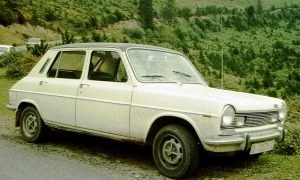
Simca 1100 – a wee trip down memory lane for me.
I have noticed blank looks similar to mine when I start talking about my first car. “Who makes that?” is quite a common question. As it would be nice to have a nice article to direct these dinner party guests to, I thought I’d put together a bit about Simca, what they made and what happened to them.
My father had called the Simca the French equivalent of the Beetle or Mini. He would have done better to say that Simca was the equivalent of the Fiat Bambina or Fiat 500. This is because the company, originally known as “Société Industrielle de Mécanique et Carrosserie Automobile” (that’s French for “Mechanical and Automotive Body Manufacturing Company”) was founded by Fiat in 1934 so they could outsource the production of their 508 and 518 models. Then World War 2 happened and Simca nearly went under, especially because of its Italian roots, and the Italians (under Mussolini’s Fascists) had been rather pally with the Nazis who had occupied France during the war. However, the company won a contract to repair US Army Jeeps, which put them on a sound financial footing.
For the next two or three decades, Simca grew slowly, although they were overshadowed by the better-known French marques, Renault, Citroen and Peugeot, especially Renault. However, it was successful in its home country, with the 1100 being one of the most popular cars in France by the late 1970s. Simcas were manufactured in a number of countries, including Australia, which is probably where the one I owned was made. The company also managed to take over the Talbot-Lago brand, with several Simca models also being sold with Talbot badging.
However, Simca was itself taken over, slowly and surely, by Chrysler. The American company bought a sizeable share of Simca in the late 1950s, although the company was still mostly a subsidiary of Fiat. Chrysler gradually edged Fiat out and took over the majority of shares in the 1960s. Finally, by the early 1970s, Chrysler took the company over completely and Simca’s name was changed to Chrysler France. The old Simca badge was phased out, with the last official Simca being made in 1973, which tells me that my car was older than me. After that, the cars made in Simca’s factories all had the Chrysler badge, including the Alpine and the Horizon.
I doubt I will try hunting down another example of my old Simca (presumably) 1100. If I were to look for a classic car, it would probably be something else, even though I thoroughly enjoyed driving my Simca, despite the lack of power steering and the fact that the speedo was in mile per hour, meaning that I had to do plenty of mental arithmetic during my daily commute to ensure I kept to the speed limit. However, given that Chrysler Europe was itself taken over by the Peugeot group in the late 1970s, I started speculated what the closest modern-day equivalent would be. I had a look at the latest offerings available from Fiat-Chrysler Australia (an appropriate blend of names, given Simca’s history) and decided that the closest thing was… the Fiat 500. Which is where Simca started, ouroboros fashion.

The Ouroboros – ending where it begins. Wouldn’t it make a great automotive logo?
Filled For Life? The Truth About Automatic Transmissions
“Oh, you don’t have to change the automatic transmission fluid,” he said. “It’s filled for its lifetime.” He was a university professor (in the field of biomechanics) so I assumed he knew what he was talking about. However, things didn’t go so smoothly when his automatic transmission tried to change gears later. Turns out that biomechanics experts aren’t actual mechanics!
The idea of having a fluid in your car that doesn’t ever need to be replaced or topped up sounds great. We should be topping up everything else on a regular basis, from the radiator to the window washing fluid to the oil. Not having to do this for the transmission fluids sounds almost too good to be true.
And you know what they say about things that sound too good to be true…
 The trap that a lot of us can easily fall into is the whole idea of the “lifetime” automatic transmission fluid. What does a lifetime actually mean? Does it mean forever until the end of the universe (short answer: no)? Does it mean for the rest of your lifetime? The car’s lifetime? Or something else?
It turns out that the lifetime in question is the planned lifetime of the car. This is not the same as the actual lifetime of the car. Car manufacturers, who are always coming out with nice new models want you to buy those nice new models. No harm in that and if you want a new car, why shouldn’t you get one? However, some manufacturers have a sneaky way to push you into buying a new car possibly sooner than you want to, known as “built-in obsolescence”. This means that the car manufacturers expect that a vehicle will wear out – and need to be replaced – at some point. You can get an idea of what the expected lifetime of a car is by looking at the warranty, which is either going to be the age of the car or the mileage. After the car has clocked up that many kms or that many years, you and the manufacturer can expect things to start showing a few signs of wear.
Don’t blame the car manufacturers too much for this. There is nothing that can be done about the law of entropy, and it’s in the nature of things to break down and wear out over time. You can see evidence of this fact when you look in the mirror (and the biochemist could tell you more about that in great detail). I know my face doesn’t look as smart and new as it did 15 or so years ago.
However, some of us like our cars and we’re rather fond of them. We don’t want to move on something as comfortable and familiar as an old friend. We would like to keep them for longer, thank you. There are those of us who are into classic cars, and there are those who, despite some of the great offers out there, are more likely to get a second-hand car that has passed the threshold of the magical number in the warranty. What happens then?
The fact is that you’re going to have to do something about the fluids in your automatic transmission. That fluid gets old and deteriorates over time, and when it does, then it won’t work as well as it used to… and neither will your automatic transmission. To keep the gears changing the way they should, then it’s time to do something about the fluid.
I don’t want to hear that line again about not changing the automatic transmission fluid because it’s got a lifetime guarantee. Remember those cheap watches that had a “lifetime guarantee”? That “guarantee” that meant that the watch wouldn’t break until it came to the end of its life, and you knew when it came to the end of its life because it would break, i.e., it was guaranteed not to break until it broke. The same thing applies here. The lifetime is the lifetime of the fluid, so it won’t need to be replaced until it comes to the end of its lifetime – which is shorter than the lifetime of the car, to say nothing of yours.
So what comes next? To flush or not to flush the automatic transmission, that is the question.
There’s a bit of debate about whether one should flush an automatic transmission, or whether it’s better to simply change the fluids. If you’re new to the world of motoring – which we all are at some point – then let’s start by describing the difference between them.
- Changing the fluids means that the old fluids are simply drained out without the help of any special equipment, new fluids are put in, then the filter is replaced and there you go. You can do this yourself. Some of the old fluid will still be left inside the system and will mix with the new fluid.
- Flushing the automatic transmission involves the use of a pump that will ensure that every single bit of the old fluid, along with any junk and debris that’s got caught in it, gets removed from the system and completely new fluids will be added.
You can get a rough idea of this by picturing a bottle of hand sanitiser or similar goop. Changing the fluids is like squeezing or pouring out the contents and putting fresh stuff in (try it; you’ll see bits of the old stuff stuck on the sides). A full flush is like giving it a full scrub out under the tap before putting new stuff in.
Some say that you should only change the fluid, as the forces involved in flushing can move that inevitable debris from the corners and get it into the working parts, which can damage the transmission. This argument has some weight to it, and the risk is real. However, a mechanic who knows what she/he is doing will have the right equipment and will be able to do it properly. Because this can be a bit pricey and it’s something of a deep clean for your car’s transmission, it shouldn’t be done that often. Have a look at the fluid in question. If its still a nice translucent scarlet, a flush isn’t needed. If it’s thick and black, then it’s flushing time.
Merely changing the fluids can be done more frequently – about every 2 years or thereabouts for your average driver. It will need to be done more often (as will a full flush) if you put your automatic gearbox through a workout on a regular basis – lots of towing or lots of very short trips being the main ways to stress the auto gearbox.
How often should you change the fluids in your automatic transmission or get it flushed? The answer will vary. However, one thing’s for certain: the gearbox is not filled for life and when it comes to automotive maintenance, listen to the person in the blue overalls with black smears, not the person in a white lab coat.
 Level 2, 9 Help Street