

Author archive
Private Fleet Car Review: 2018 Holden Equinox LT Diesel.
This review is a little different in that the difference between the Holden Equinox LT petrol we’ve reviewed and the Holden Equinox LT diesel is….the engine. And gearbox. Apart from that, there literally is nothing different about the car inside or out. Same interior trim, same annoying Stop/Start tech that canNOT be switched off manually, same reasonably attractive exterior. The link to that review is here: 2018 Holden Equinox LS Plus and LT petrol
What the diesel offers is a 1.6L capacity engine, with a six speed auto transmission only. The current RRP is $39,990 and that’s a three thousand dollar difference over the equivalent petrol version. Standard warranty is five years but Holden were offering a seven year package.
Peak power is 100kW, with peak torque being a very good (for the size of the engine) 320Nm. That’s a narrow maxium torque range, from 2000 to just 2250 rpm. Fuel consumption for the 1.6L in LT trim is a thrifty 5.6L/100 kilometres on the combined cycle. Go to the heavier LTZ & LTZ-V and that goes to 5.7L/100km or 5.9L/100 km. The six speed auto is also a standard auto, in that it’s a torque converter style, not a dual clutch or CVT. It’s an interesting drive setup; the traction control appears to have been formulated to allow some front wheel drive slip. Give the go pedal a good prod from stand still and there’s a noticeable scrabbling for grip for a second or two before the tyres hook up. Actual forward motion is deceptively quick. There’s a mild thrum from the front, which indicates there’s plenty of noise insulation and there is. There’s sheets fitted to the wheel arch and firewall, plus there’s a form of active noise cancellation too. The transmission selector is the same mechanism as found on the nine speed, with a rocker + and – switch for manual shifting. Like most well sorted electronic autos, there’s little to be gained in normal driving conditions by using the manual change. From a standing start and a low throttle application, the six speeder rarely disappointed. The diesel itself is throttle responsive, with a free spinning nature up to around 4000 rpm. Our real world drive, covering both urban and highway, saw a final fuel consumption figure of 6.1L/100 with a 75/25 urban leaning driving style.
Expect that figure to increase if you fit a towbar and utilise its 1500kg (braked) towing capacity. Bear in mind it’s a small diesel, not the bigger 2.0L or 2.2L (or even bigger) as seen in larger SUVs or utes. Other reviews seem to point out the relative lack of oomph from this engine but they’ve matched the 1.6L in the Equinox against 2.2L engines as found elsewhere. A fairer comparison would be against Suzuki’s excellent Vitara diesel. Although smallish, there’s still plenty of get up and go for when it’s needed. Roll off slowly and there’s quiet, unobtrusive changes and barely a hint of that traditional diesel rattle. Push a little harder and the changes are crisper, with the engine making itself known audibly but still quietly as mentioned. It’s really only when a heavy right foot is employed that the diesel really gets noisy and the six speeds seem to be lacking a cog or two or three.
Holden’s electronic engineers haven’t built in a feature to turn the Stop/Start mechanism off. The theory behind the feature is that it’s a fuel and emissions saver for when stopped at stop signs or red lights. the downside is that sometimes the car’s barely stopped before forward progress can be restarted. It can catch the car (and driver) unawares and sees the Equinox lurching forward, rather than moving smoothly. A little trick is that if the foot is lifted slightly off the brake pedal, it’ll re-engage the engine and still stop the car moving forward.
Ridewise it’s the same well sorted and compliant Australian tuned for Australian conditions ride as found in the petrol models. If there’s really anything that Holden should consider with the Equinox diesel, it’d be to evaluate having the nine speed fitted and calibrated to suit the specific torque delivery of the smaller oiler.
Another factor to consider is the forthcoming release of the Acadia, a larger SUV and a seven seater at that, helping Holden to re-target customers in the SUV market.
Contact Holden for more details on both and contact Private Fleet to see what we can do on a deal.
2019 Kia Sportage Has Arrived.
Korean car maker Kia has given its Sportage mid sized SUV a mid life makeover. There’s some exterior enhancements, interior updates, and changes to the safety packages.
Safety: Autonomous Emergency Braking (AEB) and Lane Keep Assist (LKA) are now standard across the range. Diesel transmission: an eight speed auto is standard for any diesel engined model.
The Si has as standard: ABS, ESC, Downhill Brake Control, Hill Start Assist, reverse parking sensors, rear view camera with dynamic guidelines, Lane Keeping Assist, AEB with Forward Collision Warning, High Beam Assist, 3-point ELR seatbelts in all positions, six airbags, front seatbelt pretensioners and load limiters, and impact sensing auto door unlocking.  Also standard on the Si is Apple CarPlay and Android Auto connectivity, engine immobilizer, remote central locking, 6-way adjustable driver’s seat, 6-speaker audio unit, cloth trim seats, rain sensing wipers, cruise control, power windows front and rear, Bluetooth functionality, 2.0-litre MPi engine or 2.0-litre CRDi engine, 6-speed automatic on petrol and 8-speed on diesel and 17-inch alloys with 225/60 R17 tyres.
 Next up is the Si Premium. Satnav is standard, as are front parking sensors, LED DRLs, 225/55/18 rubber and alloys, DAB and an eight inch touchscreen, plus ten years worth of SUNA satnav. SLi adds a tyre pressure monitoring system, powered driver’s seat that’s adjustable for ten ways, and LED rear lights. The GT-Line ups the ante even further with Blind Spot Detection, Rear Cross Traffic Alert, 8-way power front passenger seat, Intelligent Parking Assist System, LED fog lights, GT-Line sports pack (bumpers, side sill and grille), panoramic sunroof, flat-bottomed sports wheel with gear-shift paddles, wireless phone charging, heated and ventilated front seats, hands-free power tailgate, Advanced Smart Cruise Control, 19-inch alloys with 245/45 R19 rubber and LED headlights with auto levelling.
 Exterior design changes have the rear lights tidied to provide a more integrated look and better brake light visibility. LED lamps up front for the GT-Line provide a better lighting spread, plus the bezels for the fog lights in the Si and Si Premium have been sharpened for a more assertive road presence. Even the wheels have been changed in design for a new, fresh, look.
Interior room has been increased with a 30mm lengthening of the wheelbase. Overall length has moved to 4485mm, an increase of 45mm, with headroom and legroom increasing by up to 19mm. A subtle lowering of the bonnet’s leading edge adds to raising pedestrian safety levels. Underneath are changes that aren’t easily seen but will be noticed on road. Revised and relocated suspension components. The suspension bushes have been moved, wheel bearings have been stiffened, as have the bushings. The rear suspension cross member was also uprated to reduce vibration input to the cabin and the whole rear subframe has been mounted on uprated and isolated bushings.
Motorvation is courtesy of a 2.0L petrol four with 114kW and 192Nm of torque, 2.4L petrol with 135kW & 237Nm. The diesel is 2.2L of capacity with 136kW and a thumping 400Nm of torque. Pricewise: Si 2.0-litre petrol: $29,990. Si 2.0-litre diesel: $35,390. Si Premium Petrol: $32,290 (D/A $31,990). Si Premium diesel $37,690 (D/A $37,390).
SLi 2.0-litre petrol: $36,790. SLi 2.0-litre diesel: $42,190. GT-Line 2.4-litre petrol: $44,790. GT-Line 2.0-litre diesel: $47,690. Head to the Kia website
2019 Hyundai Santa Fe Is On The Way.
Hyundai‘s big SUV, the Santa Fe, has received a substantial makeover and it’s heading our way. The sheetmetal has been completely reworked, safety standards have been lifted, and overall ride & build quality has been improved. The Active petrol starts from $43,000, with the diesel at $46,000. The Elite kicks off at $54,000, and Highlander at $60,500, with these being the manufacturer’s list price. Here’s what we’ll be getting.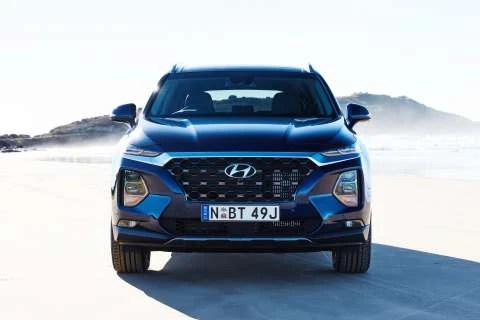 Santa Fe comes in three trim levels: Active, Elite, and Highlander. The Active offers a choice of a 138kW 2.4L petrol and six speed auto or a revamped 440Nm diesel and eight speed auto that’s new to the Korean brand and gears can be paddle shift selected. The petrol’s peak torque of 241Nm is available at 4000 rpm. The diesel offers the peak amount from 1750 to 2750 rpm. Economy for the petrol is quoted as a reasonable 9.3L/100km on a combined cycle. The Elite and Highlander are specced with the EURO 5 compliant diesel and is quoted as 7.5L/100km for the combined.
 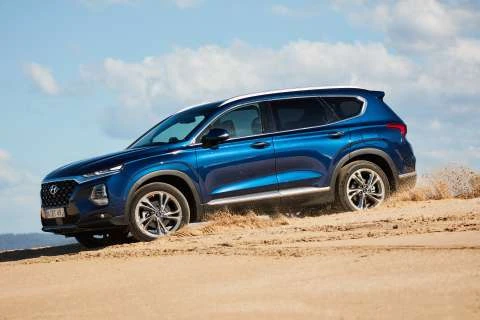 The exterior has been sharpened and flattened all around. Design cues from the Kona are strong, with the signature Cascading Grille, which is in a carbon effect finish on Elite and Highlander, split level lighting system being balanced via reprofiled tail lights which are LED lit in the Highlander. In between is a reprofiled body including a strengthened look to the wheel arches. Overhang at the rear has increased, and the overall length has gone up too. It’s an increase of 70mm to 4770mm and wheelbase size is also up, to 2765mm. Hyundai has also relocated the wing mirrors to the door panels.
 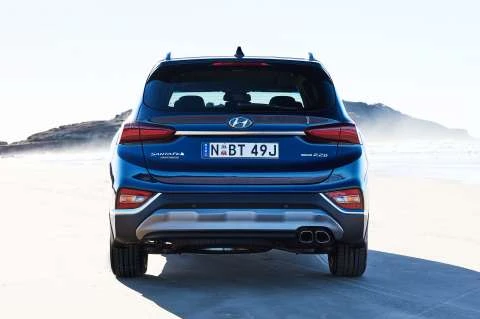 Height and width are impressive at 1680mm and 1890mm. Drive is courtesy of the HTRAC AWD system which is standard in all three and ride is thanks to revamped MacPherson struts and multilink rear. The HTRAC system comes in three drive modes, Comfort, Sport, and Eco, with torque being apportioned front or rear depending on which mode is selected. Sport has up to 50% shifted rearwards, Comfort up to 35%, and Eco goes to the front wheels. The rear has been stiffened and components realigned to provide more travel. Suspension rates have been further adapted for Australian roads so the Santa Fe will sit more comfortably on the road yet will follow contours precisely. Weight has been saved by utilising aluminuim for the front steering knuckles and rear carrier mountings for a total of 3.6kg and 5.6kg for each side.
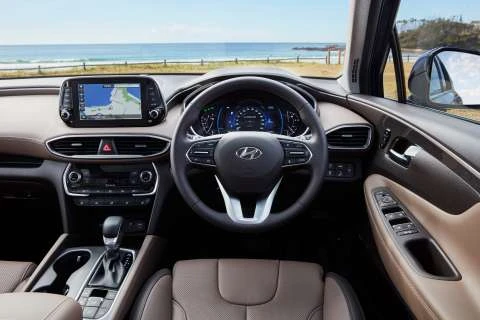 Safety has gone up a notch or two also. The physical structure of the Santa Fe has been improved with fifteen percent more high tensile steel and fifteen hot stamped components, up from six. Then there’s the standard list of equipment. Forward Collision Avoidance Assist (FCA) with pedestrian and cyclist detection (with autonomous application), Smart Cruise Control (SCC) with Stop and Go, Blind Spot Collision Avoidance Assist (BCA)Rear Cross Traffic Collision Avoidance Assist (RCCA), Driver Attention Warning (DAW), High Beam Assist (HBA), Lane Keeping Assist (LKA) are in all three.
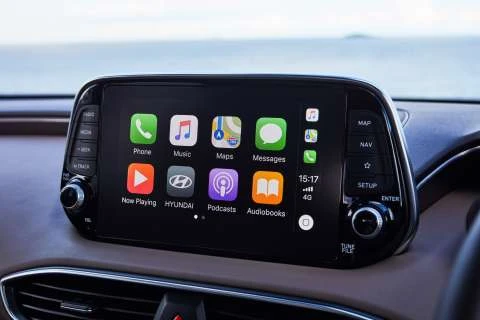 A couple of other nifty features are auto opening tailgates for the Elite and Highlander when the Smart Key is detected, and there’s a “Walk In” feature for the second row of seats that folds them flat, allowing easier rear seat access. The sound system in the Elite and Highlander is a ten speaker setup courtesy of Infinity. Highlander also features a smartphone charging pad for compatible items.
Head to Hyundai’s website for more information.
Private Fleet Car Review: Suzuki Vitara S Turbo All-Grip.
It’s been some time between drives with Suzuki’s cool and funky Vitara. A recent catch-up with the turbocharged petrol fed S Turbo All-Grip, one built in November 2016 and close to ten thousand kilometres on it gave us a chance to see how they’ve held together.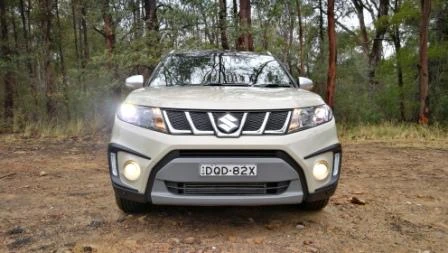 Sizewise the Vitara is a compact machine, with an overall length of just 4175mm. However clever packaging sees a wheelbase of 2500mm squeezed in. Breadth and height is decent too, at 1775mm and 1610mm. Up front is a 1.4L BoosterJet four, complete with 103kW and 220 torques from 1500 to 4000 revs. Transmission is a six speed auto and a torque split system to divert oomph from the front to the rear on demand.
 Having said that there is a drive mode selector button inside for Sports and Sand/Snow which lights up on the monochrome centre dash display. The switchover is seamless but the transmission was prone to stuttering and hesitation when cold. There’s a win for economy though, with a thousand kilometre week finishing on 6.1L of 95RON being consumed per one hundred kilometres. That’s from a 47 litre tank and pretty much on the money with Suzuki claiming a 6.2L/100 km for the combined cycle.
 Acceleration is pretty good, with that level of torque matching the light weight (1235 kg plus fuel and passengers). It’ll quickly and quietly drop a cog or two on demand and roll forward at speed easily enough. Overtaking then also becomes a simple matter of flexing the right ankle, and thanks again to its light weight, stopping is a brezze. Time and again the brakes would haul up the All-Grip with less than usual pressure but it helps when the pedal travel is intuitive and pressured well enough.
 It’s still the edgy yet slightly boxy shape that was available in the noughties, if perhaps somewhat more upright and squared off at either end. The front end sports LED driving lights in the lwoer quarters but also has globe lit driving lights that come on and override the LEDs when a switch on the indicator stalk is used. Hmm….The grille itself is a series of hexagons but it’s a solid sheet, meaning air is drawn in only through the lower extremities.
 Rubber is not off road suitable, even though the Vitara is, ostensibly, capable of light off-roading. They’re 17 inch Continentals with a 215/55 profile, wrapping five spoke black alloys. Dry weather grip is superb but in the wet weather they combined with the MacPherson strut front & torsion beam rear to feel skittish. The coil springs fitted to the Vitara S Turbo All-Grib are tuned for a more sports oriented ride, with a small amount of compliance dialed in to give comfort initially. As such the whole package needed dialing back on accelerator and steering input on Sydney’s greasy roads, just to be sure.
 Ride and handling is well sorted otherwise. It’s comfortable, if a touch taut. Bang crash is minimal on catseyes, speed reducing bumps in shopping centres, and the bigger road based bumps. Unsettled surfaces have the Vitara All-Grip unflustered and the suspension tune allows the dips and wallows to be flattened out with nary an intrusion felt past a momentary bump. Turn-in is precise and feedback is natural from the front.
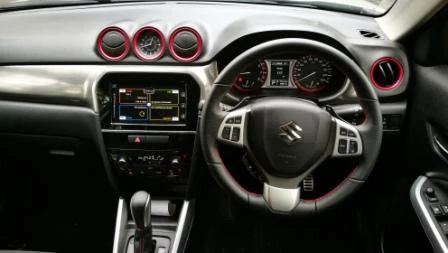 Inside is a compact but non-claustrophobic workspace. There’s splashes of colour such as the red ringed speedo and tacho displays matched by the simple twist and open airvents, a metallic grey insert on the passenger’s side of the dash, and alloy plastic touches on the tiller and gear selector. The radio is AM/FM only in this one, but partners with Apple CarPlay and voice command to provide interactivity. Satnav is standard across the Vitara range.
 Safety is high with seven airbags including a kneebag, with a full suite of traction control systems. Autonomous Emergency Braking isn’t fitted but remember that this car was built a year and a half ago from the review date. ISOFIX seat restraint points are standard. Hill Hold Control is also fitted to all autos and Hill Descent Control is available for the All-Grip. There’s parking sensors, rain sensing wipers and reverse camera as well.

Cargo space of 375L (seats up, 710L down) is compromised by virtue of the car’s smallish size. Pop open the non powered rear door and there’s a split level cargo area with blind. The lower level highlights a major safety issue common to almost every car maker. That is a space saver spare. Consider for a moment that the Vitara is an off/soft road capable vehicle so fitting them with a space saver is hardly sensible. Consider also the dry weight of the Vitara is only 1235 kilograms so a full sized alloy would have been a minor weight impost over a steel space saver.

The car was driven on a longish day drive to Canberra and return, copping a vee shaped construction nail in the right rear. Complicit in the situation was the suspension tune as there was no indication of a flat. There was no pulling, no drag, no obvious noise as such. The tyre itself looked initially to have been only a nail but upon being “deconstructed” showed a clear groove on the inside exterior where it had rode the alloy’s rim. This resulted in an unwelcome ninety minute delay at a certain tyre retailer. At The End Of The Drive.
Available in seven colours, the Vitara S Turbo All-Grip is currently available on a drive-away program at $33,990. It’s immensely good value, a comfortable ride, and in real terms ideal for a couple. Having piloted these cars before they’re borderline for a family of four outside of urban usage, again simply because of their compact footprint. Although rear legroom is adequate it’s the cargo area for baggage that holds it back and that’s unavoidable. But it IS a fun drive. Overwhelmingly so. It’ll be interesting to see what Suzuki does when its inevitable update comes along. Here’s where you can find out more about the existing model: 2016 onwards Suzuki Vitara
 Level 2, 9 Help Street