

Author archive
Greeted With Raptorous Applause: Ford Ranger Raptor
Anticipation can lead to either joy or disappointment. When it comes to the long anticipated Ford Performance Vehicles Ranger Raptor, so far it’s looking more of the former. Here’s what we know.
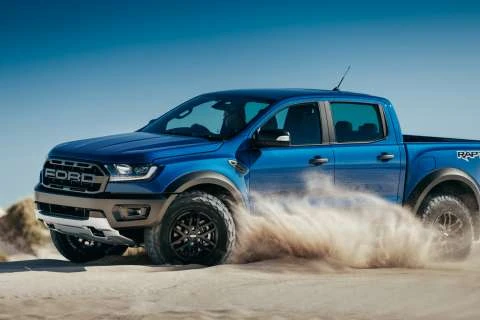
Engine: a 2.0L diesel provides peak power of 157kW and 500Nm (1750 – 2000 rpm)and means the Raptor will have plenty of bite, thanks to a bi-turbo system that will drink from a 80L tank. It’s EURO V compliant at 212 gr/km, will be offering a 8.2L/100 km fuel economy for the combined cycle, and see a top speed of 170 km/h. with a 0-100 km/h time of just over ten seconds. Good figures from a 2.3 tonne machine before fuel and passengers. The transmission is a ten speed (yes, ten speed) automatic with ratios picked to ensure quicker shifts and to be as close as possible to the right gear for the throttle setting. It’s good enough for a 2500 kilo towing (braked) figure.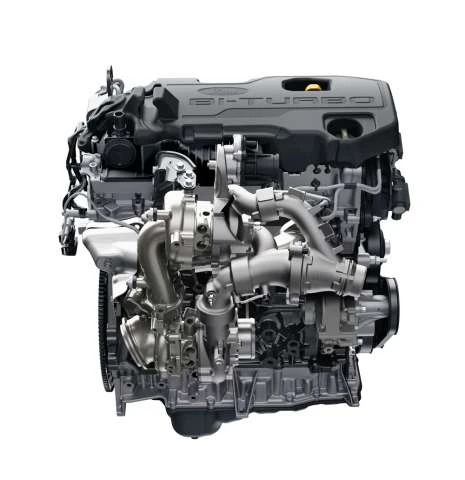 Chassis: 283mm of ground clearance, a broader track than the standard Ranger at 1710mm front and rear, and 285/70/17 wheels & BF Goodrich All Terrain rubber, specially made for Raptor, combine with composite material front fenders and a bumper with integrated LED fog lamps to provide an assertive on and off road presence. Turning circle is a tight 12.9 metres. The load tray is 1743mm in length and 1560mm in width on a 5398mm long body. Maximum width is2180mm with the mirrors out.
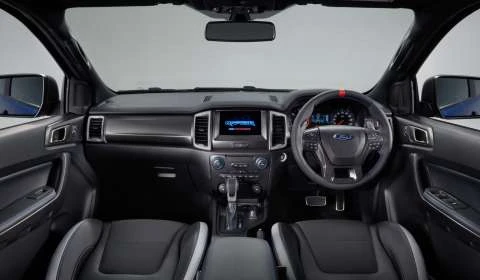
 Inside: a bespoke interior with blue stitching, leather highlights and “technical suede” for extra lateral grip, a rejigged look to the instrument bezel, and perforated leather sections on the steering wheel make for a classy cabin environment.
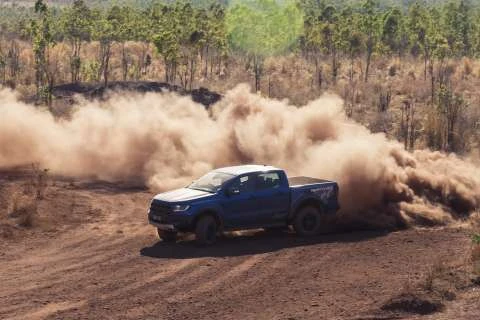
 Ride and Drive: There’s a Terrain Management System, TMS, which includes a Baja mode. This sharpens up the engine and transmission and blunts the intrusion of the traction control to give a driver a real off-road experience. It’s a pair of Macpherson struts up front and Ford’s tried and true Watts linkage at the rear.
 Brakes: Plenty of swept area on the discs means plenty of stopping power.332mm x 32mm up front and 332mm x 24mm at the rear meet a 54mm caliper. They’re bolted to Position Sensitive Dampers that provide, at full extension and compression, a higher level of rebound force. Mid range damping force is specifically tuned for comfort during normal driving.
Extras: A “breadcrumb” feature in the satnav allows drivers to backtrack the way they came when in areas that may not be included in the mapping system. There’s a Rollover Mitigation System to deal with the 32 degree approach, 24 degree departure, and 24 degree break over angles.
DRIVER ASSISTANCE AND CONVENIENCE TECHNOLOGIES
Adjustable speed limiter, Auto lighting, 25W HID headlights with LED Daytime Running Lamps, LED Fog Lamps, cruise control, Electronic Automatic Temperature Control, Electronic Stability Control, Passive Entry Passive Start (PEPS), Rear Parking Sensors, Lane Departure Warning, Lane Keep Assist, Hill Start Assist (HAS), Hill Descent Control (HDC), ESC system with Trailer Sway Control (TSC), Load Adaptive Control (LAC), Roll Over Mitigation (ROM), Traffic Sign Recognition, Steering Wheel Paddle Shifters, Part time 4×4 with Terrain Management System, Unique Transmission Calibration and “Live in Drive” Functionality, rain sensing wipers, rear view camera, Roll Stability Control
SYNC 3 with touchscreen navigation, Auto Start/Stop.
2018 Kia Picanto GT-Line
What do you do to improve your baby city car? New wheels, some exterior garnishes, additional lighting and a cool exterior colour. What don’t you do to improve your baby city car? Give it more grunt and change the gearbox is what. And that’s exactly what you’ll find with Kia‘s otherwise good looking Picanto GT-Line. Quite frankly it’s a wasted opportunity from the Korean car maker. We’ll cover that off later in more detail. What you do get is the standard 1.25L petrol fed four, a four speed auto, 62 kilowatts and 122 torques at 4000 rpm. Fuel economy is, naturally, great at 5.8L/100 km of normal unleaded for the combined cycle from its 35L thimble. Consider, too, a dry weight of 995 kilos before passengers etc. Kia’s rationalised the Picanto range to a simple two model choice, the S and the GT-Line. If you’re after a manual the S is the only choice. Price for the GT-Line is super keen at $17,290. Metallic paint is a further $520, taking the test car’s price to $17,810.
 It’s a squarish, boxy, yet not unappealing design, especially when clad in the silver grey the test car has. Called Titanium Silver it’s more of a gunmetal grey hue, and highlighted by red stripes at the bottom of the doors, red rimmed grilles for the airvents and the lower section is splashed with silver around the globe driving lights. The grille itself is full black and the angle of the grille combines with the laid back styling of the headlights (with LED driving lights) to provide an almost Stormtrooper look. At the rear the neon light look tail lights complements the twin pipe exhaust. It’s a cool and funky look.
 Kia has upped the 14 inch alloys to classy looking eight spoke 16 inchers. Rubber is from Nexen and are 195/45. As a package they look fantastic. Going further is the grip level. For a vehicle that’s a long way off from being a sports car it has some of the most tenacious grip you’ll find under $30K. AWT’s Blue Mountains lair is close to some truly good roads for handling and ride testing. On one particular road, a specific one lane and one direction (downhill) road, the slightly too light steering nevertheless responds to input cleanly and succinctly. Cramming a 2400mm wheelbase inside an overall length of 3595mm helps, as does the low centre of gravity. It’s a throttle steerer too; come into a turn and back off, let the car make its own way and feel the nose run slightly wide. Throttle up and the nose settles, straightens, and all is good with the world. Body roll is negligible and direction changes are executed quickly, Braking from the 254mm and 236mm front and rear discs is rapid, stable, and quick.
 Ride quality from the Macpherson strut front and torsion beam rear is delightful for the most part. It does lend towards the taut and tight side and that could also be attributed to the lower profile rubber. Yet it’s never uncomfortable in normal and everyday usage. Hit some ruts or ripples and it’s here that the Picanto GL-Line gets flustered. The short travel suspension will kick back at the chassis and the car will, momentarily, become unsettled. On the flat it’s composed and will provide a comfortable enough ride but with any undulations may get a little choppy thanks to the short wheelbase.
 It’s on overtaking or uphill climbs that the drive-line shows its Achilles heel. Kia seems to be the only car maker that has stayed with a transmission so archaic and out of step with the industry. For both versions of the Picanto, as much as many loath them, a CVT would be a better option. For the GT-Line, and emphasis on the GT, a turbo engine such as those found in the Suzuki range or even Kia’s own tech would be a better option. Although our test drive finished on a commendable 6.6L/100 km, an extra cog or two would help that and make the Picanto a far more enjoyable car to drive.
 Inside, too, could do with a lift. Although there’s piano black door inserts with hints of red striping, and red highlights on the driver and passenger seats, the rest of the cabin, complete with Cadillac tail-light inspired air vents, lacks real cache compared to the opposition. Considering its size there’s adequate room up front, barely enough for the rear seats, and a 255L cargo space over a space saver tyre that’s fine for two people shopping wise. All good however the standard all black theme would greatly benefit from strategically placed dabs of colour.
 However, there’s an Audi style touchscreen mounted on the upper dash edge. Android Auto and Apple CarPlay are on board but satnav isn’t, meaning you’ll need the smartphone connection for guidance. It’s AM/FM only, so misses out on DAB. The 7 inch screen is clean and user friendly, as is the driver’s view. Simple and unfussed designs work best and here Kia has nailed that. Two dials, speed, engine revs, fuel level and engine temperature. Simple. A centred monochrome info screen with information made available via tabs on the steering wheel. Simple.
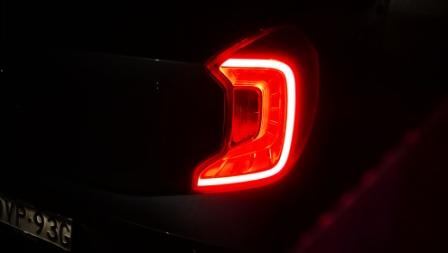 Small in size the Picanto GT-Line may be but it doesn’t lack for tech. AEB or Autonomous Emergency Braking is standard, as are Euro style flashing tail lights for the ESS or Emergency Stop Signal. Add in six airbags, vehicle stability management, Forward Collision Warning, and it’s pretty well covered. It does miss out on Blind Spot Alert and Rear Cross Traffic Alert though, but rear sensors are on board. This is all backed by Kia’s standard seven year warranty and fixed price servicing that will cost just $2552 over seven years.
At The End Of The Drive.
The Kia Picanto and the 2018 Kia Picanto GT-Line represent astounding value. Consider a RRP of $17,810 plus on roads, a decent set of safety features, and that could be better than it is fuel economy, and it’s a walk up start for anyone looking for a city car that’s a good looker, a sweet handler, and will have enough room for a average shop for one or two people. Our shop for four filled the boot and required only a bag or two to be relocated to the back seat. Kia’s Picanto is a very good car, but a real need for change in the engine and transmission would make it better. Yes, it’s economical but could be better. Drive one and make up your own mind or have a look here 2018 Kia Picanto info to find out more.
German Odds And Ends: VW Crafter Van & Audi TT
They’re the lifeblood of the small courier driver business, of the larger postal delivery services. LCVs or Light Commercial Vehicles come in various shapes and forms, including the van. There’s plenty to choose from and Volkswagen has just made that choice even more difficult.
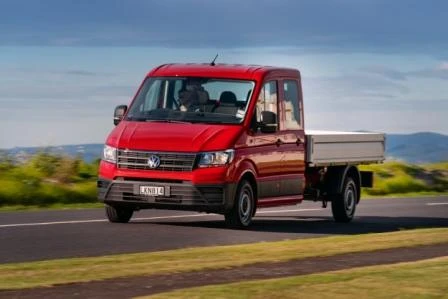
The Crafter range offers a more car-like experience both inside and out. There’s the Medium wheelbase, Long wheelbase, Long wheelbase with Overhang, the cab chassis versions in both single and dual cab options and with single and dual rear wheel designs. All up a new Crafter comes in a minimum of 36 versions but with 4 body styles, 3 lengths, 3 heights there’s a total of 59 derivatives including front wheel drive, rear wheel drive, and 4MOTION all wheel drive. The starting price for the immense range is for the Crafter 35 TDI340 LWB (Long wheelbase) SCC (single cab chassis) 8 Speed with auto and FWD at $48,290. Just two hundred more sees you in the Crafter 35 TDI340 MWB (Medium Wheelbase) Van 6 Speed Man ‘RUNNER’ front wheel drive.
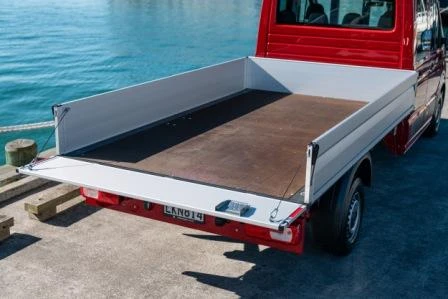
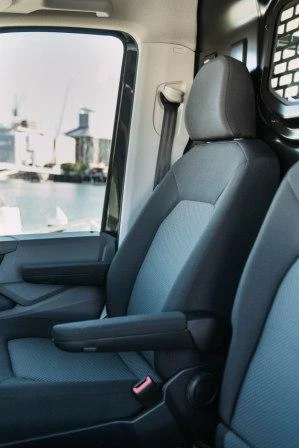
There’s different load capacities that are dependent on which drive configuration is chosen. Tick the front-wheel drive option and there’s a cargo capacity of up to 18.4 cubic metres and a maximum cargo space height of 2196 mm. Total permitted weight is between 3.55 to 4.0 tonnes. Load width between the wheel arches is 1380 mm and cargo space length is 4855 mm. Have the driven wheels at the other end and the permitted total weight ranges from 3.55 to 5.5 tonnes. The load width on the heavy vehicles with dual rear wheels has been increased in comparison to the previous model by 402mm, thus allowing it to be loaded using a wider range of standard carriers.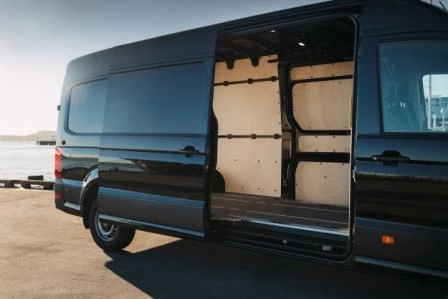 Inside it’s a more comfortable workspace. LED lighting has been fitted, the base model has four way electric adjustment and there’s a higher level of comfort available. Called ergoActive, it’s part of a German health and safety campaign to help drivers look after their postures and driving positions. Central locking is standard, dual zone climate control is available, and the Trendline package offers extra features such as a second 12V socket, chromed highlights, and front fog and cornering lights.
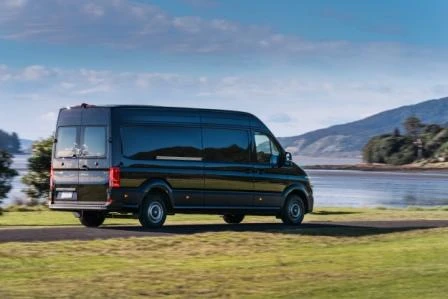
Dimensions wise there’s the medium wheelbase 5986mm, a long wheelbase at 6386mm, and the overhang version with 7391mm. Engine wise there’s a 2.0L diesel that offers either 340Nm or 410Nm. More features and details will be released in coming months. Head to Volkswagen Australia for more information and to register for updates.
Audi‘s iconic TT coupe made its world debut in 1995 and was available for sale in 1998. The 2018/2019 update brings exterior and interior changes, and updates to the drivetrain. There’s a six speed manual, and a new seven speed DCT or dual clutch auto. The S Line package or magnetic ride drop the ride height by 10 millimetres and work with the progressive steering and four link rear suspension to further enhance the already fluid handling.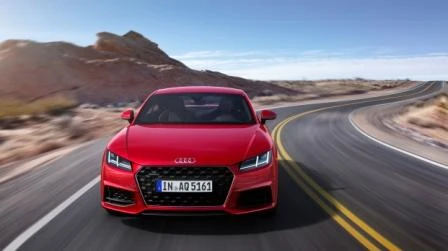
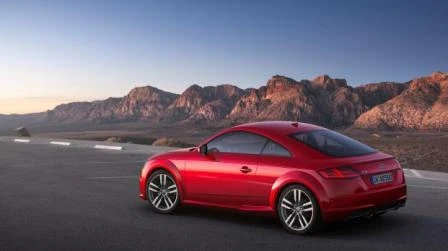 Standard wheels are 17 inches in diameter, with 18, 19, and 20 as options. These complement the redesigned front and rear, with interior features accessing the Audi drive select dynamic handling system that’s available from the base model, a rain and light sensor, heated exterior mirrors, and the multi-function steering wheel plus This allows the infotainment and voice control system to be controlled entirely using the steering wheel. Also standard are the illuminated USB ports as well as Bluetooth for wireless pairing of devices. The front has a more assertive grille and is flanked by stylish air vents with the rear featuring a subtle work-over to the classic lines.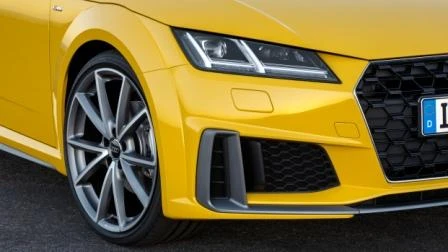
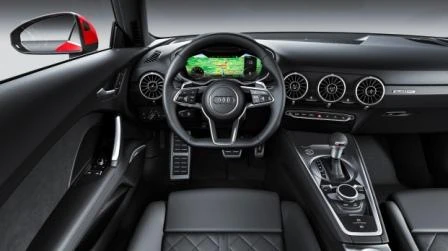
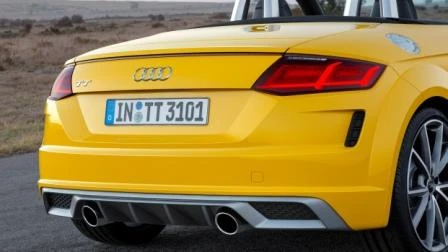 The new TT is due for Australia in the first six months of 2019. Head to Audi Australia to register your interest.
Private Fleet Car Review: 2018 Jeep Compass Limited
Jeep. It’s a name that’s synonymous with unbreakable cars, uncompromising off road ability, and being uniquely American. Well, once. Any Jeep labelled TrailHawk is still uncompromising in its ability to deal with mud, snow, sand, gravel, as easily as the tarmac, but not all Jeeps are unbreakable and not all Jeeps are American. I reviewed a Jeep a couple of years that refused to play ball. It was a time when quality control wasn’t part of the first sentence in how to build one. Thankfully it seems those times are well and truly past as our Indian built 2018 Jeep Compass Limited with 2.4L petrol fed “Tigershark” engine proved.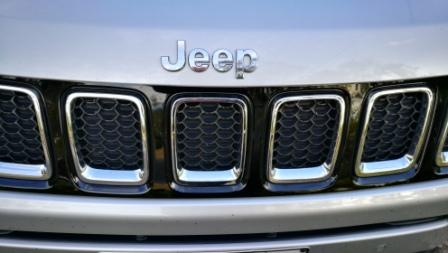
 The time the Compass Limited spent with us coincided with a trip that would ultimately cover 1150 kilometres. This would start at AWT’s Blue Mountains based HQ, south via Goulbourn and Queanbeyan, east of Canberra, to Cooma before overnighting at the Aalberg Chalet. Mine hosts were Ulla and Lindsay, an engaging and effervescent couple, providing an atmosphere of welcome and warmth. From there a few hours at Thredbo for ski lessons for my junior staffers, before a drive along the “Barry Way” via Dalgety, the Boco wind farm, and the parched depths of the NSW plains before our eastward bounds journey had us in Bega for one night. From there is was north through Narooma, Ulladulla, and Nowra, diverting through the gorgeous Kangaroo Valley and marveling at the once ocean floor cliffs before rejoining the Hume on our way home.
 The Compass sits above the Renegade and below the Cherokee in Jeep’s substantial range. A choice of four trim levels are available, with Sport, Longitude, Limited, and TrailHawk on offer. The Compass Liited has a 2.4L petrol engine named Tigershark, or the preferred for long distance haulage diesel. The petrol engine has 129kW, 229 Nm, and a nine speed CVT auto. Fuel consumption is quoted as 9.7L/100km on a combined cycle from the 60 litre tank and 7.4L/100 for the highway. AWT’s best figure was 8.6L/100km on a purely highway driven cycle. This was with four up and the cargo area filled with three bags/travel cases. The petrol Limited’s weight is 1503 kilograms dry.
 Our journey starts with an eastwards bound run from the lower Blue Mountains to one of Sydney’s orbital freeways, The M7 takes drivers south towards the city bound M5 or the Canberra and beyond Hume. What’s immediately noticeable is suspension tune. It leans towards the harder side of compliance, and there’s an initial feeling that tyres were at the wrong pressure. That didn’t turn out to be the situation. What was also becoming clear was the lack of torque at low revs. On the flatter country roads it would purr along in a quiet, unfussed, manner. Thew CVT changes smoothly, unobtrusively. Heading towards Goulbourn, around two hours drive south of Sydney. there’s some good long gradients that test cars and with that peak torque available at 3900 rpm it needs a hefty shove on the go pedal to get the engine and transmission to drop back enough to get close to that rev point. Forward motion slows appreciably and in order to keep safety up for traffic flow, more pedal is needed.
 Downhill runs have the CVT finding itself in a cog and holding that, using the engine as a braking device. This would be ideal in a hybrid to charge batteries but it’s disconcerting in the Compass as it holds revs in the upper range. There’s a little more effort than expected to move the gear selector left to engage manual shift mode and override the computer’s selection choice. The movement isn’t silky smooth either. The same applies to the indicator stalk, mounted on the left hand side of the steering column in this case. There’s a plasticky click to engage but there’s an upside. Just about every other car maker has a soft touch program that indicates just three times. the Compass Limited’s blinker count is five.As the journey progresses south what also becomes noticeable is the lack of real road safety shown by far too many other drivers. NSW and the ACT have a myopic focus on speed as to why people crash. By the time a stop at Lake George, twenty or so minutes north of Canberra is undertaken, the amount of vehicles successfully completing a safe lane change is one. That’s the Jeep.
 The all purpose rubber fitted, Bridgestone‘s Turanza, with a 225/55/18 profile isn’t a fan of the rougher road surfaces and transmits that to the cabin via the MacPherson strut front and Chapman front rear. Get onto the smooth blacktop and the noise level drops dramatically and the ride becomes far more enjoyable too. Queanbeyan and it’s an 80 kp/h limit. The Compass Limited exercises her brakes here more than anywhere, with traffic lights and roundabouts working together to not make a fluid traffic flow possible. Unexpectedly the initial feeling of the seats being hard and lacking in support is slowly being disproved, with no real sensation of seat cushion related fatigue. The storage nook based under the passenger seat cushion is handy too.
Outside temperatures vary along the way. Countering that is the Jeep’s electric seats (quick, thankfully) and dual controlled climate control. There’s dial or icons on the eight inch touchscreen which are well laid out, simple to use, and efficiently effective. Economy has stabilised at 8.6L/100 and a pitstop for a break and top up has been undertaken. Mid afternoon has Cooma through the front windscreen. We’re in a convoy that includes an Audi Q7 and Ford Territory, driven by people that have no sense of road manners or safety. One overtaking lane has a Range Rover and Corolla ahead of the Jeep, with the Corolla inexplicably moving right, forcing the Rangie to brake momentarily before scooting past the left side of the Toyota. This has allowed us to do the same as the Corolla is clearly struggling. However again that lack of low rev torque is appreciable but the cams come on song at around 3500, and there’s a noticeable in the Jeep’s behaviour. It’s needed as the Q7 ranges up behind the Corolla before a sudden non indicated dart left to take up position a foot shy of the Compass. The merge lane to one lane is here and all of a sudden the Territory is almost buried in the Corolla’s rear, with the driver having no apparent sense of when to brake appropriately. The Jeep’s overall drive and safety package have been tested and passed.
Jindabyne and the twisting downhill run to the picturesque town has the steering come alive. Electrically assisted it’s light enough to not feel it is out of touch with the road, and weighty enough to provide a real sense of communication between car and driver. The CVT appreciates this sort of road more, and works in concert with the accelerator to be where it should be gear wise. Being a vehicle that has a 4WD mode that splits drive front and rear on demand, the predominantly FWD bias has the Compass track wide only occasionally. This requires naught more that a tap of the brake or accelerator to bring the nose back on line.
Finally it’s time to exit the Compass Limited and it’s a chance to appreciate the cabin ambience. There’s the natural level of fatigue after six hours of travel and breaks, but none extra from the seats and ride. The dash dials have a slightly old fashioned style of font for the numbers, with small LED light points spread around the dials. In between is a colour LCD screen, as is standard in just about every car, offering trip info, average and on demand fuel usage, and more. The rear seat passengers have enough leg room even with the adults pushing their seats back. Rear seat passengers also get a USB point, handy for the older but not yet teenaged ones. There’s a ski-port fold out cupholder for them as well.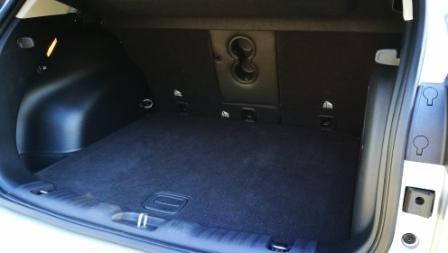
 The front seat passengers have an elegantly designed dash to look at and feel. Soft touch materials abound, the trim is subtle, tasteful, and there’s plenty of room for legs, heads, and shoulders. A centre console mounted drive selector dial gives the Compass Limited some off road prowess including Snow, Sand, and Mud. All round vision is excellent and ergonomics including a push button start where one would find a keyhole makes the process natural and intuitive. It complements the redesigned exterior, aligning the Compass range more with the Cherokee and Grand Cherokee appearance. Audio is superb and well balanced, with the DAB tuner more sensitive than others, thankfully. What was noticeable was a lack of height adjustment for the passenger seat.
 It’s clearly not a big vehicle, making the interior packaging all the more remarkable for its successful implementation. The Compass is just 4394mm long, 1819mm wide, and stands 1644mm tall. It packs in a 2636mm wheelbase and has a stable chassis thanks to the 1550mm and 1546 mm track font and rear. This gives the Compass excellent cross wind stability and helps the compact SUV in its high levels of agility both off and on road. A 212mm road clearance allows for some good running on those tracks well beaten, plus the approach and departure angles of 16.8 and 31.7 degrees, it’s able to handle a good coverage of terrain.

 Although Thredbo was cold, it wasn’t overly endowed with snow. This unfortunately didn’t give us a real chance to try the Snow mode for any length of time. However some drifts were found and a simple flick of the drive dial had the Compass Limited crawl its way out without issue. Where the Compass Limited shine came later. From Jindabyne and along the Barry Way the road and terrain is tight, testing the handling and ride. The vistas are incredible, with ridge high roads providing unparalleled views all around. Sadly this meant that the view provided evidence of the terrible drought the farmers are enduring and all too often the tragic signs in a paddock were evidence of this.
The flat runs were fine for the auto and engine, but any uphill runs tasked the combination time and again. Anything over four thousand rpm and the noise was thrashy, whiny, and the Compass Limited really struggled to maintain forward momentum, even with the torque coming on stream. However there’s no doubt that with a lighter load the effort would, naturally, be less evident. Evidence of power was seen on the horizon, with a wind farm coming into view and the road would take the Compass directly between the line of the Boco Wind Farm. Almost silent, the huge turbines swung lazily, majestically, with the ridge they’re mounted on hiding a sudden drop to the eastern plains.
 The Jeep’s off road ability was tested somewhat after crossing the Snowy River and heading towards Bega. A rutted, sandy, gravelly road east of Cathcart called the Tantawangalo Road is a long, mostly one laned affair. It was here that the Jeep Compass and its all wheel drive system gets a workout. Slip the dial onto Sand and the dash lights up with an icon saying so. However it also shows that the traction control is disengaged. To us it seems odd that on such a surface that traction control would be disengaged. Especially when farmers are lawfully allowed to range cows freely on the roads.
 What also happens is that the computer bumps the engine’s rev point to around three thousand, taking advantage of the rise of the torque curve. This endowed the Compass Limited with a frisky, energetic, attitude, and could be coaxed into gentle skids on turns where it could be done safely. The handling tightens up and becomes even more responsive, and there’s just enough freeplay in the steering to set up for a Scandinavian flick style turn. The taut suspension also magically dials out the rutted surfaces and worked the coil springs wonderfully. The car could be throttle controlled, easing off for the turns before getting back on the juice, powering out and settling the Compass.
Overnight in Bega and north along the Princes Highway. Again there were far too many examples of why the government’s myopic focus on speed is a failure. Should the highway patrol police vehicles without working indicators then an absolute motza would be made and basic driving standards would increase. Further north to Nowra and to Kangaroo Valley. Again the uphill runs tested the engine and transmission and still averaged a sub nine litre figure.
The final run from Mittagong and Bowral and along the Hume to home, and the Compass Limited is settling into a rhythm. It’s a rev point of under two thousand at cruising speed and the car is composed, relaxed, almost as if it knows the home base is near.
At The End Of The Drive.
Jeep quotes 7.4L per 100 kilometres for the highway run. To achieve a final figure of 8.6L/100 km with a load aboard was a welcome surprise. The diesel is quoted as 5.1L/100 km for the highway so that final figure is superb in context. The overall fit and finish is as it should be, the initial misgivings over the ride quality were dispatched quickly, and for a family of four for a weekend away it suffices. Off road manners show why the Jeep name is the one to go to. In essence the 2018 Jeep Compass Limited was better than expected. And that’s a winner in anyone’s book. Here’s where you can find your true north: 2018 Jeep Compass range
 Level 2, 9 Help Street