

Author archive
2020 Mitsubishi Triton GLX+: Private Fleet Car Review.
This Car Review Is About: The slightly updated Mitsubishi Triton four door cab chassis in GLX+ spec. There was a couple of updates for the range and specifically for the GLX+ it received a rear diff lock as standard (also for the GLS), plus the dual cab (as tested) was given a rear air circulator. The GLX+ model comes standard now with Easy-Select 4WD. A centre console mounted dial, as seen in other Tritons, allows easy switching between 2WD and 4WD modes and offers 2H, 4H and 4L transfer case settings. Under The Bonnet Is: A 133kW, 430Nm 2.4L diesel. Peak torque arrives at 2,500 rpm but there’s mixed messages below that. There’s an indecent amount of lag before the torque curve suddenly leaps upwards. From 2,000rpm there’s a gunshot surge of torque, not a smooth progessive delivery, and it’s enough to chirp the rear rubber and that’s with the driveline’s electronic nanny activated. It also provides a towing capacity of 3,100kg.
 How Much Does It Cost?: Mitsubishi’s RRP for the GLX+ four door cabin body starts at $40,990 for the manual diesel version with 4WD capability. The auto is $43,490. The Triton range itself kicks off with the 4X2 GLX Cab Chassis 2.4L Man Petrol $22,490 in a single cab body. The four door Crew Cabs start at $36,290 for the 4×2 GLX ADAS Pick Up 2.4L Auto Diesel. There is a three trim level Club Cab as well. Metallic paint is a $690 option. The manual was on sales at $37,990 drive-away at the time of writing (November 2019).
On The Outside It’s: Long and white. The redesign for the Triton range sharpened up each end, with the now signature “Shield” grille and inwards angled bumper side up front, a subtle change to the curve behind the second row doors, and a less curvy shape to the tail light cluster. It’s a look that seems to define the Triton as a “bloke’s ute”. That’s backed up by a solid looking set of tyres, The Bridgestone Dueler A/T rubber has a chunky tread block and stand at 245/70/18 with the alloys an efficient six spoke design. Driving lights and indicator lamps are in the far corners of the blocky front bumper. The tray fitted is big too. It’s 1,520mm in internal length, 1,470mm in width, and 470mm in depth. cargo capacity is 950kg. At the other end are hard jet washers for the windscreen. This is an area where the finer mist style would be far more efficient.
 On The Inside It’s: Functional and aesthetic in a minimalist sort of way. The aircon rear air circulator is perhaps the standout, as it’s a biggish dome shaped protrusion from the roof, with a set of slats facing the windscreen. The outlets are a pair of slimline vents and each have a flap to redirect the airflow. Up front is Mitsubishi’s standard and functional dual analogue dial and LCD screen setup. The centre console in the dash has a seven inch touchscreen and is better in usage than the screen in the Eclipse Cross. It’s the slightly older GUI and it’s safe to say it’s more user friendly. There is DAB, Bluetooth, a pair of USB ports and a HDMI port as well.
 Seats were cloth in covering, manual in adjustment, and comfortable enough for normal day-to-day driving. It’s a charcoal and light grey colour mix, contrasting with the black and light shades in the lower and upper sections of the cabin. The tiller is height and reach adjustable as well, meaning getting the right driving position shouldn’t be an issue. There is a dull alloy look plastic on the steering wheel’s spokes, circling the airvents, and on the centre console around the gear selector.
 Leg and shoulder room has never been an issue in the Triton and there’s plenty of space for people of all sizes. Shoulder room is 1,430mm, leg room a handy 1,020mm up front. 970mm is the measurement for rear seats. There is also a handy little icon that shows which seatbelts haven’t been connected when the car is ready to move away.
 On The Road It’s: Not nearly as wayward as its underpinnings as a work ute would suggest. It’s decently comfortable, handles better than expected, and speed can be washed off with the front end scrubbing the tyres. The suspension is tight up front, a little less so for the rear, naturally, in order to cope with the expected load usage. The steering is heavy but manageably so, and there is little free-play from centre, meaning steering response is quick.
 Unfortunately the very good handling and ride is hobbled by horrendous turbo lag and then a punch in the back. Twist the start key, fire up, engage Drive, and hit the go pedal. There’s a real and genuine wait for anything to happen as the turbo spools up, and the revs rise. Then kapow bam wham, it’s a far too instant launch as the numbers see two thousand. This really needs a smoother and more progressive torque delivery in order to make this a more driver friendly vehicle.
The brakes are well balanced, with enough feedback on the press of the pedal to get a sense of where the foot needs to be in order to haul up the two tonnes worth of metal. There’s enough to make sure than when going into corners and dabbing the brakes to use the front end scrub as well, that the combination become instinctive and driver friendly. The Safety Package Is: Good but could be better, and work utes are getting better in an area they’ve lagged in. Forward Collision Mitigation Warning with Pedestrian Detection is standard on the GLX+ as is Lane Departure Warning. Lane Change Assist and Blind Spot Warning, plus Rear Cross Traffic Warning are missing.
And the Warranty Is: Listed as 7 years, 150,000 kilometres, and servicing is free for two years as of December 1, 2019. Four years road side assist is included.
At the End Of the Drive. For what it is, the Triton range are a sturdy, solid, and worthwhile investment. The GLX+ drives well enough but that turbo lag is a problem. Standard equipment and trim is good enough for its intended market as well. The Mitsubishi website is where you’ll find out more.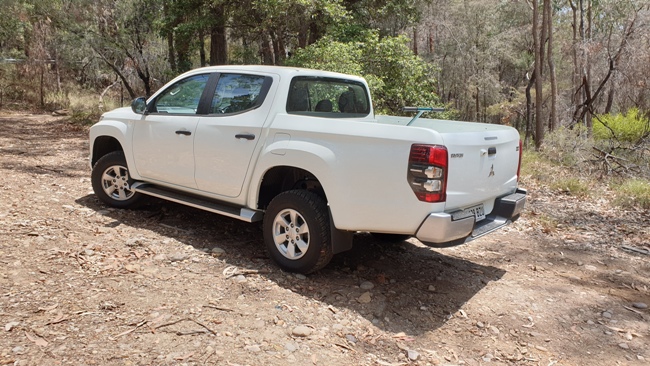
2019MY Jeep Wrangler Overland: Private Fleet Car Review
 This Car Review Is About: A slightly updated version of the overhauled Jeep Wrangler range that Australia received in mid 2019. That change occurred between December 2018 and early 2019 in the manufacturing process, and it was the addition of a forward facing sensor for anti-collision technology. The range itself covers the Overland in the middle, Sport S at the beginning, the range leading Rubicon. The Overland tested was also given the coveted “Trail Rated” badge. Jeep says this means: “The new Jeep “Trail Rated” badge indicates that every Jeep 4×4 has been designed to perform in a variety of challenging off-road conditions identified by five key consumer-oriented performance categories, including Traction, Ground Clearance, Manoeuvrability, Articulation and Water Fording.”
 How Much Does It Cost?: The list price is $63,950 plus on road costs. That’s as of November, 2019 for the MY19 version. Check with Jeep for the 2020 spec. The Wrangler range comes in a two and four door for the Sport S and Overland.
Under The Bonnet Is: 209kW and 347Nm of 3.6L V6 Pentastar petrol engine. Only the top of the trio Rubicon has a diesel option. Transmission in the Overland is an eight speed Selec-Trac auto and there is no manual available in the range. All Jeeps have a transfer case that offers 2WD, 4WD Auto, and high and low range. Our final economy figure was 11.7L/100km which worked out to be better than Jeeps quoted 13.0L/100km for the urban cycle. Tank size is 81L. That’s for the Sport S and Overland four door body. the two door versions have a 66L tank. On The Outside It’s: Oh so familiar with the round (and LED powered) headlights, squared off guards and stance, plus that seven bar grille. The doors, roof, and windscreen are removable and foldable in the case of the front screen. The driving and rear lights (in the traditional squared off housing) are also LED for the Overland. The rear gate is different in that the bottom door opens horizontally and has to be opened first to allow access to the top door. The wheels on the Overland at 18 inches in diameter and are wrapped in Bridgestone Dueler H/T 255/70. Big, solid looking, strong plastic steps run between the front and rear wheels. The black on the review vehicle contrasted nicely with the brushed satin alloy look og the wing mirror surrounds, driving light surrounds, and subtle enhancements to the grille.
What’s somewhat surprising about the Wranglers is just how small they are. Small in the context that they’re just 4,334mm in length, and pack inside that a 2,459mm wheelbase. Height is what makes the Wrangler look bigger, especially in the deep metallic black the review car was covered in. 1,839mm is the number here, and from the front the 1,894mm is obvious. The front has a very obviously American spec front bumper, protruding forward like a caricature’s chin. There is still 35.8 degrees of approach angle however. Departure is rated as 31.2 degrees, and breakover is 20.4. Wading depth is 760mm. On The Inside It’s: Far from the spartan look and feel once reasonably expected of a dedicated off-road capable vehicle. The overland has superbly supple black McKinley leather and an embossed Overland logo. The seats are beautifully comfortable, but are manually adjusted. That’s no bad thing though. Naturally there are grab handles for the front seat passengers, and the Wrangler Overland stays true to its basic roots by having a strong cloth strap as the door’s restrainer, not a mechanical option in the hinges.
It’s a beautiful and elegant design to the dash. and a highlight is the use of “old school” rotate and flip” airvents. This simple design allows airflow to be sent to any direction by twirling a circular and slotted design. Effective and ridiculously so. Front and centre is an 8.4 inch touchscreen that is also ridiculously simple to use. Climate control, satnav, and an beautifully tuned Alpine nine speaker DAB audio system are stars, and the audio is possibly the second best for depth, clarity, and stage presence, that we’ve heard. The materials used on the Overland’s dash look and feel premium, and it instantly said “welcome to your new home”. This gets backed by a 230V socket for the back seat, plus USB and USB-C plugs, and remote starting to get the aircon up and running. For the driver, it’s a design that can only be described as smart, clever, historic, and, yes, elegant. There is an LCD screen that shows multiple forms of information, but a small section on the left is cleverly blanked into a separate display to show which actual drive mode the Wrangler is in. A Jeep logo also shows briefly on the screen. A nice little touch is the compass information built into the rear vision mirror. It shows N, S, NW etc in a simple backlit font. A not quite so nice touch is the fact all four power window switches are one touch for down, but have to be held for the upwards travel. They’re also located in the centre of the vertically oriented dash, not in the driver’s door. The front guards aren’t also visible from the driver’s seat so sometimes it’s a bit “guessworky” to gauge where the fenders are.
Build quality for the body was tight, with no squeaks, rattles, or other extraneous noises that shouldn’t have been there. That included the removable roof panels, with a flick-twist lever to lift off. But there was a glitch with the driver’s seat belt mechanism. Seatbelts have a safety mechanism, one that tightens the belt before an impact. They also have a mechanism that allows a passenger to pull the belt out to buckle in. In this car, the mechanism simply refused, on numerous occasions, to release the belt to strap in. On the Road It’s: Somewhat spongy in the ride and loose in the steering. The sponginess comes from the high profile dual purpose rubber, and the steering….well. It really could do with being tighter for our market. What also needs tightening is the tolerance for the brake pedal. It’s one of the longest we’ve had for response and grip. Long, in the sense that there’s well over an inch of travel before bite, and it goes longer down the path before grip really improves. It’s these two areas that detract, and unfortunately quite a bit, from an otherwise engaging and enjoyable drive experience. Acceleration is decent enough, and there’s a satisfying rort and snort from the engine and exhaust. The off-rad capability is access via a lever on the left of the gear selector, and it’s a simple to use system. Neutral, select, go. And there’s no doubting the agility of the Overland thanks to that Trail Rated badge.
 What About Safety?: It has a good package. Front and rear sensors, airbags all round, plus Rear Cross Traffic Detection and Blind Spot Monitoring. Trailer Sway Control and Forward Collision Assist are there too. Tyre Pressure Monitoring is an essential item for vehicles such as this and this proved its worth thanks to an invisible nail in one tyre. the Reverse Camera is handy and the touchscreen’s HD capability makes reversing easier due to the clarity. Unseen is the high tensile strength steel that underpins the chassis rigidity and side panel strength.
 And The Warranty and Service?: Jeep offer a five year warranty on their range. Servicing costs are capped and here Jeep recommends contacting a dealer for your specific pricing.
 At The End Of The Drive. The Jeep Wrangler Overland delighted. That in itself was unexpected, and yes, that can be seen as damning with faint praise. Loose steering and spongy ride aside, it’s a delight to drive, and the ambience of the interior makes being in it to drive an enjoyable experience. It’s a long way from the sparse and spartan interiors, and indifferent build quality of years gone by. The tech features, comfort level, and the well proven off-road ability from its heritage made the time the Wrangler spent with us thoroughly engaging and drew a wry grin from a family friend who’d bought the same model, but just prior to the Forward Collision Warning system being made available. The Jeep Wrangler range and information can be found via the Jeep website.
Hiccups And Glory: Tesla Cybertruck Revealed.
 Mid afternoon Friday 22nd November (Sydney time) and Tesla has unveiled a surprise.
Called the Cybertruck it’s fair to say it’s unlike anything seen from any manufacturer, both in looks, and in specification. Tesla says: it will have a range of 500+ miles, and will see a zero to 96kph (60mph) time of around 2.9 seconds. The body is made from a sledgehammer resistant “Ultra-Hard 30x Cold-Rolled Steel”. The window glass is also intended to be shatter and impact resistant as evidenced by a few ball-drop demonstrations. Somewhat embarrassingly, a short range throw of a small steel ball like that used in the drop test broke the supposedly shatterproof glass in the vehicle shown.
 The cargo section is big enough to house an electric ATV, also shown during the launch, and has a payload capacity of up to 3,500 pounds or 1,587 kilos. There is 6.5 feet of length in the bay and there are extendable ramps and a charging point built in. An estimated 100 cubic feet of storage space is available inside the sci-fi looking wedge shape. There is also room for six adults and a 17 inch touchscreen to access the vehicle’s main controls.
 The ramp that allows cargo access showed the flexibility of the suspension with up to four inches of travel. The drivetrain will be a rear mounted engine, front and rear, and a triple motor configuration. The exterior is striking, to say the least, with a distinctive wedge shape and eye-catching LED strips front and rear. And in an alloy sheen reminiscent of a De Lorean, it should be an all-weather capable vehicle.
Pricing is slated to start at around $40,000USD.
2020 Mitsubishi Eclipse Cross Exceed AWD: Private Fleet Car Review
This Car Review Is About: A slight revamped version, for 2020’s Model Year, of the top of the tree Exceed from the oddly proportioned and oddly named Eclipse Cross. The range itself had minor updates, such as the LS gaining the S-AWC, or Super All Wheel Control, drive system. The Exceed has some trim changes, with revised front door trims with illumination and a black interior headlining. Mitsubishi have also joined the club when it comes to offering a “Black Edition”. This adds in a front skid plate, black front bumper and radiator grille. There is also a black interior and black spoiler. Safety goes up a step with variable auto rain-sensing windscreen wipers, dusk sensing headlamps with auto high beam, fog lamps and forward collision mitigation.
How Much Does It Cost?: The range starts at $29,990 for the ES 2WD with CVT. The LS 2WD with CVT is $31,990, before moving to the LS AWD at $34,490. Exceed 2WD starts from $36,690 with the AWD at $ 39,190. Black Edition 2WD with CVT is listed at $31,690. These are the manufacturers list price, without government and dealer charges. At the time of writing, Mitsubishi list it on their website as $42,990 drive-away.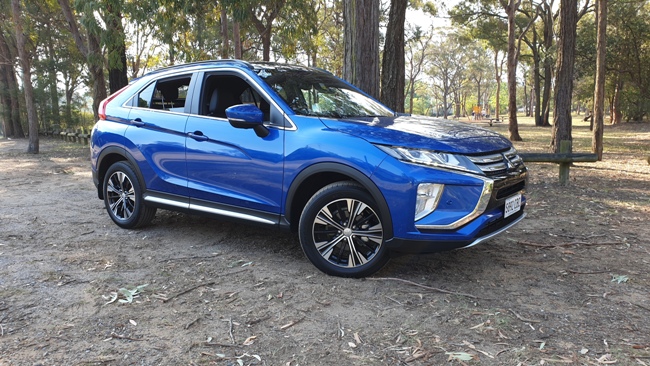 Under The Bonnet Is: A surprisingly small “donk”. It’s just 1.5L in capacity, drinks petrol only, and there is no hybrid option currently. It does have a turbo though, and that means there’s decent torque. In fact there is 250Nm from 2,000rpm to 3,500rpm. Peak power is 110kW at a typically high 5,500rpm. Fuel is 91RON or above, with economy quoted as (combined cycle) 7.7L/100km. That’s a figure we achieved and beat in our mainly urban drive cycle, with 6.7L/100km recorded. That’s a good figure considering it’s not a big vehicle yet starts at 1,555kg before any load and fuel.
 Drive was put to all four paws via an eight ratio CVT. It’s one of the better examples of a CVT and possibly due to not being overwhelmed by torque so much compared to bigger capacity, higher torque, engines. There was a notable lack of slippage in comparison to some of the CVTs we’re driven recently. By the way, Mitsubishi no longer offer a diesel in the Eclipse Cross.
On the Outside It’s: Awkwardly shaped. There’s no polite way of saying otherwise. It sports the “shield” front end treatment and LED headlights, however in profile and from the rear it’s….angular and somewhat out of proportion. The 4,405mm length hides a 2,670mm wheelbase, a high 1,685mm stretch from top to bottom, and 1,805mm in width. From the rear the glass is split horizontally and right in the eyeline of the driver. That wheelbase and length have a relatively normal looking profile from the nose to the rear of the passenger door, but then there’s a vertical rear that then folds forward over a truncated cargo section of sheetmetal. It’s not really helped by a long, straight, windowline that comes from the upper corner of the headlights and terminates just over a deeper crease line that starts mid-front door. This itself finishes at the base of the rear lights that also fold forward with the metal. The wheel arches offset this by being clad in the now familiar polycarbonate.
Above the driver is a glass roof, with a fixed panel for the rear seat passengers. It’s needed as the interior trim is black on black. Underneath are a set of 225/55/18 tyres from Toyo. They’re compromise tyres, so mainly for road, not off-road. Speaking of which, approach angle is just 18.8 degrees, with a departure angle of 29.6. That’s largely thanks to the squat arse it has. Ground clearance is 175mm, so if the plan is to get hot and heavy with anything other than the occasional puddle and speed-bump, this isn’t the faux off-roader for you. On The Inside It’s: Not uncomfortable. Leather seats, heated (not vented) up front and power adjustable for the driver’s, Head Up Display, four cup and bottle holders, start the party. DAB audio/Android Auto/Apple CarPlay are on board but via a very confusing layout on the 7.0 inchtouchscreen. We’re far from technologically impaired but when a need to consult a manual to find out how to store a radio station is required…The screen is high-definition, making the 360 degree camera views crystal clear.
 The tiller and gear selector have leather covering as well, and the plastics have a nice soft touch under the fingertips. All four windows are one touch up/down, and ignition is Start/Stop push button. There’s alloy look plastics to provide a bit of brightness around the centre console, airvents, and dash binnacle. Contrasting gloss piano black is on the door handle surrounds and the touchscreen. Outside, the wing mirrors can be power folded and they’re also heated.
Roomwise there’s enough. 1,003mm of headroom up front, 933mm in the rear means a feeling of spaciousness. Leg room is ample too, with 1,039mm and 897mm front and rear. Again, it’s needed with the black on black trim possibly feeling a bit claustrophobic. At least a shrug of the shoulders shouldn’t upset anyone, not with 1,428mm of space up front. Somehow Mitsubishi cram in 374L to 1136L of shopping space in the back. It’s JUST enough for the family average shop. BUT the rear seats may need to be called in as an assistant. On The Road It’s: Not a sparkling performer. That’s unsurprising given the size of the powerplant and the dry weight. But it’s not a slug, as such. Rapid, no. Adequate for Nan? Utterly. But this isn’t the kind of car that Nan would look at. This is for those that will look at the ASX and deduce it’s not right for them. It’s slightly bigger in presence and being petrol only it lacks the low down punch that a good diesel, even a small one, can deliver.
The upside is that the CVT really is one of the better ones. Because the turbo eases delivery in, the constant variable transmission doesn’t have that slippage feeling so commonly found elsewhere. This translates to a better driving experience as a result. And using the manual shift imbues the Eclipse Cross Exceed with a little more dynamism, a little more verve. The S-AWC helps somewhat, with the torque being distributed front to rear as required. But it’s not heavily front wheel biased in steering feel though. It’s also not light enough that a finger twirl elicits results, with a bit of heft required to get the front wheels angling.
It’s well tied down, with a ride that sets it apart from the competition. It’s flat on all but the most unsettled tarmac, with the dampers really in control. Absorption of general road irregularities is up there with the best. There’s no pogoing, no floppiness, it’s a tightly written composition underneath and confidence inspiring as a result. When it’s wound up it’s actually a fun little machine to take into some of the lovely curvy roads in the region. When the engine’s into its stride, it handshakes beautifully with the steering and suspension to get into an almost sporting mode.
What About Safety? It’s packed. First up, there is Forward Collision Mitigation system, which works with Adaptive Cruise Control. For sideways looking there is Lane Departure Warning and Blind Spot Warning plus Lane Change Assist. Seven airbags including driver’s kneebag feature also. Rear and front safety is backed by Rear Cross Traffic Alert and Ultrasonic misacceleration Mitigation System. Supplementary safety systems have Adjustable speed limiter, Automatic High Beam, Emergency Stop Signal function, plus Emergency Brake Assist system and Hill Start Assist. Warranty And Service? Five years warranty or 100,000 kilometres is their standard. It’s good but doesn’t quite measure up against those offering the unlimited kilometres offerings from competitors. However, new 19MY and 20MY Triton go the extra mile with 7 Year / 150,000km Mitsubishi Diamond Advantage New Car Warranty† when purchased before 31st December 2019. Mitsubishi says the capped price servicing covers: all items specified under the regular service tables for each vehicle type detailed in the service and warranty booklet, including parts, labour, oils and fluids, workshop supplies and any applicable environmental or waste oil disposal charges. Pricing can be found here.
At The End Of The Drive. The Mitsibishi Eclipse Cross range provides a solid, if unspectacular option to vehicles such as Hyundai’s Tucson, or Kia’s Sportage. It’s a quirky looker, reasonable if familiar in its unspectacular interior and dash layout, and not an uncomfortable place to be in either. It’s dependable, and drives well enough. There’s enough, as expected, room for four, plenty of safety to protect the occupants, and, difficult to follow DAB screen aside, a user friendly environment in the equipment sense.
The engine is a reasonably willing unit, and the CVT is a well sorted unit for the engine’s capabilities. As a whole, the package is good enough for those that have chosen to buy it and that’s the end result Mitsubishi would hope for. The 2020 Model Year Eclipse Cross information can tell you more.

 Level 2, 9 Help Street