

Author archive
2020 Toyota Corolla Sedan Is Here.
Toyota has released details of the forthcoming Corolla sedan. Due to be released by the end of November, the range and pricing is as follows. Ascent Sport petrol manual: $23,335, Ascent Sport petrol CVT: $24,835, Ascent Sport hybrid CVT: $26,335, SX petrol CVT: $28,235, SX hybrid CVT: $29,735, and the ZR petrol CVT: $33,635. All prices are manufacturers recommended and not inclusive of government and dealer charges.
All CVT equipped models will feature a solid safety package. Lane-trace assist with steering assist, plus lane-centring functionality and all-speed active cruise control, with the manual Ascent Sport featuring high-speed active cruise control and lane departure warning that has steering assist. Rear camera and seven airbags will be across all models, whilst the SX has Blind Spot Monitor and the ZR will received a Head Up Display. Toyota’s SafetySense package is standard. This includes autonomous emergency braking pre-collision safety system with daytime and nighttime pedestrian and daytime cyclist detection, auto high beam, and road sign assist. The Corolla Sedan will feature, for the first time, a hybrid drivetrain. This will be available on the Ascent Sport and SX versions. A new 2.0L petrol engine can be specced for all three trim levels, with a six speed manual or a CVT with ten preset manual shift points in the Ascent Sport. It will be connected to the CVT as standard in the SX and ZR. Maxiumum power is rated as 125kW and peak torque is 200Nm. 6.0L/100km and 6.5L/100km for the CVT and six speed manual respectively.
Choose the hybrid and the petrol side is a 1.8L engine and what Toyota call a e-CVT. Power is rated as 90kW. It’ll drive the front wheels, with all four corners to have low rolling resistance rubber. All up, Toyota quoted 3.5L100km. Emissions are rated as just 81g/km.
Toyota will add dusk sensing LED headlights, rear lights, and daytime running lights to all versions. Alloy wheels and climate control will be standard across the range except for the manual Ascent Sport. This will have manual aircon. For those that use them, Android Auto and Apple CarPlay will now be standard and accessible via an 8.0inch touchscreen. Bluetooth and Siri eye-free functionality will also be standard. Go hybrid and it’s a keyless Start/Stop.
The SX Corolla sedan will have a new three-spoke tiller with paddle shifters. Wireless smartphone pads are standard in the SX along with DAB and satnav. The ZR goes up a notch with a full glass roof, 18 inch alloys, and the front seats will be heated. Again, Australia misses out on venting, an oversight for our climate in summer. The driver’s seat will be 8 way power adjustable and audio is via a JBL 9 speaker system. Outside is a restyle that brings the sedan’s look closer to the needle nosed hatch, whilst the rear has been refreshed as well.
Servicing costs have been aligned with the hatch, meaning every Corolla has capped price servicing that costs just $175 per service with 12-month/15,000km intervals. Contact your Toyota dealer to book a test drive.
2020 Nissan Patrol: The Big Machine Gets A Makeover.
Nissan’s long-running competitor to the Land Cruiser, the Patrol, has been given a substantial makeover for the 2020 specification. Available to order through Nissan dealerships now, in a two model range, it’s priced from $75,990 (plus ORC) for the Nissan Patrol Ti, and the Ti-L is from $91,990 (plus ORC).
The exterior has been revised at the front and rear, and the safety levels have also been improved. The suspension has been further tweaked for a better ride, and there are now extra colours to choose from. Safety.
Standard equipment for both the Ti and Ti-L include: Intelligent Emergency Braking, Intelligent Forward Collision Warning, and Rear Cross Traffic Alert. The Ti now also has: Intelligent Cruise Control (ICC), Lane Departure Warning (LDW), Intelligent Lane Intervention, Blind Spot Warning (BSW), and Intelligent Blind Spot Intervention.
Outside.
The Ti has been given it’s own sportier looking front end treatment. The Ti-L goes for a premium, upmarket, look. The bonnet, fenders, grilles, LED lights and front bumpers have been modified for a more upright, no-nonsense stance. the headlights have a total of 52 LEDs, and there’s 44 LEDs in the rear. the rear lights are now in a stylish boomerang shaped cluster. The rear bumper has been restyled to match the solid lines of the rear, with a squarer look. Colour choices now have Moonlight White, Galaxy Gold & Hermosa Blue, which are new to the range. Inside.
Australia’s hot weather conditions require better air-conditioning and Nissan have updated the system in the Patrol for a tri-zone setup. Airflow has been improved and the rear seat passengers have been given better flow too. This means cooling will take place quicker and therefore will be more efficient. Access is via an intelligent key with remote keyless entry with push button Start/Stop, cruise control, heated door mirrors, plus 3D mapping for the sat-nav in an eight inch touchscreen. Power and Ride.
Both vehicles will have 298kW of power and 560Nm of torque from Nissan’s 5.6 litre V8 petrol engine. Drive gets to the ground via a seven-speed automatic transmission featuring manual mode and Adaptive Shift Control (ASC). There is also an electronic rear diff lock, Hill Descent Control (HDC) with on/off switch, Hill Start Assist (HAS) and an off-road monitor. The suspension tweaks have the dampers retuned for a more positive response for an increase in on-road comfort, and enhanced off-road comfort as well.
Contact your local Nissan dealer for a drive evaluation.
Car Review: 2020 Kia Stinger 200S
This Car Review Is About: The now entry level model to a realigned in 2019 Stinger range. There is the 200S, the same 2.0L engine in GT-Line spec, them two mainstream 3.3L V6 models called 330S and GT, and a limited edition. The 200S features a mildly restyled interior and exterior to differentiate it from the others.
How Much Does It Cost?: Kia’s Website lists the Stinger 200S four location as a not inconsiderable $50,490 driveaway. However that is around $1,250 under the list price plus charges. Under The Bonnet Is: Kia’s well sorted 2.0L turbo petrol four cylinder engine that powers the rear wheels via an eight speed auto. Peak power is 182kW at 6,200rpm, with peak torque of 353Nm available between 1,400rpm and 4,000rpm. There is Launch Control fitted to the smooth eight speeder too. Consumption for the urban cycle is rated as a whopping 12.7L/100km, a big bugbear in the Kia engine range. Combined is rated as a more reasonable 8.8L, and on the highway consumption drops by nearly half to see 6.5L/100km from the 60.0L tank. Our final figure was 9.3L/100km.
 On The Outside It’s: Subtly restyled in one key area. Kia’s cleverly used the same shape of the headlight cluster and has a main, circular, light to the outside and this dips downwards to where the LED indicators are in the GT-Line versions. The shape of the bumper is subtly restyled as is the shape of the air intake. The wheels are of a lower-spec but have a still nice to look at…look. Size is 225/45/18 and rubber is Continental ContiSportContact.
The body is otherwise identical with quad exhausts, the pair of faux bonnet vents, the Maserati-esque LED tail lights. Kia’s design team really got the exterior right when the car was first released two years ago. Paint was Silky Silver and is listed as a standard colour. On The Inside: The main difference here is the introduction of a smaller touchscreen on the upper dash. It’s a 7.0inch screen, down one inch from the screen available in the rest of the range. Satnav is standard, as is DAB audio through a six speaker, not 15 speaker, audio system. Android Auto, Apple CarPlay, Bluetooth streaming are also standard in the 200S. A pair of 12V and USB ports are standard.
The driver faces a simple 3.5 inch monochrome display (same in the 330S), not the better looking 7.0 inch found in the GTs. It’s not un-userfriendly, it just looks…dull. But there is leather pews, electric adjustment, paddle shifters, a drive mode selector in the console, and a pack of driver information options in the touchscreen menus. Drive itself is a shift-by-wire rocker selector. On the Road It’s: Noticeably affected by the 1,700kg dry weight. Although peak torque comes on stream at low revs and is available through a broad rev range, that weight holds back performance and clearly contributes to that pretty average urban consumption. It takes a heavier right foot to get the 200S up to speed, but when on the highway it shows its other side. The Stinger is a superb tourer, and in our previous reviews has shown that the long distances between towns suits the Stinger’s character perfectly.
 Handling and ride in the 200S are just as good too, with nothing found wanting in these two departments. The steering weight is a tick on the heavy side, with a slight numbness on centre, but these are minor quibbles in an otherwise well sorted and well proven package. Even with the 1,800kgs plus it packs, it’s nimble, rapid in response, and lacks initial feedback only in braking too.
What About Safety?: The only thing the 200S (and 300S) misses out on of note is front parking sensors. A 360 degree camera view isn’t provided but that’s not a biggie. In the exterior stakes Blind Spot Detection and Rear Cross Traffic Alert are also deleted. Otherwise it’s on spec with AEB (Autonomous Emergency Braking) with FCWS (Forward Collision Warning System) and Lane Keep Assist, plus pedestrian oriented Active Hood Lift Assist on board. What Is The Warranty And Service?: Warranty is 7 years, and unlimited kilometres. For servicing Kia says: we’ve capped the maximum price you will pay for the first seven scheduled services (fourteen for T-GDI petrol turbo models) for up to 7 years or 105,000kms (excluding Kia Stinger and MY 19 and onwards petrol turbo models) and for Kia Stinger and MY 19 and onwards petrol turbo models for up to 7 years or 70,000kms, whichever comes first.
 At The End Of The Drive: There’s a faint sense of disquiet in driving the turbo four powered Stinger. But it’s the only game in Kia-town now that the underrated Optima has been dropped from the range when it comes to a largish sedan body. That disquiet is knowing the Stinger is aimed at the performance oriented driver yet a fuel consumption of over 12.0L per 100 kilometres in its normal environment will hurt, and that’s due to its bulk. Kia should either find a weight reduction regime of bump the 2.0L up in capacity. Would the increase in size tradeoff work though in providing more performance?
More on the Stinger 200S is here.
October New Car Sales Continue To Show A Downwards Slide.
The Federal Chamber of Automotive Industries (FCAI), the peak body for the automotive industry in Australia, has released new vehicle sales figures for the month of October 2019.
According to Tony Weber, chief executive of the FCAI, new vehicles have now seen the nineteenth consecutive month of decreasing sales in the Australian market, with October 2019 sales down 9.1% compared to October 2018. “Year to date sales of new motor vehicles in 2019 are almost 78,000 units (eight per cent) lower than the same period in 2018.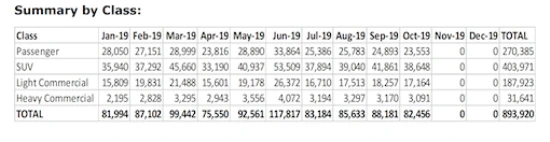 “While the drought and other domestic conditions are impacting the market, our key concern is the effect over-regulation of the financial sector is having on new vehicle sales. The FCAI and our members have been concerned about the risk averse approach to lending in Australia for some time and see improved access to finance as a key to driving economic growth in 2020” Mr Weber said. “Of particular interest is the fact that sales are down across all buyer types, with private sales down 5.2 per cent compared to October 2018, business sales are down 8.2 per cent and government sales are down 7.3 per cent.”
Total sales for the month numbered 82,456 vehicles, a decrease of 8,262 vehicles, or 9.1 per cent, on October 2018. During the month, the Sports Utility Market (38,648 units) fell by 3 per cent compared to October 2018, while the Passenger Vehicle Market (23,553 units) was down 15.3 per cent, and the Light Commercial Market (17,164) decreased by 11 per cent.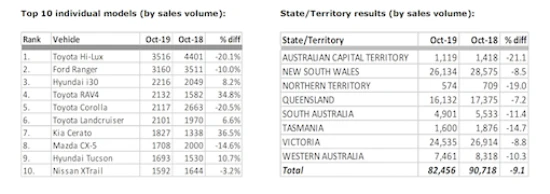
The Toyota Hilux (3,516 units) was the top selling vehicle in October 2019, followed by the Ford Ranger (3,160). The Hyundai i30 (2,216) was followed by the Toyota RAV4 (2,132) and the Toyota Corolla (2,117). Toyota remained the top selling marque for the month with 16,988 sales for 20.6 per cent market share, followed by Hyundai (7,455 for 9 per cent market share), Mazda (6,370 sales for 7.7 per cent market share), Kia (5,062 sales for 6.1 per cent market share) and Ford (4,891 for 5.9 per cent market share).
 Level 2, 9 Help Street