

Author archive
2020 Mitsubishi ASX GSR: Private Fleet Car Review
 This Car Review Is About: Mitsubishi’s ASX with a nameplate that in Mitsubishi’s history has referred to a sporting oriented vehicle. GSR was found on their hi-po Lancers and they were a little less mental than the Evo class cars. However, in ASX trim, the sporting intention has been relegated to a lairy colour on the review car and a front wheel driven chassis with the traction control dialed back a little.
How Much Does It Cost?: $30,740 is the recommended retail price. $32,490 is the drive-away price as of June 2020.
On The Outside It’s: Been given blacked out highlights to complement the Sunshine Orange paintwork. 18 inch alloys with black paint, along with the grille, door mirrors, and a subtle rear deck lid spoiler are part of the GSR’s visual appeal. It’s a combination that suits the “shield grille” treatment as it brings a more assertive look to the small SUV. The painted alloys have Bridgestone Ecopia rubber, and they’re 225/55 in profile. An identifying GSR badge is on the tailgate, and it’s the only one that says GSR.
 On The Inside It’s: The mostly cleanly laid out look newer Mitsubishis have. “Microsuede/Synthetic Leather Seat Trim with Red Stitching” is the description for the pews and they’re a delight. Comfortable, supportive, warm and there’s no need for electric heating. Air-conditioning is via the simple and classy dial system that Mitsubishi has employed to great effect. They sit above a pair of USB ports and a 12V socket, and below the 8.0 inch DAB equipped touchscreen.
 The tailgate is manually operated, opening to a 393L cargo section that expands to 1,193L with the second row seats folded. A flat loading floor and low lip make loading up a brezze, and the pair of recesses either side help for items that need a little extra security.The angular slope of the ASX’s roof doesn’t compromise interior packaging either. 963mm head room is available for the rear seats, plus 921mm leg room. They’re good numbers considering 1,000mm head room for the front seats and 1,056mm leg room.
 Under The Bonnet Is: A 2.4L petrol engine. No diesel, no hybrid. 123kW and 222Nm haul 1,390kg (dry) via a CVT driving the front wheels only. Consumption is quoted as 7.9L/100km for the combined cycle. Mitsubishi’s info system provides a driving average, as in it’ll change on the go, but there is not separate overall figure. We saw a worst of over 9.0L/100km and a shortened range, to a best of 6.7L/100km and a range of over 400km to go from between a half and three quarter full gauge.
 On The Road It’s: The front wheel driven GSR has a throttle that is open to hard work. As such it also sets up the GSR for a little bit of spirit. The rubber is partly to blame, if you will, as even a moderate amount of throttle application chirps the tyres, easily spinning them and there’s no real intrusion of the engine control nanny either. There’s nothing from the rear end though, and it comes across as being nothing more than to prop up the cargo area.
The steering has some feedback, enough to let the driver know that the front end is lively, and even manages to isolate the fact that the ASX GSR is a front wheel drive vehicle. There’s little to no noticeable torque steer, the front can be hammered quite hard and for the most part the front will stick…in a straight line. Those tyres become a weak point as the GSR will push into understeer reasonably easily and on damp roads the rubber loses grip even more readily.
The CVT is one of the better ones going, and seems to harness the 222Nm more efficiently, even under heavy throttle. There isn’t a Sport shift though, a truly odd choice for a seemingly sports-oriented style car. Yes, there are paddle shifts but…well…no Sport shift. The drive selector itself is a bit painful, having a F shaped slot mechanism and it’s not entirely intuitive in moving the lever. It got caught far too often in Neutral due to the design of the slot, and there is a low range style selection that is picked up by sliding through D to L. This is where a manual change via the paddles seems to be more appropriate. Damping is better than the Outlander PHEV tested the week before; there’s more suspension give, less reliance on the Bridgestone rubber for smaller intrusions, and a little more body lean in cornering aiding grip where it can be. This also means that road holding is improved with less tendency to feel like the tyres may momentarily lose contact on certain surfaces.
What About Safety?: Loaded for bear, is what the ASX GSR has in the safety stakes. Forward Collision Mitigation system, with Lane Departure Warning, Lane Change Assist and Blind Spot Warning. Then there is Rear Cross Traffic Alert, to finish off the main package. Auto headlights and wipers, the flashing emergency stop signalling, reverse camera and front & rear parking sensors, plus seven airbags round out the supplementary systems.
What About Warranty And Service?: 100,000 kilometres or five years, with capped price servicing details available.
At The End Of The Drive. The ASX is a competent vehicle regardless of which model you select. Versions such as this, the ASX GSR, manage to find a better level in areas such as handling and the CVT yet just miss the target by not making the gear selection a Sports style. Nor is there a console mounted Sport option.
In Sunshine Orange, along with the blackouts, it’s an eye catcher, and the paint really drinks in the sunlight giving it a true glow. It rolls along nicely, has enough squirt to please, and sells in very good numbers. Add a Sport mode that’s tweaked to suit the characteristics, and it’ll be even better. Check it out here.
Car Review: 2020 Mitsubishi Outlander Exceed PHEV.
 This Car Review Is About: A vehicle from a mainstream car maker that provides a technology still all too rare. Hybrid tech of its own right is becoming widespread, however the plug-in part is still uncommon. The Outlander from Mitsubishi is an all too rare opportunity to sample an option in drivetrain tech that perhaps could become a little more common with time. In PHEV form it’s strictly a five seater too.
How Much Does It Cost?: The Outlander falls into the medium SUV category. There are three PHEV variants, being the ES and ES ADAS (higher trim levels) and the Exceed. This starts from $56,390 plus on-road costs. At the time of writing, a drive-away cost of $60,390 was advertised. Under The Bonnet Is: The opportunity to drive, theoretically, up to 54 kilometres on a battery only run thanks to a pair of electric motors, one front, one rear connected to a single speed transmission. Otherwise there is a 2.4L petrol engine that charges the battery, and backs up the electrical drive in uphill runs or when the battery is low on charge. There are two charge ports on the right rear quarter and a separate charge cable that plugs into the standard home plug outlet. When the PHEV was first released five years ago it came only with a 15A cable. Thankfully Mitsubishi listened. There is also an app that allows a driver to monitor charging progress and set charging times.
 The petrol engine produces 94kW and 199Nm, with the electric engine adding its own 60kW and 70kW via the front and rear mounted motors. Consumption is rated as 1.9L/100km and the tank size is 45L. Our overall figure finished on a creditable 5.8L/100km, and most of that was from charging on the go. The battery itself is of a Lithium-ion mix, with a 13.8kWh capacity, voltage of 300, and 80kW maximum output for the generator. Charging time (80%) on the DC fast charger is is 25 minutes, with seven hours on the cable for home charging.
 On The Inside It’s: Time for an update. We’ve reviewed three PHEVs and the Outlander platform is aging. Gracefully, yes, but aging. The ergonomics are no longer suitable and the look and feel is obviously older compared to its opposition. There’s been barely any changes since the last model and that’s minor tweaks to the centre console around the fore and aft drive selector, a rejig of the touchscreen and the way the seat material is laid over the frames.
 The dash is a slab, there are buttons hidden by the steering wheel including the Start/Stop and information button, and it’s all just a bit out of step with the competition. Faux grey coloured carbon-fibre is laid on the passenger side of the dash, the centre console and underneath the aircon controls. There is the usual assortment of cup and bottle holders, plus auto headlights and auto wipers.
 Cargo wise there is 463L of space, down slightly on the normal five seater. This is thanks to a slightly higher cargo deck that sits over the battery and houses a compartment for tyre goo in the case of a puncture, plus the plug-in charger cable and indicator box. The rear axle houses a motor also, and this contributes to the height as well. There is a 12V outlet for this area though and the rear door is powered.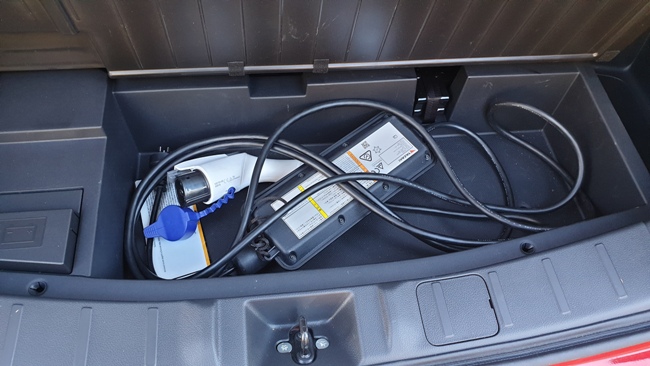
 Five seats is what the Outlander PHEV packs, and they’re also in need of an update. This is more to the material used as padding, as there’s more a sense of sitting on, not in, the pews.
On The Outside It’s: Getting closer to the angular shape of siblings AS, Triton, and Pajero Sport. There’s still the rounded, slightly bulbous shape that’s wrapped Outlander for well over a half decade now, but the nose has the look of the rest of the team. One would expect that the next update will drop the ovoid look and bring it more into line with the others.
Wheels are high gloss alloys and of a 25 spoke design. Rubber is 225/55/18 and from the Toyo Proxes range. Access to the two charging ports is via a flap on the right rear quarter, with fuel on the left rear.
 On The Road It’s: A good mix of electric propulsion for, as it turned out in the real world, around 45 kilometres. The driver’s display has a graphic that shows the charge level of the battery and any regeneration charge being fed back in. It’s a push button start system and there’s a couple of faint clicks and whirrs as the system gets ready. A flick of the drive selector to the right and a fore or aft movement for Reverse of Drive, and that’s as complicated as it gets.
 Unless the right foot is super heavy or heading uphill, the PHEV is a purely electric vehicle. There’s virtually no noise from the drivetrain, but plenty from the rubber, even on smooth road surfaces. As the charge level drops and heads towards maybe 10%, the petrol engine kicks in and tops up charge ever so gently. On the fly a driver can press a console tab to charge or use a Save Battery mode which entails the petrol engine kicking in and out as required. The swap-in and swap-out is almost seamless, with bare hints of vibration and a dull background drone the indications of the change.
The steering is leaden, heavy, and as the drive indicators don’t show torque split, it feels as if it’s a heavily front wheel drive oriented machine. The suspension is also super tight, with most of the smaller road surface niggles absorbed by the tyre sidewalls, not the suspension. The brake is also numb, a curious sensation given the regenerative ability of the system itself.
Acceleration is somewhere between not bad and slightly leisurely. A dry weight, befoer passengers etc, of just under 1.9 tonnes would have that effect… Even when the petrol engine kicks in, it’s an easy-going, unhurried affair. The single speed transmission does a sterling job too, coping admirably with the demands of either or when it comes to switching between the two power sources.
What About Safety?: Ultrasonic misacceleration Mitigation System is standard in the Exceed, as are Blind Sport Warning, Lane Change Assist, and Rear Cross Traffic Alert. Adapative Cruise Control with a simple push button to adjust, and a 360 degree camera system are also standard. Seven is the count for airbags.
What About Warranty And Service? Warranty is five years and capped price servicing applies. Service intervals are 12 months or 15,000kms. Conditions and further details can be found here.
At The End Of The Drive. Mitsubishi deserve accolades for their PHEV push. Hyundai have the Ioniq, itself an attractive proposition with electric, hybrid, and PHEV, variants Toyota doesn’t offer a PHEV. And with a real and usable range of around 40km, the Outlander PHEV is absolutely ideal for city running, and with the occasional dip into the petrol tank by using the engine to charge on the go, an easy 60+ , more than enough for most users, it’s perfect. But expect that on any other route consumption will increase.
There are other areas of mild “concern” too. The steering has no life, the dash is really showing its age, and the exterior is now the only member of the current Mitsubishi that lacks the truly hard edged “shield grille” design. And at $60K, buyers will look towards newer and competitively priced products, irrespective of fuel savings.
Outlander PHEV details are here.
Points On The Dial: 2021 Jeep Compass Released.
Jeep has announced release details of their forthcoming Compass range, complete with updates and a new entry-level model. There are also changes to the back of house procedures for service.

Models and Pricing Structure.
The Night Eagle is the new addition and kickstarts the revamped range. Power comes from the 129kW 2.4L TigerShark four, driving the front wheels via a six speed auto. It’ll start from $36,950 (plus ORC) and has optional Premium paint at $645. The same engine will power the Limited via a nine speed auto and all wheels will be spun. $42,950 (plus ORC) is the starting price. A black roof will be available at $545.
The S-Limited comes in next with the same drivetrain and starts from $45,950 (plus ORC) and will have the black roof and a dual-pane sunroof at no charge. the levels trim out with a diesel powered Trailhawk at $49,450. Peak power here is 125kW and it’s the tried and proven 4×4 system. The sunroof is a $1,950 option. The Premium paints are listed as: Vocal White, Brilliant Black, Grey Magnesio, Mojave Sand, and Minimal Grey. Night Eagle comes well specified for an entry level vehicle. It will feature Blind Spot Monitoring and Rear Cross Path Detection. There will also be, as standard, Forward Collision Warning Plus, and Jeep’s Parksense Rear Park Assist System. There will also be a ParkView Reverse Parking Camera. Wheels are 18 inch alloys, there will be seven airbags, digital radio and Android & Apple apps.
Limited ups the ante, with an even more comprehensive list. The drivetrain has the Jeep Selec-Terrain Traction Management System and will roll on 19 inch alloys. Leather pews will seat the passengers, with the driver having a 8 way powered unit whilst looking at a 7.0 inch display screen, and sound will come from a premium 9 speaker setup including a punchy subwoofer.  Engine ignition is via a Start/Stop system, with extra safety coming from front and rear park sensors. Driver assistance is from the Parallel and Perpendicular Park Assist. Exterior changes also see Bi-xenon headlights and LED rear lights, plus the rear tailgate is powered.
Head to the S-Limited and there is 19 inch Granite Alloys, and Granite Crystal exterior highlights. Inside there will be black leather seats and stitched in Tungsten Accent. Exterior choices can be from the standard Colorado Red or choose from the Premium paints listed earlier. Trailhawk has the fabled Trail Rated badging, and will feature Jeep’s Active Drive Low 4×4 System and the Selec-Terrain with Rock Mode. In order tp deal with getting dirty, there is the Off-Road Suspension with Raised Ride Height. It will have bespoke fascias for each end and the black anti-glare bonnet decal. The tow hooks are hi-vis red. Getting dirty doesn’t mean pain is a given, so Jeep ensure a return journey by fitting four skid skid plates and Hill Descent Control. All weather floor mats and a reversible cargo mat are also standard.
For peace of mind, Jeep has realigned its service rates. A Capped Price service list is now standard, with each new Jeep model purchased having the first five services set at $399 when serviced at Jeep dealership.
Head to the Jeep website for more details.

October Faction: BMW Set To Launch 4 Series Coupe.
BMW Australia has confirmed the 4 Series Coupe is set for an October 2020 launch date down under. There’s plenty to look at and plenty to like in this striking new machine.
BMW’s TwinPower turbo technology is applied to a pair of four cylinder engines and a six. BMW says the fours will produce 135kW and 300Nm for the 420i, 190kW and 400Nm for the 430i, and for the big six in the M440i 285kW and 500Nm. Autos are the super slick 8 speed Steptronics complete with steering wheel paddle shifts.
For those that prefer the personalisation aspect, BMW’s M Sport Package is ready and waiting. The already bold air intakes are increased in area, and matched at the rear by a large contoured apron. Underneath is the M Sport suspension and 19 inch M Sport M alloys, plus Cerium Grey external accents for the M440i and M Carbon exterior highlights can be optioned. Inside, comfort and safety has the extra touches of knee pads on either side of the centre console plus specific other touches. BMW’s design team may have looked at the past for the future; the front sports a pair of striking yet familiar kidney grilles, with inspiration possibly from the art deco and pulp science magazines of the early part of the 20th century and nod towards their own BMW 3.0 CSi. There’s a heavier nod towards a vertically inclined styling, with a deeper reach towards the lower edge of the front apron. Inside is the newly added horizontal mesh material. There are assertive looking intakes on either side, and sit underneath LED headlights that sweep back deep into the upper edges of the front fenders. Adaptive swivelling adaptive LED with BMW Laserlight are optionable. Laserlight increases high beam range to over 500 metres at speeds of over 60 kilometres per hour.
The designers have looked at how the 4 Series Coupé can stand still and look fast and muscular. Elegant lines in curves and straight work together to pick out the frameless windows in the doors, the short front and rear overhangs, and emphasis the taut LED rear lights. The roofline is a metal wave, smooth, yet powerful. There has been subtle increases in size; there is an extra 128mm to 4,768, width is up by 27mm to 1,852, and a small height increase of just 6mm. It is now 1.383mm and makes the 4 Series 57mm lower than the 3 Series. The wheelbase is up by 41mm for2,581mm. Handling is sharpened by the increase in track with an extra 28mm up front, and 18mm for the rear.
Depending on model, integral head restraints will be fitted, with the rears eats sculpted for a 2+2 configuration. The front seats are a sports style, and the driver graps an M specific leather wheel. It’s a proper cockpit feel with a centre console that houses the Start/Stop button flowing high into the dash itself, and the door panel trim complements that of the instrument panel which is now a broader surface area design. Noise is reduced thanks to an acoustic glass windscreen.
Cabin tech arrives in the form of Android Auto, Apple CarPlay, and a SIM card for 4G LTE connectivity. The BMW Connected Package Professional brings in BMW’s Teleservices which includes the Intelligent Emergency Call, Reat Time Traffic Information, Concierge Services and Remote Services.
A built-in SIM card with 4G LTE connectivity and standard BMW Connected Package Professional enable use of digital services including BMW TeleServices and Intelligent Emergency Call, Real Time Traffic Information with hazard warning, Remote Services and Concierge Services. BMW’s 7.0 OS is standard too, with fully integrated digital access and information. The Live Cockpit Professional delivers a 12.3 inch driver’s screen and a 10.25 control display for the centre. There is also a Head Up Display as standard.
Pricing will be confirmed closer to the October launch date.
 Level 2, 9 Help Street