

Author archive
Maserati’s New Engine Finds The Right Formula.
Italian luxury sports car maker Maserati has declared its interest in rejoining motorsport. It’s done so in emphatic fashion by trickling details of the upcoming MC20 super-sportscar, and now the company has released details of the engine, called “Nettuno”, that will be the heartbeat of the machine. It’s got some real oomph; capacity is 3.0L, in a 90 degree twin-turbo V6 configuration. The dry-sumped design provides a peak power figure of 463kW and torque of 730Nm. 7,500rpm is where the power comes in whilst torque is at a very useable 3,000rpm. It’s close to a square-bore design too, with bore and stroke 88mm x 82mm. It will run a 11:1 compression ratio. Looking to Formula 1, Maserati have employed the use of a pre-chamber combustion system featuring twin-spark plugs. This will mark the first time this kind of technology will be provided for a road-going vehicle.
 Three features define the MC20’s engine. The pre-chamber is located between the “normal” combustion chamber and the electrode of the ignition system. A set of specially engineered holes connect the two sections. A traditional sparkplug is utilised as a backup to to the new ignition system, and is designed to make sure combustion is ongoing when load is such the pre-chamber’s services are not required. The final step is an innovative fuel injection system, with a direct and indirect system lowering consumption and emissions whilst ensuring fuel is appropriate across the rev range.
Lateral sparkplug: a traditional sparkplug acts as a support to ensure constant combustion when the engine is operating at a level that doesn’t need the pre-chamber to kick in. Twin injection system – direct and indirect: linked to the fuel supply pressure at 350bar, the system reduces noise low down on the rev range, lowering emissions and improving consumption. The MC20 itself will make its world debut proper in September and will showcase the work done at Maserati’s Modena HQ division There is the Maserati’s Modena facilities: the Maserati Innovation Lab on Via Emilia Ovest, the workshops on Via Delle Nazioni and developed at the Engine Hub, situated at the famous Viale Ciro Menotti address where it will be built. Currently the new production line and new paint shop are being modified to host the much-anticipated MC20. MC20 means Maserati Corse 2020.
Mercedes-Benz GLB Ready To Roll For Australia.
 Mercedes-Benz has released to the Australian market the GLB. For the brand, it’s the first compact vehicle they manufacture to include a third row of seats. There’s enough space, by the way, for anyone up to 1.68 metres to suit the rear two seats. Conveniences such as a pair of drink holders, storage, and USB ports will be fitted, plus the seats will fold flush with the GLB’s cargo floor. These can be accessed by a 40:20:40 split fold centre row that moves by up to 140mm.
There will be three models available, the GLB 200, GLB 250, and GLB 45 Matic. Both the Mercedes-Benz GLB 200 and the GLB 250 4MATIC are available to order now. Deliveries are expect for July as a starting point. The manufacturer’s list prices are: GLB 200 from $59,900 (MRLP) and GLB 250 4MATIC from $73,900 (MRLP). The Mercedes-AMG GLB 35 4 MATIC will be priced at $88,900 (MRLP) when it arrives in Australia later this year. The Mercedes-Benz GLB 200 sees 120kW and 250Nm from a direct injection turbocharged 1.3L four cylinder. A dual clutch automatic with seven ratios sends drive to the front wheels. The GLB 250 amps that with a 2.0L engine that produces 165kW and 350Nm. Transmission is the 8G-DCT eight-speed auto, and grip comes from the 4MATIC all wheel drive system.
AMG step in for the GLB 35 4MATIC and have waved their wand over the 2.0L petrol engine. 225 kW and 400 Nm power down via AMG’s SPEEDSHIFT DCT eight-speed auto with their Dynamic Select drive system. There will also be the AMG exhaust system, their bespoke braking system, plus their Sports suspension called Ride Control with electronically controlled damping. AMG’s power steering with speed sensitive adjustment is also on board. Mercedes-Benz have their highly regarded MBUX multimedia system as standard and the front seat occupants will be able to access infotainment via a pair of side by side 10.25 inch screens. Keyless entry, remote tailgate and engine start, the THERMOTRONIC climate control system, and “Comfort” seats will be standard. The door sills will be internally illuminated, and again convenience is standard thanks to satnav, smartapps including the Mercedes-Benz Me Control app and a charge pad, auto wipers, 19 inch alloys, and aluminuim roof rails. PARKTRONIC parking assist is backed up in the safety stakes with Blind Spot assist, Lane Keep Assist, and Traffic Sign Assist. Active Brake Assist with semi-autonomous braking is standard as are nine airbags.
The GLB 250 factors in a sunroof, powered memory front seats with heating, twin spoke 19 inch alloys and an adjustable suspension. Steering is aligned with the all wheel drive system with Sports Direct-Steer, and even a form of off-road suspension. Downhill Speed Regulation and the cornering lamps come into play as well, with the lights on each lower corner coming into play at speeds of up to 50kph. There are a few extra touches for the GLB 35 4MATIC, such as an AMG steering wheel with Nappa leather, Lugano leather on the seats, brushed stainless steel AMG foot pedals, and Carbon Structure interior trim. Outside is AMG’s Night Package trim, 20 inch diameter five spoke alloys, AMG body additions and dark tinted rear window glass.
The arrival of the GLB brings to six the number of models in the Mercedes-Benz compact car portfolio, which includes the A-Class hatch and sedan, B-Class, CLA Coupé and GLA compact SUV. Says Britta Seeger, Member of the Board of Management of Daimler AG, responsible for Mercedes-Benz Cars Sales: “Every third Mercedes-Benz is now an SUV, every fourth a compact car. So a compact SUV such as the GLB blends all the success factors of our two highest-volume segments.”
Sparking The Ride: JLR Provides Electric Taxis.
Luxury sports car and SUV building company Jaguar Land Rover has agreed to support the capital of Norway, the City of Oslo with the world’s first high-powered wireless taxis.
In a programme known as ‘ElectriCity’, the global vehicle manufacturer will join Fortum Recharge (the region’s biggest charge point operator), Nordic taxi operator Cabonline (NorgesTaxi AS), along with US technology developer Momentum Dynamics, and the city itself to build wireless, high-powered charging infrastructure for taxis in the Norwegian capital. This lays the groundwork for Norway’s push to have, by 2025, all new cars sold as zero emission vehicles.
The project will be the first wireless high-powered charging system for electric taxis in the world. As a test bed it will prove the validity of providing a charging infrastructure model that can be implemented almost anywhere, and it will help the rapid adoption of electric vehicles globally.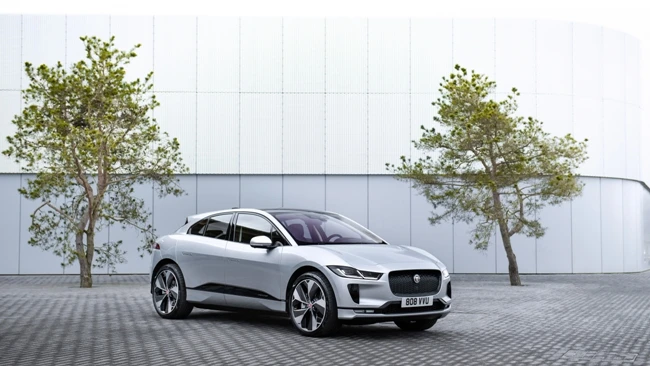
Fortum Recharge, who will be supporting the installation and electrification of the project, have identified a need for a more efficient charging experience for taxi drivers in Oslo and have partnered with and enlisted the support of Momentum Dynamics in integrating the wireless charging infrastructure.
Jaguar Land Rover will provide 25 Jaguar I-PACE models to Cabonline, the largest taxi network in the Nordic region. The brand’s performance SUV has been designed to enable Momentum Dynamic’s wireless charging technology, making it an ideal vehicle to drive the initiative. A team of engineers and technicians from both Momentum Dynamics and Jaguar Land Rover were engaged to help in testing the solution, and Cabonline signed up to operate the fleet as part of Oslo’s ElectriCity programme.
For usage efficiency, taxi drivers need a charging system that does not take them off route during their working hours. Multiple charging plates rated at 50-75 kilowatts each, are installed in the ground in series at pick-up-drop-off points. This allows each equipped taxi to charge while queuing for the next fare. The below-ground and cableless system provides a no-contact method for charging, engages automatically and provides up to 50kW for an on average 6-8 minutes of energy per each charge. The taxi then receives multiple charges throughout the day on its return to the rank, maintaining a high battery state of charge and the ability to remain in 24/7 service without driving range restrictions.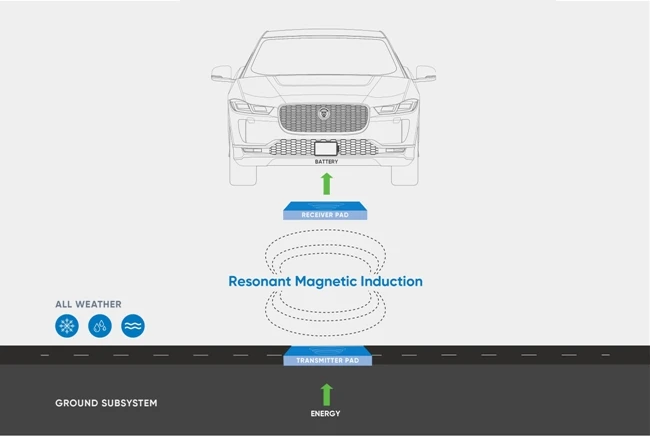
The Oslo ElectriCity partnership is part of Jaguar Land Rover’s ambition to make societies healthier and safer, whilst reducing emissions. Delivered through relentless innovation to adapt its products and services to the rapidly changing world, the company’s focus is on achieving Destination Zero, a future of zero emissions, zero accidents and zero congestion.
Prof Sir Ralf Speth, Jaguar Land Rover Chief Executive, said: “We’re extremely proud of our track record in electrification and we’re committed to making electric vehicles easier to own and use. The taxi industry is the ideal test bed for wireless charging, and indeed for high-mileage electric mobility across the board. The energy efficient and inherently safe,high-powered wireless charging platform will prove critical for electric fleets, as the infrastructure is more effective than refuelling a conventional vehicle. We’re delighted to be part of ElectriCity and to continue to lead the field in electric vehicle technology. This is a great step forward to reaching our Destination Zero mission.”
Arild Hermstad, the City of Oslo’s Vice Mayor for Environment and Transport, said: “We’re delighted to welcome private enterprises to help us to turn our vision into reality.
As part of our commitment to reducing emissions by 95 per cent before 2030, we have put many exciting measures in place, but transport continues to be a key challenge. By improving infrastructure and providing better charging to the taxi industry, we are confident that by 2024 all taxis in Oslo will be zero emission. To reach our goal, the public sector, politicians and private enterprises must come together, as we do in this project.”
An Abundance Of Energy: H2X Australia
Australia’s car manufacturing industry is dead. Long live the Australian car manufacturing industry.
But all is not yet lost…Hydrogen is seen as the potential next step in powering automobiles on Earth, and the technology has been around for decades, featuring strongly in the aerospace industries. Australian company H2X, based in Sydney, has been quietly working away since 2015 on using the most abundant element known, hydrogen, as the source material for automotive propulsion. The heart of a hydrogen powered vehicle is the fuel cell. Take hydrogen and oxygen, wave the magic wand, and electricity is made. The resulting leftover is water. Simple H2O. The efficiency of this process varies and comes in between 40 to 60 percent. Waste heat can be reused and brings efficiency to over 80%.
H2X are applying hydrogen fuel tech to vehicles that they hope to have up and running by the mid 2020s. A minivan, a tractor, and an SUV are amongst the range that the company has in mind. The firm recently turned the dirt at a location at Port Kembla, south of Sydney. It’s here that they currently intend to build the vehicles and also invest in battery and super-capacitors. However, in a reasonable effort to minimise extravagant start up costs, the firm will first use pre-assembled parts readily available from Asia, and a fuel cell from a company called ElringKlinger. A common issue with starting a new company is sourcing people with the required expertise. Here, H2X don’t appear to have a problem. Their CEO is a person that comes from hydrogen related businesses plus a solid automotive background with BMW, Audi, and Volkswagen. Heading the design bureau is the designer of the Giulietta, Chris Reitz. He’s also worked with VW and Nissan. Saab and GM have their DNA running in the veins of Peter Zienau as he worked on hybrid and electric programs with the pair. Opel, Lotus, Volvo, Aston Martin and Tesla have given Peter Thompson over thirty years of experience, including his involvement in the Tesla Roadster.
 There’s more power to come in the board, with Alan Marder, also with plenty of experience in startups dealing with hydrogen fuel cell and automotive industries spanning 35 years. He’ll head the marketing and strategy section, while the former head of the VW Group Asia, Kevin McCann, who also works with Hyundai, Volvo, and Deloitte, will be on the supervisory board.
Picking Port Kembla, says H2X, was a given, as it’s a focus for industries H2X will need as supports. Rail, metal manufacturing in the forms of steel and aluminuim, the size of the port to allow cargo ships, and electronics makers at a military spec level will go a long way to assisting the rumoured workforce of 5,000. They’ve already put forward what they hope will be the first vehicle to drive off the production line. The “Snowy” SUV, with a mooted range of 650km, a refuel time of around three minutes, and a freeway speed reaching time of 6.9 seconds, will be backed by a bio-safe interior, smartphone apps, and autonomous emergency braking. The powertrain is said to be a combination of a 60kW Elring Klinger PEM fuel cell, a graphene ultracapacitor from Skeleton Tech, a powerful 200kW electric motor, and a 5.0kg-capacity hexagon Type 4 hydrogen tank. A key feature that’s under the radar is a suspension system that will, like braking regenerative energy, apply the same process from suspension travel. The Snowy is on track for a 2022 unveiling.
 Level 2, 9 Help Street