

Author archive
Tesla Car Australia Expands The Network Range.
A concern for owners and drivers of purely electrically powered cars is what’s called “range anxiety”. Much like a conventional car, range will vary depending on driving style, with spirited and exuberant driving draining charge quicker.
Tesla Cars Australia recently updated the list of charging stations available, with its 300th charge point being added at the Yarra Valley De Bortoli estate at Dixon’s Creek in Victoria. Over that, Tesla have added 100 charger stations in just six months and announced a global doubling of stations, demonstrating their committment to making having a Tesla car as convenient as possible.
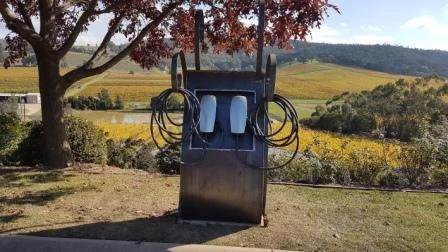
With locations identified across South Australia, Victoria, New South Wales, Western Australia and Queensland, once completed and installed Tesla owners will be able to drive from Adelaide’s city centre to Gympie in North Queensland completely emissions-free.
South Australia and Western Australia will see their first Supercharger locations, whilst the other additions in New South Wales, Victoria and Queensland will allow for Tesla owners to visit popular holiday locations. Tesla’s milestone 300th Destination Charger is situated approximately 50 kilometres north-east of Melbourne near the towns of Yarra Glen and Healesville and is famous for producing some of the finest Pinot Noir and Chardonnay in Australia.
 The winery is well suited as a Destination Charging site, which is designed to be installed at locations where owners of the award winning Model S and Model X will spend a few hours to recharge. Most Destination Charging sites are found at wineries, shopping centres, hotels, resorts and secure parking locations, utilising the same infrastructure as owners use at home.
Tesla Destination Charging stations are designed to enable Tesla owners to drive to key locations where Tesla owners frequent for longer stops with the knowledge they have a charging solution. Destination Charging stations use the same unit as the Wall Connector used at home and charge at a rate of 40km every hour on 32amp or up to 81 km per hour with 3 phase. All charging is dependent on a site’s power output. This style of charging is a replication of the convenience Tesla owners receive when charging at home.
(With thanks to Tesla Car Australia).
Private Fleet Car Review: Mitsubishi Pajero Sport GLS
It’s a hearty welcome back to Mitsubishi for Private Fleet and it was straight into the top level. The Pajero Sport, formerly known as Challenger, comes in a three trim level range. You can choose from the GLX, GLS, and Exceed. Private Fleet goes one on one with the 2017 Mitsubishi Pajero Sport GLS. Mitsubishi have loaded the Pajero Sport with a grunty 2.4L diesel and eight speed auto. Off road driving is catered for with the Super Select 2 four wheel drive system and the GLS cops a rear differential lock. Up front, that diesel delivers a handy 133 kilowatts at 3500 revs, backing up the more than decent 430 torques one thousand revs lower. Mitsubishi quote a combined fuel efficiency for the two tonne plus behemoth of 8.0L/100 km from the 68 litre tank, a figure we more or less matched.
 It’s a super smooth combo, the eight speeder and diesel. It’s slick, smooth to a fault, with barely perceptible changes at almost any throttle setting. Manual gear changes are available via the gear selector or metal paddles on the steering column. The diesel is a old school chatterer, however, with plenty of ratta-tatta under any form of load. It’s noisy, yes, but lends the Pajero Sport a sense of extra character.
 Some would say the exterior design of the Pajero Sport has character and you’d have to study their face to see if they’re serious. The front is what Mitsubishi calls its “shield” design and it’s handsome enough. Chrome plates blend with the angular headlights and it flows nicely. In profile, there’s a sense of a hunch in the windowline at the rear, combined with a deep set crease over the rear wheel arches. It’s from the rear that the Pajero Sport’s design has raised the most eyebrows since it was launched, with tail lights that look as if heat has been applied and they’ve melted from top to bottom. Beauty in the eye of the beholder and all that…
 There’s some big numbers for the Pajero Sport; length is 4785 mm long and it stands 1815 mm tall, taller than most. Front leg room is good at 1087 mm whilst the rear seats may seem a little tight for taller people, with 880 mm leg room on display. Towing capacity tips the three tonne mark, at 3100 kilograms, meaning caravanners will be delighted. There’s plenty of grip to do so from the Bridgestone Dueller 265/60 rubber on 18 inch 12 spoked alloys.
 Inside it’s typical Mitsubishi, with spot on ergonomics, leather seats in the GLS (sans heating and cooling), auto headlights, rear diff lock and towing braking package as well. Front and centre for the driver is Mitsubishi’s Eco messenger display in colour, with a five leaf clover indicating the economic efficiency (or lack there-of) of your driving skills. The display is a typical Mitsubishi highlight, with little to no eye strain and beautifully clean in layout making it easy to read at a glance.
 The six speaker sound system in the GLS (eight in the Exceed) comes with DAB and the digital sound is superb in the Pajero Sport. The seven inch touchscreen also allows access to Apple CarPlay and Android Auto, adding some up to date technology to the field of play. The dash is a mix of glossy piano black, charcoal matt textured black and aluminuim look highlights that run down into the console and splashes on the doors As expected in a family oriented SUV there’s storage pockets aplenty and the underfloor storage provides some extra security.
  Although the seats aren’t heated and cooled, they’re comfortable and supportive enough, with quicker turns on road having minimal human body movement. You arrive at a distant destination feeling refreshed enough and being set high, you’ve got both great all round vision and easy entry and exiting. You need to be refreshed as the dynamics of the Pajero Sport aren’t exactly razor sharp. Although it’s got a big footprint, with a 2800 mm long wheelbase, front track of 1520 mm and rear at 1515 mm, it’s unwieldy on the road thanks largely to the perhaps too soft suspension, a mix of double wishbone & coil springs up front and 3 link coil spring & stabiliser bar rear. If you’ve never driven a vehicle such as this you feel as if you’d need to slow to a crawl to turn corners, such is the sensation of body roll.
 It’s not a point and shoot style car, for sure, however by sitting up high as one does in such a vehicle, anything other than a straight and flat road transmits a feeling of slight uneasiness as to whether the Pajero Sport will go where you tell it. It’ll understeer easily even at moderate speeds but that’s a handling setup issue as the tyres give no indication at all of losing grip. Eventually, and quickly, it must be pointed out, you adapt quickly to the handling and roll foibles, and start exploiting the ability, not agility, of the thing.
 Being fitted with a proper transfer case for high and low range driving, plus the aforementioned diff lock, is an example of that ability. Low range 4WD has the Pajero Sport head down and bum up as it crawls over rocks, through mud, over gravel and brings back the ability to instill confidence in its ability. There’s a 45 degree climb angle, approach and departure angles of 30 and 24.5 degrees, and will swim through water safely at up to 700 mm in depth.
 Throttle control is en pointe, with bare flexes of the ankle seeing and feeling response straight away. Unfortunately the same can’t be said of the brakes. For such a large vehicle and with the mass it has, the brakes simply aren’t good enough. There’s absolutely no feel with an initial press and a lacklustre feel when the pads start to bite from far too much pressure being required on the pedal. Too often it felt like the Pajero Sport wouldn’t pull up in time and an emergency brake press was needed in order for an appropriate bite to work.
Should something go awry, you can rely on the front/side/curtain/driver’s knee airbags to come to play, along with Active Stability and Traction Control, Emergency Brake Assist, Hill Start Assist and Smart Brake. The seatbelts have pretensioning and of course there’s Mitsubishi’s RISE (Reinforced Impact Safety Evolution) body. Going backwards is covered by a reverse camera, standard across the range.
The range starts at $47500 driveaway (at the time of writing, check with your dealer for pricing) for the GLX five seater and metallic paint is a cheapish $590 option. Mitsubishi also offer an extensive range of options to help you personalise the Pajero Sport just the way you like.
At The End Of The Drive.
The Triton based Challenger/Pajero Sport has always been a solid, if not sparkling, performer on road and certainly works well enough off. It’s dynamically not as sharp as some of its competition, retains the charm of an old school oiler with the chatter, but backs up with modern tech, a great transmission, and the bulletproof reliability that Mitsubishi’s off road heritage brings to the Pajero nameplate. For now, it’s also the best five or seven seater off road capable vehicle Mitsubishi has. Head here for more information and a look at the options list as well: 2017 Mitsubishi Pajero Sport range
Mercedes-Benz Provides A Ute With The X Factor.
Mercedes-Benz Vans announced the new X-Class ute will launch in Europe in November 2017 with Australia and South Africa to follow early in 2018, as well as Argentina and Brazil at the beginning of 2019.
Diane Tarr, the Managing Director of Mercedes-Benz Vans Australia and New Zealand, said: “The high level of interest and anticipation in the lead up to revealing the new X-Class has been a reflection of just how engrained dual cab utes are in both the Australian and New Zealand culture. The fact is we love utes and we are showing a desire to incorporate this type of vehicle into our lives in more ways than we did in the past. Not just for work, but also increasingly for private use.
She also said: “The new X-Class finds the perfect balance between the stylish design expected of a Mercedes-Benz and the uncompromising robustness and functionality demanded of the category. As a result, with the X-Class, we can effectively provide a solution for trade and fleet customers, and we will find out just how far this category can evolve for private customers who need the vehicle to support their lifestyle.”

Mercedes-Benz X-Klasse – Exterieur, Kabaraschwarz metallic, Ausstattungslinie PURE // Mercedes-Benz X-Class – Exterior, kabara black metallic, design and equipment line PURE
The Mercedes-Benz X-Class has been specifically developed for the changing requirements of the ute market in mind. The demand for midsize utes with typical passenger car characteristics and comfort features has been steadily on the rise for years. At the same time, the number of utes for private use is increasing. They are no longer viewed purely as “workhorses”.
There are three design and equipment variants to choose from as well as four or six-cylinder engines, rear-wheel drive and engageable or permanent all-wheel drive, a six-speed manual transmission and a seven-speed automatic transmission. It consists of a ladder-type frame, rear multi-link solid axle, front independent wheel suspension and coil springs on both axles. There’s also vented discs front and rear.

Mercedes-Benz X-Klasse – Exterieur, Limonitgelb metallic, Ausstattungslinie PROGRESSIVE // Mercedes-Benz X-Class – Exterior, limonite yellow metallic, design and equipment line PROGRESSIVE
Built on this platform, the distinctive X-Class design is available in three model variants to suit different lifestyles and work environments. Named “Pure”, “Power”, and “Progressive” The Pure is aimed at the more workhouse style environment, whilst the Progressive is more upmarket and mixes a touch of luxury and family oriented usage along with the ruggedness of the Pure. The Power will aim at the high end driver and market, where style and performance along with comfort are of high importance.

Mercedes-Benz X-Klasse – Exterieur, Beringweiß metallic, Ausstattungslinie POWER // Mercedes-Benz X-Class – Exterior, bering white metallic, design and equipment line POWER
There’ll be tech in the form of Lane Keeping Assist, Traffic Sign Assist, and Active Brake Assist, plus M-B’s me Connect which allows owners to use their smartphones to track the vehicle’s location and even measure the fuel capacity without being in the vehicle.
Engines wise, select markets will see a 122 kilowatt petrol, a 2.2L diesel with 120 kW and a 2.5L diesel with 140 kW. Mercedes-Benz says there will be a 2.5L V6 diesel available in 2018 with 190 kilowatts.

Mercedes-Benz X-Klasse – Exterieur, Beringweiß metallic, Ausstattungslinie POWER, Hardtop und Side Bar (Mercedes-Benz Zubehör) // Mercedes-Benz X-Class – Exterior, bering white metallic, design and equipment line POWER, canopy and side bar (Mercedes-Benz accessories)
Deliveries to Australia are expected to start at the beginning of 2018 and pricing is yet to be confirmed.
With thanks to Mercedes-Benz for content.
Jaguar Electrifies London With E-Pace.
Jaguar’s relentless onslaught with new models continues, with the forthcoming E-Pace giving an electrifying performance during its world premiere unveiling. Driven by professional stunt driver Terry Grant, the car was driven inside London’s ExCel building, one of a handful of venues big enough to accomodate the run up and structure that lead to the E-Pace being driven through a barrel roll. The incredible vision can be found here: Jaguar E-Pace barrel roll
E-Pace takes the Jaguar design philosophy of the “Art of Performance” to the next level with this world record setting drive. It also finalised over two years of testing across four continents to ensure the E-Pace would fit snugly into the Jaguar family.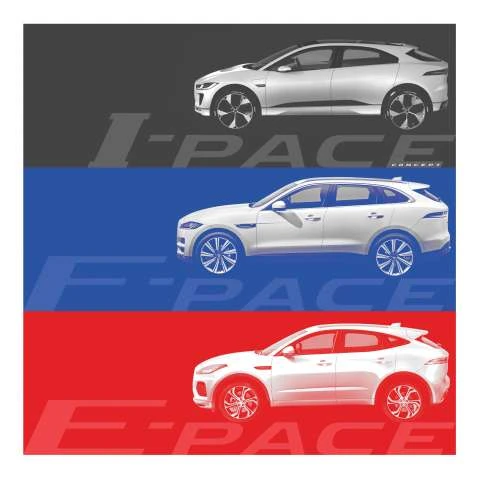 Powered almost exclusively by 2.0L diesels, with two different power outputs available at the top end from the 2.0L petrol engine, the E-Pace slots into the growing small SUV with an overall length of 4395 mm, stands 1649 mm tall, and will have a total width (including mirrors) of 2088 mm. The wheelbase will be 2681 mm, maximising interior room for the five seater vehicle. The differing power outputs will have the variants see 0-100 kph times from 10.1 seconds down to sub six seconds.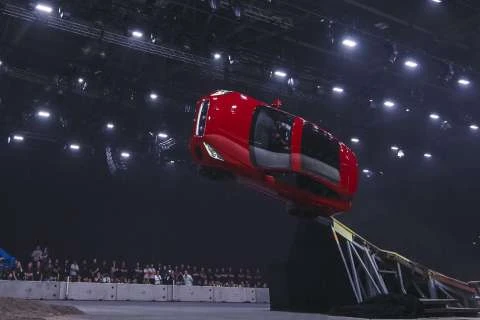
Jaguar’s also added some pretty handy tech. A 4G wireless system allows up to eight devices to connect, the TouchPro system on the 12.3 inch screen is packed with apps, a Heads Up Display provides info and safety, torque vectoring and all wheel drive make for a great driving experience.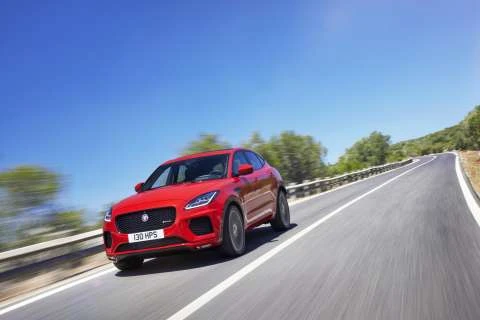
Jaguar also says: “Configurable Dynamics gives the driver even more control with individual settings for the throttle, automatic transmission, steering, and, where fitted, the Adaptive Dynamics suspension system. Adaptive Dynamics senses driver input, body and wheel movements and pre-emptively loads the suspension and chassis and adjusts the damping for improved roll control and agility in all conditions. “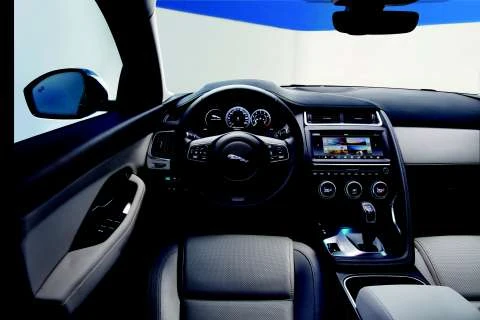
Pricing is currently slated to start from just under $50K plus on roads. Jaguar Australia will confirm pricing and specifications closer to launch.
 Level 2, 9 Help Street