

The Splatometer.

Some of us might be familiar with the car care product “Bugger Off” – a really useful product that cleans insect splatter off the front of your car with ease. In Australia there still seems to be plenty of insect life around but wildlife experts have been warning about the decline in insects for decades. I’m not sure if you’ve noticed any decline in bug splatter on your windscreen over the last decade or so?
ACCC Industry Findings: A World of Shared Data
The ACCC recently released a series of findings pertaining to the Australian automotive industry. Among these findings were observations concerning the resolution of new car buyers’ complaints, fuel efficiency and emissions tests, as well as sharing manufacturer data with independent mechanics and body shops. While each of these topics is contentious in its own right, the last of these, shared vehicle data, should have relevance to just about every stakeholder in the industry.
Looking at the ACCC’s observations more closely, the consumer watchdog is advocating for repair and body shop members of the Motor Trades Association of Australia to receive current vehicle data from all manufacturers, so that they may also carry out work on vehicles.
Car Review: 2017 Kia Picanto.
There’s small cars, and there’s micro cars, and those that sort of slot in between. Kia’s Picanto is a small car that defies its external size to offer a well packaged and uncommonly roomy interior, all the while looking like it would fit into the tray of a four wheel drive ute. Private Fleet explores the funky 2017 Kia Picanto, priced at (at the time of writing), $16230 driveaway with metallic paint (Pop Orange on the test vehicle). And when PF says Picanto, it means Picanto. To paraphrase Chief Engineer Scott from Star Trek:The Next Generation’s brilliant episode “Relics”: “There’s no bloody S, no bloody Si, no bloody GT Line”. What you get is a single trim level, a 1.25 litre four, a five speed manual or archaic four speed auto, which is what the test car was fitted with. The little engine that could delivers 66 kilowatts at 6000 rpm and 122 Nm which peaks at 4000 rpm.
 The fuel thimble holds just 35 litres however fuel consumption for the auto is rated at 5.8L/100 km for a combined cycle. As it’s a city car in intent, figure on 7.9L/100 km around town. If you do decide to drive outside of the big city, it’s rated for 4.9L/100 km. That’s from a dry weight of five kilos under the tonne. We finished on 6.6L/100 km in a mainly city environment and generally with one aboard.
We said it was small. How does 3595 mm long, 1595 mm wide, 1485 mm tall, and a huge (relatively 2400 mm) wheelbase sound? Sounds horrible, right? But it’s that wheelbase increase (up slightly from the previous model) that provides ample legroom up front, enough for reasonable comfort for two adults in the back, and enough shoulder and head room for four without constant body contact. There’s even enough room to slide in 255L of cargo space with the comfortable rear pews up. What’s not small is the ability of the Picanto to deal with varying driving conditions, thanks to the brilliantly Australianised specification for the suspension. Kia’s engineers have tweaked the McPherson strut front and coupled torsion beam rear even further, and what is delivered is nothing short of surprising. It’s fair to expect a small car, riding on 175/65/14 rubber (wrapping steel wheels with alloy look wheel covers) from Nexen, to hop/jump/skip around on anything other than billiard table flat surfaces.
 Nope. You’ll get a car that’s composed, unflustered, sometimes even displaying indifference to broken or breaking up surfaces. Toss the little machine into a long flowing curve and there’s a subtle shift of balance as the car resettles. It’s nimble, adept, and sure footed.
Why You Need To Keep Left
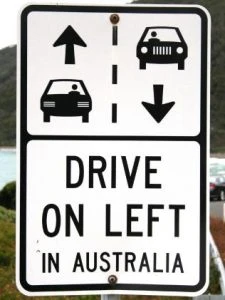 … Because you’ll be killed in a head-on smash, that’s why.
OK, let’s clarify a few things here. Obviously, all of us need to drive on the road so that we don’t bump into other drivers. When Car A is travelling north at 65 km/h on a road and Car B is travelling southwards at 85 km/h and the road is – whoops, channelled the old-fashioned maths books there for a moment – anyway, how do they keep from bumping into one another? Very simply, in Australia, we have agreed to keep to the left.
 Level 2, 9 Help Street