

Peugeot Loads Up With 508 and 308GT
Peugeot’s all-new 508 has hit Australian shores and has a raft of class-leading technology and drivetrains. It also features the best of the brand’s design and engineering prowess, and will have them packaged in two stunning body styles. The All-new 508 will be available in Fastback and Sportswagon body styles. Dollar wise it starts at $53,990 and $55,990 respectively, with exterior colour choice ($590 for metallic and $1,050 for pearlescent) and an opening panoramic sunroof ($2,500) the only options. It’s an award winner too, with the “2018 Most Beautiful Car of the Year Award”. GT spec will be the only model trim level. Power will be from an all-new, high-output version of Peugeot’s proven 1.6L, turbo-petrol, four-cylinder engine developing 165 kilowatts of power and 300 Newton metres of torque. Transmission is from Aisin and is all new. Eight will be the cog count.
The engine and transmission combination will deliver impressive performance. Combined with the vehicle’s light overall weight, the sprint to 100kmh will take just 8.1 seconds for the Fastback, and 8.2 seconds for the wagon. Consumption is rated as 6.3L per 100km. It’s a complete redesign with the 508 shorter, lighter, and more low slung than the previous model. Better packaging means a bigger interior. Ben Farlow, Managing Director of Peugeot Australia, said that while the term “all-new” is one that tends to get over-used in modern times, in the case of the Peugeot 508 the vehicle is all-new not just in design but also in its thinking, engineering and intent. “The Peugeot 508 arrives at a time when the sedan segment is ripe for a shake-up. Not only is the 508 outstanding value, it’s great to look at, great to drive and it stands out in its class.”
The Perfect Form of Transport???
 Here at Private Fleet, we keep an eye on trends in car design and the way things are shaping up. At the moment, I reckon there are three biggies: fuelling systems, autonomous vehicles and sensors.
Let’s start with fuel. We all know that the supplies of crude oil aren’t as big as they used to be and the ones that are left are frequently in places that are very hard to get at or are located in politically volatile countries. This means that if we can cut down our dependence on non-renewable fuels, we’ll be able to keep on trucking the way we’re accustomed to. We’ll also help cut down on greenhouse gases, which is supposed to stop global warming or climate change.
2019 Toyota 86 GTS Manual and Auto – Private Fleet Car Review
This Car Review Is About: Toyota’s joint venture with Subaru, the two door sports coupe Toyota call 86. In this case we drove, back to back, the 86 GTS Manual with Dynamic Sports Pack, and the 86 GTS Auto.
 How Much?: The GTS Manual with Dynamic Sports Pack is priced from $43,534 driveaway with the “standard” GTS priced from $40,497. The Manual has Apollo Blue paint, a specialist colour for this model and trim, with the Auto being clad in White Liquid. Metallics are a $500 option. The auto is $42,866 with Ignition Red, $43,381 with the Liquid White.
Under The Bonnet Is: Subaru’s fabulous flat or “boxer” four. Peak power is 147kW (auto) and 152kW (manual) from the 2.0L capacity engine, with peak twist being either 205Nm or 212Nm. There are slightly different cog ratios in the manual as compared to the auto, with the manual’s final drive at 4.3:1, compared to 4.1:1 with the auto. Peak power is at a lofty 7,000rpm, with that peak torque found between 6,400rpm to 6,600rpm in the auto, 6,800rpm in the manual. In order to get those figures the engine is tuned to run on 98RON. Economy is quoted at 7.1L/100km or 8.4L/100km for the auto and manual on the combined cycle. Due to the physical size of the 86, fuel tank capacity is just 50L. We returned figures in largely urban driving of 7.9L/100km for the auto and 8.6km/100km for the manual. Gross vehicle masses are 1,670kg (auto) and 1,700kg (manual) with dry weights between 1,250kg to 1,280kg. On The Inside It’s: a nightmare for rear seat passengers, a tight squeeze for front seat passengers, and a harken back to “the glory days” of Toyota with a retro look and feel to the cabin’s design. The front seats use a lever method for moving the seats forward to allow access to the rear, but they also use levers for seat back and height adjustment, not the preferable electric or at least “roller dial” adjustment. They are heated via a two position switch but only for the squab, not the whole seat.

 The GTS spec has Alcantara trim on the doors and dash for a little extra comfort, plus carpeted floor mats which also add a little extra sound deadening. Pedals are alloy with rubber tabs for the retro look and aiding shoe grip. The dash dials are fully analogue with a small 4.2 inch LCD screen set at the bottom right. This provides oil and coolant temperatures, G-force instant and history, a power and torque delivery graph, and more. The main screen is 6.1 inches in measurement and is a modern look on a retro theme. There’s a solid black surround, a CD player slot, and AM/FM only, meaning no DAB. Satnav, reverse camera, and streaming apps are standard.
 The actual look is of dials and toggle switches. It’s meant to evoke a sense of looking back in time and it works. The dual zone climate control, the air intake for fresh/recirculate, even the glowing red LEDs for the clock and temperature displays, are all “olde timey” in look. The centre console plastics are a chintzy silver plastic and have the traction control tabs embedded. Both have the standard push button Start/Stop and that’s visually obvious by being located in the bottom right corner of the centre console stack. And for those that prefer mechanical stopping, a proper hand brake is employed.
 The dash is a sweeping design that joins both doors in an arc and wave and has the centre airvents looking not unlike a impulse engine housing from a starship. The top of the dash binnacle and the flat panel have the Alcantara trim, and there is a subtle silver hue to the airvent surrounds. That colour is also wrapping the gear selector. Thankfully, both headlights and wipers are Auto on. There are a couple of centre console cup/bottle holders, and just enough room in the door pockets for a bottle. The boot is also surprisingly big, and coped well enough with a weekly shop. For its more obvious audience, a couple or single, it’s ideal for an overnight bag or two.
 On The Outside It’s: Largely unchanged from the original model however a very mild facelift was applied in 2016. Tail lights are LED as are the headlight cluster driving lights. There are aerodynamic strakes in the lower quarters of the front bumper around the globe lit driving lights. The chin of the front bumper has been subtly restyled, and there are even thin strakes on the outer edges of the plastic at the bottom of the windscreen for air guidance.
Pencil Sharp BMW M240i
BMW Australia has managed to negotiate a super sharp driveaway price for its stonking M240i coupe. With deliveries due to start for Q4, buyers will look at $74,900 as a driveaway starting price. Standard inclusions make for a long list.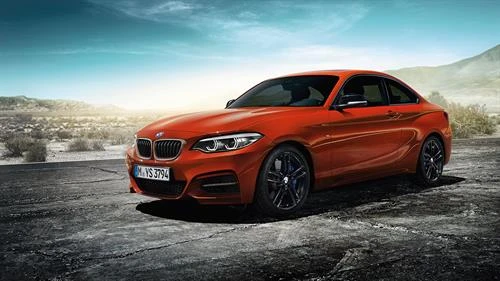
Up front is their M Performance TwinPower Turbo 6-cylinder in-line petrol engine. Peak power is 250kW of power with peak twist rated as 500Nm of torque. It’s quick, with a 0-100kmh of 4.6 sec. Drive gets to the tarmac via an 8 speed Sport Automatic gearbox, and the car rides on their proprietary Adaptive M Suspension with stopping power thanks to the M Sport brakes. The driver connects with the road through the variable sport steering, including the servotronic speed-sensitive assistance. Both driver and passenger have Sports seats to park their rear in and the driver has electric adjustment and memory positioning. Both front pews are heated but not vented. Sounds are fr
 Level 2, 9 Help Street