

Who's Hugh? An Aussie On The Rise Barters For The Future.
Go-karting is one of the avenues that many high level drivers have used to enter motorsport. Be they a V8 Supercar driver or in the F1 family, karting is in the bloodline of many. One of the high profile Australians in motorsport, Daniel Ricciardo, started in karting. There’s a “new kid on the block” in the form of Hugh Barter. Aged 13, Barter already has close to a decade’s worth of karting experience, and is looking to drive in the upper echelons of motorsport. Hugh was admitted to the AWC Motorsport Academy earlier this year. The academy has joined with former V8 Supercars driver Marcus Ambrose to help train and coach the “next generation” of drivers.
Hugh’s path to the academy has included the Rotax Pro Tour. 2019 sees him in his second year in the Junior Max class, a category recognised around the globe for junior drivers. The tour kicked off in Port Melbourne and proved to be a challenge first up. Round 2 of the tour and Round 1 of the Australian Kart Championship in Ipswich, Queensland, showed promise in each of the heats however mechanical issues arose and took Barter out of contention in most of the heats. These hiccups has Hugh start in 11th in the round’s final race, and it all came together with the chequered flag seeing Hugh across the line in 1st.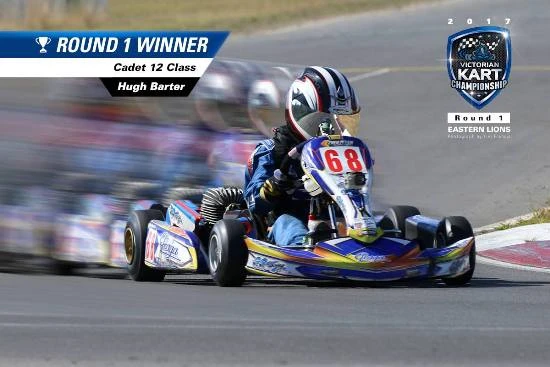
Will Driving Faster Really Get You There Quicker?
 (Warning – contains maths!)
It seems ingrained in our human mentality. If you go faster, you get there more quickly, right? After all, we’ve all seen this in childhood. When you walked to school, let’s say it usually took you 15 minutes. I am possibly showing my age here with the assumption that you walked 15 minutes to school – although a 15-minute walk is pretty reasonable and there’s no reason why kids these days (that’s really showing my age) can’t do it as well. Anyway, back to the topic. When you were a kid walking to school, if you realized that you’d forgotten your homework and had to double back for it, you pretty soon found out that if you jogged or ran, you’d still make it to the school gate before the bell rang.
2019 Toyota C-HR: Private Fleet Car Review.
This Car Review Is About: The 2019 Toyota C-HR. It can be seen as an alternative companion to the RAV4. Alternative because it’s a different option, companion becuase it’s a five door SUV that seats five. It’s a two-model range, with the Koba as the other entry.  Under The Bonnet Is: A turbocharged 1.2L petrol engine. There is a manual transmission or CVT for the entry level, CVT only in the Koba. Opt for the CVT and it’s front wheel or all wheel drive for a choice. Peak power is 85kW between 5,200rpm to 5,600rpm. Torque is a bit more useable, with 185 of them between 1,500rpm and 4,000rpm. Economy is quoted as 6.3L/100km on the combined cycle. On our urban drive we saw a best of 7.4L, and a worse of 7.9L/100km. Recommended fuel is 95RON. There is no paddle shift in the base model, just the transmission selector for manual shifting.
 What’s It Cost?: Toyota’s website says the 2WD starts from around $30, 500 in Hornet Yellow. Head to a metallic colour and that goes to just over $31K. The AWD will start from around $34,700. You’ll get a five year and unlimited kilometre warranty. Servicing can be booked via the myToyota app.
On The Inside Is: A reasonable amount of standard equipment and safety features for the ask. It starts with something basic but useable in the shape ofI an auto dimming rear vision mirror. There are auto headlights, dual zone aircon, but no DAB in the overly boomy audio system. The 6.1inch touchscreen system has a CD to make up for the lack of digital radio, plus USB & Bluetooth connectivity. Satnav and voice activation are also standard is the ToyotaLink app function. SafetySense is the name Toyota give to their suite of driver aids, and the C-HR has Lane Departure Warning, Auto High Beam, Blind Spot Alert and Rear Cross Traffic Alert. Autonomous Emergency Braking and Active Cruise Control are standard as well, as are seven airbags.
 Trim material in the C-HR is black and black. This may make the interior somewhat claustrophobic for some, as there is a hunchbacked look thanks to the rear window line being steeply sloped. There is some triangular shaped embossing in the roof lining which matches the interior light above the manually operated front seats and mirrors the rear light design.
  For the driver there is a sense of having their own office space. the dash sweeps around from the window to the centre stack, and this faces towards the driver’s seat. Trim here is of a piano black and there’s some smartly integrated buttons for the aircon controls.
 On The Outside It’s: Not unpleasing but definitely one example of beauty is in the eye of the beholder. This is down to the profile. The rear roof line slopes dramatically forward from the tail lights, which can compromise interior headspace for taller people. There’s a huge roof-lip spoiler too, which in the Hornet Yellow is noticeable. The wheel arches and guard are pumped out from the body and these are defined by strong crease lines coming down from the windscreen and rear window.
Updates And Freebies For Triton, Eclipse Cross, And Colorado.
Mitsubishi has released details of its 2020 updates for the Triton, and Holden has confirmed some special servicing costs for the Colorado.
Any buyer of a Colorado that is delivered between October 1 and December 31 will receive free scheduled servicing for seven years. It covers all LS, LSX, LTZ and Z71 4×4 vehicles, and this will save owners over $3,000. This is up and over the standard five year warranty for the Colorado. This offer also applies to Holden’s seven-seat SUV’s Acadia and Trailblazer. 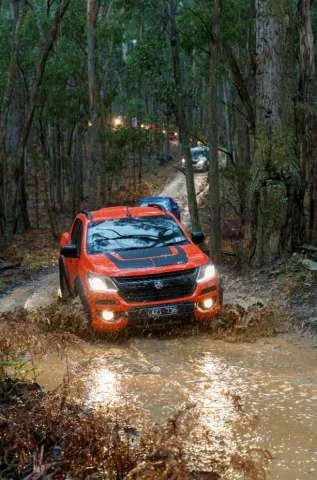 The Triton range has been given a tickle, with the GLS and GLX+ models receiving a rear diff lock as standard. The GLS now has keyless start as standard and the double cab GLX+ now gets a air circulator for the rear seat passengers.
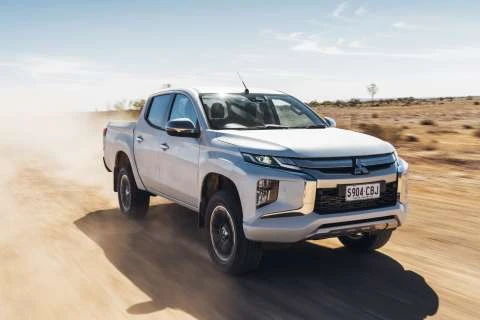 In the driveline section, Mitsubishi’s Easy-Select 4WD is fitted to the GLX+ model. With the twist of a dial 2WD, 4WD high range and 4WD low range are made available. Move up to the GLS and GLS Premium the Super-Select 4WD-II offers 2WD and 4WD high range, plus what Mitsubishi calls 4HLc (lock up) and 4LLc (lock up in low gear). The electronics are programmed to provide Gravel, Mud/Snow, Sand, and Rock capability And when equipped with 18 inch wheel and tyres, ground clearance is 220mm. This gets added to the 31 degree approach angle, 23 degree departure angle, and “break over” angle of 25 degrees.
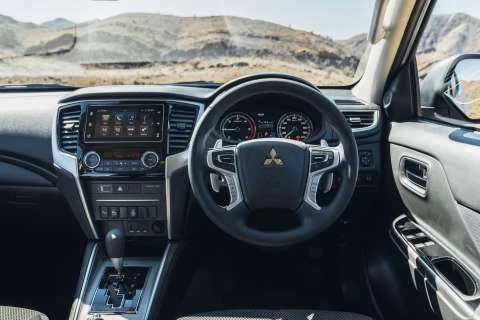 Pricing for the Triton range starts at $22,490 4X2 GLX Cab Chassis 2.4L Man Petrol (RRP). This is the only petrol engine in the range, with the 4X2 GLX Cab Chassis 2.4L Man Diesel clocking in at $25,990. The Club Cab 4×4 GLX Cab Chassis 2.4L Man Diesel starts the second tier at $35,490, with the dual cab range starting with the 4×2 GLX ADAS Pick Up 2.4L Auto Diesel at $36, 290. before topping out with the 4×4 GLS Premium 2.4L Pick Up Auto Diesel at $51,990.
 Level 2, 9 Help Street