

The Future of Driving: AR and VR in the Automotive Industry

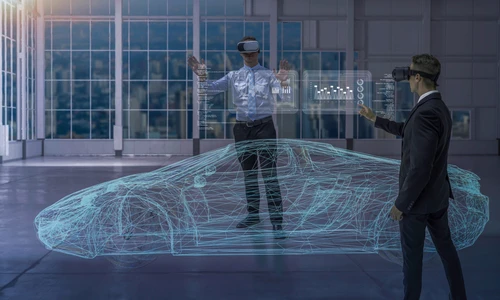
Over the years, Augmented Reality (AR) and Virtual Reality (VR) have been (re)shaping the way we see the world. In fact, you might be more exposed to AR and VR than you realise
Just picture all those filters on Snapchat, Instagram or Messenger. Have you played Pokémon Go? That’s a fun one! There’s also Google Street View which seemingly takes you to a place you’ve never been to or IKEA’s app which allows you to virtually impose furniture in your home.
Beyond these, there are also more complex and practical uses of AR and VR, one of them being its applications to automotive design.
In this article, we’ll discuss the use of Augmented Reality and Virtual Reality in the automotive industry and its implications for the way we drive every day.
Understanding AR and VR
What is Augmented Reality?
Augmented Reality (AR) allows users to experience an enhanced (or augmented) version of the actual physical world through digital visual, auditory and other sensory elements delivered via technology.
So far, these features have been used mostly for games, filters on apps, or catalogue apps that allow people to visualise furniture in their homes. In the healthcare sector, AR is also used so medical professionals can see detailed images of body systems.
If you’ve heard of AR, you’ve probably heard of VR as well.
What is Virtual Reality?
Virtual Reality (VR) is the use of computer modelling and simulation to immerse users in a computer-generated environment. Typically, VR simulators require users to wear headsets, goggles, gloves or body suits to send and receive information that will simulate reality.
The most typical uses of VR are in the entertainment space, where people can experience being in fantasy spaces. It’s also widely used for virtual training programs for various professions (e.g. flight simulators, surgery simulators, etc.) as it reduces costs and is far safer than practising with real systems.
While VR and AR are closely related, the difference is that AR adds virtual elements to the real world, while VR creates an entirely different environment for the user to experience.
These immersive technologies are now being utilised across various industries and the automotive industry has naturally followed suit.
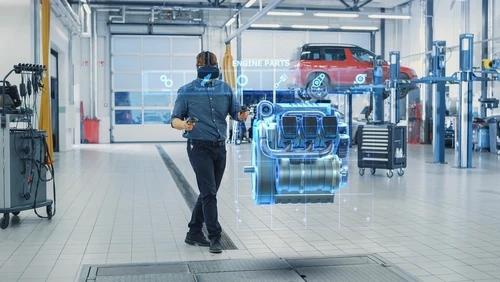
What is the role of AR and VR in the vehicle and automotive industry?
While these technologies are relatively new, several areas of the automotive industry are already leveraging the potential of AR and VR, including:
- car manufacturing and design
- prototype testing
- marketing and sales
- employee training and more.
With all these, we can expect AR and VR to largely impact the automotive industry today and long into the future.
What are the most common uses of AR and VR in the automotive industry?
1. AR and VR are used in designing and prototyping new cars.
Immersive technologies like AR and VR are already being used at the beginning of the car design process. For example, engineers use VR to design cars virtually, allowing them to spot errors early on and reduce costs during the process.
AR can also be used to overlay instructions and assist manufacturers, while VR simulations are great for test drives (even for cars that haven’t been manufactured yet).
If you’re a fan of customised cars, some technologies allow users to visualise cars with different colours, wheels and other accessories. These are great steps towards road safety and can greatly reduce costs during the manufacturing and testing process.
2. Automotive industry employees are now trained using AR and VR.
Because the market expectations for the automotive industry are constantly changing, extensive training is also needed to allow employees to keep up; and with AR and VR training, the possibilities are endless.
BMW trains employees through a virtual vehicle assembly line, while Ford has a virtual lab that allows designers and engineers to collaborate remotely. Peugeot has developed a virtual training course for a productive workday, while Audi uses VR to enhance their sales team’s communication skills.
With AR and VR, employees can train in a safe and controlled virtual environment – and these are transforming the automotive industry as a whole.
3. The automotive industry also uses AR and VR to enhance customer experience.
Lastly, AR and VR are being used now for marketing and selling cars.
Today, it’s possible to shop for your dream car from the comfort of your home through an immersive Virtual Showroom. The different types of virtual showrooms today showcase several interactive features such as allowing users to walk around the car, press buttons and even test drive new cars.
Audi, BMW and Porsche are among the brands that utilise Virtual Showrooms – and it’s only a matter of time until everyone else follows.
The automotive industry is currently experiencing revolutionary changes driven by digital transformation. It’s quite fascinating to see how these change the experiences of everyone in the industry: from the manufacturers to the users who will be driving the car of their dreams.
With all these changes to the car-buying experience, it helps to have a vehicle expert who can guide you.
If you have questions about cars, Virtual Showrooms and how you can choose the right vehicle for you, simply reach out to us for a chat.
Find the right vehicle (virtually or in-person) for you with Private Fleet.
Private Fleet empowers you to gain all the benefits of a fleet purchase, but as a private buyer.
Backed by decades of vehicle industry experience, fleet buying power and a network of car dealers across Australia, we are here to ensure that buying your next vehicle will be as straightforward as possible for you.
Shopping for a car is an enjoyable process – let us make it hassle-free, too.
Reach out to us today for a seamless and simple car-buying experience.
 Level 2, 9 Help Street