

Author archive
How Does An Airbag Work?
 Airbags – they’re in every single new car coming out and if your car doesn’t have at least one airbag somewhere, it’s probably old enough to just about qualify as a classic. It’s probably just about getting to the point that Millennials (or the children of Millennials – whatever trendy label you slap on that generation) will probably take airbags for granted much the same way that Gen X takes seatbelts for granted. (Boomers and Busters probably remember a time before seatbelts were compulsory back and front – I’m Gen X and I’ve got vague memories of cars with no rear seatbelts. They weren’t common.)
The airbag concept has been around since the early 1950s, with patents being granted just about simultaneously in the US and in Germany to two different inventors, Walter Linderer and John Hetrick (which makes me suspect a little idea swapping was going on during the post-war Allied occupation of Berlin). However, airbags didn’t really become popular until the 1970s, which was when Ford decided to give them a try. This was about the time when legislating bodies around the world were taking a long, hard look at what was happening on the roads and were really getting serious about road safety, although it wasn’t until 1984 that the US made seatbelt use compulsory. It was also in the 1980s that saw vehicles of all marques installing airbags in an attempt to pick up accreditation from the newly established EuroNCAP.
Now, of course, airbags are everywhere: front airbags for the driver, front airbags for the front passenger, side airbags, knee airbags, curtain airbags – even “pedestrian airbags” that deploy on the outside of the vehicle in some Volvos.
Most of the time, if we’re driving properly and everyone around us is driving properly, we won’t see diddly-squat of the airbags. So it should be. This means that how they work can be something of a mystery.
Any airbag, no matter where it’s located, has three parts to it: the bag itself, the sensor that tells the airbag to deploy (you don’t want the airbags firing at the wrong moment) and the inflation system. The airbag itself is somewhat uninteresting: it’s a bag of nylon fabric that can pack up nice and tight, withstand the forces of sudden inflation, is airtight enough to actually inflate but has enough holes so it can deflate afterwards. They also come lubricated with ordinary talcum powder to help them move easily and stay supple. It’s the sensors and the inflation system that are a bit more fun.
The sensor picks up any force that’s equal or greater to the car going head-first into a brick wall at about 16 km/h, meaning that if you nudge the back of the garage at a crawl, if you ram the front bumper with a shopping trolley or if the cat jumps onto the car to enjoy the warmth of the bonnet, the airbag won’t deploy. The sensors usually sit in the crumple zones and the typical modern vehicle will have about three of them. The sensors are simple affairs, consisting of a ball in a tube as the main trigger. If the ball is jolted out of the tube, this sets the inflation system off.
The inflation system is, quite literally, rocket science. In other words, it uses the same technology as solid fuel rocket booster systems. One of the early teething troubles they had with airbags was finding a method of inflating the bags that didn’t take up too much room or create an additional hazard (canisters of compressed gas had storage problems), deployed quickly enough and didn’t save your life but leave you deaf thanks to a thunderous explosion. Nasty toxic gases were also to be avoided. No point saving your life from the crash if it’s going to asphyxiate you as the gas dissipates.
The solution came in the form of two very reactive chemical compounds: sodium azide (NaN3) and potassium nitrate (KNO3). Don’t play with these in the chemistry lab at school. When the trigger goes off, these two are ignited so the reaction begins. And does it begin or what! These compounds burn fast and release a heck of a lot of nitrogen gas in a very short space of time. This gas inflates the airbag super-fast so the bag deploys out of wherever it’s stored at over 300 km/h. The nitrogen gas isn’t going to harm anyone as it goes back into the atmosphere – which is about 90% oxygen anyway. Some mechanisms use slightly different chemicals but still work on the same basic principle and produce an equally harmless gas, such as argon.
In summary, the system works like this:
1 The force of a collision knocks the ball out of the tube (the most basic version of the accelerometer that detects a massive slowdown – there are other types out there).
2 The trigger flicks an electric switch that heats up an element.
3 The heat sets off a very, very fast chemical reaction.
4 The reaction produces heaps of gas very quickly, which fills the bag.

Can you get an airbag to deploy if you brake hard enough? No. In spite of urban legends and speculations tossed around by younger drivers, emergency braking in itself won’t set off the airbags. Brakes just don’t generate the sharp, short force needed to set them off – even emergency braking is more gradual than that. The airbags also won’t deploy if you are rear-ended (you’re being shoved forwards, not brought to a sudden stop) or if you use the bull bars on the front of a 4×4 as a DIY bulldozer (unless you try to get a running start into whatever you’re trying to push). They will probably deploy if an enraged bull or ram takes a dislike to your car and charges it head-on, although I doubt this has been tested. The popular amusing video of an elderly pedestrian setting off the airbag on the car belonging to an impatient driver is probably a fake, meaning it’s been carefully staged with a vehicle that has had the sensor system adjusted, then hit in exactly the right place. But it’s still funny.
Airbags are not without hazards of their own. Yes, they have saved thousands of lives. However, anything that is moving at over 300 km/h is going to pack a lot of punch, even if it is only air and cloth. Anyone who’s been on the receiving end of a well-flicked tea towel while drying dishes with siblings knows that “just” cloth can draw blood if it goes fast enough. Not that an airbag will draw blood. It can break your glasses as your head flies forward to meet it and it’s still going to hurt. It will hurt even more and probably will draw blood and worse if you have anything on your lap that gets between you and the airbag – another reason not to try hiding your cellphone on your lap!
The force involved in a deploying airbag is too much for small children, which is why it’s best to put little kids of an age to sit in a booster seat in the back. However, we know that sometimes, you just have to put a small person in the front (although this isn’t likely to happen unless you have three other littlies already in the back). This is why some vehicles have occupant seat detection for the front passenger seat that has a weight sensor, so the airbag won’t go off if whatever’s in that seat is below a certain weight.
Airbags should never, ever, ever be used as a substitute for a seatbelt. It’s a case of “both–and” rather than “either–or” and why would you want to skimp on your personal safety anyway? It’s not as if an undeployed airbag is going to get in your way, limit your fun or restrict your freedom of movement or ability to drive well. Don’t be a silly muggins – wear your seatbelt!
Fact Or Fiction: Headrests Were Designed To Be Detachable
A number of you may have seen that meme buzzing around Facebook and other social media platforms letting you know that headrests were deliberately designed to be detachable so that if you are trapped inside the car and need to break a window to get out, you have a useful tool for smashing the glass. As we’re interested in quirky facts, great designs and safety features here at Private Fleet, I thought we’d check this one out. Is it, in fact, true that this is what the designers were thinking when they designed headrests?
OK, in a nutshell, here’s the results after a quick bit of research:
- Yes, head rests tend to be detachable.
- Yes, head rests are a safety feature.
- Yes, you can use a detached head rest to break glass if you need to exit via a window.
- No, this was not a deliberate part of the design.
(Thanks to Snopes.com and Truth Or Fiction for doing some of the hard yards of research here).
The primary 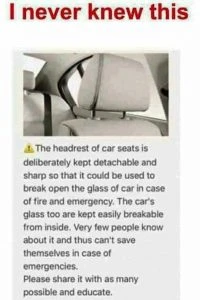 purpose of a head rest is to protect the occupant of the seat in question from whiplash injuries, as they prevent the head from lashing back suddenly during a collision or if the car is rear-ended. Your head is quite heavy, after all, and the momentum and G-forces involved in a whiplash inducing collision puts one heck of a strain on your neck vertebrae and muscles. It’s the weight of the head and the strain on neck muscles that has been the primary concern of designers right from the beginning. The first US patent for head rests in vehicles was issued in 1921, although the designer’s main concern was driver fatigue. It wasn’t until 1969 that they became mandatory in the US.
If we have a quick look at the original patent issued to Benjamin Katz of Oakland, California (another inventor a lot of people ought to be grateful to), there’s no mention anywhere of the importance of being detachable so that occupants are able to use the headrest supports as a tool for breaking glass. The patent is more concerned with reducing driver fatigue and hopes to provide something that allows the driver to “rest his head, relax the tired neck muscles, and still maintain his alert vigil.” Of breaking glass and even of whiplash, there is no mention.
The new, improved patent from 1930, issued to Sverre Quisling of Wisconsin, mentions the ability to use a head rest as a hanger for jackets and the like. The 1950 patent granted to Lawrence Schott of Detroit certainly mentions detachability but has no mention of using the headrest to break glass. The designer had folding seats in mind, as removing the headrest made it easier to fold the seat. Various other designs were developed and put forward over the years between 1950 and 1969, all aiming to either prevent whiplash or to reduce driver fatigue. The patent that I can find that resembles the modern head rest design most closely was issued to Rachel L Rising in 1958. One could spend quite a while trawling through all the different designs and all the different patents (somebody’s written a whole book on the topic – fact!), but you’re not going to find a mention anywhere of using the supports of the headrest to smash glass for an emergency exit.
Fast forward to today and car designers are still working on head rest design. They’re height and tilt adjustable, they’re provided in rear seats as well as front seats and they come in special active whiplash-preventing designs. Saab was the first to come out with an active whiplash protecting headrest, with marques from the upper and lower end of the prestige spectrum following suit, from Toyota and Subaru through to Mercedes-Benz and Jaguar. It’s passive safety and protection of the occupants that are the key concerns of the designers.
 So why are head rests removable? In the case of rear seat headrests, they’re removable for better visibility – if the driver wants to and there’s nobody in the back, the head rests can come out to allow the driver a clearer view of what’s behind. In the case of front seats, they’re detachable so you can fold the seats flat should you want to sleep in it, or so you can put a car seat cover on easily. Removability also had the possibility of making sure that all seats were compatible with child safety seats. The National Highway Traffic Safety Administration standards on the topic make it clear that if head rests are removable, you can only remove them deliberately with two hands to prevent idiots monkeying about and whipping the head rest out if they don’t like them. Not a word about using them as a tool for breaking glass.
So where did the idea of using a head rest to break the glass if you get your car into deep water come from? According to Snopes.com, it goes back to a Japanese TV show that demonstrated this survival tip:
Using a head rest to break a window is a fine example of human ingenuity and quick thinking in an emergency. Certainly the person who first thought of doing this is something of a genius. If you are unlucky enough to drive your car into deep water and the car is sinking, you are going to have to exit via the window, and modern fast-glass cars with electric windows make this a problem, as the water shorts out the system if the car goes underwater – but it won’t do so straight away, so this should always be your first move, along with taking off your seat belt. Car glass is also very tough, especially on the windscreen (don’t; bother smashing this – go for the door windows). Other tools can be used if you can’t get the window open in time: special tools bought for the purpose, stiletto heels, spark plugs, hammers, etc. Certainly, the detachable headrests are handy but this is an added and unintended bonus rather than an integral part of the design.
If you can’t get the technique right for busting the window, the recommendation is to wait until there’s enough water in the car to equalise the pressure inside and out (try not to panic), take a deep breath and open the door as soon as you can.
Of course, if you have an older car with older windows that wind down manually, you are probably feeling smug at this point, as the issue of window mechanisms shorting out isn’t a problem.
How Not To Use A Phone While Driving
 They say that driving distracted is as bad as driving drunk when it comes to reducing your reaction times and making smart driving decisions. Some distractions are beyond our control, such as half a swarm of bees flying through the open window (not making that one up – this happened to someone I know), a screaming child or a busting bladder. However, using the phone is something that you can control.
We all know the rules. Handsfree is the only way that you can do this legally and safely. Putting the phone on your lap and glancing down so nobody knows that you’re using the phone is not an option. In fact, this is probably worse than having the thing openly visible up by the steering wheel in your hand – at least that way, you have half an eye on the road even if you do risk being spotted by the cops. When the phone is on your lap, you have to take your eyes right off the road to look at it. Bad idea.
You’ve got to think beyond the stereotype of teenagers compulsively stuck on smartphones madly using social media, too. Often, it’s adults who are at fault and who cause the accidents: “I can do it because that text, tweet or email might be really, really important for my work/family, and I’m a good experienced driver and I know the road and it’s not really busy and I’m used to multitasking and…”
Why do people compulsively check their phones while driving? A lot of it probably comes down to standard cellphone etiquette: it’s considered bad form to not respond to someone who’s texted you, preferably as promptly as possible. There’s always the thought at the back of our minds that the text that’s just come through might be something urgent – your significant other saying that he/she has locked the keys in the car and needs your help urgently, the school saying your child is sick, or a client from work trying to rearrange a meeting.
On the one side, you’ve got the fear of missing something urgent plus the desire to be polite. On the other side, you’ve got the law and the desire to drive safely. How are you going to resolve this one?
Go cold turkey
Even if the call is an emergency, you can wait a few minutes until you find a suitable place to pull over. It is possible to leave the phone alone and not respond instantly. Nobody is going to die. If the situation is that urgent, the person in question should have dialled 000 rather than you. Anyway, emergencies are few and far between, and there’s a chance that the text in question is going to be something along the lines of “3oclock Monday fine for meeting”. Put the phone on silent and put it in the glovebox or somewhere you can’t reach it or see it, then ignore it. It won’t kill you. However, texting while driving can kill you or someone else. This is also one of the only two options for L-plate and P-plate drivers.
Hand it to the passenger
If you’ve often got people in the car with you, the person in the front seat can be your hands while you get on with the driving. Your passenger can read out texts, send texts for you, look things up and give you information such as “Shirley’s sent you a hilarious picture on Instagram that you’ll have to look at later.” A strong-minded front seat passenger can also growl at you if you make a grab for the phone, or even physically stop you grabbing the phone, as suggested by this road safety ad from New Zealand:
Driving apps
Some apps solve the etiquette problem, meaning that the person on the other end of the text doesn’t think you’re rudely ignoring them. These apps are similar to the automatic reply emails that you can set up when you’re on holiday but are more short-term. Just before you start the engine, you turn the app on. If someone texts you while you’re driving, the app will auto-reply saying that you are driving and will reply as soon as possible. You can get them for iPhone and Android and several are free. Even the ones that aren’t free are a hang of a lot cheaper than a fine. This is the other solution for L-platers and P-platers.
Other apps go a bit further than merely auto-responding. Some block cellphone use while driving, are linked in with another device belonging to someone else for accountability purposes (e.g. a parent, significant other or boss, who get a notification if you do text and drive) and dish out rewards for appropriate behaviour (i.e. not using the phone while driving).
Handsfree
Going handsfree isn’t as hard as you think, especially if you have one of the newer Apple devices (which I don’t – I’ve got an older Android machine, so this isn’t an endorsement; however, I’ve seen my 19-year-old son’s Siri in action, especially after I started growling at him for texting while driving, which prompted the demo). Siri and the Android equivalent (e.g. Robin) can read out your texts and you can dictate texts to them, all while your hands stay on the wheel and your eyes on the road. This can lead to some interesting typos, or whatever you call the equivalent of speech recognition glitches, especially if you use that very common shorthand for seconds, “secs”. Pop your phone in a suitable cradle and turn on the loudspeaker, then you’re good to go.
Full integration
In a heap of recent vehicles, the makers have realised that people want to stay connected and get those important calls and the like while on the road, especially in the case of contractors and people who travel for business. Most vehicles come with full Bluetooth preparation and/or smartphone integration, basically turning your car into an extension of your device, so you can make those handsfree calls, send private messages on Facebook and get your texts read out by Siri or Robin. Some of them also work in tandem with the driver aids and will shut down (so you’re less distracted) if it senses from your driving and all the other sensors that the traffic is getting heavy and things are getting a bit hairy. These fully integrated “smartcars”, to coin a term, are also smart enough to refuse to let you go online and watch YouTube videos while the car is moving.
Jamming devices
Mobile phone jamming devices are illegal in Australia, so don’t even think about them. Yes, you can block your own phone use while driving but you can also block everybody else’s phone use, including all the people who are using handsfree and Bluetooth integrated calling, and all passengers in your vicinity. You could also block someone’s emergency call to 000.
The Guy We All Need To Thank: Nils Bohlin
 What would you call a guy who has saved approximately 11,000 lives every year in the US alone and way more than that around the world? You’d probably think that you were reading a cracker of a superhero comic but this guy is for real. Was he a war hero? An emergency response guy like a medic, firefighter or cop?
Nope – he was an inventor. What he invented was the three-point seatbelt. His name was Nils Bohlin. In later life, he looked a bit like Father Christmas. Which is kind of appropriate, considering the gift he’s given to the world.
Bohlin was born in 1920 in Sweden, the country where he worked after graduating with an engineering diploma. His first significant employer was SAAB , but he wasn’t working on their cars; his area was on the planes. Specifically, he got to work on ejector seats, which were in hot demand at the time, the time in question being World War 2 when pilots were getting shot down and needing to bail out ASAP. At the time, there was a bit of competition going on, and the German aircraft manufacturer Heinkel got the idea at the same time as SAAB and managed to get an operational ejector seat first. (Did they really independently get the same idea simultaneously? Or was there some skulduggery going on? Plot for a WWII spy thriller here.)
After the war was over (and SAAB had got a good working ejector seat), a new problem was cropping up. The demand for masses of fighter and bomber planes had died down but in the post-war period of prosperity, the demand for and use of the car had soared. It wasn’t just a toy for the rich any more. With a lot more cars on the roads going faster thanks to all the technology developed during wartime, there were a lot more accidents. A sort of seat belt had been invented: a two-point lap belt with a buckle that did up in the middle over your stomach. If you’ve been in some classic cars, you may have seen them (I have some very dim memories of using one of these, possibly in the ancient Mini owned by my grandparents when I was little… I think). While these two-point jobs were a heck of a lot better than nothing, they were not ideal. For a start off, they didn’t stop your head pitching forwards during a crash thanks to all that momentum with the end result that the driver whacked his/her head on the steering wheel. You also had the problem of sliding up and out of the seat belt. Then there was the belt itself. At high speeds, that meant all the momentum and force was caught and stopped by a band across your tummy. With a heavy metal buckle right in the middle where the force would be greatest. At best, this would make you puke. At worst, it would cause nasty internal injuries. Don’t even think about what would happen if the person wearing the lap belt was a pregnant woman. Something had to be done.
The something was done by Volvo, who hired Nils Bohlin to try to improve the design. This was 1958 and Volvo had decided that one of their key design principles was going to be safety, safety, safety, rather than merely concentrating on power and speed (one of the CEO’s relatives had been killed in a car crash). Bohlin was the perfect choice. After all, he’d had to think about stresses on the human body at speed, restraints and sort of thing when developing ejector seats. Ejector seats had four-pointer restraints but Bohlin knew that this wasn’t going to work in a family car. He wanted a design that could be put on with one hand. As he had four stepchildren and one child, he probably knew all too well that getting multiple straps onto a wriggly child was pretty tricky! On top of that, he had consumer attitudes to contend with. As he said, “The pilots I worked with in the aerospace industry were willing to put on almost anything to keep them safe in case of a crash, but regular people in cars don’t want to be uncomfortable even for a minute.” The restraints had to be comfortable.
It took him a year of testing, going back to the drawing board, retesting, tinkering and general improving until he came up with the three-point system we are all familiar with today: a belt running from shoulder to hip that attaches to a fixed point at hip level on the opposite side from the shoulder-height anchor points. It was simple. It could be done up with one hand. It was comfortable for men and women (this was the 1950s when the ideal female figure was very, very curvy…). This spread the force of impact across the ribcage and abdomen, which reduced the risk of internal injury dramatically and made slipping out over the top less likely.
His new design was patented in the US in 1959 and you can see it here. However, even though Bohlin and Volvo held the patent, Volvo was public-spirited enough to allow other manufacturers to use this life-saving design for free, putting people ahead of profits (and giving their company image and reputation one heck of a boost).

Nils Bohlin demonstrates his invention to the public.
It took a while for the new invention to catch on. After all, people just weren’t used to wearing seat belts on buses or the like. They weren’t planning on crashing (who does?) so why on earth did they need to wear a seat belt. Seat belt use wasn’t mandatory (and belts were only installed in the driver and front passenger seats at first), so a fair bit of PR work was needed to educate the public. At first, seat belts were just nice accessories in a car. However, a demo using eggs in rolling cart, one with a seatbelt and one without, got the message across, along with a bunch of other stunts presented in a world tour. In 1969 in the US, seatbelts (in the front seats at least) became compulsory. Today, in all developed economies, seat belt use is mandatory front and back. On top of that, even the centre rear seat lap belt that most of us grew up with is being phased out, with more and more cars offering three-point seat belts for all five (or seven) seats.
The design has been tweaked a fair bit over the years, with pretensioners being added by Mercedes Benz in the 1980s, Audi adding height adjustments and those bra-strap style length adjusters being replaced by retracting inertia reels. However, the basic design is still the same as Nils Bohlin’s original design. Since its invention, it has saved over a million lives, and the US safety stats figure that seat belt use saves over 11,000 million lives every year.
Bohlin also invented the buckle design that is used on his seat belt, and he also worked on the Side Impact Protection System that has been another Volvo special that has since spread to other marques.
Bohlin became head of Volvo’s safety design team, and received numerous awards throughout his lifetime, including being inducted into the Health and Safety Hall of Fame and the Automotive Hall of Fame. He was also inducted into the Inventors’ Hall of Fame in 2002 upon his death.
Despite his invention, seat belt laws and more, some people still don’t seem to get the point and insist on not wearing their seat belts. Come on, folks! To quote Winnie-the-Pooh’s Eeyore, “the funny thing about accidents is that you never have them until you’re having them.” Buckle up!
“My greatest pleasure comes when I meet people who tell me that a seat belt saved their life or the life of a loved one. Many inventions make life better for people. I have been fortunate to work in the area of safety engineering, where innovation doesn’t just improve our lives; it actually can save lives.”—Nils Bohlin
 Level 2, 9 Help Street