

Author archive
Understanding Your Air Conditioning
The weather is starting to get at least a bit warmer, and it’s about time that we started thinking about summer and about summer motoring. For most of us, especially if we’re in the hotter parts of Australia, having air conditioning that works well is an absolute must if you want to stay sane during the daily commute during the heat of summer – or while on your holiday road trip.
Making sure that your air conditioning is in good working order becomes a bit easier if you understand how it works. It might seem that it works by magic – you switch it on and cool, refreshing air blows out of the vents – but of course, it doesn’t. Unless you don’t ride to work on a car but on a flying carpet or on a broomstick Harry Potter style.
 Like a lot of systems in your car, air conditioning works by pumping some kind of fluid around a system, transferring heat energy as it goes. Your radiator does much the same thing, using fluid to take the heat energy away from the engine and put it somewhere else. This process is simpler in the radiator, as the natural way things work is for heat energy to pass from the hot object to the cold object – that’s part of the Second Law of Thermodynamics. However, the trick with air conditioning is to cool something down, which is a bit harder. However, it’s not rocket science and, in fact, the science of air conditioning pre-dates rocket science (almost) and cars have been sold with air-con since the 1940s at least.
Air conditioning systems have three main parts: a compressor (#4 in the image above), a condenser (#1) and an evaporator (#3 – and #2 is a one-way valve). The compressor is the powerhouse of the system and it’s driven by your car engine. This is why old-school penny pinchers wanting to get a few more kilometres per litre will advise you not to run the A/C unit unless you have to – the more you ask your engine to do, the more fuel it will consume. However, on a hot day, the only other way to keep cool while driving is to open the windows, which increases drag, which also increases fuel consumption. Your choice was between saving fuel and keeping cool. Anyway, I digress. The compressor has the job of taking the refrigerant gas and putting it under loads of pressure. This pressure heats the gas up (think of how hot a bicycle pump feels when you use it), which seems counterproductive although it’s necessary. It needs the pressure to get around the condenser.
From the condenser, the pressurised refrigerant gas moves into the condenser. This is a sort of radiator that manages to steal the heat from the pressurised gas as the gas worms around the tubes in the system. As the gas cools in the condenser, it turns to liquid. It’s now ready for the evaporator.
Cooling by evaporation is the oldest known method of cooling down. This is how your sweat works and why spritzing your face with water feels so refreshing. The process of turning the liquid into vapour or gas, be it the refrigerant in your air-con system or the sweat on your forehead, uses heat energy, so the place where the liquid used to be feels cooler. This, incidentally, is why alcohol swabs and perfume (and aftershave) feel cool on the skin: alcohol evaporates at a lower temperature than water so it evaporates quickly, using some of your skin’s heat to do so, and we perceive any rapid loss of heat as cold. The evaporation (technically boiling) temperature of the refrigerant is even lower (and so is its freezing temperature). In fact, when it hits the evaporator, the refrigerant should be at about 0°C.
When it gets to the evaporator, which is usually located away from the rest of the system and quite close to the car’s cabin, the refrigerant absorbs some of the heat of the cabin as it changes from liquid back to gas again. Abracadabra – the heat energy goes from the air around you and into the refrigerant and you feel nice and cool, especially if the fans in the car take that cool air and make it move, which makes the most of the windchill factor. Ahhh – refreshing!
The gas then cycles into the compressor and the process begins again. There are a few other bits and pieces in an A/C system, like the parts that remove actual water from the refrigerant liquid (this is why water drips out of the bottom when your A/C is running). Removing water and other bits is vital, as water would actually freeze in the system and damage it badly.
On the whole, air conditioning systems take care of themselves unless they’ve been physically damaged. This is why the hoses in an A/C system need to be checked, as they’re the most vulnerable parts (all that pressure!). However, no system is absolutely perfect and bits of gas will escape so from time to time, you will need to re-gas or re-charge the refrigerant in the system. Simply, this involves topping up the refrigerant levels.
And what about climate control? How does this differ from ordinary air conditioning? The big difference is that air conditioning just tries to cool things down no matter what. Climate control, on the other hand, tries to keep things at a set temperature (which YOU select). Climate control will turn the air conditioning system on or off, and will adjust air flow and add hot air from the radiator as needed, using input from the temperature sensors. And that’s about it. They say that climate control is more fuel-frugal than ordinary air conditioning because it doesn’t need to run the air conditioning system all the time nonstop – it only does it when it needs to.
Dual zone and multiple zone climate control works in the same way as ordinary climate control but it’s got a few more temperature gauges so the system can fine-tune what it’s doing in different parts of the vehicle, which avoids the “I’m too hot” – “I’m freezing” argument.
If it’s been a while since you had your air conditioning system checked out, then maybe it wouldn’t hurt to take it in for re-gassing before the summer starts.
How To Clean Car Seats

Hello, I’ve left tons of hair and drool over your upholstery. What you gonna do about it, boss?
In my post last week, I discussed the advantages and the disadvantages of the different seat upholstery materials. In that post, I mentioned the ease of cleaning as a factor that might be the deciding one for you
Now, it’s super-easy to clean car seats if you have vinyl, which is about the only good thing about vinyl. Wipe it down with a damp cloth and there you go. If you have a classic that is cursed with vinyl seats and you’ve done the sensible thing and put aftermarket covers on them, it’s still simple. Take the covers off the seats, toss them into the washing machine on the gentle cycle, dry them on the old Hills Hoist and pop them back on. Simple.
It’s not so simple if you haven’t got car seat covers that come off for washing quite so easily. You’re going to have to get in there and clean it yourself. Tackling this job is going to be different depending on whether you chose the leather or the cloth.
OK, let’s start with the cloth seats. If you decided against leather on the grounds that you have messy children or dogs that would wreck leather, you’re definitely going to have to get the grub out of the upholstery from time to time. Banning really messy food or sticky drinks in the back seat might help keep the muck to a minimum but accidents happen and everybody has the odd icecream in the car now and again. Plus there’s always that small child who needs the loo while you’re stuck in the middle of heavy traffic with no way to pull over… In short, mess will happen!
Here’s how to clean cloth car seats front and back.
- Get out the vacuum cleaner and go all over the seats, the back and the headrest, plus any armrests. You may as well give the footwell a good going-over and the cupholders too, while you’re at it. This gets off dog hair, human hair, dirt particles and other loose grit.
- Hire one of those carpet shampooing machines and make sure that you get the upholstery head. Follow the instructions and leave the seats to dry out before you sit on them again… which could be a problem if you need to drive back to where you hired the upholstery cleaning machine from before your time runs out.
- If you don’t hire one of those machines but want to give it a go yourself, you still have to allow for plenty of drying time, during which you can’t sit on the seats. It’s also a good idea to leave the windows open for better evaporation and air circulation. Also avoid the temptation to use lots of water – use only just enough. What you’ll need plenty of is elbow grease.
- Sprinkle the seats all over with baking soda. Be generous. Use one of those kitchen shaker things or a reclaimed talcum powder container. Baking soda absorbs smells, so if your car interior is particularly stinky, then leave the baking soda on overnight. If you want to spot-treat just one stain or area, you can do this, but you might be left with a conspicuously clean patch.
- Get a spray bottle of the spritzer or plant mister type and spray the baking soda. Don’t overdo it – you should spray on just enough to make the baking soda pasty.
- Grab a toothbrush (if you’re feeling masochistic) or a larger scrubbing brush that isn’t too stiff or scratchy. Now get busy scrubbing the fabric.
- Once you’re done scrubbing, get an old towel and blot up as much moisture as possible.
- Get your spritzer bottle and fill with a 50/50 mixture of white vinegar and warm water. You can add some essential oils if you feel like it or if you want a nice smell. Detergent like you use for handwashing dishes can go in, but no more than a couple of drops. Now spray this all over the baking soda – again, not excessively. The vinegar will react with the baking soda and it will fizz up.
- Blot again with another old towel – or possibly several. This will absorb the moisture plus the grime loosened by the baking soda, the vinegar and the elbow grease. Once you think you’ve blotted it all, do it again just to make sure.
- Open the doors and windows and leave the car interior to dry out. If you can leave the car in the garage with the windows open overnight, all the better.
Admittedly, this process is going to be easier if you have a small city hatch rather than a van or MPV. With larger vehicles, just spot-treat any obvious bits of awfulness (e.g. the place where the dog threw up) and keep up the regular vacuuming. If you really want a perfect interior, then use the hire machines.
Now for leather seats. With leather, you have to be really careful with moisture (which will leave leather tough and hard after it dries) and with scratching. You can start with vacuuming but be very careful to use a proper head with a nice soft brush.
The trick for cleaning leather is that you will wipe rather than scrub. The good news is that this will work. Baby wipes and damp cloths will work but be sure to have a towel handy to dry the leather off immediately. There are truckloads of recipes for cleaning leather, most of which use some combination of soap and water, or detergent and water plus a nice soft cloth. The alternative is vinegar, which has the added bonus of killing mould and bacteria. Actually, a rag moistened in water or vinegar followed by drying could be all you need. Just be careful not to let the water/vinegar soak into the leather – you need only enough moisture to loosen the dirt.
However, you might want to add a bit of sheen to the leather and something to help it stay supple – kind of like a moisturiser for the cow skin (or goat skin) covering the seats. If you’re a horsey type, you probably already have access to saddle soap – and what works for the leather of a saddle or bridle will work for leather seats. However, the rest of us needn’t despair. You can buy some overpriced fancy specialist product for cleaning leather seats. Or you can look for a cheaper option in your pantry: mix up some oil and vinegar, just like you would for a salad. A lot of recipes out there call for olive oil but the secret is that any sort of oil will do the job. Again, essential oils can be added if you fancy but these are optional. If you want to add them, my advice is to use lavender (for calming) or eucalyptus (for mental alertness).
Shake the mixture up in a spritzer bottle (and you’ll need to shake before every spray) then spray sparingly on the seats, treating one part at a time. Again, don’t use too much. Buff the leather well with a nice old towel or a nasty old T-shirt that’s seen better days – the vinegar and the oil will loosen grime, and any leftover oil will soak into the leather and give it a nice natural shine that helps keep the leather supple. If you’ve got any of the mixture left over, then you can actually use it in a salad – unless you’ve added essential oils, in which case, use it in the bath or as a body oil.
But what about Alcantara, that synthetic suede from the motor racing world? How do you clean that? OK, it’s a beast to clean because the suede-like finish shows marks so easily. However, it is stain-resistant, so the dirt will at least be surface dirt.
To clean Alcantara, you will probably need a proper cleaning product. Stay away from steam cleaning machines and from products designed for leather. If you can’t get hold of the products made by Alcantara for their product, then you can make do with a lightly moistened sponge or a soft cloth – and make sure that the cloth in question is white just in case the colour bleeds from the rag to the upholstery. Car detailers have been known to use old-school shaving brushes. Run the cloth over the upholstery, taking great care not to (a) crush the soft little floofy finish down or (b) use too much moisture. You’ll need to do it several times, and it’s best to work in a circular motion to avoid leaving streaks in the suede-like finish. Leave to dry overnight, then get a very soft brush (that old-school shaving brush) or a dry sponge or a dry terrycloth face flannel and gently fluff up the finish again. Imagine that you’re stroking a kitten and you’ll get the action about right.
Cloth Versus Leather
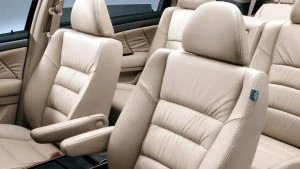 There are two main choices these days when it comes to what the interior designers of new cars put on the seats: cloth and leather. Leather is definitely the material of choice for luxury cars, but if you ever find yourself in a situation where one of the key differences between two variants is what’s on the seats, is it really worth it going for the leather just because it’s posher? If you’re into keeping up with the Joneses, then this one’s a no-brainer – you go for the more expensive one with the leather – but what if you’re a bit cannier with your cash?
Thankfully, the days of vinyl have gone, so that’s not an option. Those of us who are old enough to remember vinyl seats or who have ridden in classics with this type of upholstery know perfectly well why vinyl seats aren’t found in modern vehicles. About the only good thing you could say about vinyl was that it was easy to clean. It was slippery when cold or if you had long trousers on. In hot weather and for those wearing shorts, vinyl became sticky but not like spilt jam – more like clingfilm on steroids grabbing bare skin. It also got really hot on a summer day – add in the hot seat belt buckle on old-style seatbelts and you got your very own personal torture chamber. I’m shuddering with the memory.
However, back to today. There you are evaluating two models that are more or less the same apart from the upholstery. What do you need to say before you say “I’ll go for the one with the leather seats”?
Leather is, of course, a natural material. It’s the skin of some animal, probably a cow, sheep or possibly a goat. Given the popularity of beefsteaks around the world and the size of a cattlebeast, what you see on the seats of a luxury car probably came from a cow. If you’re a vegan or a PETA supporter, then this fact might be the deciding factor for you and you’ll go for the cloth. However, if you’re omnivorous, then you may see the use of leather as car upholstery as a wise way of using meat byproducts and a sustainable choice (yes, cloth seats are usually acrylic or nylon sourced from plastics).
Here, you might have questions about the difference between Nappa leather and ordinary leather. Nappa leather is a natural animal skin leather that has been tanned and dyed in a particular way to make it smooth and even. Nappa leather tends to have a more durable finish and is softer and more pliable. It’s the softness that adds the extra level of luxury and why the really top-end models are trimmed in Nappa leather rather than common or garden leather. It also tends to come from something more delicate than cowhide, such as goat or sheep.
Alcantara, however, is an artificial leather – OK, it’s cloth! It’s stain-resistant and flame-retardant, and it has a scrummy finish that feels like suede. The flame-retardant properties of Alcantara mean that it’s widely used in racing cars, and this is why it’s popular in sports and supercar models, similar to other racing-inspired accessories and styling. Alcantara is a brand-name, unlike Nappa leather and all the other seat materials, and it’s produced by one single factory in Italy, which means that it’s a bit more exclusive and more expensive than other cloth.
There are other synthetic leathers around the place. They’re called things like “PU leather”, “pleather”, “leatherette”, “vegan leather” and “faux leather”. One company produces a leather substitute made from pineapple fibres but this isn’t used for car seat upholstery – or at least not yet.
The sort of cloth used for upholstering vehicle seats is usually some sort of synthetic material because this tends to be more durable than natural fibres such as wool, linen, tencel or cotton. Car manufacturers haven’t tried upholstering seats with natural plant-sourced fibres in an attempt to be more sustainable… at least not yet. Cloth is cheaper than leather because it doesn’t need quite as much cutting, stitching and shaping as leather. Synthetic cloth comes out of the factory in nice regular shapes of an even and predictable width. Cows and goats aren’t quite such a nice, regular shape, so leather seats require more work; hence the extra cost.
So what are the pros and cons of each upholstery material type?
Leather:
Pros: Natural material from a renewable source, soft (especially in the case of Nappa), durable, looks amazing, smells nice, doesn’t give off nasty chemical gases
Cons: Stains easily, gets scuffed and scratched by doggy paws and small children’s shoes, absorbs bad smells, comes from a dead animal that may have been killed for the skin, doesn’t like getting wet and especially hates salty seawater
Cloth:
Pros: Cheap, comes in a range of colours and patterns, more forgiving of children, dogs and seawater
Cons: Synthetic material from a non-renewable source, can give off weird gases when new, doesn’t look quite as upmarket as leather.
Alcantara:
Pros: Flame-resistant, stain-resistant, comes in a range of colours, racing heritage, nice suede-like feel, exclusive and upmarket
Cons: A beast to clean, synthetic material from non-renewable sources
To sum up the bottom line about what sort of fabric you want under your bottom, it really depends on your lifestyle and your values. If you’ve got messy small children or dogs that jump on the seat, then leather isn’t for you. If you love to spend heaps of time at the beach and you are likely to get salt water on your clothes and other bits that you are likely to chuck onto the back seat, leather probably isn’t for you either. Cloth is also going to appeal to those who want to save a few bucks, as it’s cheaper. Leather looks gorgeous and is a natural material from a renewable resource, but if you’re more of a vegan-and-PETA type, then you’ll steer clear of it.
And if you have a classic car with a vinyl seat, do yourself a favour and buy a set of seat covers if you haven’t already!
SUV, Hatch or Wagon?

SUVs like the Volvo XC40 look really cool!

The ever popular Toyota Corolla Hatchback

Station Wagons like the new Ford Focus are brilliant.
Why do most women like the SUV, wagon or hatchback shape? These are the preferred vehicles that women are driving. SUVs definitely offer that extra status not to mention size. It seems too that Teal coloured cars are the ones that most excite the ladies.
SUVs are hitting our road on mass, thanks to the buyers, female and male, preferring their practicality, safety and room. You can buy FWD only SUVs, which if you never go in search of the wide open spaces outside of Suburbia then these types of vehicle will do all your townie jobs nicely, and often with plenty of room to spare. AWD equivalent SUVs are more expensive anyway!
SUVs are bigger than anything else on the road besides trucks and buses, so anyone will likely be attracted to the safety aspect of owning an SUV. Many guys will like the fact that their special other half drives a big safe SUV, which often ends up carrying the kids too. Having a higher ride height does give you a commanding view of the road ahead, and generally speaking, the extra ground clearance works wonders should you be into off-roading.
SUVs are easier to get in-and-out of, and for loading child seats, child accessories, and library book and shopping bags. Generally speaking you step inside an SUV, rather than sink down into them- like in a hatchback. When it comes loading cargo into the boot the space is usually large, higher and easier to access. That said, there are some nicely designed station wagons and hatchbacks that are very practical.
Downsides to owning an SUV are that they cost more to feed; cost more to maintain, and they generally need more wizardry and expensive technology to defy the laws of physics should you want to drive them quickly around corners. Still, manufacturers are beginning to build a wide variety of SUVs to suit your tastes. You can even buy convertible SUVs or 2-door coupe SUVs – which pushes the contemporary envelope somewhat.
So if you are a lady on the lookout for a nice new SUV – perhaps Teal coloured or close to it, that is competitively priced then there are some models you may consider. OK, you men could consider this as well – though you’ll probably prefer a silver, black or white colour (though flaming orange and buttercup yellow is said to get a guy’s heartrate up). So, how about a Honda CR-V, Toyota RAV4, BMW X3, Ford Ecosport, Ford Escape, Ford Everest, Foton Sauvana, Haval H2, Hyundai Sant Fe or Kona, Jeep, Kia Sportage, Mazda CX-3 or CX-5, MG GS, Mitsubishi Eclipse Cross or Outlander, Nissan Qashqai, Peugeot 3008, Renault Koleos, Skoda Kodiaq, Subaru Forester or XV, Suzuki Vitara, VW Tiguan, or any of the Volvo XC models? Modern, safe and great multipurpose vehicles, this list is a good mix to get you thinking.
But if you don’t go the SUV way, there’s plenty of savings to be had by sticking to a hatchback or station wagon instead. If you spend most of your time travelling within the confines of Suburbia then the SUV size might not make so much sense if a Station wagon or Hatchback will do. And even at their most practical, an SUV is a bit more difficult to park in the tiny city car parks – unless you have an SUV with all the self-parking aids.
If you think that a good small hatch or station wagon will suit your needs just as well, you will enjoy the benefits of this type of vehicle being cheaper to buy, cheaper to maintain, more fun to drive and, thanks to the swelling tide of SUVs on the road, you’ll be bucking the trend and looking pretty cool.
Here’s some wagons or hatchbacks you might like to consider: Volvo V60, VW Golf wagon or hatch, your good old Toyota Corolla wagon or hatch, Subaru Forester or Impreza or Liberty, Skoda Octavia Wagon, Renault Megane, Proton Preve, loads of Peugeots, Nissan LEAF (Electric Vehicle), Mitsubishi ASX, a Mini, MG3, Mercedes Benz B-Class or C-Class, a Mazda 3 or 6, Kia Cerato or Soul, Hyundai i40 or i30, Honda Civic, Holden Astra, Ford Focus or Mondeo, Citroen C4 or C5, BMW 3 or 5 Series wagon, Audi A3 or A4, and Alfa Romeo Giulietta.
 Level 2, 9 Help Street