

Author archive
Mini’s Hot Secret!
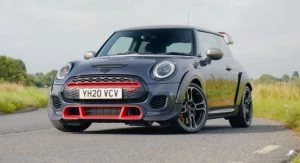
MINI JCW GP
There is one other Mini that might have flown in under your radar. It is the wildest Mini hot hatch yet, and it’s called the Mini John Cooper Works GP. The car looks really cool and boasts the highest price tag of any Mini yet – but for good reason.
It was built as a JCW GP 60th year birthday present for Mini, and it sits low down on a 40 mm wider track. The massive grille, bold GP badge, massive front spoiler and two large air foiling scoops just give the car a special presence that is brutal and focused. The air intake slot in the bonnet is large and ready to suck in gallons of air to help spool the turbo.

Look at the Mini JCW GP hot-hatch side on, and the chunky styling looks awesome, mean and racy. It features huge wheel arches, massive side skirts and an enormous spoiler. The car is also lower than standard JCW cars.
Head around the back, and you note that the spoiler has also been skilfully incorporated into the roof guttering showing a nice level of attention to detail. The taillights have been darkened and the twin exhaust outlets poke aggressively out from the centre of the rear skirt. These crackle and pop with full throttle and under serious braking. What a car!
Inside, the racy Mini JCW GP is fairly simple. It boasts nice leather bucket seats, a digital dash, 3-D printed panels with an array of options for logos and displays. A special ‘GP pack’ adds all the comfort and bells and whistles like heated seats and dual zone climate control, but remember this is a stripped out limited edition racer that comes standard with just the two seats. A horizontal strut brace takes up where the rear seats would normally sit.
So just 3000 units will be made worldwide, and 65 of those will make the journey to Australia – and they have almost certainly already been sold to their lucky owners. They are around $12,500 more expensive than a ‘regular’ John Cooper Works, so I’d imagine if you did own one and tried to sell it now, you could fetch even more than the original price.
The Mini JCW GP is significantly more expensive than more generously equipped hot hatch rivals such as the Volkswagen Golf R ($56,990); but who cares – the car is a phenomenal performer and it is a limited edition. The new John Cooper Works GP is driven by a special version of BMW’s 2.0-litre turbo engine with an output of 225 kW of power and 450 Nm of torque available. Just the eight-speed automatic with paddle shifters is available, however this set-up ensures that the power is delivered precisely on time – every time. Mini has developed a unique suspension for the GP, designed to make it even faster around a racetrack than the standard JCW Hatch. Mini claims the FWD JCW GP hot-hatch will do the 0-100 km/h dash in just 5.2 seconds. This is just the start of the rush of power and acceleration that goes on to a governed top speed of 265 km/h. This is very quick indeed! The FWD power is controlled with a limited slip-diff.
You’ll want to keep your ear to the ground and see if you can find a seller of the wonderful little Mini JCW GP ‘hottie’. It’s distinctively different and extremely aggressive, and you’re in for a thrilling and wild ride.
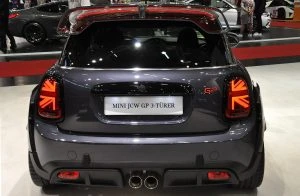
Mini’s Hottest Hatch
Vehicles for Towing
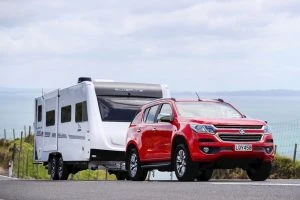
Getting the right Tow Vehicle
For a number of people, towing the boat or caravan to the holiday spot for some much needed R&R is what makes life exciting for them. And, on a more work-related note, towing is essential if you’re a builder, labourer, farmer or gardener. So what does make a good tow vehicle? A good tow vehicle must be structurally strong, and it must offer plenty of torque - the lower down the revs the better.
Before all else, always check the manufacturer’s tow capacity guidelines for any vehicle that you are interested in purchasing, particularly if towing is going to be one of the tasks on the vehicle’s to-do-list. A vehicle’s towing capacity is determined by its manufacturer and it is based on factors such as: the engineering and structural design of the vehicle, the vehicle’s rear axle load limits, the capacity of its tyres, the effect the laden trailer will have on the vehicle’s handling and stability, and the durability of the car’s underpinnings, and overall road safety.
So, after checking the manufacturer’s guidelines, then you need to look at what power and, more particularly, what torque is on offer. Generally, vehicles with diesel engines make better towing vehicles than equivalent petrol-powered models because they produce much higher torque in low-to-medium engine revolution. They are also more fuel efficient when under load. Peak torque figures under 200 Nm will struggle to keep up with modern-day motorway and open-road demands, and throw in a hill or two and you’ll quickly have a build-up of traffic following behind you.
RWD vehicles are better than FWD vehicles for towing because any weight that pushes down on the tow ball will generally lighten the front wheels at the same time, which lessens the traction available to the front wheels. The more wheel chatter (where the front wheels lose and gain traction instantly) that the front wheels endure, the more the wear and tear will be found on the FWD componentry.
If you’re only pulling a small trailer load of rubbish to the dump, then it’s surprising what most vehicles will tow. However, I’m focusing on those of us who require trailer loads that are going to be more than 700 kg laden. Here are some useful towing vehicles you might like to consider:
The Mitsubishi Outlander is a seven-seater SUV that has a maximum towing capacity of 2000 kg braked. Its 2.2-litre Turbo-Diesel engine boasts 110 kW of power and a very useful 360 Nm of torque. The Outlander Turbo-Diesel motor offers 360 Nm from 1500 rpm to 2750 rpm, making towing a breeze. It’s also a fuel efficient and roomy SUV even when you’re not towing. A combined fuel consumption is a claimed 6.2 litres/100 km: quite impressive.
Hyundai’s Tucson has a maximum towing capacity of 1600 kg braked. This mid-size SUV has a 2.0-litre turbo-diesel engine with 136 kW of power and 400 Nm of torque. That 400 Nm is definitely a strong asset when it comes to towing. The Tucson is also frugal without the trailer.
Another option for light towing duties would be the Suzuki Grand Vitara Sport. With a maximum towing capacity of 1700 kg braked and 750 kg un-braked it’s a handy workhorse to have around. Being RWD that will employ the FWD when required makes for decent traction. A larger 2000 kg braked capacity is offered with the V6 Sport model. The Grand Vitara uses a 2.4-litre petrol and a four-speed auto delivering a 122 kW/225 Nm combo through the dual-range transmission. The torque comes on strongly from lower down in the revs.
A Hyundai Sante Fe with the 2.2-litre turbo diesel can tow a 2000 kg braked trailer. On offer is a remarkably grunty 440 Nm of torque that sets off low down in the revs for easy power delivery for towing.
The Mazda CX-5 2.2-litre diesel is also capable of towing a braked trailer up to 1800 kg. With 393 Nm of torque, this is a smooth cruiser. Mazda’s CX-9 can tow a 2000 kg braked trailer or up to 750 kg unbraked. Mazda’s CX-9 petrol engines perform very well and are very fuel efficient. This is a big seven-seater wagon with a turbocharged 2.5-litre four-cylinder petrol engine boasting 170 kW at 5000 rpm and 420 Nm of torque at 2000 rpm. This CX-9 is a great family all-rounder with plenty of space on offer.
The small Audi Q3 2.0-litre diesel SUV, which can tow a braked trailer up to 2000 kg offers a decent European towing option. A responsive 380 Nm of torque from 1750 rpm works well, and it’s also Quattro (AWD).
SKODA’s Kodiaq SUV can tow up to 2000 kg braked. It’s also roomy and very practical. With the option of 4WD and some very powerful diesel engines, this is a really good tow vehicle to have parked up the driveway. It also has a 620 litre boot space with five seats up or 270 litres in seven-seat guise.
What about the Volkswagen Tiguan? This is a stable and spacious drive, offering a 2500 kg braked towing capacity. Having the option of AWD, the Tiguan goes some serious places and is therefore great for getting onto gravel-type roads. A towing assistance package and plenty of space makes this a likable tow vehicle.
Something a bit different would be BMW’s 520d Touring wagon, which is RWD or AWD and is a decent towing vehicle (2000 kg braked). Excellent handling, even when towing, makes it a joy to drive. The 4×4 automatic transmission and strong engine makes this a really easy car to manage for drivers towing a load. There’s heaps of room in the boot to pack in everything you need for family weekends away.
Another station wagon that happily tows a trailer or caravan is the Audi A6 Allroad. This is an Estate with AWD, and it is also very comfortable and well-equipped. The toque-filled TDI engine makes for a quick drive and a heap of grunt. You also get 565 litres of boot space, which goes up to 1680 litres with the rear seats down.
On the station wagon theme, the last of the recent Falcon and Commodore Wagons are RWD and have always been great towing vehicles. They offered RWD utes as well. Sadly these icons won’t be with us anymore.
Some more serious towing machines:
The Mitsubishi Pajero 3.0 diesel 4X4 SUV is capable of towing a 3300 kg braked trailer.
Toyota’s Prado 3.0 diesel 4X$ SUV will tow up to a 2500 kg as a braked trailer.
The Land Rover Discovery and Range Rover vehicles are a very good towing machine. It’s also luxurious and practical, and will happily head of into the toughest off-road terrain. The Discovery can pull up to 3000 kg braked. Inside there’s room for seven adults as well as an impressively-sized boot to bring along the luggage for all those people.
An LDV T60 ute is a solid, capable performer. With a 2.8-litre 110kW/360Nm turbo diesel four-cylinder, this is more than enough grunt to tow up to 2200 kg. Boasting a remarkable fuel economy figure of 10 litres/100 km towing and offering a low buying price makes this a very tempting tow package.
Though Nissan runs both a single- and twin-turbo four-cylinder in the Navara, they’re both rated to 3500 kg for towing. The best engine is the twin-turbo 2.3-litre that pumps out 140kW/450Nm. Very fuel efficient (around 7.2 litres/100 km unladen) and it’s also equipped with a recent rear spring upgrade..
Don’t forget to check out the Isuzu D-Max ute with 430 Nm of torque on offer. It’s a rugged ute with 4×4 ability. There is also the Isuzu MU-X SUV 4WD rated to tow 3000 kg (braked). LS-T models are very well equipped vehicles that are extremely comfortable.
With a high 3500 kg tow rating, thanks to its solid rear axle, the SsangYong Rexton is a highly capable tow vehicle. So too is the SsangYong Rhino ute. Both use the same 2.2-litre turbo-diesel engine that can easily pull up to 3500 kg (braked).
The legendary Toyota Hilux’s towing capabilities are superb. The new 2.8-litre turbo-diesel motor delivers a 130kW/450Nm blend of power. Depending on the model, your new Hilux ute can tow from 2500 kg braked.
Mazda’s latest BT-50 ute shares mechanicals with the Ford Ranger, which means that 147 kW and 470 Nm is impressively competent. Towing over 2500 kg braked in this comfortable, practical ute with all the bells and whistles is easy, and like many utes these days it also offers 4×4 action.
Ford’s Ranger packs great tow grunt and capability with its 3.2-litre, five-cylinder turbo-diesel engine. You can tow up to 3500 kg braked. There is also a 2.0-litre bi-turbo option for towing up to 3500 kg.
A whopping 500 Nm from its 2.8-litre turbo diesel four-cylinder has the Holden Colorado ute take top spot for popular 4WD ute towing grunt; and it tows like a champion.
In V6 guise, the Volkswagen Amarok packs a 550 Nm or 580 Nm torque delivery option with its 3.0-litre V6 engine. You can tow up to 3500 kg braked, but with the optional softer suspension pack this drops to 3000 kg braked.
Very Serious Towing Machines
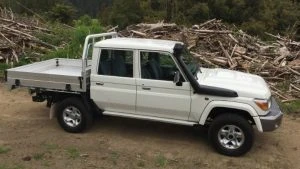
Capable of towing up to 3500 kg braked, the Toyota Land Cruiser 70 Series ute has a V8 under the hood. The 4.5-litre 32- valve quad-cam turbo diesel V8 with 151 kW and 430 Nm is a total beast and highly recommended for use as a tow vehicle. Impressive fuel economy (for a V8) should see well under 12 litres/100 km fuel use when unladen. The only gearbox is a five-speed manual. Toyota’s reputation for reliability and dependability makes this a beauty.
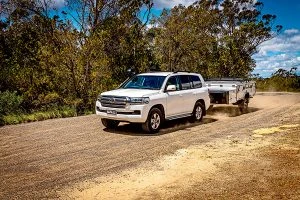
Toyota LandCruiser 200 Series GXL (4X4): This vehicle cruises comfortably and effortlessly over long distances, powering up long hills without a sweat. Extremely capable when the tarmac runs out, along with its smooth six-speed automatic and 4.5-litre twin turbo-diesel V8 you’re always finding grunt at any revs. The combination of 200 kW at 3600 rpm and 650 Nm at 1600 rpm makes this one of the very best vehicles for 4X4 towing.
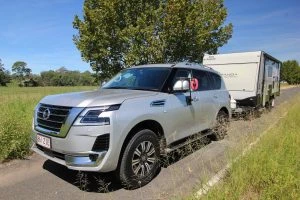
Nissan Patrol TI 4X4 (Y62): OK, this is petrol; but with 298 kW and 560 Nm on offer, who cares! This base-spec eight-seater Patrol is rated to tow 3500 kg (braked). Comfort and premium technology makes this an effortless vehicle for cruising and towing. And premium off-road action is guaranteed.
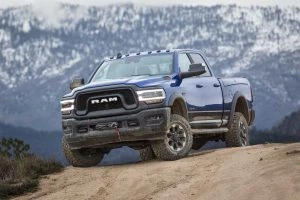
The RAM is the ultimate tow vehicle
RAM Laramie 2500 4X4: This one has a maximum towing capacity of 6942kg (braked) and its power comes from a 6.7-litre six cylinder Cummins turbo-diesel engine (276kW/1084Nm!). The sweet six-speed automatic transmission makes towing a doddle.
RAM 3500: is another big tow option with a maximum towing capacity (braked) of 6171kg.
Robert Opron and the Simca Fulgur: Better Than Nostradamus?
The question as to where all the flying cars are now that we’re in 2020 has become a bit of a cliché. It’s been a bit of a cliché ever since we hit the new millennium. This is a reference to the way that popular culture envisioned what family cars would look like in the 21st century.
However, at least one car designer had ideas that were a bit more down to earth – literally. The year was 1958 and the designer was Robert Opron. This designer had accepted a challenge to produce a concept car for the 1959 Geneva Motor Show for his parent company Simca. Never heard of Simca? This was a French company owned by Fiat that rivalled Citroen for the title of “France’s answer to the VW Beetle”. I owned one back in my student days – possibly a Simca 1300; it had a front engine like a normal car rather than a rear engine and it’s probably worth a mint now, so I’m rather regretting selling it. Its only quirk was a flaw in the speedo: after it hit 50 mph, the needle went back down even when I accelerated.
Anyway, enough memories of student cars and back to Robert Opron. Opron later took his genius to Citroën, then Renault, then Alfa Romeo. He has been recognised as one of the top 25 designers of the 20th century, although he wasn’t the chap responsible for the very distinctive Citroen 2CV. The Renault Alpine was his, though, as were a number of 1980s Renaults.
Opron had come across a challenge issued by the Journal de Tintin. Yes, that’s Tintin as in the intrepid red-haired reporter who has a dog called Snowy and a best friend called Captain Haddock. The challenge was to design a “typical” car for the 1980s or for the year 2000. The challenge included a list of specifications that had to be included in the design, including the following:
- fuelled by a nuclear-powered battery or a hydrogen fuel cell with a range of 5000 km
- running on two wheels, balanced gyroscopically, at speeds over 150 km/h,
- voice controlled
- radar guidance for navigation and for detecting hazards
- top speed of over 300 km/h
- automatic braking if it detected a hazard
- headlights that adjust automatically with speed
Although Opron didn’t produce a full working prototype, he did show a shell of the concept at the 1959 motor show and the full details of the concept car, known as the Simca Fulgur, were published in the Journal de Tintin (this suggests that it would have appeared alongside The Red Sea Sharks and/or Tintin in Tibet – just in case you were curious, like I was).
The Simca Fulgur – which takes its name from the Latin word meaning “lightning” – looked like the classic Jetsons flying car, except it didn’t fly. It captured the public imagination somewhat and became the basis for what people thought futuristic cars would look like. Or what UFOs would look like – take your pick.
 Anyway, from the perspective of late October in 2020, 61 years later, it’s amusing to take a look at the cars of today and see how close we’ve actually come to getting some of these features. How well did the Fulgur predict what we’d have on our roads?
- Voice control: Yes, we’ve got this, although it’s not quite a case of telling the car your destination and letting it get there (they’re working on that). But you can use voice control on quite a few things, including the navigation system.
- Top speed of over 300 km/h: Yes, but most cars that are capable of this have their speeds limited for safety purposes.
- Autonomous braking and hazard detection: Yes. However, human input is still needed.
- Automatically adjusting headlights: Yes, although they adjust for the ambient light levels rather than how fast you’re going.
- Electric motor with hydrogen fuel cell technology: Yes, although the range isn’t anywhere near what was predicted. We’d all love a range of 5000 km in an EV (electric vehicle) or HFCV (hydrogen fuel cell vehicle).
- Electrical motor with nuclear power: Are you kidding me? Since Chernobyl and Fukushima, nuclear power isn’t quite the sexy answer to our energy problems that it was back in the 1950s.
- Balancing on two wheels with gyroscopic stabilisers at speeds over 150 km/h: No. Just no. If you want that sort of thing, get a motorbike, not a family saloon.
All in all, not too bad a job of predicting the future, Monsieur Opron – you did a better job than your compatriot Nostradamus.
Supercars – Just For the Hell of it!

Bugatti Chiron Super Sport
Fast cars mean different things to different people. What is the draw card for driving a quick car? For me, a super-fast car does hold an aura that you just can’t associate with your typical Toyota Corolla or Ford Mondeo. I have nothing against these two amazingly practical, comfortable and reliable cars. They are great cars for everyday life in much the same way that the trusty hackney pony/horse was the common horsepower used by most family carts in the 19th century. The thoroughbred horse, however, was the show pony; this was the one that had the aura, the glamour and the speed.
So, similarly, there’s something about supercars. It’s not just how good they look; it’s about the engineering and development that has gone into making them so quick. A supercar challenges the laws of physics every day. And there aren’t too many of us “kids at heart” who don’t enjoy the speed and the thrill covering the ground quickly. I did have the most amazing experience as I was driving into Wellington city, NZ, of all places. This was some years ago now, and I was cruising in to Wellington to catch the ferry to Picton. I happened to be travelling behind a few cars that were drifting five-or-so km/h under the speed limit. From out of nowhere, a Porsche 928 S whipped out and around me in an acceleration of speed that left me in awe. It slipped in and out of the cars ahead of me like they were standing still, and the visual excitement has stuck with me to this day. I have also never seen anything like it since. He wasn’t dangerous, either. Each overtaking manoeuvre was carefully calculated and quite safe. The time it took to whip past each car was over as quickly as it started.
So, just for a bit of fun: What are the fastest production cars in the world today? They’ll definitely be quicker than the awesome 928 S, for sure!
The number 1 undisputed champion is the Bugatti Chiron Super Sport which has been clocked at 304.7 mph (487 km/h)! Like the Bugatti Veyron Super Sport, this purpose-built speed machine was taken to its top speed by British sportscar veteran Andy Wallace at the VW Group’s Ehra-Lessien test track. Using a quad-turbocharged W16 engine that produces 1578 bhp (1177 kW), this was a supercar on a mission. It was given a new gearbox with longer ratios, and front and rear bumpers that were optimised for higher speed runs – the perfect match for claiming the world’s top spot.
Who will be next to break the record set by the Bugatti Chiron Super Sport? Now that Bugatti have promised to bow out of setting production car speed records, there are a few potential successors to its crown.

Hennessey Venom F5
The Hennessey Venom F5 carries on where the Venom GT has left off. So with its 6.6-litre twin-turbocharged V8 producing 1817bhp (1355 kW) and 1193 lb ft (1617 Nm) of torque, we should see this Hennessey Venom move easily past the 300 mph (480 km/h) barrier.

SSC Tuatara
Until now I had never heard of the car, but the SSC Tuatara packs some serious speed along with its sharp looks. The car is claimed to have already sped past 300 mph, unofficially. SSC will only build 100 Tuatara supercars, and don’t ask how much to buy one! They are eye-wateringly expensive. The car was originally planned to run with a 6.9-litre twin-turbocharged V8, however the production car is set to use a 5.9-litre block with a higher redline. On E85 fuel, it should produce 1750 bhp (1305 kW) and be capable of more than 300 mph in a straight line.

Koenigsegg Jesko Absolut
Now here is a name I have heard before… ‘Koenigsegg’. The Koenigsegg Jesko Absolut is the latest of the Koenigsegg supercar line and it has to be one of the hottest looking machines on wheels. Koenigsegg claim the car is more than capable of over 330 mph (528 km/h). Seriously, we couldn’t think Koenigsegg was going to let Bugatti keep the speed record for long, could we? The Swedish manufacturer has been around for some time now and has set previous uppermost speed records. Gunning for top spot, the 1600 bhp+ (1193 kW+) supercar will be the fastest car Koenigsegg has ever produced. Simulations suggest the combination of the twin-turbocharged, 5.0-litre V8 engine, its low 0.278 drag coefficient, and its unique multi-clutch 9-speed transmission will allow the Koenigsegg Jesko Absolut to reach a top speed of 330 mph+.
Now, I’ve always had a soft spot for anything Swedish! I used to own a Volvo, but that was given to my son who needed a car when he left home. And we did own a Saab (my favourite of all cars owned by us). Its Turbo 2.3-litre could really get-up-and-go, but nothing like a Koenigsegg, mind you!
 Level 2, 9 Help Street