

Author archive
AMG: It's All Four The Coupe.
It’s rare that Mercedes-Benz and AMG make lots of noise about a new model so when they do it’s clearly something special. And so it is with the AMG four door coupe called, logically, the AMG GT 4 Door Coupe. However there’s more being offered to commemorate the release. The Edition 1 will feature bespoke interior and exterior enhancements.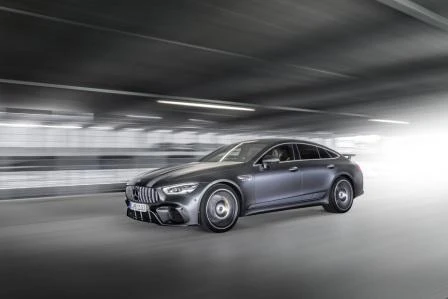
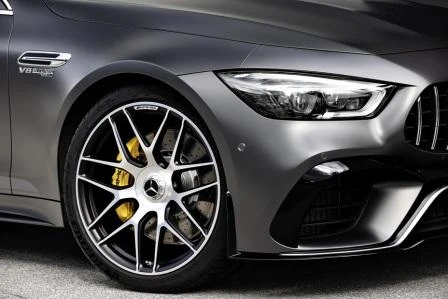
There will be 21 inch forged alloy wheels in black, a Graphite Grey Magno paint scheme, a bluff nose that links to a longs and slinky coupe body. Aerodynamically there’s a larger front bar and integrated air intakes, a larger rear diffuser, and a stand out rear wing. It’s fixed to the metalwork however the wing itself can be adjusted by the driver whilst on the move, with the whole body package dropping the drag co-efficient and increasing downforce.
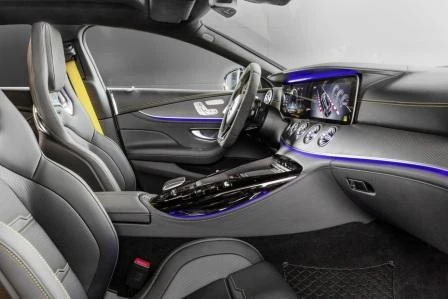
AMG fit their Performance seats with memory placement inside and they’re a gorgeous mix of Magma Grey Nappa leather with black highlights, highlighted by contrasting yellow cross-stitching. The cabin is further enhanced by matt toned carbon fibre and a Performance enhanced steering wheel with micro-fiber and yellow stitching, plus the seat belts are complementary yellow. The door panels are trimmed in Magma Grey as are the armrests and center console. The air-conditioning is also supplied with a new, bespoke, AMG #63 fragrance.
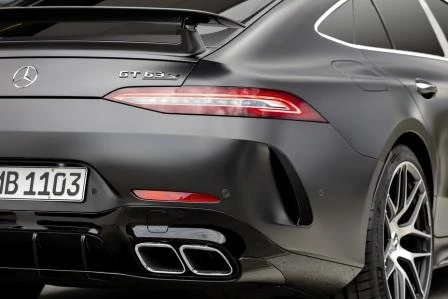
AMG engines are known for their ferociousness and to celebrate their first four door coupe, a hand-built 4.0L twin turbo V8 is shoehorned into the engine bay. Power and torque are indecently decent at 630 horsepower and 664 lb-ft of twist between 2,500 to 4,500 rpm. This results in a zero to sixty mph time of 3.1 seconds as it gets on its way to a top speed of 195 mph.
The powerplant is bolted to the Performance 4Matic + all wheel drive system. Electronically there’s variable torque distribution, Drift Mode, and works hand in hand with the AMG Speedshift nine speed auto.
Pricing hasn’t yet been released but the car will be showcased at the Nurburgring during the ADAC Zurich 24 Hour race over the weekend of 12/13 May, and will be available for the US market in early 2019. A GT 53 model will be made available for later in the year.
Private Fleet Car Reviews: 2018 Subaru Liberty 3.6L and 2.5L.
Subaru‘s Liberty sedan continues to be a pillar of the Japanese brand’s sales success. The current three tier range has the 2.5L engine in the 2.5i and 2.5L Premium before a 3.6L flat six trim. Private Fleet goes back to back with the Subaru Liberty 3.6L and 2.5L Premium.
 The Liberty range itself received a mild facelift in early 2018, with a change to the front lights and bar, the rear lights, and a freshen up inside. Software such as Apple CarPlay and Android Auto was added to a touchscreen that was slightly larger than before, Lane Keeping Assist was added to the safety package, plus the Premium gains a updated safety package. Premium variants add a suite of Vision Assist features including: Steering Responsive Headlights, Adaptive Driving Beam, Side View Monitor, and Front View Monitor.
 Underneath there were changes to the suspension and drivetrain. There’s a smoother and more refined feel to both engines, and the seven speed CVT autos in both also feel crisper and smooth in the changes. However, in this driver’s opinion, the suspension is a backwards step, being floaty, soft, far too short in travel and banging quickly to the bumpstops on even the smaller speed inhibitors in shopping centres.
 There’s more noticeable skipping sideways as well, with a two and a half day trip to the Kiama and Illawarra region, south of Wollongong, finding plenty of spots where the rear would suddenly move sideways and too easily on the Dunlop 225.50/16 rubber and alloys.
 The two different engines require, like all petrol engines, plenty of spin to see the maximum power. The 2.5L four sees 5800 rpm for 129 kW, and the bigger six 6000 rpm for 191 kW. However real driving relies on torque, and it’s here the six wins with 350 Nm at 4400 revs. The smaller donk has 235 Nm and 4000 revs, a still not inconsequential amount for its size.
 Both do a sterling job of pulling the 1577 and 1655 kilo machines around, however the four suffers in comparison on the uphill runs. There’s noticeable drop-off quicker which requires a firmer right foot. That relative lack of torque in a vehicle that weighs as it does sees a zero to one hundred time of 9.6 seconds, and a full 2.4 seconds quicker for the flat six in an eighty kilo heavier car.
 Economy on the 2.5L shows that it’s otherwise a brilliant highway performer, with the return figure from the Illawarra standing up at 6.4L of standard unleaded per 100 kilometres from the sixty litre tank. That’s on par with Subaru’s claimed 6.2L/100 km for the highway. The 3.6L is quoted as 7.5L per 100 km and driven in a more urban environment wasn’t far from the quoted combined figure of 9.9L/100 km. It’s the quoted figure of over fourteen litres for every hundred kilometres for the urban cycle that’s the concern.
 In profile it’s a handsome machine with a full 4800 mm length, and with the LED C shaped tail lights glowing at night, the auto swivelling headlights at work, and the white metallic paint glinting in the night, looks eye-catching and appealing. There’s also door mounted puddle lamps which cast a LED light over a broad area. Inside, the bigger touchscreen is easy to use, is well laid out, and features satnav, apps, and compatibility with Apple CarPlay and Android Auto.
 The powered seats are heated but not vented, and lack enough side bolstering for genuine comfort. There’s no shortage of shoulder or leg room though, thanks to a wheelbase of 2750 mm, width of 1840 mm overall, and a long but height shallow 493L boot. There piano black trim on the steering wheel looks and feels cheap and is at odds at the otherwise classy interior.
 There’s a good level of tech on board with Active Torque Vectoring, and the Premium & 3.6L feature the Vision Assist package which is Front View Monitor, Lane Change Assist, Rear Cross Traffic Alert, Side View Monitor, and Adaptive Driving Beam. Seven airbags including the driver’s knee bag means occupant safety is high. Height adjustable seat belts enhance that level. Reverse camera is standard across the range.
 But, and this is a big but, neither car had rear sensors and in an age where these are virtually mandatory this level of oversight is simply not good enough. What is good enough is Subaru’s Eyesight system. Stereo cameras mounted alongside the rear vision mirror, which is auto dimming by the way, rear the traffic ahead and are part of a safety bundle.
 Adaptive Cruise Control, Brake Light Recognition, Pre-collision Braking (which occasionally threw out some false positives), Pre-collision Brake Assist, Pre-collision Throttle Management, and Pre-collision Steering Assist work with the other driving aids to provide as much warning and support to drivers to avoid a crash as possible.
 But it’s the ride and handling that distinguishes this version compared to the previous and that’s not necessarily a good thing. It really does float, waft, and roll, and that suspension crash at low speeds just simply doesn’t feel good nor does it inspire confidence. It’s a chassis feel that a neighbour with a 2013 model Liberty said would turn him off from buying a new model. And it’s a chassis tune that feels aimed at more…mature drivers.
At The End Of The Drive.
Subaru’s list price for the 2.5L Premium is a reasonable $36,640. The six comes in at $43,140. Factor in on roads and those prices suddenly don’t look quite so attractive compared to the new Commodore and on a par with the Mazda 6 2.5L. The ride quality isn’t as good as expected, the lack of rear sensors may outweigh, in some buyer’s minds, the excellence of the EyeSight packagae, and the thirst around town of the six may also counter the positives. There’s always the Outback, though….Book a drive and make up your own mind, here: 2018 Subaru Liberty range
Car Review: 2018 Mitsubishi Eclipse Cross Exceed AWD and LS.
Mitsubishi have joined the ever growing band of car makers supplying a smaller mid sized SUV. The oddly named Eclipse Cross fits snugly between the Outlander and ASX in size yet packs a 1.5L turbocharged four cylinder and CVT. It’s a comfortable four seater, has a couple of nifty features inside, and comes with a cargo space big enough for a family of four’s weekend away luggage or a week’s shopping. It’s priced from the high $20K mark plus on-roads so it’s not a bankbuster either.
 The three model range has the LS 2WD, Exceed 2WD, and AWD. All three have the same 1.5 litre turbocharged four cylinder petrol engine that produces 110 kW at 5500 rpm and 250 Nm from 2000 to 3500 rpm, and CVT with eight steps. There’s a 60 litre tank that holds standard unleaded, and runs at a quoted fuel consumption figure of 7.7 litres per one hundred kilometres for the combined cycle. However, part of the dash display screen option list is expected range. On highway and freeway usage the range does extend and from pickup to home saw over two hundred kilometres being added.
 Exterior design is eyecatching; there’s Mitsubishi’s signature shield design for the front, free flowing sheetmetal for the wheel arches, and an angled scallop that reaches rearwards from the middle of the front doors that lines up the door handles. The rear is the question mark of the design but sets the Eclipse Cross apart from its competitors. It’s sharply angled from the arrow head tail lights to the roof in profile and both end lights are joined by a horizontal bar through the glass that also blocks some rearward vision. Rolling stock is standardised at 225/55/18 with rubber from Toyo being more dry land and tarmac oriented.


 An interior highlight for the range is the addition of a trackpad device located in the centre console. It’s intended to backup the seven inch touchscreen but in practical use, with a drag and slide and push down to enter, it’s not really that effective. The touchscreen and trackpad themselves seem to be Audi inspired, as the touchscreen is now housed in a pod that stands proud of the upper dash construction. The aircon controls are buried under a ledge that houses the centre airvents and a pair of USB ports.
 The Eclipse Cross Exceed AWD has a Bose speaker system that’s clean, crisp, punchy, and takes advantage of the DAB radio that’s fitted to all three variants. The touchscreen’s interface isn’t hard to use but sourcing stations in the digital realm was tricky and not intuitive. Naturally there’s apps that can be selected via the touchpad that include Bluetooth, Apple CarPlay, and Android Auto. Alongside that is the variable information available on the driver’s dash display that gives you economy, trip, eco rating, but not speed.
 The cabin itself is spacious and airy in feel, thanks to an overall height of 1685 mm, a width of 1805 mm overall, and a wheelbase of 2760 mm inside the compact 4405 mm length. The black of the lower seat level section is contrasted by alloy plastic highlights, glossy piano black, and the roof lining in a cloth weave of an almost beige shade. The seats themselves are cloth with a sliver diamond motif in the LS and heated leather (no cooling, sigh) in the Exceed. The Exceed also has a Head Up Display that folds up from the binnacle.
  Although it’s easy to read and populates itself with information such as speed, crash alerts for the radar assisted cruise control, the screen itself is perhaps a couple of inches too low for ease of vision. Also, the rear tail gate in the Exceed AWD isn’t power operated, as expected. Cargo space is 341L to 448L and sits above a space saver spare. That capacity goes to 1136L with the seats folded.
 Where the Eclipse Cross claws back points is in the manners on road. The 1.5L needs a little bit of coaxing off the line when loaded up but once into its stride responds willingly enough. With one aboard it’s a sparkling performer, an adept handler, and a surefooted performer in ride quality. With four aboard and the cargo area full it’s less willing to get under way but still has some solid mid range urge. The multi-link rear feels tauter when not loaded up and the front is well balanced in comparison. Absorption of bumps and irregularities is smooth and progressive with even the short and sharp speed restrictors in shopping centres lessened in their crash into the cabin. Turn in is measured and precise, with no feeling of oversteer in the AWD and little understeer in the 2WD. Mass, or lack thereof, helps, as the LS and Exceed 2WD weigh 1490 kilos dry, the AWD 1555 kilos dry.
 The Eclipse Cross AWD was taken on a good country drive, from Sydney to Bega and surrounds and back, covering in all over 1600 kilometres. Some of that was through the soft, wet, coarse sand of a crossing at the Bega River. Although CVTs tend not to engage straight away when the accelerator is pushed, the development from Mitsubishi has lessened this to the point that engagement is quick and combined with the AWD system (which is switchable for Snow and Gravel) allowed safe, unhurried, and unconcerned crossings. Only rarely, too, did the 1.5L feel that more torque was required, and naturally this was moreso uphill and when overtaking. The CVT is smooth and well matched to the engine, and when the go pedal is pushed to the carpet, has a steady and progressive climb through the revs to 4000 where it plateaus.
 Safety is paramount here with seven airbags, Autonomous Emergency Braking and radar cruise control. This needs some work as the braking is far too harsh and sudden. Modulation down to a more progressive stop would make this a far better experience. A full set of parking sensors is complimented by the reverse camera, 360 degree view on the touchscreen, Lane Departure Warning, and Rear Cross Traffic alert.

At The End Of The Drive.
It’s somewhat of an oddity, the Eclipse Cross, both in name and looks. As a family car and a daily driver, it fits the bill. It’s fine for four but no more, isn’t unattractive, drives well enough to suit almost every application, and the AWD system is ok for some gentle soft-roading. But a few minor quibbles such as the way the HUD sits, the lack of showing speed in the driver’s display, and the compromised rear vision take some of the gloss away.
The LS is priced at the time of writing at %31,990 driveaway, with most of the paint options at $590. The gorgeous metallic red that Exceed AWD is clad in is $890 and tops out at $39,380 driveaway. Specifications for the 2018 Mitsubishi Eclipse Cross are available here: 2018 Mitsubishi Eclipse Cross specifications.
Private Fleet Car Review: 2018 Peugeot 208 GTi
Some say size isn’t important, and it’s how you use it. Clearly one of the world’s oldest car brands have this in mind with the 2018 Peugeot 208 GTi. With a starting price of a blink under $30K, it’s a pocket-sized road pounder with a smooth engine, slick six speed manual, and not a lot of real estate when it comes to the sheetmetal. Hiding under the thumbnail sized bonnet is a turbocharged 1.6L four cylinder petrol engine, punching out 208 horsepower or 153kW. There’s also 300 torques on tap at 3000 revs but plenty of twist on board below that. It doesn’t add up to be a rocketship but performance is nonetheless more than satisfactory. So is fuel consumption with a quoted combined 5.4L/100. We clocked 6.3L/100 km in a mainly urban drive environment.
 The clutch is light-ish and the pickup point isn’t entirely precise but there’s enough feedback from the clutch pedal travel to engage it smoothly. The six speed manual has more feel in the selector lever than Suzuki’s Swift Sport tested recently and is therefore more confidence inspiring. Once engaged there’s a minute hit of turbo lag before the torque comes in smoothly and allows the 208 to kick up its heels smartly. An 1160kg dry weight certainly aids this.
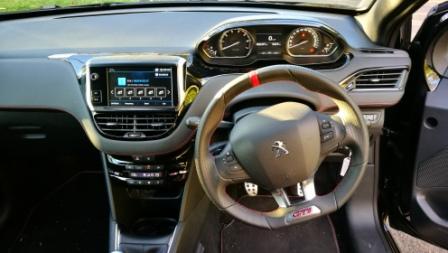 Steering is well weighted via the flat bottomed, red striped, leather bound tiller. There’s some lack of connection dead on centre however lock either way has the steering become more communicative in regards to where the front wheels were going. Ride quality itself was firm, leaning towards hard, but with just enough initial give to not be completely uncomfortable.
 Out on the freeway, as a result, it was a flat, slightly taut feel to the chassis, and with the engine ticking over at around 2500 in sixth, right in the sweet spot for the waiting maximum torque. Changes of direction are lightning quick thanks to an overall length of 3973mm yet packs a 2538mm wheelbase. Front and rear track are almost identical at 1476mm and 1478mm respectively, also helping the rapid response handling.
 That gearing also made it pretty tidy around town, with fifth the preferred gear for most 80 km/h zones and sometimes needing a judicious heel and toe for lower velocities.Unfortunately, there was also more tyre rumble than expected on most road surfaces. The Michelin Pilot Sport 205/45/17 rubber is superbly grippy but that grip came the cost of the aural noise.
 Inside the 208 GTi features the i-Cockpit setup favoured by Peugeot, and one that receives mixed reactions from some. This has the driver’s dash binnacle sitting above the sightline of the steering wheel. For me this wasn’t an issue but it’s also easy to see just how the top of the wheel could impede vision of the dials. Thankfully the steering column is adjustable for both height and reach.The binnacle itself has a switch, which when activated, limns the binnacle in blood red, matching the stripe on the wheel.
 The cockpit itself is comfortable with red and black trimmed sports seating, which are fully manual in operation, soft touch materials throughout, and a seven inch touchscreen for satnav, reverse camera with guidelines, and six speaker audio. Apps are on board and using a USB connection has a smartphone connecting for Android Auto and Apple CarPlay.
 Other features include a tyre pressure monitoring system, folding power mirrors, six airbags, and Autonomous Emergency Braking. Outside there’s chromed exhaust tips, good looking alloys, cornering lamps, and rear spoiler. This sits over a cargo area that is, unsurprisingly, not big at 285L. That’s a little smaller than Ford’s Fiesta and quite a bit smaller than VW’s Polo. At night that’s overcome by the stunning claw tail lights.
 Peugeot offer a three year warranty or 100,000 kilometres and the Peugeot 208GTi comes with a five star ANCAP safety rating.
 At The End Of The Drive.
The 2018 Peugeot 208 GTi continues a solid heritage and builds nicely upon the small hot hatch history. Although not as quick off the line as expected, the mid range driveability makes it more a usable day to day proposition, especially for a single person or couple. It’s a sweet handler and will happily take you at speed through twisting roads whilst sporting a healthy grin.
Head to Peugeot Australia for more info.
 Level 2, 9 Help Street