

Author archive
2019 Mitsubishi Triton Is Ready To Rumble.
Updated, stronger, and better, the Mitsubishi Triton update for 2019 is on the way. Mitsubishi have given the Triton a new face, with their proprietary “Dynamic Shield” front and centre. The all wheel drive system has been given an update, and the level of safety has been improved even further. The design team have gone to some length to ensure that, as a 4WD capable off-roader, that design elements provide good looks and safety. This extends to the placement of the headlights and the judicious use of chrome to highlight the Shield design ethic. The rear end has been given a makeover also, with reprofiled tail lights and bumper adding extra visual appeal.
 Underneath and outside are changes to the drivetrain and body styles. There is the four door cabin or double cab, the club cab with storage space behind the seats, and the single cab, with extra tray capacity. The all terrain system has been improved with the 2WD and 4WD Super-Select now getting Mud/Snow, Sand, Gravel, and Rock in the GLS and GLS Premium trim levels, with the latter receiving a rear diff lock. Naturally there are the high and low range gearing in the drivetrain. The 4WD versions have a ground clearance of 220mm, an approach angle of 31 degrees, and a departure angle of 23 degrees. Breakover angle is 25 degrees. The suspension has been kept at the double wishbone front and double leaf rear springs, with a change to the structure and the addition of bigger dampers for better ride control.
Safety now has Rear Cross Traffic Alert (RCTA), Blind Spot Warning (with Lane Change Assist), Front Collision Mitigation (FCM) autonomous braking with camera and laser radar systems to detect cars and pedestrians;and Ultrasonic misacceleration Mitigation System (UMS) which reads surrounding areas and blanks engine power if it reads a presence. The interior has had the wand waved over it. Materials have been given a colour change to a more even toned scheme, with a alloy look plastic trim fitment and stitching on certain parts of the cabin bringing in a luxurious look. A repositioning of the console has extra storage space being made available, plus there is the addition of a USB charging point for rear seat passengers. Up front, the driver seeds a redesigned dash display with a higher definition than before screen.
 To get the Triton underway, Mitsubishi use their well sorted 2.5L diesel. Peak power is 133kW at 3500rpm, with peak torque of 430Nm coming in at a very usable 2500rpm. The engine block itself is lighter and built using a diescast alloy formula. the existing five speed auto has been bumped for a six speed, with taller gear ratios for better fuel economy. The existing six speed manual remains. The entry level model stays with the 2.4L petrol engine and five speed manual combination.
The range kicks off with the 4×2 GLX cab chassis, with the 2.4L petrol engine and manual at a manufacturers list price of $22,490. The Club cab starts at $35,490 for the GLX manual and diesel, whilst the dual cab starts with the GLX pick-up from $36,290 and tops out at $51,990 for the 4×4 GLS Premium 2.4L Pick Up Auto Diesel. The 2019 Triton range is due for release in the first quarter of the year.
The Electric Cat Wins EV Award
Infrastructure is expanding, understanding of the technology is increasing, and more brands are getting into the electric car field. Once renowned for sports cars and luxury cars, Jaguar is one of those companies. Their new i-Pace has recently been named Top Gear Magazine’s Electric Vehicle of the year, with the car racking up 19 awards in 2018.
It’s powered by a pair of bespoke electric engines that develop 400 horsepower and 696Nm of torque. 0-100 time is 4.5 seconds thanks to its all wheel drive and lightweight architecture. Getting the car underway with a drained battery takes just 40 minutes to an 80% charge level at a charging station, or, like virtually all buyers would do, a home charger will do that overnight. Expected range is 470 kilometres, enough to travel from Sydney to Canberra comfortably and take advantage of the charging stations there.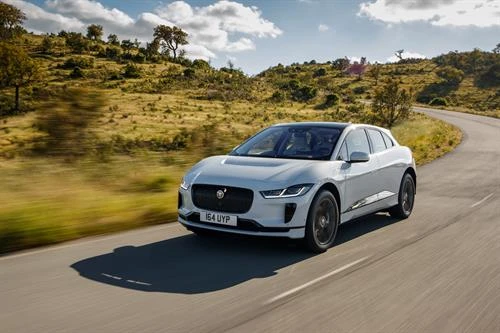
Available in Australia from $119,000 plus on roads, the i-Pace will also have the Touch Pro Duo infotainment system, capable of over-the-air software updates, and uses artificial intelligence to adapt to a driver’s personal preferences, ensuring driving and infotainment settings are matched to each individual using the car.
The legendary Ian Callum, Jaguar’s Director of Design, said: “We’re delighted to see the I-PACE named EV of the Year by BBC TopGear Magazine.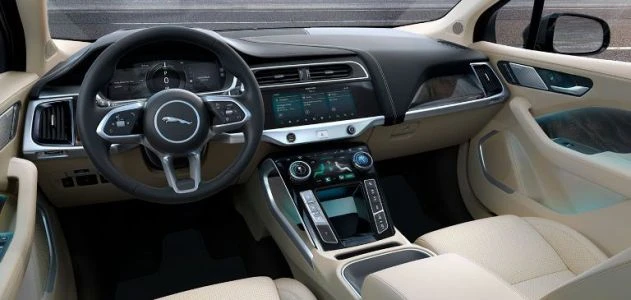
“As our first all-electric Jaguar we set out with a goal to make the I-PACE the world’s most desirable electric vehicle and recognition like this clearly shows that we are achieving it.”
Contact Jaguar for more details here.
Yellow Or Blue: The Question That Exposed Dangerous Drivers
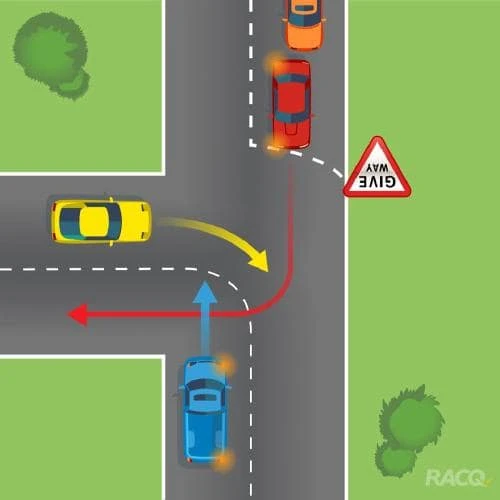 This picture, put into circulation by the Royal Automobile Club of Queensland, asked what really should have been a simple question to answer. Of the four cars pictured, which has the right of way?
Surprisingly, an overwhelming amount of respondents to the question, shared by us also, said the blue car. Straight away this raises an issue that should have the politicians and heads of traffic police investigating better driver education and training.
Of the four cars, one is behind another and therefore is immediately out of the equation. The car it’s behind is at a Give Way sign, and must remain stationary until other cars have passed through. The blue car is crossing a clearly marked delineation on the road’s surface. Road regulations state that any crossing of such a marked line,including at roundabouts, merge lanes, and intersections such as this, require indication.
This leaves the yellow car, following the road as marked by the dotted centre line, as the first car to go through. The RACQ themselves published this: “The give way sign at this intersection makes the path the yellow vehicle is on the continuing road, which curves to the right. The red and orange vehicles are facing a give way sign and must give way to all other traffic. Therefore the yellow vehicle goes first, the blue vehicle goes second as it is effectively turning right off the continuing road and the red and orange vehicles follow.”
Responses to this ranged from: “ Yellow, Blue, Red, But why is Blue indicating right? There is no right turn” to “There should be a give way sign at the t-section and not where it’s currently placed.”
Questions were raised about the road design and markings: “The marks on the road mean nothing . It clearly states in the road rules all vehicles must give way to the vehicle on your right. As there is no give way sign, stop sign or arrows on road, apart from the red car with give way sign. So it is blue ,yellow and red.” It’s this kind of response that should also raise red flags with road designers.
Many queried why the blue car was indicating. The Queensland government’s official stance on this is:” When you change lanes, you must give way to any vehicle in the lane you are moving into. This rule applies even if your lane is ending and you have to cross a lane line. “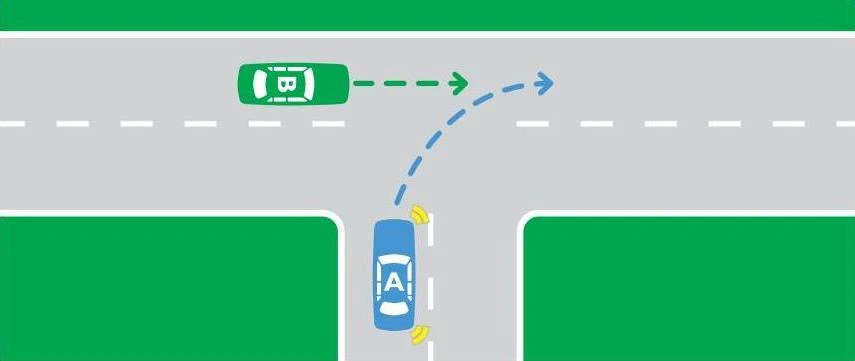
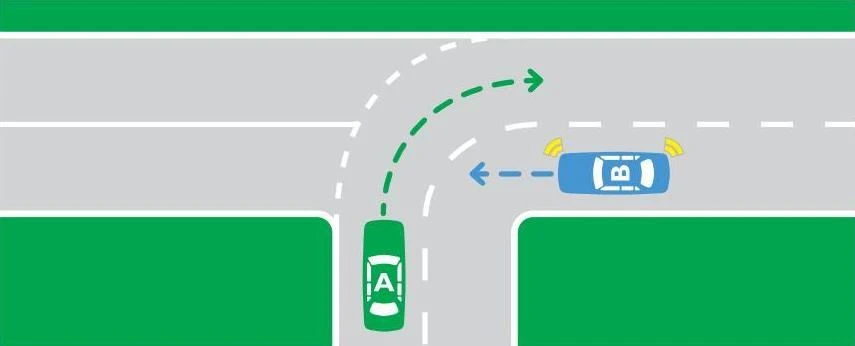 These are from the NSW Roads and Maritime Services website and clearly show the same regulations that should be adhered to. And in one succinct sentence: ” Generally if you’re turning across another vehicle’s path, you must give way.” At all times, any lane change, be it as shown here, or at merge lanes, or at roundabouts, indicators MUST be used.
Finally, it seems that governments really do need to rethink their road safety plan if something such as this, in a hypothetical sense, potentially translates to a real world situation. If so, it means many drivers in the blue cars would be held responsible for the crash.
Car Review: 2019 Peugeot 3008 Allure.
Peugeot’s 2018 3008, an award winning vehicle, is a second generation, extensively reworked version of the 3008 and facelifts released originally in 2008, with the second generation from 2016. We test the 2019 spec Peugeot 3008 Allure, priced at just under $41K plus on road costs. Power is supplied by a torquey 1.6L petrol engine, with 1400 revs seeing 240Nm being available thanks to a low pressure turbo. With 6000 rpm on the tacho, peak power is 121kW. Transmission is a six speed DCT. Peugeot quotes combined fuel economy as 7.0 & 7.3L per 100 kilometres, with city cycle driving as 9.8L & 10.1L per 100 kilometres. The two figures are quoted due to the Grip Control being off or on. Grip Control is a choice of drive modes for differing surfaces, and activated via a dial in the forward centre console.
 The actual driving experience varies from slightly frustrating to a lot of fun. Frustrating because of the delay in engagement from park to reverse to Drive, to grin inducing pull from low revs as the 3008 Allure sets sail. The changes are crisp, swift, smooth, in hte transmission when under way and manually changing does sharpen them further.
The Allure is a stylish machine, with the underpinnings a new platform called EMP2 that allows a superb ride and handling package. Steering, for example, is razor sharp in its responsiveness off centre, with a quarter turn or so having the nose swing round quickly. At speed the variable ratio steering lightens up and there’s less effort required to work. The ride on the 18 inch alloys, with 225/55 Continentals as the rubber, is beautifully tuned and balanced. There’s a suppleness that’s rare to find in anything other than mid to high end luxury cars, with an initial give that is followed by a progressive compression that stops before the bump-stops in all but the heaviest push over larger speed-bumps.
Out on the freeway it’s absorbent to a fault, dialling out irregularities and undulations as easily as it rides over the unsettled gravel and broken surfaces. It’s beyond superb and in its class a genuine leader. The passengers feel minimal movement and what there is comes through smoothly and calmly. Weighing in at just under 1400kg before fuel and cargo, the relatively lightweight 3008 moves easily from lane to lane when required, and does so without noticeable body roll.
The Peugeot 3008 range is front wheel drive biased, and for the most part isn’t noticeable as such. It’s really only, and typical of front wheel drive cars, when the loud pedal is punched hard that something resembling torque steer is noticeable.
Peugeot, being a French brand, isn’t adverse to a mix of style and quirks, with the latter good and not so. Certainly it’s stylish. The boxy design has enough lines, brightwork, and additions to the exterior to move it away from similarly styled machines. Although just the second level in the 3008 range, it comes with a powered tail gate and kick-activation. Inside it had a smartphone wireless charger. Gear selection is via a pilot style lever, with a button on the right to unlock and rock back and forth for Drive, Reverse, Neutral. Park is a simple push on the top, and Sports mode enables manual changing via the selector or paddles.
 It also features the i-Cockpit, a full colour 12.3 inch LCD screen housed in a binnacle above the sightline of the top of the steering wheel. It’s clear and easy on the eye, will change colour at the turn of the drive mode switch, but either the top or bottom of the screen gets blanked by the tiller. At odds with the charger pad and powered tail gate is no power for the cloth and leather seats. As comfortable pews as they are, to offer the two others but not electric seats is a strange decision.
  Another oddity is locating the bonnet opener in the left hand door’s forward meeting point, directly under the hinges. Bearing in mind a left hand drive market, hiding it away when the door is closed is one thing, elegance in design is another.
Ergonomics are otherwise very good, with controls for the aircon and radio (including DAB) found via plastic vertically oriented switches that act as starting points for the very well equipped touchscreen. The cockpit itself is defineably a setup oriented towards a driver and passenger separation, with the centre console gently rising and curling towards the right hand seat under the centre air-vents and eight inch touchscreen. The materials themselves, a mix of soft plastics and an almost light denim style material, on the console and dash are pleasant to look at and feel. A lovely extra touch is the soft glow of ambient lighting in the cabin, the centre console cup holders, around the binnacle, and in the doors. Sound and apps wise, the DAB audio punches well, and screen mirroring along with Android Auto and Apple CarPlay is standard.
 The exterior is sweetly shaped, especially for a relative smallish 4447mm length. The nose is a very bluff and upright chrome affair that sits over a broad horizontal set of four intakes and a alloy look chin. Intense LED driving lights eyebrow the normal headlights, with a signature “fin” motif in the design of the cluster.
 Our test car came clad in the lustrous metallic red paint with black roof, called Metallic Copper and Neon Black, highlighted by chrome strips. Tail lights are the familiar Peugeot claw. The lower extremities are black polycarbonate and the rear bumper gets a chrome strip running full width. As stated, a stylish package.
Finally, the Allure wraps up the good looks and lovely ride with a decent set of safety aids. Airbags all round, Autonomous Emergency Braking, Blind Spot Detection, Adaptive Cruise Control…not all of which are standard but can be optioned on the Allure.
Peugeot look after the 3008 with a five year warranty, a 12 year corrosion warranty, and a 24/7 roadside assistance package.
At The End of The Drive.
The Peugeot 3008 range is an award winner for the right reasons. It’s a superb handler, a very good drive, adds features at a good price, and brings the typical Gallic quirks. It’s roomy enough for four with no problems, has a good level of standard kit, is frugal enough in the real world and….well, it just does what it does at a high level all round. Check the 2019 Peugeot 3008 Allure out here.
 Level 2, 9 Help Street