

Author archive
Tesla Reveals V3 Superchargers
Fresh from the success of his Space-X mission to the ISS, Elon Musk‘s other love, Tesla, has released information on a change to their car charging system. Called V3 Supercharging, it brings a massive change in how Tesla cars are charged, and drastically lowers the charging time.
To be rolled out in the U.S. initially, V3 Supercharging moves to a different charging point, with a solitary charging cabinet, as Tesla puts it, with a 1 MW (megaWatt) capacity able to provide a new Model 3 Long Range car with up to 75 miles worth of range in just five minutes and the equivalent of one thousand miles of range in just an hour. The cabinets themselves will now provide one car with one power source, with the previous method a power-share model meaning if two cars were attached to the one charge cabinet, charge rates were slower. By providing a single stream, Tesla anticipates average charge times to drop to 15 minutes for a full charge.
Another innovative change to the Tesla charge system is a pre-warming of the batteries as the car approaches a charging point. Called On-Route Battery Warmup, the onboard system recognises the car’s proximity to a Tesla or compatible car charging point. By warming the battery on approach, it means the chemical makeup of the battery is more respondent to the incoming charge. This is anticipated to reduce charge time by up to 25%.
The overall changes are anticipated to reduce the overall charge time by 50%, and increase the number of cars being charged in the same amount of time.
Tesla will add more to their existing charging system too, with their current V2 superchargers, numbering over 12,000 worldwide, to be updated to a 145kW charge rate. The improvements are forward planning for the release of the recently re-priced Model 3 and the forthcoming Model Y. Asia-Pacific stations are currently scheduled for a Q4 2019 update.
Private Fleet Car Review: 2019 Suzuki Jimny
This Car Review Is About:
The new and reborn fourth version 2019 Suzuki Jimny. It’s a cubical machine, with styling hints aplenty from Jimnys before, comes with a reasonable range of tech, and a pile of charm that’ll fit in your pocket. Under The Bonnet Is:
A 1.5L petrol engine with variable valve timing. It gets grip through to the ground via a four speed auto with overdrive or a five speed manual. With peak power of 75kW @ 6,000rpm and peak torque of 130Nm @ 4,000rpm, the manual is the preferred transmission.
Fuel is fed to the small engine via a fuel thimble of 40-L. Consumption for the 1075kg/1090kg (tare weight) machine is rated, on the combined cycle, 6.4L/100km for the manual and 6.9L/100km for the self shifter.
There is a proper four wheel drive system, with 2WD and 4WD high range, and a transfer case for 4WD low range. It’s a simple push and pull design, and works well. Select Neutral, slide the somewhat notchy lever back for 4WD High, press down and slide for 4WD Low, and that’s it. On The Outside It’s:
Two cubes joined together. One small one, and one larger. That’s the engine bay and the cabin. It is a three door, with the rear door swinging out to a full ninety degree fold from a driver’s side hinge pairing and holds the spare wheel hidden under a black plastic case. The styling cues are plentiful with nods towards history coming from the twin slots embossed into the sheetmetal at the base of the A pillar. Round headlights (with new LED inserts) and separate indicators, combination rear lamps, and a five slot grille complete the history lesson. Paintwork is a choice of six with the test machine clad in a Chiffon Ivory Metallic. Other colours are Kinetic Yellow, Brisk Blue Metallic, Jungle Green, Medium grey, and Superior White, with a Bluish-Black Pearl roof, with the ceiling itself having longitudinal strakes. Black polyurethane wheel arches sit over a broad space between the body and the 195/80/15 rubber.
 It’s not the biggest thing on the road, with a total length of 3,645mm and that’s the front to the wheel cover. It stands 1,720mm high and is 1,645mm wide. There is plenty of all round vision through the broad glasshouse, and the front screen has a pair of simple looking wipers. The washer jets are powerful but waste water because of the power, with the fluid bouncing off the screen.
 The grille itself is the same black material as the arch covers and the front bumper, which houses standard globe lit driving lights, doesn’t stand that far out from the grille itself. The short overhangs allow an approach angle of 37 degrees, departure of 49 degrees, and the breakover angle is 28 degrees.
 The body itself is built on a ladder chassis that incorporates a structure strengthening “x” member, plus an extra pair of cross members to ensure a stiff body. Adding to the strength is a rear axle housing that is bigger than the previous model, adding up to 30% extra rigidity.
On The Inside Is:
A cabin that has largely black overtones. The cloth seats are black, the dash is black, the floor is black, most of the door trim is black. There is a splash of body colour in the doors and around the rear seats, a light grey material covers the upper section of the cabin. The dash itself is old school and not necessarily all in a good way. The good is Suzuki’s elegant seven inch touchscreen with Apple CarPlay, Android Auto, satnav and Bluetooth connectivity. The aircon vents at either end of the dash are the simple push and twirl for direction style, but the centre ones are a rectangular style and don’t feel as if they flow air terribly well.
 The centre stack holds dials for the aircon controls and it’s a twist for the fan speed and temperature. The design has push buttons for the mode (air flow direction), fresh or recirculating, A/C on and an off tab. The size of the dials makes the information screen in the centre dial hard to read clearly.
The dials sit over four tabs for the power windows, Hill Descent Control, and traction control on/off selector. Underneath them is a 12V socket and USB port. On the passenger side is a grip handle, whilst the driver gets red back-lit analogue dials bracketing a monochrome information screen. The leather bound tiller holds cruise control and audio controls.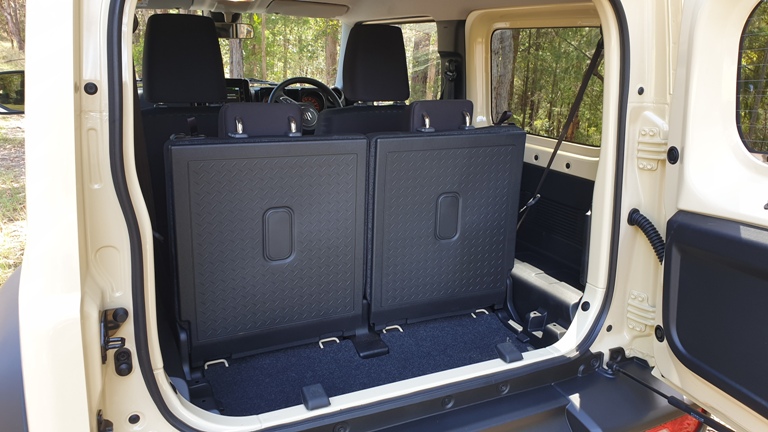

 There are plastic sheets on the back of the folding rear seats which allow wet or dirty items to be placed in the 377L cargo area. That’s a whopping 53L larger than the previous Jimny. The packaging overall is better than before, with the seat hip points increased by 40mm. The seat frames themselves have increased by 70mm in width, and there is a sense of sitting high up in the Jimny for a sense of control and the all round vision.
The plastics themselves look old school but Suzuki says that they’ve been engineered to allow bare or gloved hands to operate the tabs and switches, and the vertical lines of the cabin provide a visual reference point when off-roading.
Info for the driver is from a monochrome screen between two somewhat archaic looking red dials, housed inside a cubical block of plastic. It’s a retro look, yes, but it goes too far in the history lesson.
What About Safety?
It’s been rated by Australia’s car safety body, ANCAP, as three stars. Part of that was to do with its Autonomous Emergency Braking system, with ANCAP scoring it down believing it’s not as effective as it should be. The biggest low point was in respect to pedestrian safety. It does have six airbags, Hill Descent Control, Hill Hold Control, and flashing emergency stop signals. Lane Departure Alert and Driver Waeving Alert are also standard.
On The Road It’s:
Lacking in urge, has a spongy ride (which was partly due to 28PSI in the tyres), has vague steering, and soft brakes. The torque is enough for something resembling acceleration but by no means can the word rapid be included. Bearing in mind the size of the engine versus the Jimny auto’s weight, it should feel more lively. And then factor in the transfer case for low range, and a need for more torque suddenly becomes apparent. There’s enough in the Suzuki parts bin to make this a possibility.
The chassis and suspension don’t feel as well sorted as expected. Even with the tyres bumped to 34PSI it was crabby, squirrelly, in its handling. There was more than expected body roll, squeals from the tyres even in gentle cornering, and no real feeling of the steering being connected to the front. Push on understeer was easily achieved at low (20, 30 km/h). The brakes lack bite and the pedal has perhaps not enough feedback. Off road it’s a different animal. That soft ride tightens up, eating dirt for breakfast, and on AWT’s favoured test track, showed the manners expected. It flattens most of the gravel and rock surfaces with a less intrusive body roll, and ploughed through the deeper puddles in the test track with a mostly confident attitude. The narrow rubber was prone to tramlining though, tugging the tiller left and right with ease.
 There is one particular section that can be a nuisance for larger off-roaders due to overhangs reducing approach and departure. In 4WD Low, the Jimny was judiciously entered into the dip, and simply crawled out at the other end without a blink. Hill Descent Control was engaged for some downhill testing and although perhaps descending a little too quickly it did at least engage.
 And The Warranty Is:
Three years or 100,000 kilometres. Have your Suzuki serviced on a capped price program every six months at a dealership over five years and Suzuki offers a five year warranty or 140,000 kilometre warranty.
At The End Of The Drive.
The 2019 Suzuki Jimny is a curious mix of wannabe and nothing to prove. Sure, there’s that safety rating but part of that is due to the exterior design, meaning the pedestrian impact safety rating is down. It’s painfully soft and wafty on tarmac, but has enough goods to delight on gravel and rock and mud. It’s a “proper” four wheel drive thanks to the transfer case but really needs a dose of torque. It’s a car, frankly, that will appeal to those under thirty or to those that wish to relive their late ’80s youth. Neither is a bad thing. Here is where you can find out more.
Car Review: 2019 Renault Trafic Crew Life LCV
This Car Review Is About:
The 2019 Renault Trafic Crew Life LCV (light commercial vehicle). It’s a long wheelbase version with a dedicated passenger cabin. Renault have it, at the time of writing, at a stellar $47,990 driveaway. Under The Bonnet Is:
A surprisingly torquey twin-turbo 1.6L diesel. At just 1500rpm there is 340Nm, and peak power isn’t bad either. At 3500rpm there is 103kW, although by then it’s run out of puff. The transmission fitted to the review vehicle is a slick six speed manual, driving the front wheels, that’s geared to take advantage of the torque early on to get it under way. There is no auto option. Economy is rated as 6.2L/100km, and the final figure of over 420km for a quarter tank (80L volume) consumed speaks volumes. And that’s with a dry weight of 1,736 kilos.
On The Outside It’s:
A van. Yes, it’s stating the obvious but sometimes the obvious is all there is. From front and rear perspectives its virtually cubical. From a side profile the long wheelbase (3,498mm inside an overall 5,399mm)is readily apparent, as is the elegantly profiled nose, complete with bonnet. This makes accessing the engine easier and provides a higher measure of impact protection. Front overhang is 938mm, with a rear overhang of 968mm.
The body in white highlighted the tinted windows fitted to the left and right hand side sliding doors which aren’t remotely operable. The windows themselves house slightly tricky sliding windows, and pull down sun shades. Overall cargo is rated as six cubic metres for the standard LWB, four metres for the crew cab version.
The alloy wheels are 17 inches in diameter and are wrapped in commercial spec, yet very comfortable and grippy, rubber of 215/60 profile from Dunlop.
The non-powered tailgate is surprisingly easy to lift, with a balance point requiring little effort in order to raise it. There is also an embedded pullstrap to help lower the door.
Both driver and passenger door mirrors have a number of wide angle mirrors to back up the reverse camera and rear sensors.
On The Inside It’s:
Got seating for six. There’s adequate room up front for three, even with the protuberance for the gear selector. Underneath the centre and left seat are storage compartments which are accessed by lifting the squab. The driver’s storage has a tool kit.
The other three seats have plenty of room all around, and behind them was a bulkhead separating the passenger section from the load bay. There was just enough body flex to have the bulkhead mounts squeaking quite a bit.
Although clearly a commercial vehicle, Renault’s ergonomics cant be faulted, for the most part. The gear selector housing has some impact on the centre seat passenger, but that’s unavoidable as it’s also ideally placed to fall naturally to hand for shifting.
The starter button is quite visible, so there’s no hunting around. Switchgear is just where the body feels it needs to be, and the left mounted indicator (with auto headlights) is a fingertip away. The floor is easy to clean rubber, with driver and front passengers stepping up easily.
A handy touch or two are the inbuilt mobile phone holder and upper dash storage locker. The phone holder is engineered to twist and to extend in height with the push of a button.
The seven inch touchscreen is easy to operate and read, and there is the pleasant addition of digital radio. However, much like the Megane recently reviewed, the tuner sensitivity isn’t on par with that from other manufacturers. Having said that, overall sound quality from the door mounted speakers, partnered with a pair mounted above and behind the driver and left front passenger, delighted in their depth and clarity.
On The Road It’s:
More car like in ride and handling than it had the right to be. The front wheels are ahead of the front seats but felt as if they were directly under them. With such a long body and wheelbase there was an expectation of dragging tne rear wheels on curbs in corners. It simply didnt happen. Somehow, the knowledge of where each corner was became almost intuitive vey quickly. Not once did the length of the Trafic Life pose an issue.
Driven in the environment it was, a predominantly urban drive, and with one to four aboard, plus a week’s load of shopping, the 1.6L engine never seemed as if it would struggle in this specific kind of usage. If used in a purely commercial way, that would probably be a different story.
But that’s where the low gearing for first and second worked so well. Below 1300 or 1400 revs, the Trafic Life had little. Life, that is. But once tbe turbo spooled up there was a rapid change in tne nature of it, and the 340 torques introduced themselves with a flourish.
Further up the gears and in both town and highway driving, the Trafic Life was rarely found wanting. The engine management system has an anti-stall feature, and once or twice at traffic lights this kicked in, enabling the get-away otherwise wanted.
It’s a superb highway cruiser, and around the urban drive cycle, fourth or fifth was all that was required. Braking, too, was wonderful, with an easy to judge feel, and plenty of speed reduction quickly.
Actual ride quality was enjoyable, with a firm, but not unpleasantly so suspension setup. Matched with a quick steering rack and driven hard through the tight and twisting turns on one particular Blue Mountains thoroughfare, the Trafic Life demonstrated just how well thought out and engineered the underpinnings are.
What About Safety And Warranty?
Front and side airbags, daytime running lights, Hill Start Assist, and the mandated traction aids are standard. Renault doesn’t list AEB or distance sensing cruise control. Warranty is listed as 3 years, unlimited kilometres, with annual or 30,000 kilometre service intervals.
At The End Of The Drive.
PF handed back the 2019 Renault Trafic Life with regret. It’s a better than expected family vehicle, economic to drive, comfortable whilst doing so, and has an easy to maintain interior. In colours other than the plain white our review vehicle came in, it’d also be a reasonably handsome looker on road. And at under $50k driveaway its a screaming bargain as a people mover.
For more details on the Renault Trafic range, here is where you can find them.
Jaguar i-Pace Wins Major Award
Jaguar’s low slung all electric five door i-Pace has become Jaguar’s first car to win the European Car Of The Year award. It’s an award that is voted upon by sixty journalists from 23 countries. The award looks technical innovation, design, performance, efficiency and value for money.
To date, the i-Pace has found over 8,000 homes with around 75% of those in Europe. There’s obviously plenty of good reasons for the car to be so popular. The driveline, for example, delivers up to 294kW and 696Nm of torque, and with a pair of electric motors working together in a near perfect weight distribution, a zero to one hundred time of 4.8 seconds is just a flex of the right ankle away.
Road manners are Jaguar’s exacting standards. Torque Vectoring by Braking is standard in the i-Pace; it’s a system that delivers controlled independent braking on the individual inside front and rear wheels to add to the turning forces acting on the car. For the driver that wants to push the i-Pace even harder, an optional airbag suspension system can be fitted. This will drop the i-Pace by ten millimetres to help aerodynamic flow at speeds over 105 km/h.
Both of these are backed up by the Coventry firm’s Adaptive Dynamics monitoring system. At up to 500 times a second, the onboard system will read input from the throttle, the actual acceleration rate, braking, and the suspension to provide a best as possible ride and handling experience. Gone a little dirty? Then the All Surface Progress Control and Low Traction Launch systems will help out in low speed driving conditions.
The power system gets looked after too. Active Vanes open and close behind the grille and front bumper air intakes to provide cooling air when required for the electrical system. Enhanced Brake Regeneration feeds kinetic energy back into the power grid almost as soon as the driver lifts their foot from the accelerator. Heavy Traffic Braking is a variable system that adds power back in city driving stop/start.
Contact Jaguar Australia for information on the 2019 Jaguar i-Pace.
 Level 2, 9 Help Street