

Author archive
2020 Toyota Corolla Ascent Sport and SX Sedan: Private FleetCar Review.
This Car Review Is About: The updated Toyota Corolla sedan range. It’s possibly one of the longest running nameplates and styles in the Australian market. Lookswise the rear has been mildly massaged whilst the front takes on the appearance of the hatchback, released late in 2018. There’s some changes to the inside and a freshen-up to the ride. There’s also a change in location for manufacturing, with the Corolla returning to Japan after formerly being built in Thailand.
 There are three models to choose from, with the Ascent Sport, SX, and ZR. Engine choice is a “normal” 2.0L petrol for all three or a 1.8L hybrid for the Ascent Sport and SX. Transmission choices are a manual or CVT in the Ascent Sport, and CVT for the other two. We drove the Ascent Sport and SX 2.0L.
What Does It Cost?: $23,335 and $28,325 for the cars tested and these are prices before government and dealership charges. Driveaway charges vary around the country with variances of just a few to a couple of hundred of dollars. With the SX clad in Celestine Grey and the Ascent in a pearl white, there’s a bump of just over $500.
 Under The Bonnet Is: A 2.0L petrol engine in the cars reviewed. There is a 1.8L hybrid package available for Ascent Sport and SX, but the ZR stays with the 2.0L only. Peak power is 125kW, with peak twist 200Nm and that’s on standard pump unleaded. Toyota claims 6.0L/100km for the fuel economy and we matched that in the Ascent Sport, whilst the SX threw out 7.4L on a slightly more urban based drive. Tank size is 50L. The transmissions are the now conventional CVT for the 2.0L with the mechanical first gear cog for quicker off the line acceleration. The Ascent Sport can also be specced with a six speed manual and the hybrids have the cogless CVT.
 On The Outside Is: A mild tweak to the rear lights, with a resemblance to Holden’s Astra. In profile there’s more definition to the wheel arches whilst the front end is completely restyled and now shares the look, with slimmer headlights and deeper air intake, with the hatch. Eyecatching LED driving lights sit above a bumper with subtle differences to the hatch. It’s a good size overall, with a length of 4,630mm just 300mm shorter than the Camry. Boot space is bigger than the hatch too, with 470L swallowing up a family’s groceries or baggage with ease.
Both have alloys are they’re 16 inches in size, with the SX sporting a slightly different sheen in the alloy’s finish to the Ascent Sport. Rubber is from Bridgestone’s Ecopia range and are at 205/55 in size. There is otherwise no visible difference between the two, with the Ascent Sport lacking…something sporty to back up the name.
 On The Inside Is: Some subtle differences between the pair. The SX has a dual zone climate control versus the Ascent’s single zone, with corresponding changes to the design of the controls. Apart from a push start/stop button the SX and Ascent Sport have identical dash designs, down to the speedometer dominating the display for the driver. The display has the 4.2 inch LCD screen over to the right side, rather than centrally located like, well, just about everyone else.
 The design of the dash’s material is clean, unfussy, with the texture pleasing to the touch. There’s high gloss piano black around the aircon controls, and above them is the 8.0 inch touchscreen, complete with DAB (SX standard, optional in Ascent Sport, as is satnav), Bluetooth streaming, and bespoke Toyota app connection called myToyota. The screen’s look and layout is something some other manufacturers should look to for their screens. Android Auto and Apple CarPlay are standard, plus there is voice recognition, Siri eyes free, and Miracast. The SX has a wireless charge pad, a good feature in a mid-spec car. There are also four cup and bottle holders. Seats are manually adjustable in the two. All pews in both are cloth covered and none were heated or vented. There is a 2,700mm wheelbase on the sedan which is 60mm longer than the hatch. This provides crucial extra legroom for the rear seat passengers.


 On The Road Its: Not much different from one to the other. The SX felt as if it had a slightly softer rear to the Ascent Sport, however there is a commonality for the two. the Ecopia rubber drums and drones on harsher tarmac, and the front end lacks confidence on wet roads. Entry speeds in corners had to be drastically reduced in the wet due to push-on understeer compared to driving the same in dry conditions.
Steering both is light with a touch of feeling artificial in heft. Brakes were mostly up to the job with a reasonable amount of stopping performance in the dry, and only a touch less in the wet thanks to the rubber. Ride quality in both, apart from the perceived softer rear in the SX, was excellent, with well controlled damping, high levels of absorption of bumps, and minimal body roll. Dry road cornering is competent and confident too, with dynamics sure to please anyone with a modicum of driving ability.
The first gear cog in the CVT makes a world of difference in getting off the line. Response is zippier, sharper, and blends nicely into the CVT’s own mechanism without issue. Rolling acceleration is improved too, with highway driving and overtaking easier to perform without issue. Downhill drives have the CVT hold and work as an engine brake and it’s all nicely integrated. The engine itself is muted for the most part, and really only aurally intrudes at the higher end of the rev range. There is a Sport button in the centre console and is pretty much superfluous in usage. What About Safety?: Toyota could be said to lead the way when it comes to safety packages. Lobbed under the umbrella name of SafetySense, the range features Active Cruise Control (ACC), Pre-Collision Safety System (PCS) with Pedestrian and Cyclist detection, Lane Departure Alert (LDA), Road Sign Assist (RSA) and Auto High Beam (AHB) plus reverse camera with fixed guidelines are standard in the SX and ZR. Driving is assisted by the usual traction aids including Hill-Start Assist, plus Active Cornering Assist. This is a system that gently applies brakes to the front driven wheels if required in cornering at speed. Seven airbags are common to both.
And The Warranty?: Simple. Five years and unlimited kilometres. And by ensuring the car is serviced as per the service schedule, Toyota will extend the engine and driveline warranty from five to seven years. Servicing is capped price, at $180 for the first four services at a 12 month or 15,000 kilometre spacing. At The End Of The Drive: In 2.0L and CVT spec there is a question mark for the Ascent Sport and SX differentiation. A retail price difference of $5,000 is a substantial ask for a car that in essence only has digital audio, satnav, and a wireless charge pad over the model below. The wheels and tyres are the same, the body is the same, driving performance is the same. It’s a curious question and one only a buyer can answer when in the showroom. You can compare the specs here.

Amarok V6 Diesel Gains A Third Pedal.
Proving that some manufacturers do listen to customer feedback, Volkswagen has given its V6 diesel Amarok a third pedal. The Amarok V6 Core TDI500 4×4 Performance has 165kW between 3,250rpm and 4,500rpm, and a very decent 500Nm of torque from 1,250rpm to 3,000rpm. This means it’s good for a towed (braked) capacity of 3.0 tonnes. Payload is 1,004 kilograms.
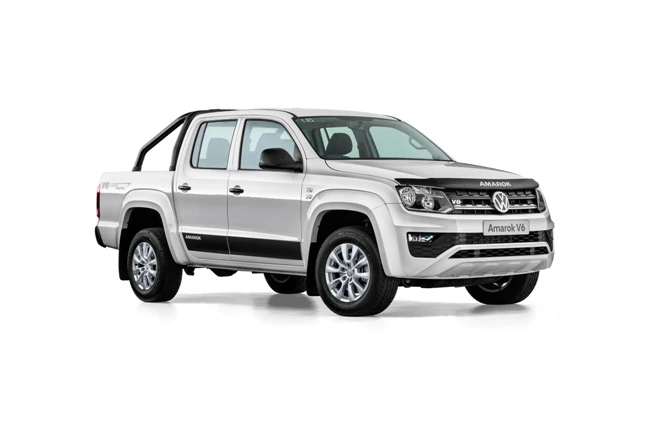
Ryan Davies, The Director of Volkswagen Commercial Vehicles Australia, Ryan Davies, said: “At every off-road, caravan and camping expo and Big Red Bash concert the team and I attend, we speak with current owners and members of the off-roading community who have begged us to bring an Amarok V6 manual to Australia. It was because of that passion that we were able to mount a case with our head office in Germany to build one and, based on Australia remaining the number one export market in the world for the V6 Amarok, we are finally able to offer this unique, Aussie-spec ‘Rok.”
It’s the addition of the six speed manual that makes the difference here. The six-speed manual gearbox is paired with a non-permanently engaged four-wheel drive system, whereas the eight speed auto has a permanent full-time 4WD setup. The part-time transfer box permits two gear stages which is the engagement of the front driven wheels and changing to the reduction speed, or low range, transmission. These are activated electronically via console mounted buttons, meaning no mechanical lever is required to get ready for muddy or off-road excursions. There is also an off-road mode, which is activated by the press of a button or automatically when 4×4 low range is engaged. A mechanical rear-axle differential lock is fitted as standard.
Hill–descent assist limits downhill velocities by acting upon all four brakes as required, and will work at keeping the speed as constant as possible. This works best between two and thirty kilometres per hour. It will also assist in reversing situations downhill.
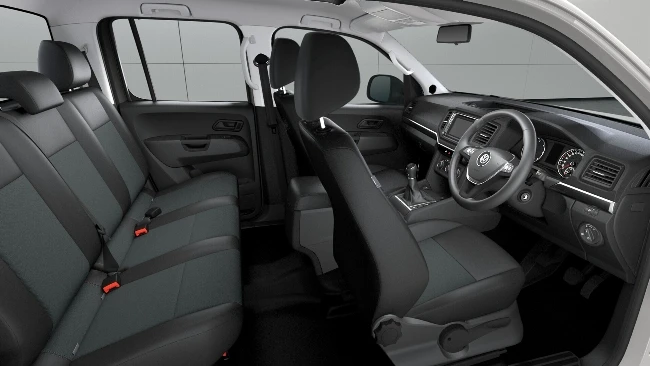
Inside there is heavy duty rubber coverings for the front and rear seats to help with cleaning after going off-road, The steering wheel is leather wrapped, climate control is of the semi-automatic style, and VW’s App-Connect system is standard, The rear view camera adds an extra safety level with Park Distance Control. 17 inch wheels and LED running lights add some visual appeal, as do the extras for the Core Enduro version.
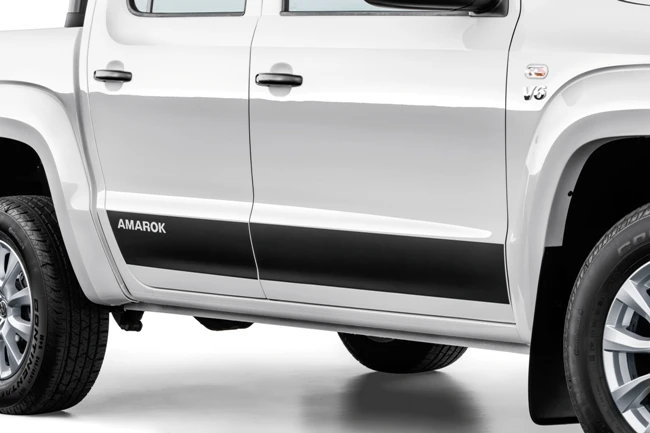
A black sports bar behind the cabin, a bonnet protector, and Enduro decals in black provide spice. Pricing is competive, with the Core 4×4 six speed manual listing at $49,590 whilst the Enduro lists at the same price. Check with your Volkswagen dealer to be sure.
BMW Has Upped The M Pure Factor.
BMW Group Australia has expanded their range by adding in four models that comes under the M Pure banner. A key factor is that value versus the standard specification has changed as there is extra features added for what is effectively the same dollar ask. They also retain the same powertrain to keep costs down. The models that have been given the extra specification cover the spectrum of the current range.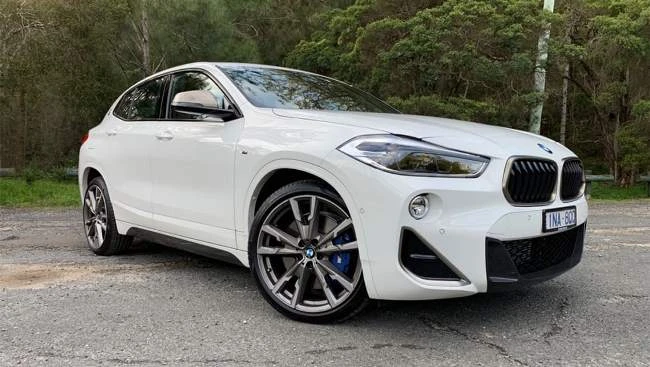
M Models have experienced startling growth for BMW Australia, with a 40% growth in 2019. Worldwide there has been a 32.2% increase for the M brand in 2019 over 2018, with 135,829 finding a new home last year.
The models that have been given the M Pure treatment are the X2 M35i, M 340i xDrive, X5 M50i, and X6 M50i. They join the M550i xDrive Pure model, which was announced late last year and will also be available from early 2020.
First up is the X2 M35i Pure and priced from $64,400, manufacturer’s list price. Standard features are extensive, and include M Sport brakes sitting inside 20inch M light alloy wheels in a double spoke style and coated in Cerium Grey. Run flat tyres are fitted. There is also the M Sport diff and front limited slip diff plus the obligatory M Suspension. There is an automatic tailgate and some good tech inside. A HUD or head up display is complemented by M Sport seats, with BMW’s Individual High-Gloss Shadow Line and BMW Individual Headliner Anthracite.
Additional equipment features are Dakota leather trim, powered and heated pews, lumbar support and BMW’s Comfort Access. Sounds come from famed audio company Harman Karmon. The extra kit is valued at $6,000.
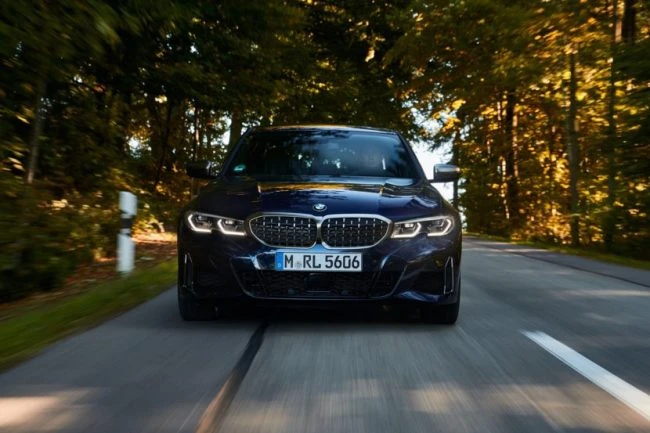
The M340i xDrive Pure starts from $94,900. Wheels here are also Cerium Grey, double spoked, and are at 19 inches in diameter. Along with the M Sport stoppers and diff, items such as adaptive LED headlights, wireless smartphone charging, and HUD, sit alongside BMW’s Driving Assistant Professional and Parking Assistant Plus. Trim is BMW Individual Headliner Anthracite whilst the Sports Seats have Sensatec/Alcantara upholstery. The standard spec on top has BMW’s innovative Laserlight system with BMW Selective Beam up front, and auto tailgate at the rear. In between is a glass roof, Harman Kardon audio, ambient lighting to be enjoyed from the heated front seats whilst all pews get leather upholstery. The instrument panel has BMW’s Sensatec. The price here starts at $104,900, with the value overall rated as $12,400.
X5 M50i Pure sees a pricetag of $136,900 (manufacturer’s list price) with the X5 M50i at $151,900. Cerium Grey again is the chosen colour, this time on 22 inch alloys with a V shaped spoke design. Again there are the M Sport features underneath and now there is the M Sport exhaust and M Sport power steering. Suspension is the adaptive M Sport system. Inside is the Driving Assistant Professional and Parking Assistant Plus, and also the BMW Live Cockpit Professional. A panorama glass roof is fitted, and LED lighting for night driving. Trim is the BMW Individual High-Gloss Shadow Line, and ambient lighting once again adds some luxury and class. Comfort Access and wireless charging round out the list.
The extra specification in addition to the X5 M50i Pure is valued at $19,000, for a starting price is $151,900. Adaptive M Suspension Professional, includes adaptive M Suspension, Active Anti-Roll Stabilisation and Integral Active Steering are underneath, and the Laserlight/Selective Beam lights the way. Soft Close Doors start the interior additions, and there is 4 zone climate control along with heated and cooling cupholders to cope with the Australian weather extremes. Leather surrounds the BMW Individual Instrument Panel.
The final stanza in the M Pure story is the X6 M50i Pure from $140,900, with the extra equipment from $155,900. There’s the 22 inch wheels and run flats, brakes, diff, exhaust, and steering, plus the adaptive suspension. The auto tailgate is standard, as is adaptive LED headlights, Comfort Access, heated front sports seats, and the Driving Assistant Professional & Parking Assistant Plus. Internals also have wireless smartphone charging, HUD, Individual High-Gloss Shadowline, and Live Cockpit Professional.
The extras underneath cover BMW’s Adaptive M Suspension Professional, includes adaptive M Suspension, Active Anti-Roll Stabilisation, and Integral Active Steering. Naturally the Laserlight & Selective Beam front end is included, as are 4 zone climate control, heated & cooled cupholders, the leather-bound Individual Instrument Panel, soft close doors, and metallic paint.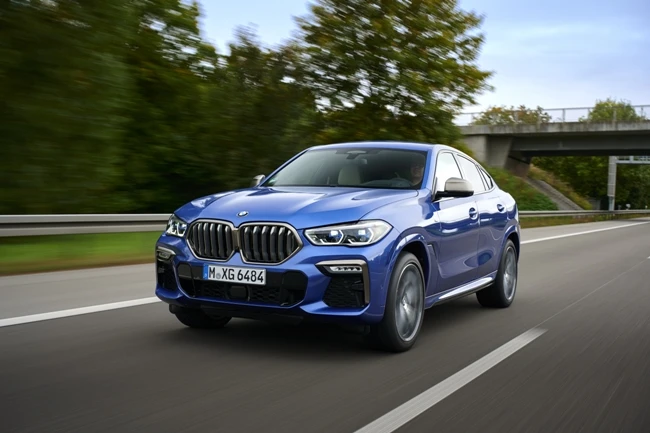
Australia’s BMW range will expand even further in 2020, with the M8 Competition Coupé, M8 Competition Gran Coupé, X5 M Competition, X6 M Competition and M2 CS due to arrive.
Jeep Helps Farmers Across Borders.
Jeep Australia is supporting Farmers Across Borders right now, leading a convoy of road trains from Esperance to Meekatharra to deliver much needed hay to drought-affected farmers.
Twenty road trains loaded with donated fodder departed from the Esperance Shire recently and made an overnight pit-stop in Leonora before reaching their destination, Meekatharra, on Australia Day.
“We’re excited to be delivering fodder to farmers in Meekatharra and surrounding towns this Australia Day,” said Ms Sam Starcevich, co-founder of Farmers Across Borders.
“West Australian farmers continue to face some of the most challenging conditions we’ve ever seen, and our support is needed now more than ever before.”
Jeep Australia will once again fuel the volunteers throughout their journey, providing breakfast and dinner over the 1000 kilometres travelled. Jeep will also provide a fleet of Jeep support vehicles for the Farmers Across Borders team to travel in, as they did for the 2019 run.
“Farmers Across Borders is an incredible cause and Jeep Australia is proud to support the team’s efforts as they give back to the Aussie farmers who so desperately need our help,” said Managing Director and CEO of Jeep Australia, Kevin Flynn.
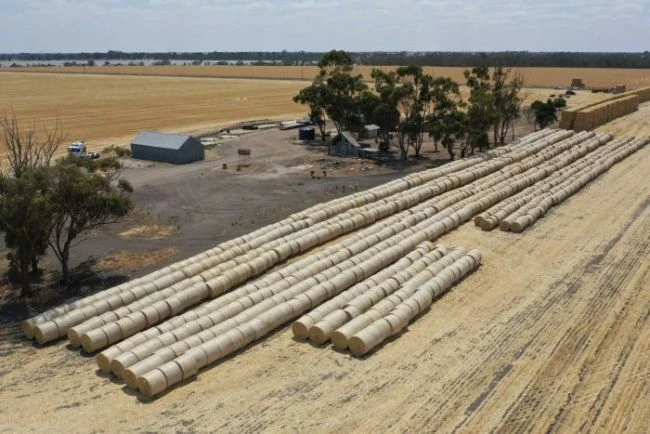
On average, a road train will need approximately $10,000 of fuel to make the trip, and Farmers Across Borders still need help to fund fuel costs. To donate or find out more information about Farmers Across Borders, please visit the Jeep “Farmers Across Borders” website.
These complement the Burrumbuttock Hay Runners drive at the same time, with 200 trucks full of hay and straw heading to the Armidale region in NSW. Around 10 trucks left Horsham in Victoria on the Thursday morning before the Australia Day weekend, meeting with another convoy of about 30 trucks at St Arnaud, also in the Wimmera, before going onto Burrumbuttock in the NSW Riverina.
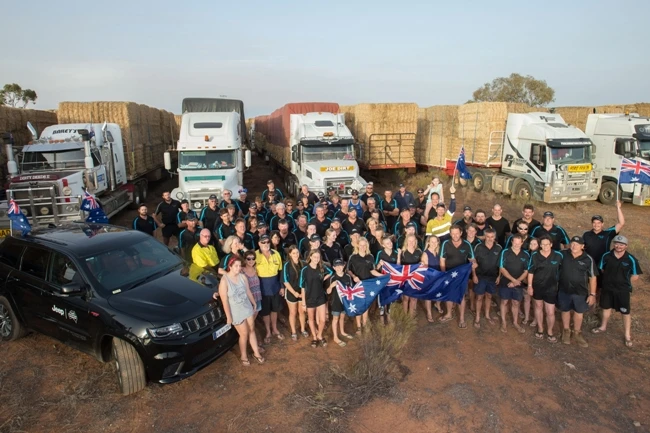
Most of the hay will be headed for Armidale, while some will go to farmers affected by bushfires. Mr Sam McGennisken, who had allocated part of his farm as a staging area for the trucks, said he was looking forward to meeting NSW farmers. “It’s just what the farming community is all about; we are more than happy to help out,” he said. “This hay will go straight to the farms and to feeding stock.”
Farmers Across Borders itself is a not-for-profit organisation started by two farmers in Western Australia. Farmers Across Borders help drought affected farmers by delivering donated hay from Western Australia to areas in New South Wales. Farmers Across Borders work with Lions – Need for Feed to provide hay and gather financial donations to facilitate the journey. To read more about Farmers Across Borders and how you can support visit the Farmers Across Borders website
 Level 2, 9 Help Street