

Author archive
2020 Hyundai iMax Elite: Private Fleet Car Review.
 This Car Review Is About: The passenger version of Hyundai’s durable iLoad commercial van is called iMax. There’s a pair of normal doors up front, a pair of sliding doors on the sides, and a rear horizontally hinged door. It’s exclusively diesel and auto for the drive-train, and in the Elite has eight leather covered seats.
How Much Does It Cost?: Hyundai’s website lists the iMax Elite as $48,990 driveaway as of April 2020. That’s with a Creamy White exterior. Go for Timeless Black, Hyper Metallic, and Moonlight Cloud (silver and blue), it’s $49,685 drive-away. Under The Bonnet Is: 441Nm of torque, and they’re on tap between 2,000rpm and 2,500rpm. The auto is a super smooth five speed unit, and although seemingly needing a cog or two extra, still manages to deliver a figure of that Hyundai quotes as 8.8L/100km for the combined cycle. Otherwise they quote 11.2L/100km for the urban, and 7.3L/100km on the highway, a figure where a seven or eight speed transmission would help. Considering a starting weight of 2,135kg and a GVM (Gross Vehicle Mass) of 3,030kg, it’s a sterling effort however. Tank size is 75L. By the way, it’s a rear wheel driven beastie. Twing is rated up to 1,500kg braked.
On the Outside It’s: A van. But having four colours and not just a fridge white makes a difference. Contrasting panels low down bring a subtle two-tone experience visually. There are also 215/65/17 alloys and Hankook Ventra LT tyres, with the wheels looking more like they should be on something a little more sporting oriented. The sliding doors have pop-out, not sliding windows. Up front it’s a more modern look for the grille and headlight cluster, and there are driving lights set low down in the bumper. Overall length is 5,150mm, with width and height providing a reason why vans are described as boxy at 1,920mm and 1,925mm respectively. The sliding doors are manually operated, not powered, nor is the rear door powered. The washer fluid jets spray in three thin jets and could use more pressure.
On The Inside It’s: Not surprisingly quite roomy. Given the cubic shape of the are behind the driver and front passenger, leg, head, and shoulder room are better than adequate. Head room is 1030 / 1018 / 987 mm for the front, centre, and rear, with leg room measured as 70 – 1039 / 839 / 765 mm, with shoulder room at 1632 / 1695 / 1627 mm. The front and centre seats have a sunroof as well. There’s beige leather and plastic trim in the iMax Elite, plus there was carpet and carpet rugs over the normal linoleum style floor.
The centre row seats have the familiar front mounted pull-rod in order to slide them, and a manual handle down on the side to fold. This allows easier access to the third row seats. Behind them is over 800L of cargo space, so for a family, plenty of room for a pram, bags, shopping, etc.

 The driver’s dash display betrays the commercial origins, and oddly even down to not showing fuel usage nor a Trip B display. It’s a very basic speedo dial, rev counter, and fuel setup, and could really benefit from a higher class look.
Auxiliaries in the form of heat seating and venting, rear seat aircon controls, and USB port are found in the centre console, along with a pull out cup holder. There is, though, no dedicated space to hold a phone, even allowing for a shallow cavity up top. Audio via the basic Hyundai family 7.0 inch touchscreen is AM/FM only with no DAB, and again something that should be a little more upmarket by having that as standard. But there are apps for the smartphone access and Bluetooth for streaming.
 On The Road It’s: Very quiet, even under load. The iMax Elite hums along with little fanfare being drawn to it. It simply gets up, gets ready, gets going. It’s mightily smooth in the way it rides and handles, but the high up seating position and cargo-van softness in the suspension, plus the dual purpose tyres, mean some corners are, by necessity, taken at a slower speed that most other vehicles.
The five speed auto, even allowing for the fact it’s only a five-cogger, is superb. It is as smooth as you can get in changing ratios up and down. This applies as equally to flat highway runs as it does to climbing or descending sloping roads. There is a manual shift option via the gear selector but that was ignored purely because the ‘box does such a good job on its own.
There’s a bare minimum of turbo-lag from the get go. The maximum torque is pretty much where highway velocities have the revs rolling to provide it, which means a gentle press of the go pedal, that silken drop back a cog or two, and access to 441 torques is there. The lack of turbo-lag helps too, as it means less effort and time waiting for the engine to deliver helps in the overall driving presentation.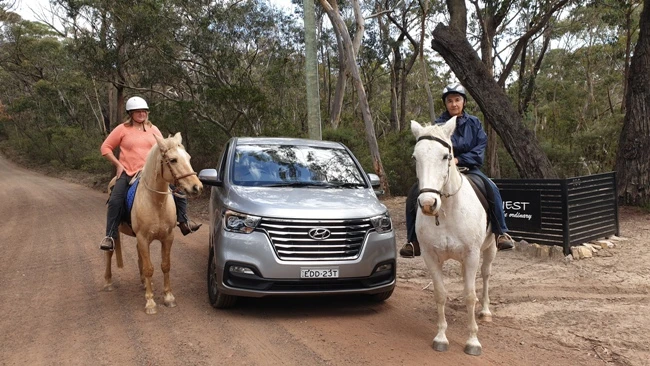 The steering is in the Goldilocks zone; it’s not too heavy, not too light. This makes for three point turns on a suburban street, or in a loading zone much easier to deal with. It also made our excursion to a Blue Mountains lookout for a couple of photos via a gravel road as comfortable and unfussed as it should be. No bump steer, no tramlining in the gravel and mud, and a pose with Jessie and Nelson, (two local equine residents that gave the iMax Elite the hoof of approval), which was set up by reversing twenty metres or so, simple due to the just-right feel.
The brakes could do with some more bite and feedback though. There just wasn’t as much coming through from the pedal to state with certainty that the pressure being put down was gripping the discs as much as they could be. Ride quality is good enough, considering the iMax’s origins and the MacPherson strut/live five link rear axle.
What About Safety?: Hmmm….could be better. The spec sheet says side and front airbags for the driver and front passenger. It doesn’t say side/curtain airbags though. It’s rated as four stars by ANCAP. The second and third row seats all have adjustable head rest heights and the second row has ISOFIX mounts. What About Warranty And Service?: For the warranty, the Hyundai website says: If the vehicle has been used for private and domestic purposes and is not and has not been previously used for a commercial application, including but not limited to taxi, hire, rental, courier, security, driving school, tour, bus operator or emergency vehicle. Vehicles used at any time for “commercial application”, as defined in the vehicle warranty policy, are excluded. Passenger vehicles that are or have been used for a commercial application are provided with a 5 year/130,000km warranty (whichever occurs first). An iMax that is used or has been used for a commercial application is provided with a 5 year/160,000km warranty (whichever occurs first).
Servicing information may vary so contact your Hyundai dealership.
At the End Of The Drive. The old saying, “for what it is” applies to the Hyundai iMax Elite. It’s a people mover that is based on a light commercial vehicle. That needs to be taken into consideration. So, for what it is, it’s ok. It’s not possibly what it could be, but for what it is, it does well enough.Given it’s a sub-50K vehicle, a few extra touches would still have it well competitive in price and lift the overall appeal, perhaps just enough, to make a little bit more of a dent in SUVs that cost more and do much of the same role.
Check it out in more detail here.
Skoda Scala: Funny Name, Cool Car.
Czech manufacturer Skoda seems to slide under the radar at times. That’s a pity because the almost criminally underrated brand does make some pretty decent machines. Their Octavia wagon and sedan, and especially in RS form, is lauded by journos globally.
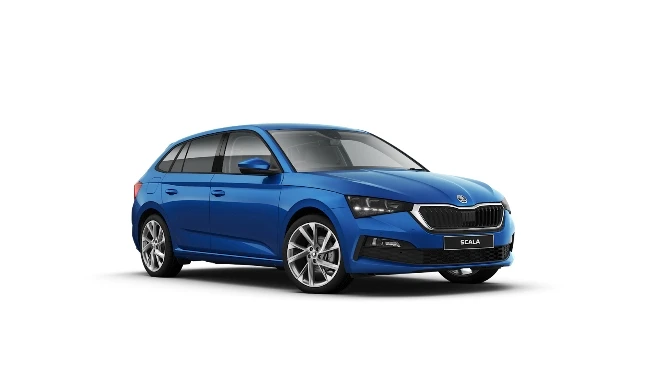
2020 ŠKODA SCALA 110TSI
2020 sees Skoda ramp up its attempt to be more visible in the marketplace and build upon their simple yet catchy “Simply Clever” marketing phrase.
A new small to mid-sized five door hatch is on the way. Named Scala, it builds upon the revamped design signature that Skoda introduced in 2019. It’s currently slated for a June release for Aussie showrooms and will come packed with plenty of tech and safety. There will be three models available: 110TSI, Monte Carlo, and a limited run Launch Edition.
It’ll be powered by Skoda’s potent 110TSI turbocharged petrol engine and drive the front wheels via a choice of transmissions. The good old three legger, a manual, is offered with six speeds and only in the entry level mode, or a seven-speed DSG transmission, available in each trim level.
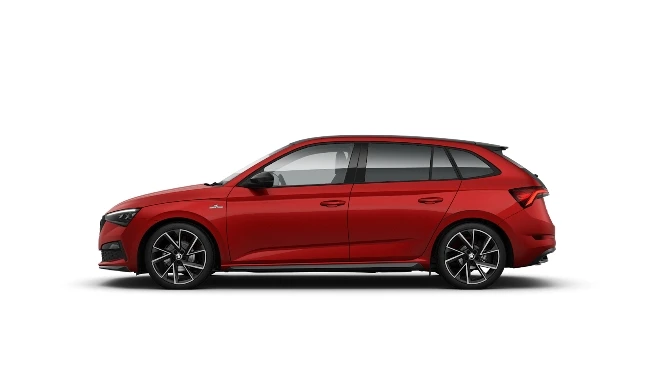
2020 ŠKODA SCALA Monte Carlo
The lead-in variant, the 110TSI, brings with a feature list that would normally be found for thousands more. The Euro style sweeping indicator lamps which are becoming more and more popular (and are a sensible addition to any car) complement 18 inch alloys and privacy glass for the rear windows. For the humans inside adaptive cruise control, Skoda’s Smartlink smartphone pairing service, along with Android and Apple apps, plus a wireless charging pad, are also standard.
The “Virtual Cockpit”, a 10.25 inch full colour LCD display features in the driver’s binnacle. This too is standard across the three. A repositioned touchcsreen of 8.0 inches for the 110TSI/Monte Carlo and 9.2 inches for the Launch, allows access to the various onboard functions and apps, plus the audio system.
Red ambient lighting will provide a warmth to the cabin’s signature red styling in the Monte Carlo sports seats, whilst the Launch Edition will have leather trim. Monte Carlo’s passenger’s will have a panoramic sunroof as standard.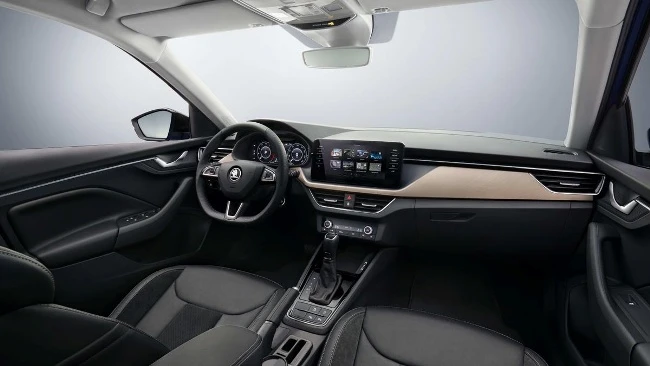
Extra standard equipment for the 110TSI includes a powered tailgate, Lane Assist, a tyre pressure monitoring system, and seven airbags. The Monte Carlo adds full LED front lighting, a dual zone climate control system, with teh front passengers having sports seats and sports pedals for the driver. The Launch Edition adds heating for the front and rear seats, body coloured door mirrors, a chrome grill frame and chrome window surrounds, Auto Parking Assist, Rear Cross Traffic Alert, and Side Assist/Blind Spot Assist.
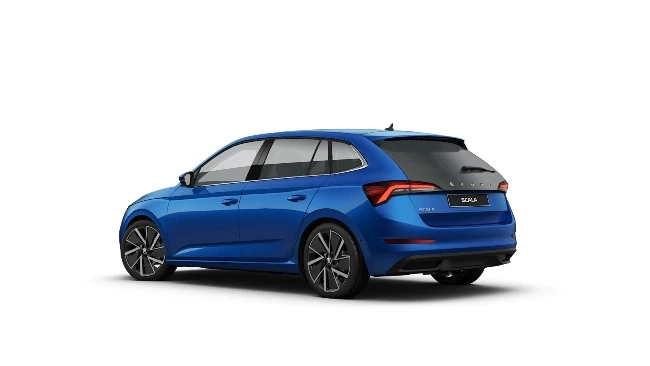
2020 ŠKODA SCALA Launch Edition
Launch pricing sees $26,990 for the 110TSI Manual, and $28,990 for the same car with the DSG transmission. Monte Carlo will start from $33,990 whilst the Launch Edition will price from $35,990. These are drive-away prices.
Classic Car Movies: The Car Is The Hero.
There are some topics in life which are more divisive than pineapple on pizzas. Star Wars versus Star Trek, Holden versus Ford, Connery versus Moore. Best car films in any discussion fall into the divisive category.
What makes for a good car film, though? Is it the car or cars that are why the movie is regarded as a classic ? The story line? The set pieces? Trying to pin down a definitive list is impossible, so we thought we’d shop around and get an idea of what people thought. One film that was a clear favourite is a home grown production.
Starring a young up and coming actor named Mel Gibson, it’s a movie that brings in just about everything a good car film needs. Action, pathos, a chase scene or three, “The Goose”, and of course that incredible XB Falcon. “Mad Max” is a film that simply can’t be overlooked.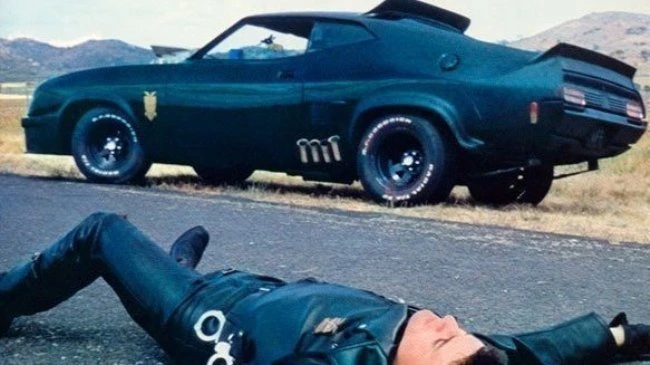 Steven Spielberg is best known for a few films starring Harrison Ford and a mind-blowing sci-fi film or two. However, an early part of his career involved a story that is about is simple as it comes. With minimal dialogue it relied on Spielberg’s ability to heighten tension with a simple camera move. Starring Dennis Weaver and based upon a book written by a car driver that had a similar experience with a mad truck driver, “Duel” remains one of the most gripping films of its kind nearly fifty years on.
 It’s almost impossible to write a list of car films without including this entry. The stars of the film were three little machines designed by Alec Issigonis. The story line, again, was simple. Money, in the form of gold bullion, a few gags, some brilliant scenery and an amazing chase sequence, toss in the broad Cockney accent of Michael Caine, and you have “The Italian Job”. This one celebrates fifty years or delighting audiences.
 It was agonizing to toss out some of the films that could have made the cut. There is the original “The Fast and The Furious” from 1955, and the remake & subsequent series of films. There was Jason Statham’s “The Transporter”, and the sublime recreation of the relationship between James Hunt and Niki Lauda in “Rush”.
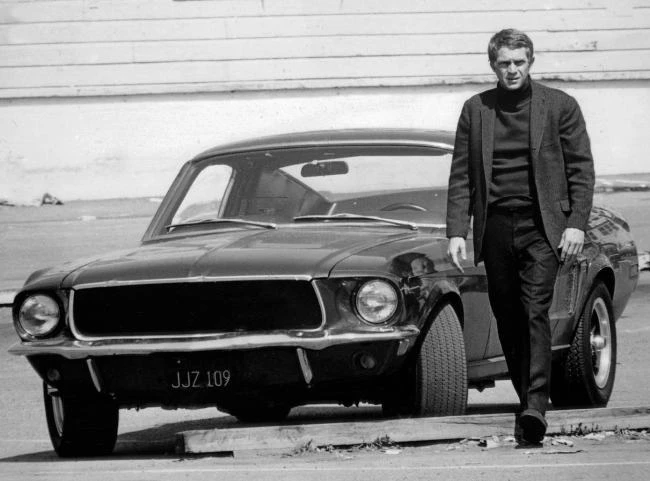
But number 4 goes to a Steve McQueen favourite. Based on real life events, and featuring film from one of the races itself, “Le Mans” takes our fourth grid spot. Packed with macho appeal, and the sense of unburnt “gasoline” hovering around the screen, Le Mans was notable for the bravery of the cameramen hanging on to the cars and heavy cameras of the time. Number five features a product of Ford. It also happens to feature McQueen. It’s a film that has an unbroken street based chase scene of nearly ten minutes. Two cars were used, powered by a 325hp 390ci V8 powering down through a four speed manual. The film is, of course, “Bullitt”. The car? A 1968 Ford Mustang 390 GT 2+2 Fastback.
  We know there are plenty of truly classic films that are built around and feature cars as the real heroes of the films. Let us know your thoughts.
2020 Genesis G70 Ultimate: Private Fleet Car Review.
 This Car Review Is About: A vehicle from the luxury arm of Hyundai, Genesis. Formerly a sub-brand, complete with one model and a Hyundai badge, it’s morphed into a brand in its own right and offers a two model range (G70 and G80) with three trim levels, being Sport, Ultimate, and Ultimate Sport for the G70. This has either a 2.0L turbo four or the punchy and potent 3.3L twin turbo V6 as found in the Kia Stinger.
How Much Does It Cost?: In a retail sense, before delivery and government charges, the G70 starts at $72,450. That’s for the Sport, with the Ultimate and Ultimate Sport from $79,950 each. In a drive-away pricing structure, Genesis says the G70 Sport is $80,500, or $83,125 with sunroof. The Ultimate is $88.375, a price shared with the Ultimate Sport.
Under The Bonnet Is: The firecracker 3.3L twin turbo V6 that continues to delight in its driving habits and flexibility. 272 kW and 510Nm, with the latter on tap from just 1,300rpm through to 4,500rpm on the rev counter dial, means switching between idling down a residential street to a lairy, chest beating display, is merely the flex of the right ankle away. It’s responsive to a “T”, with urgency all the way through the rev range when needed, as docile as a tired kitten when required. The choice of transmission is simple. It’s an eight speed auto or an eight speed auto. And it’s one that works best once it’s had a coffee or two to wake up in regards to smoothness. Economy hasn’t been the strongest part of the engine/transmission combo. The official figures are 10.2L/100km for the combined cycle, and on our restricted urban drives we saw nothing below 9.0L/100km. That’s with a mix of quietly idling away from the kerb to brief extractions of the potency of the power-plant. Fuel tank capacity is a little on the small side at 60L. Dry weight is 1,725kg.
 On The Outside It’s: Coated all over in a luscious, deep, red metallic, on our test car, called Havana Red. The door handles are a dark gunmetal grey door handles and dark grey painted alloys are wrapped in 225/40 and 255/35 on 19 inch grey painted alloys. It’s a stunning colour and beautifully highlights the supermodel curves of the G70. The wheels house 350mm and 340mm vented discs, clamped by Brembo.
The G70 is somewhat BMW-esque at the rear, and the snout is low, and broad, not unlike a Jaguar. The main lights are outboard, with a pair of sloping LED driving lights drawing the eye to them and the blades below. For all of the styling hints, the G70 is its own definitive look too. It’s wind-tunnel tested, with a drag co-efficient of 0.29cD. The guards, windscreen, and rear screen are tailored to provide as optimal an angle as possible for clean airflow, plus an under-body plate helps the G70 cleave its way through. The lack of wind noise is apparent as a result. It’s a touch shorter than expected, with 4,685mm in total length. That’s down to a 1,400mm height that makes it look longer, whilst an 1,850mm width adds to the stance. It’s also nearly impossible to not notice the resemblance to its sibling, Kia’s brilliant Stinger. Although the Kia is slightly longer, even though the pair share the basic chassis design, and more a five door hatch/coupe, the lineage is visible and not a bad thing.
What isn’t a good thing is the relative small 330L of boot space. A high cargo floor that holds the space saver spare is the culprit. Width isn’t a problem, but on our weekly shop test we had to put a bag or two into the rear seat section, a very rare occurrence. On The Inside It’s: Sumptuously appointed are the words most often used for cabins such as the ones found in the G70. Quilted leather seats, and complementary trim in the doors, set off the luxury feel. The front seats have for heating and venting, plus cushions that adjust for lateral support when Sport mode is selected, catch the eye first. There is venting for the rear seats, a nice touch. There is also a tab on the upper right shoulder of the passenger seat that allows the driver to move it fore and aft.
The driver works in a comfortable office; soft touch indicator stalk, a Start/Stop button in clear view, metallic buttons in the centre console plus a Drive selector button provide visual and tactile appeal. The Ultimate 3.3 has a HUD, it’s crystal clear in definition and shows items such as velocity, lane keeping status, cruise control status and more. The dash is a leather appointed affair with contrasting stitching.  Information for items such as the door lock settings is found via the now standard tabs in the tiller. This includes a turbo pressure/torque/oil pressure screen, and one with G-Force and lap-timer. If there’s an area that the G70 could up, it’s having a driver’s display that isn’t, surprisingly, a full width LCD screen such as that found, say, in a Volvo S60. It’s an area that more than whispers the Hyundai/Kia origins and one that appears easily enough updated to say Genesis instead.
An eight inch touchscreen is the control centre for the car, with aircon, DAB audio via a premium Lexicon speaker system, drive information, satnav, and apps. Underneath the screen is a gentle slope towards the console and a sliding door opens to show the smartphone charge pad and USB/3.5 mm sockets. There is a sunroof for that extra sense of airiness when needed, and it does lighten the black-on-black ambience of the cabin. The DAB tuner is one of the best going. In areas where many other brands, including its own sibling, Stinger, drop out, the sensitivity of the Genesis DAB tuner is always pulling signal. Should there be an area where DAB isn’t available, Android, Apple, and Bluetooth stand ready to connect.
Drive-wise there’s a rocker gear selector and the electronic park is a button just ahead of the rocker mechanism. The material in the centre console is a cool and classy looking alloy style. The drive selector dial is located just south and is ergonomically placed.
Rear leg room though isn’t fantastic. There is 884mm versus 1,083mm up front. Head room isn’t an issue, even with the sunroof fitted. 978mm and 938mm are the front and rear measurements. Shoulder room is 1,430mm and 1,387mm, plenty here. There are a pair of ISOFIX anchorage points also to provide ample access for the little ‘uns. What About Safety?: Genesis achieved a five star ANCAP rating in 2018. ANCAP says: “All three grades of autonomous emergency braking (City, Interurban and Vulnerable Road User) and a lane support system with Lane Keep Assist (LKA), Lane Departure Warning (LDW) and Emergency Lane Keeping (ELK) are standard on all variants.” Seven airbags including driver’s knee are standard.
There is also a 360 degree camera system in high definition clarity. The camera allows for selection of differing points of view, including a fold down left hand side when reversing to pinpoint where the wheels are in relation to a kerb.

 On The Road It’s: A ball-tearer of a car to drive. Having over 500 torques on taps at the press of a pedal is an absolutely intoxicating experience. When the car is warmed up, it’s a potent package. A zero to one hundred kph time of 4.7 seconds from a car weighing close to two tonnes is mightily impressive. There is a setting in the touchscreen that allows for what mode of sound the cabin hears too, and on full song it’s a real snarl as the G70 hauls arse.
The transmission benefits from a warm-up period. We’ve found that the engine is ready to stretch and bellow almost from the get go, but the eight speed auto was indecisive, unsure, and stumbled between gears up and down. These hiccups slowly disappeared one by one as the fluids warmed, and it was just a few minutes before everything was smooth, slick, sharp.
The suspension varies depending on drive mode and on its most relaxed setting, Eco, the G70 still has limpet grip. Long sweepers don’t trouble the machine, the nose is still quick in response to the gentle tug of the tiller, and it all seems effortless. Sport feels as if the steering gets some weight and tightens up the front end; the steering wheel is at just the right diameter to hold and this allows the arms to move as they should to feel connected to the nose. In normal driving it’s neutral, there’s no wavering as the chassis track straight and true, and only minimal input is required.
The Michelin rubber is the type found on cars costing over one million, so there’s already an expectation that they’ll hang on tenaciously. In Sport mode with a tighter suspension setting, there’s some rear end skipping on the road joins in corners, however the response time from the suspension is such that rebound is nullified instantly, allowing the rubber to do what Michelin intended. Ride quality across the board is nothing short of brilliant. There’s almost nothing in our drive loops that put the Genesis G70 to the sword. Genesis have allowed the whole drivetrain some leniency; there is an option to use launch control, which involves the stability control being switched off, raising the revs, and hitting the go pedal hard. Without that process and simply sinking the slipper, the rear will squirrel momentarily before the system intervenes just enough to have the G70 regain its sense of sensibility. Brake feedback is sublime, with the pedal telling the braking foot just where it is in travel and the force needed or not.
In essence, the handling apckage of the G70 can boil down to this: it feels natural. It feels like the 2,000 kilos isn’t, the car shrinkwraps around the driver and it’s like picking up what looks like an iron glove only to find out it’s pure leather.
Warranty And Service Are: Five years with unlimited kilometres. complimentary servicing for five years or fifty thousand kilometres. There is also a pick-up service for addresses within 70 kilometres of the service centre. Genesis also offer a Connected Care package, which involves areas such as Automatic Collision Notification and Assistance, SOS Emergency Assistance, and On-Demand Diagnostics.
At The End Of the Drive. Dynamically the G70 shines. It’s an incredibly easy car to become one with, and the engineering and R&D work that the Hyundai team have expended is clearly obvious. It simply wraps around the driver like a custom made shoe, and does the job it should. The trim level is luxurious and ergonomics spot on. Audio is excellent and the usage of the controls is fingertip intuitive.
However the cramped rear sear seat and smaller than it should be boot aim the G70 more towards a DINK (Double Income No Kids) or for a young family. That does add a narrowing of appeal in one area, but makes its appeal perfectly clear in another.
Either way, it’s capable of delivering stonking performance and the grip ability to cope. Organise your own test drive via the Genesis website.
 Level 2, 9 Help Street