

Author archive
Looking Smart: 2021 BMW 6 Series Gran Turismo.
BMW has the wherewithal to build a car for all segments, potentially even a segment or two that don’t exist. The 6 Series Gran Tourismo could be considered to be a segment creator. An update has just been released and here’s what we know.
Outside there has been a redesign of each end. BMW’s fixation on enlarging the kidney grille, its signature part of the frontal view, has been applied here. Slimmer headlights accentuate these, making them look even larger. On either side are new Adaptive LED Headlights with matrix technology fitted as standard, and latest version of BMW Laserlight can be ordered as an option.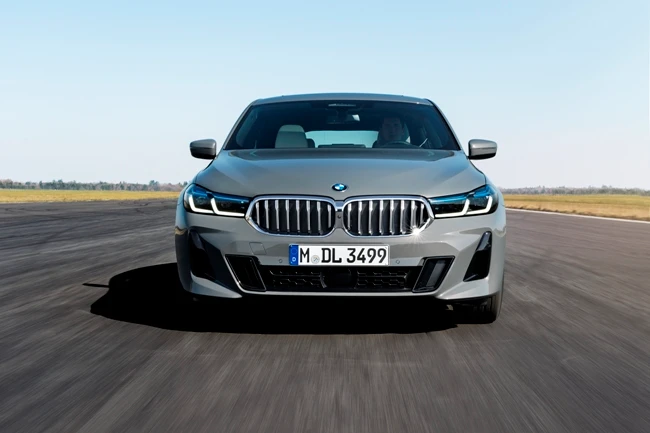 There are new exterior colours and additional BMW Individual paint finishes to allow personalisation. There is a M Sport package with new parts, particularly a striking front apron and large diffuser element at the rear. Optional M Sport brakes now with a choice of blue or red-painted callipers. These will sit inside 18-inch light-alloy wheels fitted as standard on the most powerful petrol and diesel engines, and there are new light-alloy wheels in 19- and 20-inch formats available as an option.
BMW offer their optional Integral Active Steering which now offers greater assistance in low-speed manoeuvring. There is rear-axle air suspension with automatic self-levelling fitted as standard. Also available as an option: adaptive two-axle air suspension, adaptive suspension, and BMW’s Executive Drive with active roll stabilisation.
Two petrol and three diesel engines will be available. All engine variants now come with 48V mild hybrid technology and there is more rapid response and greater efficiency thanks to 48V starter-generator that provides up to an extra 8 kW/11 hp to boost the combustion engine’s power and ease its workload. All diesel engines now arrive with two-stage turbocharging. All four- and six-cylinder petrol engines now comply with the Euro 6d emissions standard. Power hits the ground via an eight-speed Steptronic transmission which is standard for all model variants. BMW’s xDrive intelligent all-wheel drive system is either standard or optional for three engine variants.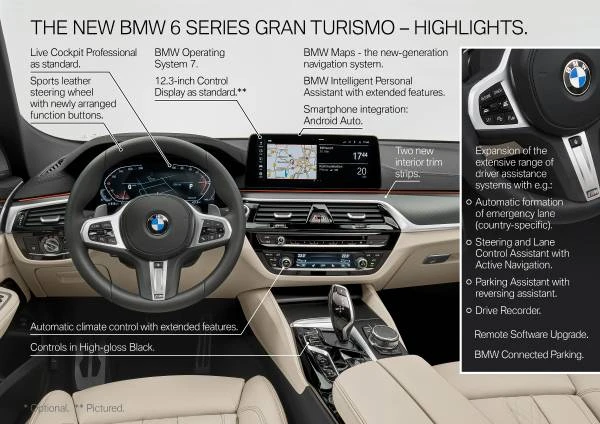 BMW’s excellent Live Cockpit Professional is fitted in the new BMW 6 Series Gran Turismo as standard. The BMW Operating System 7 optimises intuitive operation, and opens up a wealth of new application and connectivity possibilities. BMW also fits their Intelligent Personal Assistant digital companion and now has extended functions with optimised interaction that uses new graphics in the Control Display. There is also now the premiere for BMW Maps. This cloud-based navigation system enables extremely fast and precise calculation of routes and arrival times whilst updating real-time traffic data at short intervals. The human touch comes from a free choice of words to select navigation destinations. A vivid 3D visualisation of the surrounding area shows traffic situations and possible inputs from driver assistance systems in the instrument cluster. BMW’s Optional Parking Assistant with additional reversing assistant is available and the BMW Drive Recorder shoots up to 40 seconds of video of the area around the vehicle.
Model variants at launch are: BMW 630i Gran Turismo with 2.0L four cylinder petrol engine. There are 190kW and 400Nm with a 0-100 time of 6.5 seconds. Consumption will be around 6.0L/100km.
BMW 640i Gran Turismo with 3.0L six cylinder petrol. Peak power is 245kW, peak torque is 450Nm between 1,600 to 4,800 rpm. 0 to 100 is 5.5 seconds and consumption is around 6.9L/100km.
BMW 620d Gran Turismo packs a four cylinder diesel with 140kW and 400Nm between 1,750 to 2,500rpm. 7.9 seconds is the time to 100kph from zero and will average around 4.5L/100km.
BMW 630d Gran Turismo runs with a six-cylinder in-line diesel engine, mild hybrid technology,and has 210kW plus 650Nm of torque between 1,500 to 2,500rpm. Economy is 5.0L/100km.
BMW 640d xDrive Gran Turismo goes up a notch with 250kW and 700Nm. That’s between 1,750 to 2,250rpm and sees a 0-100 time of 5.3 seconds. Consumption is 5.5L/100km.
Pricing for the Australian market is yet to be confirmed.
A Legacy Of Luxury: Bentley Digital Design.
With a brand such as Bentley, and the history and heritage the brand has, embracing the digital age can be fraught with conflict. Just how does a design for something to go inside be compatible, will it suit the look and “feel” of a particular vehicle, will its intended purpose grow old gracefully or be out of date in a few years?
Design teams aim for a particular look and in the case of such a brand as Bentley, that look must tie in with what has come before. One key area is that of what the driver will look at every time they slide onto the sumptuously appointed seats of a Flying Spur. The dashboard dials and multimedia interfaces are an area that Graeme Smith and his team of Human Machine Interface (HMI) designers at Bentley have taken on with great success. Utilising what is called a “mood board”, Smith and the team lay out the images of what will appear on the digital screen for the Flying Spur. The colors, the icons, that will be seen are reviewed in conjunction with the main designers at Crewe, the home of Bentley. Critical to the look, says Smith, is choosing to go 2D or use what is called skeuomorphic design. “A Bentley isn’t a smartphone; it’s going to be used and cherished for generations. So we chose a skeuomorphic approach that will age with the car. Look at pure digital instrument graphics from ten years ago – they’ve dated faster than the car they were part of.”
It’s a tricky ethos to deal with, he says, as going to a clean, ultra-modern, look, would be at odds with the history of Bentley, and by using skeumorphic design, they can be in the digital age and still convey the message that fits with the Bentley presentation. There is also a requirement, says Smith, to provide a family relationship between the vehicles yet provide a difference. For example, the speedometer and rev counter dials in the Flying Spur have bronze rings, a different hue to those in the Continental GT. Then there’s the end purpose of the vehicle a design goes into. The dials in the Continental GT have a 3D look to the knurled appearance, echoing the look of that cars gear selector. the Flying Spur has the outer edges looking akin to a machined appearance, reflecting the Spur’s more luxury oriented drive, as opposed to the overtly sporting nature of the GT.
Road time is also considered, as in when the car is on the road and the driver’s interest is in simply driving. A reduction in potentially distracting information is provided, says Smith. In a form of digital detox, the driver can see dials that provide the sheer essentials; fuel gauge levels, the temperature of the engine, local time, the vehicle’s velocity, and the ambient outside temperature. Bentley refers to its own history here, by dimming the dials to the point only the needles are visible, and allowing a driver to consider the night time drives at Le Mans, or Woolf Barnato’s legendary night drive through France to beat the Blue Train.
However, the story doesn’t finish there. The final part of the journey in the digital design of the dials is where the Flying Spur will live its life. Will it be in the United States? How about Dubai? Will it be used to chauffeur a Sheikh in Saudi Arabia? The central screen is also part of this equation, meaning that the team must consider something like 600 different icons and over 1,500 varying menu screens. The different languages (up to 27!) and idioms for the markets are considered, plus the varying market specific services such as satellite radio, apps such as Android Auto (with final sign-ff to be granted by the owners of the systems themselves), even the three different audio systems from Naim, Bang and Olufsen, and the brand’s own bespoke setup. It’s here that the HMI team divide the load. There are function owners, nine in total, that work with three graphic designers and focus on a specific area. This can be the climate control, audio settings, the interface that shows fuel consumption.To say Bentley says luxury, it says history, it says motorsport. It takes love and dedication to ensure that the history of Bentley is continued with eyes on the past, and eyes on the future. Graeme Smith and the Human Machine Interface team have those in mind and their eyes look forward with the past firmly in focus.
2020 Toyota Granvia VX: Private Fleet Car Review.
 This Car Review Is About: A big box on wheels that has luxury inside. Toyota has taken the HiAce LCV that was updated in 2019, and given it a makeover on the inside, and a light tickle outside. In Granvia or Granvia VX specification, it can be fitted with either a six or eight seater configuration. We drove the VX with the six seats.
How Much Does It Cost?: Toyota’s website gives an area dependent costing. The Granvia in Ebony Pearl is circa $68,360, and with Crystal Pearl, Silver pearl, or Graphite is circa $68,990. Bump to VX spec and there’s $81,560 to $82,200.
Under The Bonnet Is: A 2.5L diesel, packing 130kW and a torque figure of 450Nm. That’s a peak available across a very narrow band of revs; 1,600rpm to 2,400rpm, to be precise. Powering the rear wheels via a six speed auto, economy is rated as 8.0L/100km on the combined cycle. Our final figure was 8.6L/100km. Given a dry mass of 2.6 tonnes, that’s an agreeable figure, and one that could be shaving a few bits here and there with a more modern eight or nine speed. On The Outside It’s: A box on wheels and there’s no disguising that fact. There are 5,300mm of length, 1,990mm, and 1,940mm of height and width that come into play, and with around 1,750mm from the leading edge to the beginning of the flat roof…well…it’s a box on wheels.
Up front there is a broad grin of chrome that replaces yet follows the lines of what is seen on the HiAce. Four horizontal chrome strips replace the two on the donor vehicle. The rear has a similar styling and broader taillights. In profile the Granvia has centre and rear glass, no panels as seen on the HiAce, and each side has a powered sliding door. The rear door is manually operated. Initially this seemed like an oversight however given the layout for the six seats….but, still…..Wheels are multi-spoked alloys and have Bridgestone Duravis rubber at 235/60/17.
On The Inside It’s: A curious mix of luxury and the basic structure of the donor van. There is gorgeous wood paneling in the door trims, passenger dash, and on the top of a truly dowdy looking centre console section, with plastic of that really basic look and feel. Yet it sits between and ahead of a total of six leather seats, with heating all round, and powered recliners in the middle. The second and third row seats slide, and this again raises a query about the non powered rear door, as it could allow entry and exit from that third row. The driver’s section has a seven inch touchscreen, piano black trim, and analogue dials in the VX. Again, it’s a missed opportunity where a LCD insert would have added just that little bit more of extra class. There are a few tabs for items such as the parking sensors and night light adjustment for the screen, and four that have no apparent use. The Drive selector is console mounted and there is manual shifting.
 The side powered doors have roll up/down window shades, and to activate the sliding mechanism it’s a soft touch push/pull on the door handles inside and out. Or there’s remote opening and closing from the key fob. Safety is covered with very audible beeping as the doors open or close.
Convenience is looked after by having USB ports for the rear rows, a separate air-conditioning system with controls on the roof behind the front seats, and cup holders for each seat. Each rear row seat also has its own map-light. On The Road It’s: Nice to drive up to freeway speeds. Above the legal limit it’s missing a key factor: confidence. There’s something about the way the Granvia VX is set up that has it feeling just fine until freeway velocities are called for. It’s simply doesn’t feel….right… it was the oddest sensation and one that couldn’t put our finger on. The speedo would indicate 110, 115, and it effectively then communicated “don’t go faster”. It was impossible to tell if it was a stability issue, the sensation of being seated at the height the driver is, the steering ratio that was fine at suburban velocities but not faster…..annoying? Mightily.
The steering is nicely weighted, and allows for easy three point turns. Navigating suburban roads, even with the near two metre width and 5.3 metre length, was also easy. helping matters was the relaxed attitude of the diesel, with that 450Nm peak torque barely above idle. The auto is typical Toyota with a swift and slick change, and holds gear for downhill runs. Manual changing makes no real difference in this part of the drive experience.  The brakes are a touch grabby at times, meaning a gentler foot was required, and a softer press meant earlier braking. And here too a minor hiccup; retardation feedback wasn’t entirely forthcoming, with judgement of where the pedal needed to be pull the Granvia up not always corresponding to the rate the Granvia would pull up. Compounding the drive was the engine power reduction from the Active Yaw Control. This comes in when the Granvia VX would move across the road and cross white lines. This quickly became, in our eyes, a safety issue as the sudden power loss would slow the Granvia and gave rise to a potential impact from the rear. the other is that although thes eats would recline, in upright positions the rear view mirror was full of seats, not a clear rear glass.
What About Safety?: Safety is comprehensive. 9 airbags including both front seats, driver’s knee, front curtain shield x 2, rear curtain shield x 2, side airbag x 2. Blind Spot Alert, Lane Departure Alert, and Pre-collision alert with cyclist and pedestrian sensing make for a very good package.
What About Warranty And Service?: five years warranty and capped price servicing for the Granvia VX. Follow the service schedule and warranty goes out to seven years. Service intervals are six months or 10,000 kilometres with a cost (as of May, 2020) of $245.
At The End Of The Drive. It’s an absolutely ideal vehicle to be used as a courier of the well heeled from hotel to airport, from rock concert to hotel. The seats really are beautifully comfortable, and with a six seater configuration there’s room and flexibility aplenty. Around town it’s a doddle to drive. The downsides of the centre console and dash look and feel, plus the nervousness above 100kph hold the Granvia VX firmly in place as a suburban utility and a lovely one to be in. Check it out for yourself here.


2020 Hyundai i30N Hatch: Private Fleet Car Review.
 This Car Review Is About: Hyundai’s foray into the hot (warm?) hatch arena. It’s the i30, but not as we know it as it’s the N badge that sets it apart from its lesser brethren.
 How Much Does It Cost?: Hyundai’s list price is $41,500 plus on roads. The website lists it as $46,133 to $49,781 drive-away, depending on seeing the Luxury Pack (as tested) inside or not.
Under The Bonnet Is: A potent 2.0L petrol fed and turbocharged four cylinder, mated to a super slick six speed manual. In N spec it’s good for 202kW and a hefty 353 torques. There is an overboost facility that provides 378Nm. “Normal” torque is available from 1,450rpm to 4,700rpm. Overboost is 1,750rpm to 4,200rpm. They’re delivered in a very linear fashion, rather than a lightning bolt kapow. It makes for an extremely flexible drivetrain. Economy around town reflects the performance aspect though, with urban assaults seeing numbers north of 10.6/100km. That’s pretty much on the money for our drive. Hyundai quotes 8.0L/100km for the combined cycle. Our lowest figure was on the highway, not unsurprisingly, and clocked 7.0L/100km. That’s still above the 6.4L/100km from Hyundai’s official figures. Final overall was 8.7L/100km. Tank size is 50L and recommended fuel is 95RON. There are drive modes and these will be covered later.
On The Outside It’s: Well….it’s an i30. There’s some nice alloys and a discrete N badge, plus some bright red brake calipers with the N logo….but that’s it. That’s if you don’t include the twin exhausts inside a nicely styled diffuser and the black chin guard that balances the rear of roof deck lid spoiler.
 Wheels are 19 inches in diameter and have a distinctive spoke design. Rubber is from Pirelli, they’re P-Zero and 235/35 are in size.
Paint on our review vehicle was the luscious Engine Red and is one of six colours including the signature Performance Blue hero colour. The hatch is 4,335mm in length, just a tick shorter than the i30N Fastback at 4,455mm.
On The Inside It’s: An opportunity missed to stamp the N as a sports oriented vehicle, but that’s a first glance situation. The air vents have red piping to the surrounds and that’s largely it in comparison to the largely otherwise unremarkable interior. The steering wheel has red stitching, and there is subtle red stitching in the seats. The look is subdued and dare we say, generic with unremarkable plastics, the standard looking touchscreen interface bar the N tab, and analogue dials where a full width LCD screen would have been better optioned. Ignition in the hatch is a standard key insert, the fastback is a push-button. The tiller has the drive mode switches; one for Sport/Normal/Eco, and one for the N performance package. The Sport engages the throaty rumble mode for the exhaust whereas the N selection firms up the steering and suspension, and offers a preset or customisable set of settings for exhaust, steering, engine and more via the touchscreen. Standard look is showing power, torque, turbo boost, and g-force readings, plus lap timings for track days.


 Inside the 381L cargo area is a brace bar to provide extra torsional rigidity. The cargo section itself opens up to 1,287L with the rear seats folded. A cargo net is standard in the Fastback but not the hatch, a curious decision. Head room front and rear is 994mm and 977mm, with 1,073mm and 883mm for leg room. Shoulder room is over 1,400mm front and rear.
 On The Road It’s: A sleeper. Left in Eco and Normal mode it’s…normal. There’s a typical feel to the whole package in acceleration, noise, handling. The clutch is curiously heavier than expected and resulted in more than a few stalls. Hit the Sport mode and there’s a change of attitude. The exhaust suddenly gets more snarl, there’s an extra sense of weight to the steering, and sharper handling.
N mode lights the candle. There’s an extra depth to the anger of the exhaust and especially on up and downshifts. There’s a crackle, a sharp and hard edged note that’s evident on even light throttle. Go hard and the length and volume of the growl becomes longer thanks to some electronic assistance. Launch Control is standard and that’s activated via the disabling of the traction control system. Hold that button down, wait until a couple of lights flash to say things are happening, and then push down the clutch. Floor the throttle and somewhere around six seconds later it’s freeways speeds. 
 There is torque steer but the electronic or “e-diff” makes a great fist of smoothing that out. Although hydraulic in nature, the electron brains behind the scenes distribute torque as per where the sensors say it should. It makes for a pretty much arrow straight line on a hard launch, and keeps both front wheels in contact with the ground. Steering is super precise and is just two turns lock to lock. This means input results in instant response. Rev-matching works on getting the engine to be in a rev range suitable for the cog selected on downshifts.
It’s slick and smooth, and gets the rumble and snarl from the rear happening. The selector itself is light, with Hyundai saying the actual feel was built in for “enthusiastic drivers”. For us, it felt accurate in throw, perhaps a little long, but also disconnected and remote from the driving experience. Braking is the complete opposite, with one of the best sensory experiences available. Think about where the pedal needed to be and it was, with instant response from the lightest of touches. The N mode makes, as mentioned, for harder suspension. It’s noticeably different in quality and brings forth a benefit. That’s every corner, as firm as they become, being able to provide to the driver a picture of every ripple, every dent and ridge on a 20c coin without a feeling of being overly tight and taut. It’s a superbly tuned package and one honed by 500 laps of The Nurburgring. The torque spread makes for easy freeway driving, and overtaking is as simple as either squeeze and go, or drop a cog or two. There are shift lights and a shift indicator notification in the LCD screen in the driver’s binnacle.
  On a run along some pretty average roads in the nor-west of Sydney the N setting was barely adequate for the car to stay on the road without being bounced off into the greenery. The Sport mode was better in compliance, with a subtle shift in comfort, yet still providing a taut and sporty ride.
What About Safety?: There is no stinting here. The full Hyundai SafetySense package is available, with Forward Collision Avoidance, Driver Attention Warning, and Lane Keep Assist. The DAW in the liftback was overly enthusiastic, saying a break should be taken after just a few minutes worth of travel time. Quad sensors front and rear provide accurate parking measurements as does the clear view from the reverse camera which includes guideline assist. On the passive safety front there are seven airbags including the driver’s kneebag. Hill Start Assist was welcomed due to the vagaries of the clutch point.
What About Warranty And Service?: Hyundai have done track day drivers a huge service here. Under most warranty guidelines, issues found to be as a result of track days aren’t covered. Hyundai disagree with that and do offer that coverage. Also it’s a seven years warranty, instead of five. Service costs are capped (check with your Hyundai dealer) and items such as satnav updates can be done when a car is booked in for a service.
At The End Of The Drive. It’s an excellent all-rounder, family and enthusiast friendly, and bar the downmarket look and surprising lack of low end in the sound system, provides a wonderful environment in which to spend time in. Outside the hatch looked resplendent in red but didn’t visually yell it was an N spec. A matter of personal taste, one would suggest. This is your source for more info.
 Level 2, 9 Help Street