

Author archive
Kia Updates Logo And Carnival For 2021.

This is the new logo for Kia. It was unveiled on January 6, along with the new motto for the Korean car company. “Kia’s new logo represents the company’s commitment to becoming an icon for change and innovation” said Ho Sung Song, Kia’s President and CEO. “The automotive industry is experiencing a period of rapid transformation, and Kia is proactively shaping and adapting to these changes. Our new logo represents our desire to inspire customers as their mobility needs evolve, and for our employees to rise to the challenges we face in a fast-changing industry.”
The company also employed drones to make a skyshow reveal, with 303 separate craft took to the darkness above Incheon. By doing so the drones are now listed in the Guinness Book of Records for the most unmanned aerial vehicles involved in a pyrotechnic display. Kia have also released details of the 2021MY Carnival. Based on the same new platform as the recently updated Sorento, the Carnival brings striking new looks to the four model range. Here is the pricing matrix, with premium paints at $695. Kia’s signature is the “Tiger Nose” grille and this now extends widthwise via the front lights to further dominate the bluff nose. Slimmer headlights incorporate LED Daytime Running Lights at either end. The Carnival will feature a full tail-width light bar, similar to the look as shown on the Korean release Stinger. It loses weight visually for the rear of the Carnival.
Depending on specification, Carnival will have 17, 18, or 19 inch alloys. Eight colours for the skin will be available, and a “floating island” roof is a stand out, thanks to blacked-out A And B pillars, along with the new signature for the C pillar, a fin that abuts the rear of the sliding door.
Kia have shortened the front overhang, and moved the A pillar rearward to give a longer bonnet to the popular people mover. The chin has the familiar black urethane airdam. The chassis is new and provides better interior packaging, enhancing and providing a more useful interior. Kia calls the philosophy “Spatial Talents”, with a futuristic feel including a wider panoramic screen dash and haptic feedback tabs. The drive selector is now at a more “fall to hand” position at the centre console’s base.
Interior room improves thanks to an increase in the wheelbase, up to 3,090mm. Width is up slightly, by 10mm to 1,995mm. In length, an extra 40mm has been added for a full 5,155mm. This adds 30mm to the rear overhang and increases room for both cargo and third row passengers.
With the middle and rear rows laid flat, cargo is up to a class leading 2,095L. With the third row up there is a huge 627L. Loading items in is now easier with a lip drop of 26mm. The hub of the car’s connectivity features is the high-tech digital display. In Si, SLi and Platinum trims this links Kia’s latest 4.2-inch digital driver instrument cluster and 12.3-inch touchscreen infotainment and navigation system under a single seamless piece of glass. The S level trim has an 8-inch Audio Visual Unit and a 4.2-inch TFT information cluster for the driver. Voice recognition tech is on-board with both Android Auto and Apple CarPlay.
In a market dependent sense, Kia Live will allow for information such as live traffic updates, weather updates, remote destination provision, and potentially even parking information. The satnav system has a ten year update availability for the maps.
An unusual feature is the Rear Passenger View & Talk. This allows the driver to keep their view ahead whilst using a small camera and microphone to check on and converse with the passengers behind them. The rear seat passengers also may be able to operate the infotainment system.
 The SmartFob provides a higher measure of hands-free operation for the powered sliding doors and tailgate with a presence sensor opening or closing the doors if read for three seconds. A safety feature embedded in the Carnival’s extensive package is SEA, Safe Exit Assistance. Sensors will monitor traffic and stop the sliding doors from opening if traffic is detected. This is aimed at the family users with smaller children eager to disembark.
HDA, Highway Driving Assist, is Kia’s Level 2 autonomous driving technology. This brings the Carnival into a different level of safety, with a front view camera and radar reading forward traffic and adjusting braking, acceleration, and steering if required.
A new safety system is Rear Cross-Traffic Collision-Avoidance Assist (RCCA) and this works by automatically braking the Carnival if sensors detect oncoming rear traffic. Other features such as Lane Following Assist (LFA); Highway Driving Assist (HDA); and Surround View Monitor (SVM) will be available on a market dependent basis. Power will come from either a 216kW/355Nm petrol V6, or the grunty 2.2L diesel with 148kW and 440Nm. The latter will already be familiar to many, and has also been given a makeover with new injectors, balance shafts,an alloy block instead of iron, and a different exhaust system for better emissions. Kia says 170 grams per kilometre. For the petrol engine, refinements have a combined fuel consumption figure of 9.6L/100km, a betterment of around 10 percent.
Transmissions will be the very good eight speed auto across the board. Underneath are completely revamped front and rear suspension components with a new IRS and a new “skeletal cross member” up front. This provides a better geometry to improve ride and sharpen handling. Liquid filled suspension bushes further improve ride quality. The body is comprised of different styles of steel, adding flexibility where required, strength where required.
We’ll have the Carnival Platinum soon.
FCAI Releases December & 2020 Vehicle Sales Figures.
Australia’s FCAI, the Federal Chamber of Automotive Industries, has provided the final vehicle sales figures for 2020 and for December of 2020.
Covid-19’s effects were obvious, as the final figure for 2020 was 916,968, down from 2019’s 1,062,867. That’s a reduction of 13.7%. However, December 2020 saw an increase from December of 2019, with 95,652 sales. That’s up by 13.5% with 84,239 sold in December 2019. It rolls on from the previous month, with 95,205 and that’s up by 12.4% from November 2019.
FCAI chief executive, Tony Weber, said signs of the recovery of the new vehicle market were welcomed by automotive brands. “COVID-19 has brought a health crisis and a corresponding economic crisis to the world during 2020. And along with the rest of Australia, automotive brands and their dealer networks have found the last twelve months an extremely challenging period. The automotive industry in Australia accounts for more than 60,000 employees, with over 4,000 dealerships across the country. The contribution made by these businesses is critically important to the economic wellbeing of communities across Australia. It is therefore with great relief that the industry, along with the general economy, is finally noting some positive signs within the market.”
As has been the norm for the past few years, SUVs and utility vehicles made up the lion’s share of the sales. For 2020, SUVs finished with 49.6% of the market, up from 45.5% of overall market share from 2019, with sales figures of 454,701 in 2020. That’s still down by 5.9% from 2019.
Toyota continued its number one positioning, with 204,801 vehicles sold and resulting in 22.3 market share for 2020. Mazda took second, with 9.3% and 85,640 sales. Hyundai took the bronze with 64,807 and 7.1%. Ford was nipping at their heels with 59,601 sales and and 6.5%, followed by Mitsubishi on 6.4% and 58,335 sales.
Light Commercial Vehicles finished with 22.4% market share in 2020, with 205,597 and down by 8.9% on 2019. Passenger vehicles had a 24.2% market share, with 222,103, and down by 29.7% in total from 2019.
It’s interesting to note that seven of the top ten vehicles for the year were either SUVs or LCVs. Toyota’s HiLux moved 45,176 units, Ford Ranger was a close second with 40,973 sales, whilst Toyota RAV4 had 38,537 sales. Toyota’s Corolla finished on 25,882 sales and their Landcruiser rolled out 25,142 sales.
Mazda CX-5 saw 2020 out with 21,979 sales, whilst Hyundai’s i30 finished with 20,734 sales. Mitsubishi’s Triton had 18,136 sales, just ahead of the Toyota Prado with 18,034 sales and Kia Cerato’s 17,559 sales.
In an overall market and sales figures context, the pickup/cab chassis market had 32,783 units in the 4×2 sector, 168,869 units in the 4×4 for 2020, down by 9.5% from 2019. PHEV SUVs had a small increase both for December and the year, with a monthly figure of 183, up from 110 the year before, and 1,282 for the year, up from 1,178 for 2019. Hybrid SUVs saw a bigger jump, with December 2020 seeing 3,470 from 1,333 for December 2019, and 34,933 for the year, up from 9,732 for 2019.
Hybrid and PHEV passenger cars also saw small increases, with fully electric cars moving 66 in December 2020, up by just six from the same month of 2019. The year’s figures had 939, up from 2019’s 831.
2021 Peugeot 308 GT-Line: Private Fleet Car Review
This Car Review Is About: Peugeot’s stylish contender in the small to mid size hatchback category, with the addition of a wagon. There is the entry Allure, a Touring (wagon), the GT-Line and GT, which disappeared from the Peugeot Au site in January and has been discontinued. The 308 itself is an attractive looking machine, but is it a city or highway car? How Much Is It?: The range starts at $30,499 for the Allure, and has $34,990 against the GT-Line as a drive-away price.
Under The Bonnet Is: Peugeot’s award winning engine at 1.2L of capacity, with three cylinders, a preference for petrol, and their EAT6 auto with eight ratios. Peak power is 96kW @5,500rpm, and a handy turbo-fed 230Nm @1,750Nm. It’s EURO6 emissions compliant at just 112 grams of CO2 per kilometre, and comes with Stop/Start tech. Peak economy is best seen on the highway, says Peugeot, where they quote 4.2L/100km.  In the “burbs” they say 6.4L/100km, and the combined cycle is 5.0L/100km. Fuel tank size is 53.0L. This didn’t equate to our real world driving, as just 250km worth of city driving had the gauge reading at a half tank used. Our overall average finished at 7.7L/100km on our typical 70/30 urban to highway split.
On The Outside It’s: Typically French with good looks, svelte curves, and a hint of in-your-face assertiveness. It stands just 1,457mm in height yet is a proportionally longish 4,253mm, and spreads 1,553mm to 1,559mm in track. It’s low, long, and as a result, comes with an assertive road stance. There are the signature fins in the headlight assembly and the strip of LEDs for the indicators located in the “eyebrow” of the headlights.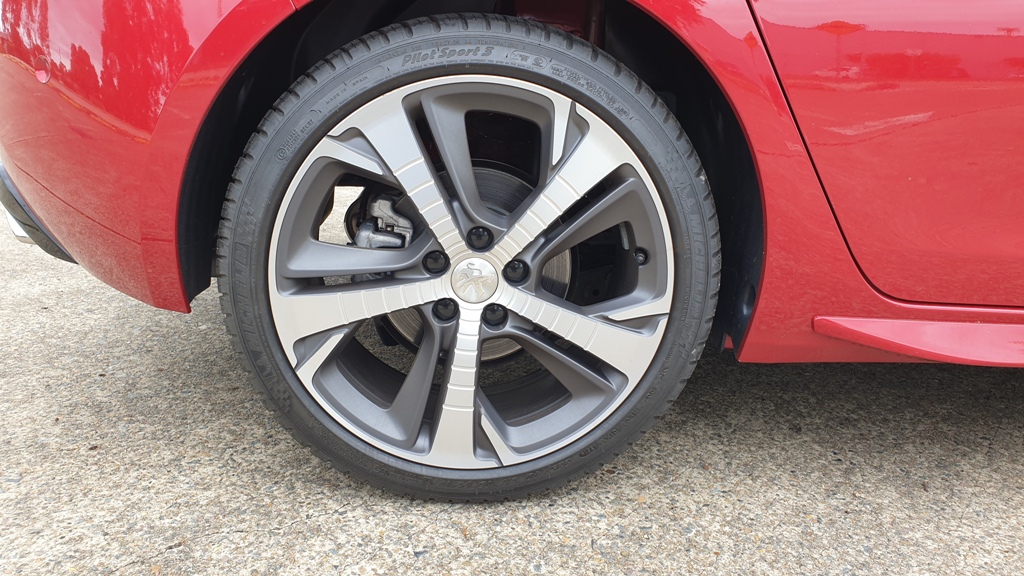 The rear lights feature another “Pug” signature, with the three strip “claw marks”. Wheels are alloys and painted a flat dark grey on sections of the wheel that give a ten spoke look. Rubber is, of course, Michelin, and are the super grippy Pilot Sport 3 at 225/40/Z18.
On The Inside It’s: Oddly, not quite as user friendly, in a couple of ways, as the Partner van. That has a better driver’s screen interface which is more accessible via the steering wheel tabs. In this 308 it was a button the right hand, wiper operating, stalk.
The button to deactivate the Stop/Start system, which is just that little bit too eager in the 308 GT-Line, is also more visible in the Partner.
Seats are cloth covered with leather type material on the wings, and metallic looking threads in the middle. The audio is AM/FM only, however a smartphone can be connected via USB or Bluetooth. It sits atop a dash with a defined W styling, and with minimal secondary controls.
This means using it necessitates eyes off the road as all main controls are on the exterior of the screen, and don’t always respond to a tap the first time whilst in motion.
Cabin plastics have a hard touch yet have a fine grain to the touch.
To start the 308, a press button Start/Stop system is employed, with the button in the centre console and for safety’s sake must be held for a second or so. The park brake comes on automatically when the doors are opened and although there is a setting to disengage it, it’s just as easy to start, then press it off as it’s right behind the Start button.
The indicator stalk is on the left hand side, with auto wipers engaged and disengaged by a dip of the right hand stalk. The wipers themselves aren’t terribly robust in motion. Airvents are thin horizontally and the touchscreen is the only option in controlling the system. And until you re-touch another tab, it’ll stay on the chosen (i.e. aircon) screen until the car powers off.
That centre console holds just one cup, with smallish bottle holders in the four doors.
The rear hatch is manually operated, opening to a 435L cargo section, with the press tab logically located in the upper section of the number plate recess. Seats down, there’s 1,274L. The spare, incidentally, is a space saver. On The Road It’s: A firm ride on the highways, with just the right amount of damping when required.
It does, though, exhibit skittishness on some road joins and the like, with a mild but noticeable steering rack shake and accompanying left or right hop.
The location of the steering wheel, a Peugeot design signature, allows the GT-Line to feel sporty in the hands and in the handling. Its light, but not so that it isolates feedback.
The eight speed auto is a pearler, with quick shifts and perfectly matched to the tiny engine’s torque delivery.
We did notice though that the engine isn’t a fan of cold morning starts. Our time with the Peugeot 308 GT-Line coincided with some varying La Nina weather, with some mornings having a lacklustre and slow to react driveline.
We also noticed that the turbo behaviour would be different in nature at the same driving points, such as being ready to kick in or well off boost at the same speed coming to the same stop sign or give way sign.
In some instances, this lead to a few deep breath as the lack of urge at times had oncoming traffic looking to be in proximity earlier than they should, whereas at other times the engine would be ready to pull the 308 away without fuss. Disconcerting? Just a bit…
When it’s all cooperating, the engine and auto make a wonderful around town companion. There’s some decent urge from a standing start, and rolling acceleration is also decent without being outstanding. It’s a good highway cruiser, and is relatively quiet, even with the limpet grip Michelin tyres.
Unfortunately for us, the 308 wasn’t as suitable as needed for our Christmas travel requirements. This means the economy for the distance knowing to be travelled would be problematic with four humans and a decent amount of luggage.
Also, in some areas, the 1.2L would have struggled in the numerous uphill runs known for the route, and again would have played havoc with the economy.
What About Safety?: Pretty standard nowadays with AEB, Forward Collision Warning, and Sign Recognition.
Blind Spot Alert, reverse camera, and six airbags complement the main features.
What About Warranty And Service?: Five years warranty and unlimited kilometres are standard, and servicing is capped price, with Peugeot’s website providing specific pricing per vehicle type.
At The End Of The Drive. In a very competitive market, the 308 range is up against the Cerato, i30, Corolla, offerings from Ford and Mazda, and Renault’s Megane.
The drive is good, the drive-train a willing package, and it’s not unattractive inside and out.
In our opinion, it’s a very good city car and a not unworthy consideration on price. Having just two models to choose from makes choice an easy one but when others offer a broader range, it can be seen as a factor against it.
The dichotomy of the engine’s performance left us wondering about the overall consistency of delivery, a factor that doesn’t appear to be an issue in other brands.
Electric History: Hispano-Suiza Carmen Boulogne.
One of the oldest names in automotive and aviation circles, Hispano-Suiza, has launched a second vehicle in its 21st century rebirth. In 2019 the company unveiled the Carmen, a re-interpretation of a classic design from the 1930s called the Dubonnet Xenia. The Carmen Boulogne is a sportier evolution of that iconic vehicle. It is a fully electric vehicle and exclusivity will be stratospheric. Just five will be produced.
Dubonnet Xenia 1930s
The company’s lineage can be traced back over 120 years. Emilio de la Cuadra, a Spanish artillery captain, had been working on electric cars in Barcelona in 1898. During a visit to Paris, he met and subsequently employed Marc Birkigt, a Swiss born engineer. The pair collaborated and swiftly produced two gasoline powered engines which were released in 1900. Some financial hiccups saw a restructuring in 1902 and 1903, with a new owner and name change to Fábrica Hispano-Suiza de Automóviles (Spanish-Swiss Automobile Factory) which went bankrupt in 1903.
La-Cuadra automobile
José María Castro Fernández was the owner and in 1904 the company underwent yet another rebuild, this time more successfully and known as La Hispano-Suiza Fábrica de Automóviles. Damian Mateu, a Spanish entrepreneur, would partner with Birkigt to formalise the rebirth, and his granddaughter, Carmen, is the inspiration for the naming of the company’s 21st century vehicles. Come WW1 and aircraft engines would be produced under the watchful eyes of Birkigt. 1919 and they returned to automotive manufacturing and grew from there.
The Boulogne name dates back to 1921, when Hispano Suiza made a racing version of its high-performance H6 Coupé and entered it in the George Boillot Cup, an endurance race lasting more than 3.5 hours around the French city of Boulogne. Three consecutive victories with André Dubonnet (1921), Paul Bablot (1922), and Léonce Garnier (1923) driving the mighty Hispano Suiza H6, would be the results.
The Hispano Suiza Carmen Boulogne pays tribute to these historic motorsport victories with this fully electrically powered version packing 1,100hp/820 kW and a maximum velocity of 180mph/290kmh. The sprint to 100kmh (62mph) will take just 2.6 seconds. Four permanent-magnet synchronous engines, two on each rear wheel, will power the carbon fiber roof, body, and subframed Carmen Boulogne. The design, engineering, and production of the Carmen Boulogne is a result of a collaboration between Hispano-Suiza and a company specializing in the development of electric motors and motorsports, QEV Technologies.
Formula-E, a race series and a working test-bed for battery powered vehicles, has contributed to the development of the 1,180ft-lb/1,600Nm engines, and lithium-ion polymer batteries. These have a capacity of 80kWh (and can be upgraded later, says the company, with a 105kWh pack in development), and can see the Carmen Boulogne to a range of up to 250 miles/400 kilometres.
2021 Hispano-Suiza Carmen Boulogne
They are an in-house designed and produced T-shaped unit, including a complete temperature control system (including three radiators) to ensure that the cells can operate optimally. It has a fast-charging capacity of more than 80 kW DC, requiring only 30 minutes to charge to 30-80% capacity via a CCS2 fast charger. It also has CHAdeMO and GB/T charging options. Torque-vectoring is employed to ensure the Carmen Boulogne is kept straight under acceleration.
That 4.7 meter long carbon fiber body will be protected by coats of clear varnish, allowing those outside to see the strength of the material, and the emphasis on light-weight sportiness. It will also dramatically emphasise the slippery design, with a drag co-efficient of just 0.32cD. The distinctive semi-circular headlights of the Carmen will be kept, and flanked by a new copper coloured grille, with highlights of the same hue found inside.
2021 Hispano-Suiza Carmen Boulogne cabin
The five buyers can customise the Carmen Boulogne to their own bespoke tastes, thanks to Hispano-Suiza’s “Unique Tailormade” in-house department. Suede or Alcantara will be the interior trim choices as a starting point.
Pricing for the Hispano-Suiza Carmen Boulogne starts from 1.65 million euros plus local taxes (approx USD1,942,000), and its manufacturing process, handmade with the utmost precision, requires approximately twelve months.
The five units of the Carmen Boulogne hypercar join the 14 units of the Carmen to reach a total of 19 units in production, with the first unit ready to be delivered in 2022.
2021 Hispano-Suiza Carmen Boulogne tail
 Level 2, 9 Help Street