

Author archive
Stellantis: One New Name, A New Home For Many
Stellantis. It’s the umbrella name for the coming together of two major automotive groups, the Peugeot and Citroen Alliance, and the Fiat Chrysler conglomerate. There are brands as diverse as Opel to Maserati, Citroen’s DS to Vauxhall, and there is already murmurs of upgrades to vehicles produced by companies now joined as one.
The full list, Chrysler, Dodge, Jeep, Ram, Fiat, Alfa Romeo, Abarth, Lancia, and Maserati from FCA, and Citroën, DS, Opel, Peugeot, and Vauxhall from to PSA means that there is over 120 years of automotive history brought together. And collectively, there are now over 400,000 personnel with that collective pool of experience and knowledge.
John Elkann is the Chairman of the Stellantis board, and says: “It is no coincidence that Stellantis is born precisely when our world requires a new kind of automotive company that will champion clean and intelligent solutions to provide freedom of movement for all. Our global scale and reach provide us with the resources to invest in state-of-the-art technologies, distinctive excellence and unmatched choice for our customers.
But it is the geographic and cultural diversity of Stellantis’ people that from Day One is our greatest competitive advantage. It is they, with their energy, their knowhow and their constant commitment who make Stellantis what it is today. And it is they who day-by-day will build an even greater company for this new era of mobility.” Echoing his words is the new Chief Executive Officer, Carlos Tavares, with: “This is a great day. One year after we announced this project, Stellantis is born, notwithstanding the unprecedented societal and economic disruption caused by the COVID-19 pandemic. I want to warmly thank all of the teams who made this possible and also thank the entire workforce who continued to move our operations forward during this exceptional year.
This demonstrates the agility, creativity and adaptability of our company which aims to be great rather than big, determined to be much more than the sum of its parts. It is also a further signal of the new company’s determination to be a leading player in the automotive industry in this ever changing environment. Stellantis is dedicated to “pursuing greatness” and enhancing the well-being of its employees.”
The group’s spread reaches to over 130 countries, and the brands cover the full spectrum of market segments from luxury, premium and mainstream passenger vehicles to hard-charging pickup trucks, SUVs and light commercial vehicles, as well as dedicated mobility, finance and parts and service brands. This new group now expects to leverage its size and economies of scale to invest in innovative mobility solutions for its global customer base. Forward estimates see Stellantis looking at a revenue base of over five billion Euro in a synergystic way of spreading the brands.
Achieving that revenue will come from a streamliniung of processes, including how purchasing is conducted, the crossover of drivetrains and platforms, and an amortisation of Research and Development. Currently, that estimate also comes from not closing any production plants. To ensure that all departments flow smoothly, including company-wide performance & strategy, planning, regions, manufacturing, brand and styling, there will be nine Governance Committees.
2021 Hyundai i30 Elite v 2021 Toyota Corolla Ascent Sport: Private Fleet Car Review
 This Car Review Is About: The two cars, in hatchback form, that dominate the market for their sector. We were lucky enough to have the 2021 Toyota Corolla Ascent Sport and 2021 Hyundai i30 Elite side by side. Five door bodies, automatics, revvy four cylinder engines, and decent tech for the average family are hallmarks of both.
  However, one of the two is not like the other, in that the i30 range was given a refresh late in 2020, with the sedan now replacing the Elantra, with Toyota’s offering always having a sedan available.
We back-to-back the pair in a not quite but close apples for apples comparison. The Elite is close to the top of the i30 range, the Ascent Sport is the entry level to a three tier range from Toyota.
How Much Do They Cost?: In basic Glacier White and auto form the Ascent Sport starts from $29,380 with metallics a no cost option but $500 on SX and ZR. For our location, Hyundai’s website priced the i30 Elite auto at $33,830 in Polar White. Clad in Intense Blue, as was our test car, that goes to $34,340. Both cars are on a drive-away price schedule. Under The Bonnet Is: A 2.0L GDI (Gasoline Direct Injection) engine for the contender in the Korean corner, and a same sized engine for the Japanese contender. The Hyundai runs a traditional torque converter auto with six ratios, the Toyota a CVT with ten preprogrammed steps. Both drive the front wheels and each have manual shifting. Power for the Korean is 120kW and peak torque is 203Nm, with 6,200rpm and 4,700rpm the required figures. Corolla has 125kW and 200Nm, however Toyota don’t appear to list the rev points.
 The i30’s overall economy finished on a creditable 7.2L/100km. We saw a best of 6.0L/100km, a very good figure considering it was loaded with four passengers and a reasonable amount of boot space filled. Corolla’s average hovered between 6.0L to 6.5L per 100km in a more urban oriented drive. Tank for the Ascent Sport is 50.0L, matched by the i30. Both are 91RON and E10 compatible.
On The Inside It’s: Black leather for the i30, with perforated squabs but no venting nor heating. The Ascent Sport has black cloth as befits an entry level vehicle. Both have DAB audio and a point of difference here. The Toyota’s layout is simple and intuitive barring the fact it’s a black and white 8.0 inch screen. The Corolla has voice recognition, a bonus at an entry level. It’s much easier to use whereas the Hyundai’s updated screen, even with the appeal of colour and in the Elite it’s 10.25 inches, isn’t as intuitive. We also found the sensitivity of the Korean’s tuner to be less than the Corolla’s. Ascent Sport has satnav as an option and includes a USB port in Ascent Sport trim. Smart apps are standard in both.
 The dash design for each stamps their mark; the Corolla’s has barely changed in some years and features the somewhat heavy and intrusive triple wave design that intrudes into the kneespace of driver and passenger. The Hyundai’s design has space between the plastic and the knees and in the i30 it’s a simple, single line from side to side that incorporates the piano black surrounds for the aircon. The Hyundai’s gear selector feels it has a shorter throw and the springing in the Corolla isn’t as tight as the Elite’s.
 Both have auto, dusk sensing headlights, with the Elite’s higher spec level adding in rain sensing wipers. It’s a key start for the Ascent Sport, push button for the i30. The Elite also has a 12V socket up front with a wireless charging pad. The Corolla’s dash display has the speedo front and centre, with the full colour 4.3inch info screen on far right. The Elite has a full colour TFT 7.0 inch display, shared across all models.
 One notable difference between the two is the Corolla’s much discussed cargo section. It’s not a high loading lip however the cargo section’s floor is level with it, and underneath is the spare wheel and associated equipment. The i30’s floor is below the lip and seems further from the rear seats too, making for a more family friendly usage.
 Also, the i30’s boot area is home to the bass driver for the audio system. The Corolla has 217L to 333L, a figure much commented on since the revamps, with the Hyundai starting from 395L and moving to 1,301L with the second row folded. Both have a full sized spare.
 994mm and 977mm are the head room front and rear measurements for the i30, 1073mm and 883mm leg room, with 1,427mm and 1,406mm shoulder room. The Toyota spec sheet doesn’t list them.
On The Outside It’s: A mild but noticeable update for the i30. Up front is a set of driving lights that have have expanded from a simple strip of LEDs to a more assertive looking set of triangular LEDs that fill out the insert, and double as indicators. The grille has morphed and moved to a broader design, and has a more flamboyant fan shaped styling. The rear lights have a slight restyle to match the very mild changes to the front lights.
Corolla was given its own do-over in 2018. It’s broader, sharper edged, and lower than the more bluff and upright standing i30. The flanks are more organic, curved, than the straight sides of the i30, and the rear has a more pronounced slope than its Korean counterpart. The LED DRLs are far more inboard and set inside the narrow headlight cluster. There’s notable differences between these two however there are similarities to other brands. The VW Golf is more akin to the squat and bluff i30, Subaru’s laid back Impreza hatch is closer to the Corolla.
i30’s length is 4,340mm, and stands 1,455mm tall. Width is 1,795mm and wheelbase is a decent 2,650mm. Corolla is 4375mm in length, with a 2640mm wheelbase. Height and width are 1,435mm and 1,790mm.
On The Road It’s: A definite difference in feeling. The Corolla’s steering is light in comparison to the i30 Elite’s but it’s also more twitchy. The Hyundai has some real weight, and it’s subtly but noticeably more front wheel drive. The lightness of the Ascent Sport means one can comfortably pootle around town with only one hand on the tiller but that twitchiness then demands both hands be in contact. The i30’s has a need for both, particularly because of the over-enthusiastic lane keep assist function. The Corolla’s is noticeable but nowhere near as “grabby”, a complaint well recognised about the Korean. The i30’s suspension is more sporting in tune, with the 225/45/17 Hankook Ventus Prime rubber gripping hard and well, and providing a little bit of absorption from the smaller sidewalls. The Ascent Sport has 205/55/16s from Dunlop’s Enasave range and the higher sideall is certainly noticeable in ride absorption. It also flexes just enough to put a bit of Sport into the Ascent Sport name. Highway and freeway ride quality certainly had the Ascent Sport in a slightly more wallowly mood, not quite as tied down nor quick to dampen, as the i30. In contrast, the i30 was a bit more bang thump.
 The i30 had a minor glitch in the engine under load. On the flat and and on uphill acceleration, there was a momentary “pinging”, a stutter in the otherwise smooth pull of the 2.0L. It has to be noted that we’ve not experienced anything like this in a modern car and Hyundai’s garage was made aware of it. The auto is smooth in changing and the electronics work with the throttle input and engine’s revs perfectly. Using the manual shift option makes fractionally quicker changes.
 For the CVT in the Ascent Sport, if a quick getaway is the required situation, manual shifting works wonders. There’s minor “slurring” on the changes but it’s preferable to the unenergetic normal sensation from the CVT on gentle to medium acceleration. A harder and heavier pedal extracts more from the 2.0L and CVT and even brings in mild torque-steer.
Braking in both is courtesy of well balanced, well modulated, discs front and rear. The pedal in the i30 has a heavier feel and in context matches the steering. The Corolla’s is lighter but not without feel. It’s also slightly quicker in the ratio, but not by much.
What About Safety?: Hyundai doesn’t skimp on the i30, with Blind Spot Collision, Rear Cross Traffic Alert, and Safe Exit warning missing only from the base i30 and Active. Otherwise the Safety Sense package adds in Driver Attention Warning, Forward Collision-Avoidance Assist (FCA) – City/Urban/Interurban/Pedestrian/Cyclist (camera & radar), Lane Following Assist and Lane Keeping Assist-Line.
Corolla matches this with Lane Trace Assist for the CVT equipped Ascent Sport, Lane Departure Alert with Steering Assist, and Pre-Collision Safety system with pedestrian (day and night) and cyclist (day) detection plus Road Sign Assist. Blind Spot Monitor and Rear Cross Traffic, like an entry level i30, is missing in the Ascent Sport. Both load up seven airbags including a kneebag for the driver.
What About Warranty And Service?: Toyota has a VIN based service structure online. Warranty is five years and unlimited kilometres. That’s the same for the i30 and Hyundai also uses a VIN based service quote system.
At The End Of The Drive. In honesty, there really isn’t a lot between them, even looking at putting the SX in the place of the Ascent Sport. It would be convenience factors such as the charge pad perhaps, the extra clearance of the dash in the i30 over the Corolla’s design, and the brilliant screen for the driver in the i30 against the slightly better economy in the Corolla and the more user friendly interface on the touchscreen. The driving experience is a user dependent one; for us the i30’s ride tune was preferable, however there is no doubt that the softer and more comfortable tune of the Corolla Ascent Sport has its adherents. There’s also that legendary Toyota sense of being bullet-proof and infallible. In essence, the gap isn’t as big as it could have been.
Mazda Hits 2021 With Updates To The Mazda6
Mazda Australia has released details of the key updates for 2021 to their Mazda6 Sedan and Wagon. Sales are due to start for the updated vehicles from March of 2021. This includes the addition of the GT SP Turbo 2.5L four cylinder engine which will be available in the sedan and wagon.  Mazda Australia Managing Director, Vinesh Bhindi, commented: “As our passenger car flagship, Mazda6 holds strong appeal in its segment with its advanced specification and option of Sedan and Wagon body styles. This latest update is highlighted by the new GT SP model, which brings a distinctly sporty characteristic to the Mazda6 range and builds on the local GT SP portfolio alongside the CX-9.”
The Mazda6 Sport Sedan and Wagon offers a solid list of standard equipment. The sedan and wagon will ride on 17inch alloys with 225/55, rubber. Headlights are LED powered, as are the rear lights. The wing mirrors will be heated for those frosty and foggy mornings, and the wagon gets roof rails and a rear spoiler as standard.
Inside is Apple and Android app compatibility via an 8.0 inch satnav equipped touchscreen plus Bluetooth streaming and Mazda’s MZD Connect function. Stitcher and Aha internet radio is listed as standard. Passengers are kept cool thanks to dual zone climate control and rear facing vents for the second row passengers. The wagon receives a cargo net and Mazda’s Karakuri tonneau cover. There’s an electric park brake, leather wrapped steering wheel and gear selector knob, and Mazda’s Multi-function Control.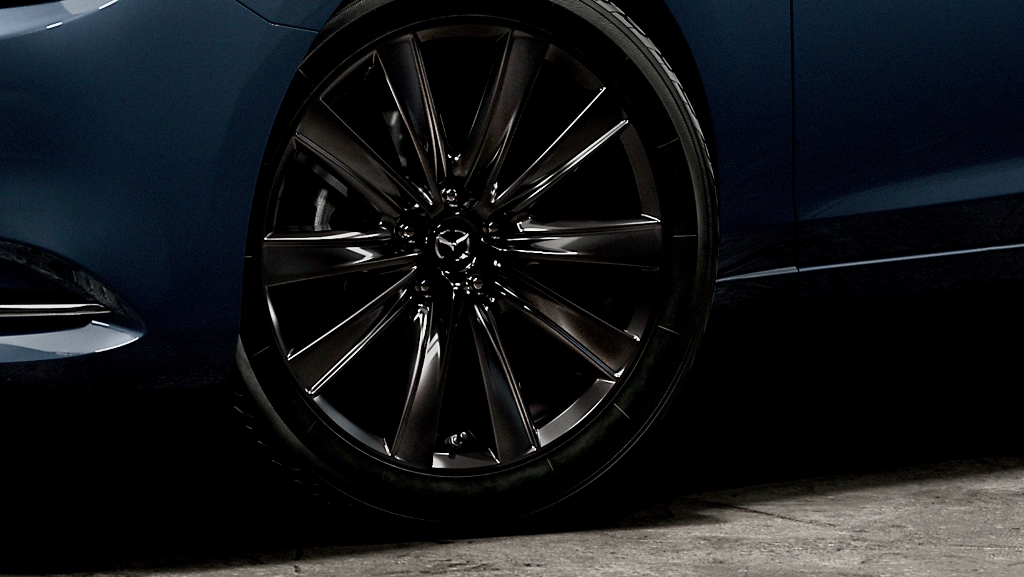 Passengers sit on black cloth covered seats, and second row passengers have a USB port in the seat arm rest.
Safety is high, with Blind Spot Monitoring, a Driver Attention Alert function, along with Lane Departure Warning, Rear Cross Traffic Alert, and Mazda Radar Cruise Control. Traffic Sign Recognition and Smart Brake Support are fitted, as is Smart City Brake Support [Forward/Reverse]. Tyre Pressure Monitoring makes sure all four corners can be checked on the go. Move to the Touring variant and there is black leather seats with the driver’s seat having a two position memory function along with 10 way adjustment. The passenger has a six way adjustment feature. LED DRLs are standard here as is keyless entry and front parking sensors.
On top of the Touring specification, the GT SP adds the turbocharged 2.5-litre petrol engine, plus 19 inch black painted alloys with 225/45 tyres. Front and rear seats gain heating and are wrapped in burgundy leather with the same colour highlights added to the instrument panel and door trims. Power for the Sport and Touring Sedans & Wagons comes from the Skyactiv-6 2.5L petrol four. Peak torque is 252Nm (4,000rpm(, and power is 140kW (6,000rpm). Economy is rated at 7.0L/100km A six speed auto drives the front wheels. Both GT SP and the Atenza variants have a same sized angine with 170kW (5,000rpm( and a very impressive 420Nm of peak torque at just 2,000rpm. Economy is rated at 7.6L/100km and that’s using 91RON unleaded.
 Visual differentiation sees both GT SP and Atenza models gaining Turbo badging. A new colour has been added called Polymetal Grey Metallic.
Over the equipment list for the Sport and GT, the Atenza specification has the same diameter wheels but are finished in a non-painted, bright, look. There is a sunroof, venting for the front seats, LED ambient lighting, and real wood trim. Nappa leather is available in walnut brown or white for the seats under black headlining and Ultrasuede door and dash trim. The driver sees information on a 7.0 inch display and the main touchscreen offers a 360 degree view. Pricing starts from $34,590 plus ORC for the Sport Sedan, with the Sport Wagon from $35,890 plus ORC. The Touring Sedan starts from $38,890 plus ORC with the Wagon from $40,190. Head to the GT SP Sedan and see $46,690 plus ORC and $47,990 plus ORC for the GT SP Wagon. The Atenza Sedan and Wagon start from $50,090 and $51,390 plus ORC each.
Takata Airbags Recall Update.
The Federal Chamber of Automotive Industries (FCAI) has today (January 14) reported that the website relating to the Takata airbag safety recall, www.ismyairbagsafe.com.au, has reached 12 million checks. As a result, over two million vehicles equipped with the faulty Takata airbag inflators have been identified as having the problem airbags, which have the potential to kill or seriously injure vehicle occupants.
Across Australia, car manufacturers have replaced faulty Takata airbags in more than 2.72 million passenger cars and light commercial vehicles. Vehicle owners unsure of the recall status of their vehicles can immediately check by visiting the website or by texting the word TAKATA to 0487 247 224.
The 12 million represents a staggering 67 per cent of the 17.8 million passenger cars and light commercial vehicles on Australian roads. The FCAI chief executive, Tony Weber, said: “The website has been an outstanding success in helping people identify whether their vehicles are affected by the national Takata recall. The heavy usage of the website clearly demonstrates that vehicle owners appreciate being able to readily access important safety information.”
And although the deadline set by the industry had passed, manufacturers are still working to identify more vehicles, said Mr Weber. “We will continue hosting the website through early 2021 to ensure vehicle owners can readily check the recall status of their vehicles. If owners identify any outstanding faulty airbags, manufacturers and dealers will replace them free of charge.”
If you have a vehicle that is unregistered, it’s recommended you check by contacting the relevant brand directly. This, said Mr Weber, is important as he warned that state and territory governments were now deregistering or refusing registration of vehicles fitted with unrectified Takata airbags. “Don’t let your vehicle be taken off the road by the authorities. Vehicle owners can easily avoid the inconvenience and serious legal risks associated with deregistration by making prompt arrangements for free replacement”.
The www.ismyairbagsafe.com.au website is an integral part of the automotive industry’s national communications campaign in support of the airbag recall. The industry campaign has made extensive use of national and regional television, radio, print, cinema, digital and social media, and of non-English press.
 Level 2, 9 Help Street