

Author archive
Tracks To Follow: Ripsaw.
In a car based culture it’s understandable to overlook that there are other ways of motorvating yourself around. No, we’re not talking boats or bikes or hovercraft. They’ve been done.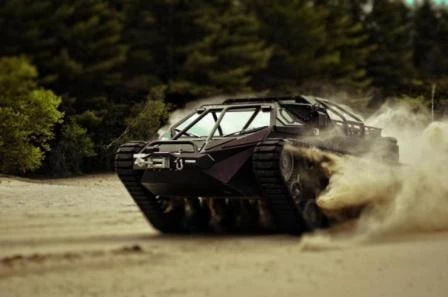 What we’re talking about is a tracked vehicle. You know, like tank tracks. American based company Howe and Howe Tech has the answer. Enter, stage left, the Ripsaw.
The easiest way to view this in your head is like this: think of a tank, take away the body and turret, replace it with something vaguely resembling a car body and that, in essence, is the Ripsaw. The vehicle is available in four specification levels and be warned, if you ask for the EV2 or EV3 (EV stands for Extreme Vehicles, by the way) it will take the firm around the six month mark to build. There’s the EV2, and now the EV3 in three levels, being the F1, F2, and F4. Simply put, they’re built to carry one, two, or four people. Price? Upwards of a half million US dollars.
But what do you get for your hard earned? Well, you can go for a powerplant that’s either petrol or diesel, and choose a power range that can go to 1000hp or 1500hp depending on an oiler or gasoline engine. You’ll get sixteen inches of suspension travel and air suspension for the cabin. There’s a choice of one or two 32 gallon fuel tanks in the F1, with 85 gallons in the heavier F4, which provide a range of up to 250 miles.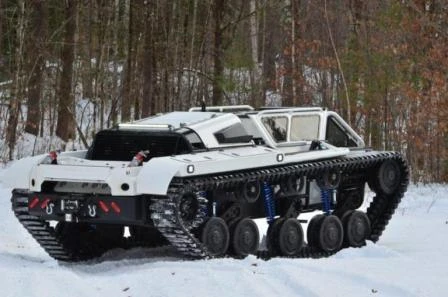 Originally designed to be a small and fast attack vehicle, the Ripsaw was quickly (pun only slightly intended) recognised as being a worthwhile base upon which to build a luxury oriented vehicle. And by using both in-house supplied and readily available commercial truck parts, repairs and spares are easily performed and obtainable.
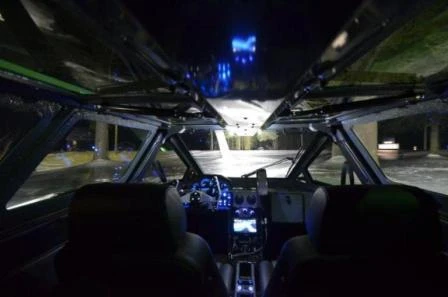 Built with military grade tracks, going off-road is as easily done as thinking about it. With a low centre of gravity and that torque, angles of fifty five degrees are achievable, as long as you have a strong stomach.
Should your bank manager be agreeable, here’s some video of what the Ripsaw can do: Ripsaw on The Grand Tour
Official Ripsaw Footage
The vehicle also featured in the Fast and Furious 8 film.
2017 Was A Car-razy Year For Sales In Australia
Car sales people in Australia should have cause to sit back and enjoy a cold one after VFACTS said that 1,189,116 vehicles were sold in 2017. That includes record numbers for Japanese niche filler, and a brand that really should be considered mainstream, Subaru. Korea should also celebrate as Kia saw record numbers as well.
But there’s also signs of a continuing trend that’ll have some smiling and others pensive, as 2017 marks the first year that SUVs outsold the traditional passenger car. Federal Chamber of Automotive Industries (FCAI) Chief Executive Tony Weber said: “2017 marks the first full year in which the sales of Sports Utility Vehicles (SUVs) have outstripped those of passenger cars. Australians bought 465,646 SUVs during 2017 for a 39.2 per cent share of the total market, compared with 450,012 passenger cars with a 37.8 per cent share. The shift in industry dynamic we observed last year has now become entrenched in our market. It is a growth pattern that we expect will continue.”
Even light commercial vehicles saw an increase; 2017 has that category with a market share of 19.9% in 2017, up from 18.8% in 2016.
The Toyota brand will be celebrating as both brand and a Toyota badged vehicle took the number one sales position. Toyota had a 18.2% market share and the HiLux was the winner for both 2017 and in December, selling 3949 units, just ahead of Holden‘s Astra at 3533.
Mazda, Hyundai, Holden, and Mitsubishi rounded out the top five, with Kia cracking the 50,000 mark for the first time ever and seeing 54,737 cars roll out from the showroom for ninth. Subaru claimed tenth, also with a plus 50K figure at 52,511. Ford, Volkswagen, and Nissan filled the remaining places with Ford’s Ranger at 3458 just pipping Holden’s revamped Colorado on 3222. It should be noted that the Colorado had an increase of 165.6% for December 2017 over the same period the year before. On 2807 for December 2017 was the petite Mazda3, a decrease of 10.6%. It was an upswing for the next highest selling vehicle and the gong goes to Mitsubishi‘s Triton, with 25.6% and 2645 sales.
Toyota’s evergreen Corolla had a backwards step, with a minus figure of 9.8% but still saw 2641 versions find new homes in December. With local manufacturing wrapping up, Holden still managed to see the VF series 2 Commodore into 2229 homes, a slight increase of just 4.6%. A facelift and some sharp pricing for the Mitsubishi ASX, in need of an interior overhaul, take ninth with an increase of 43.4% and 2128 sales. Tenth overall in December was Mazda‘s CX5, just behind the ASX on 2113 and a mild increase of 10.9%
Kia’s Cerato was behind the push to crack the 50K mark.With an increase of just under 43%, at 18,371 sales. Big numbers for Sportage as well, with 13,448 being sold and that’s an increase of 23.1%. The baby Picanto, itself receiving an update, dominated its category with a whopping 46.5% market share, as Carnival also dominated, with virtually half of the People Mover market under $60,000 wearing the Korean badge. December 2017 saw thirty six consecutive months of growth for the Subaru brand. Leading the way was the Forester, rolling into 12,474 new homes in 2017. The Liberty wagon based Outback was a close third, on 11,340, whilst the new for mid 2017 XV had increases of 22.6% for the year and 69.9% for December, with 10,161 and 1069 sales respectively. A slight revamp for the BRZ coupe saw an increase of 137.5% for 786 sales.
 It was the facelifted Impreza range that snared second place for Subaru sales in 2017, with a massive increase of 151.9% over 2016 sales and 11,903 cars saying goodbye to the showroom. Both Liberty and Outback are due for updates in 2018 and Subaru have also flagged a major revamp for the Forester which will be due in the last quarter of 2018
Safety and Propaganda.
The NSW government’s road safety office has saved a squidzillion on PR spin doctors over the last decade as they continue to repeat the same mind dangerous mantra of “slow down, speed kills” and have added “distractions aren’t the problem”.
Not once though has any statistical analysis shown anything more than 43% of crashes being related to excess velocity for the conditions. According to the NSW Centre for Road Safety it was 40% in 2017. Let’s face it folks, that’s really what speeding is. Too many roads and areas are limited to what really should be a higher velocity over distance. But of course it’s due to a spurt of fatal crashes in a the space of a week or so late in 2017 that drives (no pun intended) the monotonous drone from the pollies and certain police PR people.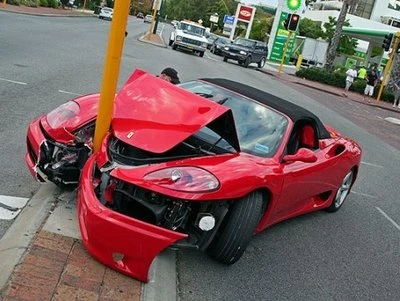 Let’s go simple for a moment: speed doesn’t kill. If it was the underlying reason then deaths on Australian roads would be in the thousands per day. Here’s what killed people: Crash causes NSW 2017 What’s disturbingly noticeable is how high a proportion of fatalities were country roads based and on a non-straight road, followed by head on impacts.
What does kill are drivers that Simply Don’t Care. They don’t care if they pull out in front of you. They don’t care if they stop in a merging lane. They don’t care if they’re on a motorbike and will travel at twenty below a posted limit whilst shaking their head at the driver behind them. They don’t care about amber and red lights. They don’t care about having headlights on when they should. They don’t care about indicators. They don’t care about you, themselves, and they certainly don’t care about road rules. The link above shows that speed may be factor but it’s nowhere near as big as the real reason: bad driving.
Don’t laugh at this seemingly innocuous statement. You’ll hear of “cars losing control” and unless the car is fully autonomous and has a does of the HAL 9000s, it’s utterly wrong. Any decent driver training organisation will tell you, without smiling, that it’s the failure of the organic component of a car that causes crashes. Not accident. Crashes.
This is why people die on the roads. It’s stuff-all to do with excess velocity. It’s got plenty to do with attitude. It’s got plenty to do with the tunnel visioned focus of governments and road bodies that are in it to promote ONLY their way of doing things.
Speed doesn’t kill. Government refusal to see past speeding and acknowledge they’re wrong, and people that don’t care, kill.
What’s needed is a complete and utter wholesale change to how the government sees road safety. A massive rethink is needed, and, as hard as it may appear to see, a reversal of the “speed kills” policy. Back to basics. Check the standards of driver educators. Educate and inform people that the basics that are being overlooked are why higher levels of driving standards that should be followed. Mandatory driver training sessions with properly accredited groups should be paired with a minimum of ten hours.
Driving a car at any speed isn’t hard. Driving appropriately isn’t hard either. But speed doesn’t kill. Bad drivers do.
Car Review: 2018 Volvo XC60 T6 R-Design
It’s a nice thing, as an independent writer, to get a vehicle that has visual appeal and plenty of chops underneath. It’s even better when that car is an award winner. The 2018 spec Volvo XC60, starting at a pinch under $60K, is definitely one of those and with a range of trim levels and engines to choose from, there’s one for everyone. I spend a Christmas week with the 2018 Volvo XC60 T6 R-Design. Visually it’s almost identical to its slightly older and slightly larger sibling, the XC90. There’s the LED headlights, the “Thor’s Hammer” indicator and LED driving light strip, and a visual cue from the S90 sedan with the new horizontal add-ons for the LED tail lights. Painted in a gorgeous metallic blue, the curves are highlighted and emphasise the new 21 inch diameter alloys and Pirelli rubber.
 It’s an imposing vehicle to look at. The 1900+ kilo machine is 4688mm in length, an astounding 1902mm in width, and stands 1658mm tall. Yet it’s as light and nimble, via the leather clad steering wheel, as a sports car, with beautiful feedback and effortless in its movement. The R-Design tested came fitted with airbag suspension and some options as well, with the ride and handling almost without fault.
 The XC60 was taken on a run to the NSW South Coast and was unflustered in its dealing with the varying tarmac conditions. For the most part. Some irregularities had the stiffer springs not dealing with them and the rear would skip sideways. The rear suspension has a name guaranteed to test anyone’s tongue: integral link with transverse composite leaf. The front is much easier: double wishbone transverse link. In layman’s terms they translate to “it’s a bloody good setup and it works”.
 The R-Design comes with a choice of diesel, a turbocharged or turbo/supercharged engine 2.0L petrol donk (T5 and T6) or a hybrid package. The Euro V6 emissions compliant T6 has pumps out a healthy 235kW via the all wheel drive system and a very usable 400 torques between 2200 and 5400 rpm. The eight speed Adaptive Geartronic auto defies logic in its unbelievably silky smoothness, imperceptible changes, and comes with drive modes including Comfort and Dynamic.
 It also comes with a 71 litre fuel tank, a clever fuel usage sensor that shows the varying range depending on thirst, and here’s the black spot for the XC60. The test car never dipped below 10.0 litres consumed per 100 kilometres. This included a couple of light throttle, flat road, gentle acceleration, freeway runs.
 The manufacturer’s price for the R-Design is $76990. The review vehicle was fitted with a number of options and the final figure was $87180. There’s the Lifestyle Pack at $2500 with heating for the multi-adjustable leather seats (which also had cooling, yay!), a Panoramic glass sunroof and tinted rear windows. The air suspension is an option and it’s worth the $2490 simply to watch the car settle on its haunches every time you exit. An extra $350 sees the front seat power cushion extensions, with interior package of leather and aforementioned ventilation another $2950. Metallic paint is $1900.
 The centre-piece of the interior is the nine inch touchscreen that houses driving aids, audio and climate control, apps, display settings, and is not initially intuitive but becomes so with practice. It’s also a highly reflective coated unit that is fantastic at holding fingerprints. It’s a three screen side-swipe that shows the choice of audio including DAB which, via the $4500 optional B&W speakers sounded spot on. The whole navigation interface is voice controlled as well. The glovebox is cooled and the climate control is a four zone capable unit. The driver has a full colour 12.3 inch LCD display with the display defaulting to a map between the speed and rev counter dials. The touchscreen has a tab to adjust the dial looks including power, Glass, and Chrome.

 Volvo’s attention to the little things is also as admirable. There’s the knurled finish to the drive selectior know, the same finish on the Start/Stop dial in the console, which requires a simple turn to the right to start or stop. Even the windscreen wipers have an identifying feature, with a gentle mist sprayed right out of the blade mounts which allows a closer and more efficient pattern to be utilised.
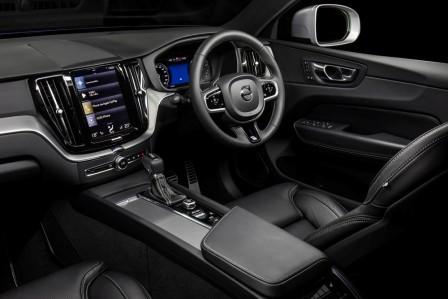 There’s a swag of safety aids as standard, including Blind Spot Alert, Cross Traffic Alert, Traffic Sign Recognition, a 360 degree camera setup, Adaptive Cruise Control, Pilot Assist which is a semi-autonomous driver system, Park Assist Pilot, Run-Off Road Mitigation and Lane Keeping Assist and it’s here some tweaking is needed. Irrespective of velocity the assistance is equal in force meaning a slow speed assist feels more like wrenching the tiller from the driver’s hands. There’s Hill Start Assist and Hill Descent Control and a complete suite of airbags including driver’s knee.
 The tail gate is power operated and is fitted with the under bumper foot sensor. This proved somewhat fiddly to use, even after a few attempts, but when it opens the rear door it allows access to 505 litres worth of cargo space, rear 12V socket, and space saving spare tyre. Rear seat passengers don’t suffer in room either, with 965mm leg room, 988mm head room, and 1408mm hip room.
It’s on the road when the ability of the T6 R-Design engine package shows its mettle. At the legal freeway limit the eight ratios see around 1700 rpm, meaning it’s not far from peak torque. Sink the slipper and the needle swings around instantly, the numbers change rapidly, and velocity is illegal very easily. Because of the superb sound insulation the XC60 has, there’s no real aural sense of what’s happening up front or outside and it’s too easy to be caught above the rated local limit, meaning the driver really needs to be aware of the numbers on screen. But if a car is going to offer such usable performance it’ll also need some useable stoppers. The XC60 delivers with brakes that can be judged to a nanometer in what they’re doing in relation to foot pressure. Nor does the R-Design’s ride quality suffer from the Pirelli P-Zero 255/40/21 tyres. It’d be fair to expect some harshness in the ride from such large tyres and a small profile, yet the suspension engineers have worked wonders in dialing in just the right amount of give for all but the most unsettled of tarmac surfaces.
 Settling into a freeway rhythm was easy in the R-Design. Loping along, enjoying either the DAB sounds or the music via connected smartphone, comfortable in the powered seats and being breathed upon by the climate control aircon, it’s an indisputably delightful place to be. Allowing for stops to allow rest breaks, exiting the XC60 after the five hundred kilometres or so drive had only the barest hint of fatigue settling in.
At The End Of the Drive.
drive.com.au have awarded the XC60 their Best SUV under $80,000 and it’s obvious to see why. Although adding some of the options add to the final price, the underlying ability of the 2018 Volvo XC60 T6 R-Design, is more than able and competent. Supplemented by an excellent safety package, an immensely flexible driveline, some high tech to use, and a beautiful exterior, the only real quibble with the car provided was the thirst.
Here is where you can configure your new XC60: 2018 Volvo XC60 information
 Level 2, 9 Help Street