

Author archive
Hyundai Showcases Self Driving Fuel Cell Powered Cars.
Autonomous driving is one thing. Using an alternative fuel source is another. Hyundai has combined the two in a stunning display. A convoy of self driving vehicles powered by technology has driven a 190 kilometre long route between Seoul and Pyeongchang in Korea.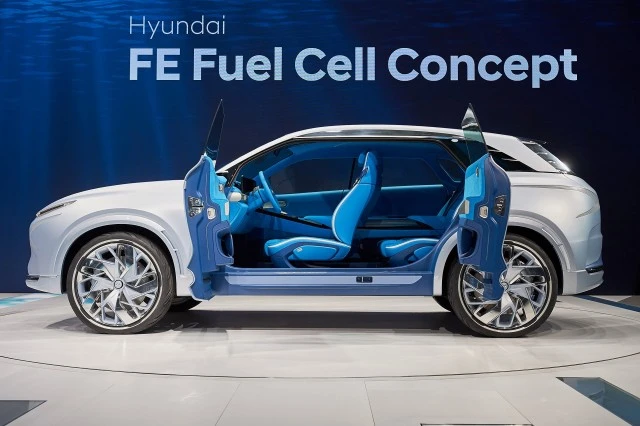
At speeds between 100 to 110 kmh, five vehicles navigated themselves with the only human intervention being at the beginning and end of the journey. Three vehicles are the next generation of SUV called NEXO, with the other two vehicles being based on the Genesis.
Fitted with the current international standard for autonomous driving, Level 4, plus the latest 5G telecommunications tech, February 2 was the start date for the tour. After both the Cruise and Set buttons inside were pressed on the autonomous driving configured steering wheel, the cars immediately went into self drive mode. Lane changes, toll booth entry and exit, even overtaking moves, were executed solely by the on board systems.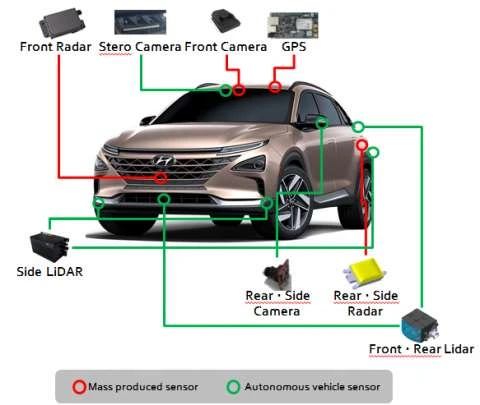
The cars themselves aren’t that different from a “normal” street version but are fitted with cameras and LIDAR plus the embedded sensors in the cars themselves.
The fuel cell side sees the NEXO cars able to travel up to six hundred kilometres on a single charge, with a refuel taking under five minutes. An efficiency level of sixty percent is equivalent, currently, to normal fuel vehicles.
Hyundai itself is readying to have autonomous vehicles on road by 2021 for “smart cities“, along with announcing a partnership with American based autonomous driving startup Aurora Technologies, with a full release of autonomous driving capable vehicles by 2030.
Private Fleet Car Review: 2018 Kia Sorento Si
I and Kia continue our long and proud association with the 2018 Kia Sorento Si seven seater spending a few days in the garage before two weeks of Stinger. The car provided has a RRP of $42990 plus metallic paint (Metal Stream) at $595 for a total price of $43585. There’s been some minor changes, both visible and non, compared to the previous model. The petrol engine has increased in size to 3.5L, up from 3.3L. Peak power of 206 kW is seen at 6500 rpm, and peak torque of 336 Nm comes in at 5000 rpm. This means the 4800 mm long, 1932 kg Si, capable of towing 2000 kilograms, has fuel consumption figures of 14.2L per 100 km of standard unleaded from the 71 litre tank around town. Get out on the highway and that drops by nearly half to 7.6L/100 km for the 2WD Si. A new eight speed auto is to thank for that and, quite simply, the combination of turbine smooth engine and silky sweet auto is superb.
 The Si is the entry level model of a four model Sorento range and comes well loaded with standard and safety equipment. Hold on: A digital and analogue dash features across the range, as does an eight inch touchscreen (up an inch on the previous model) with DAB audio, satnav, safety audio settings for driving, Android Auto and Apple CarPlay with voice control, multi-function steering wheel controls, three 12V and two USB sockets, six airbags including side curtain, Driver Attention Alert, Advanced Smart Cruise Control, and metallic look interior trim.
  That last one is an issue in the Australian climate as heat soak lends itself to burned fingertips. There’s six cup holders (two per seat row), four bottle holders (one in each door pocket), and a cargo blind is standard as well.
 The interior itself has received a mild freshen up, with new look plastics, a redesign to the look for the steering wheel and its controls, even the touchscreen and surrounds have been mildly massaged. It’s clean and elegant to both look at and touch. What’s missing from the inside is privacy glass for the rear seat passengers. Although the Si’s seats are cloth there’s no heating or venting until the GT-Line level. However dual zone climate control is standard from the Si up. It’s manual seat adjustment for the Si and Sport, with the SLi gaining power seats and two position lumbar support. The GT-Line goes to four way adjustment and thigh support.
 Leg room is always good for the front seats and good enough for most in the centre. The folding rear seats are compromised by design for leg room but wouldn’t be used, one would suspect, for anything other than city style journeying. As always though Kia’s bent towards simplicity when needed is seen here with simple pull straps employed to raise and lower the third row seats. When they and the mid row seats are folded, there’s a huge 1662L of cargo space available.
 Outside the Sorento has also been given a light massage. The tail lights have been changed in look as has the front bumper, with a smooth scallop underneath the restyled headlights. A slimmer look to the headlight structure which incorporates the LED driving lights and a restyling to the bumper’s design bring a fresher look to the exterior overall. The rubber is from Nexen, being 235/65/17, and is also the smallest tyre/wheel combination of the four.
 Although they’re a high sidewall, there’s still plenty of chirping from the front even from what could be called a medium throttle application. That speaks more about the tyres themselves than the engine, given the high revs needed for peak torque. Ride quality, as a result, is somewhat spongy, soft, with a reasonable rebound from the front end over some rather large speedbumps. The rear seems somewhat more tied down in comparison.
The chassis itself is beautiful. Taken through a downhill rural road that has a mix of sweeping curves, tightening radius corners, and a couple of straights long enough to wind up before braking, it holds on and changes direction with minimal weight transfer. Even on the somewhat spongy Nexen rubber, there’s little to no doubt that you can throw the Sorento Si around and come out the other side. The Drive modes are accessible via a tab in the centre console and have me wondering why they’re still offered. In all of AWT’s exposure to such they’ve been barely and rarely used and moreso to find out if they made a difference to the actual feel of driving. There’s Comfort/Eco/Sport/Smart, with the last an adaptive system to road and driving conditions. Sport holds gear longer and loads up the steering, Eco is designed (and more suitable for) long distance driving as would Comfort suit as well.
 As mentioned, the engine and transmission are utterly harmonious in their partnership. Light throttle application has the big machine underway easily and with no perceptible change of ratio. Light the candle and the Sorento will scamper away with alacrity. There’s no vibration in the driveline and absolutely no sense of strain or stress. Jaguar’s V12 was known for its smoothness and this combination would be on a par.
On an uphill run, where traffic ahead slows forward progress and then clears, a moderate shove of the go pedal has a momentary hesitation, a deep inhale, before launching forward with surprising speed.
As always there’s Kia’s seven year warranty, seven year roadside assistance package, and capped price servicing for seven years or every 15,000 kilometres. At The End Of The Drive.
The Kia Sorento Si is for those that want an SUV to move people but don’t want a people mover. The fact that it’s not an off-road oriented car, due to its 2WD and no transfer case, means it’s likely to be used for ferrying the kids to and from school and to sports activities on the weekend. And this highlights the Achilles heel of the Sorento Si with a petrol engine. Economy was never been a strong point of the 3.3L and an urban figure over over 14.0L per 100 km doesn’t aid the cause. We finished close to 11.0L/100km which is more reasonable but still largely unacceptable.
But if fuel consumption is something not to be fussed about, and a large, comfortable, well equipped, good handling and driving SUV is what appeals, this is one that ticks far too many boxes to be ignored. Here’s where you can find more: 2018 Kia Sorento information
H9: A Haval To Have.
Haval have unveiled the updated seven seater H9. The 2018 model comes well stocked with standard equipment in the two model range, designated Lux and Ultra, a 350Nm turbo petrol engine of two litres capacity but still no diesel…yet.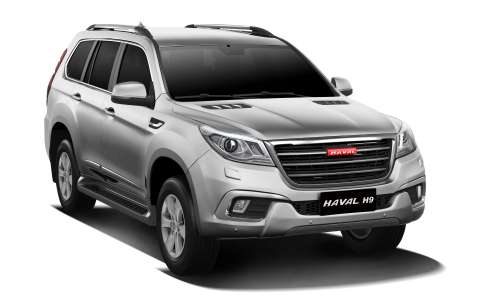 Included in the updates are both power and torque increases, from 160 to 180 kW, and up from 324Nm for the torque. Haval have fitted an eight speed auto from ZF, and combined with a change to the compression ration inside the four cylinder engine, say a fuel consumption improvement of around ten percent should be expected. A drop in the time to 100 kmh from zero is also expected, down to ten seconds.
 The exterior sees the former three bar grille changed to a five bar design, plus the lower air intake has been massaged for better air flow. Five spoke 18 inch alloys are new. Inside there’s been a raft of changes including a new TFT display screen for the driver, which amongst other information and changes displays a digital speedo.
 The seats for the Lux are cloth, the Ultra gets leather plus passengers in the Ultra can enjoy Australian sunshine thanks to a full length glass roof. Safety gets upgraded, with the Lux gaining Blind Spot Monitoring, Rear Cross Traffic Alert, and Lane Departure Warning. The Ultra steps that up with a heated steering wheel, heated second row seats, and an Infinity sound system.
 It’s also off-road capable, with a Bosch backed All-Terrain Control System (ATCS). Haval says:
Auto: The system automatically adapts to any on- or off-road situation and is designed as a select and forget setting.
Sand: The Bosch Generation 9.0 Traction Control System allows higher engine speeds and bigger torque for maximum traction through dry sand.
Snow: Traction is adjusted for the slippery conditions prevalent in snow, utilising the high torque of the turbocharged engine and the technology of the German-engineered ZF 8-speed transmission to start in second gear to minimise slippage and maximise traction.
Mud: Operates like the snow setting, but employs the BorgWarner transfer case to sense slip in one wheel and transfer torque to the appropriate wheel for optimum drive efficiency.
4L: This setting is for the toughest conditions, or when maximum traction is required such as towing through muddy conditions. By engaging the low-range transmission, the torque of the engine is multiplied by a factor of up to 2.48.
Sport: This setting is for enthusiast driving, and ensures the ZF 8-speed transmission holds lower gears for longer before changing up. At speeds below 80 km/h, it locks out the two overdriven gears, making it ideal for urban driving conditions.
The Haval H9 is rated for 2500kg in towing and features a locking rear diff as well. Pricing is sharp; the Lux starts at $40990 and the Ultra at $44990, with driveaway pricing at launch of $41990 and $45990. Head to Haval Australia for more information and to book a test drive of the 2018 Haval H9.
Private Fleet Car Review: 2018 Citroen C4 Cactus.
Citroen is known for smart engineering, clever engineering, and its famed quirkiness. The three come together with the C4 Cactus and it’s a car with something out of the ordinary. The smooth, organic, rounded, Cactus features Airbumps. Simple in concept and execution, they’re poly-urethane pockets filled with air. Made from TPU (thermoplastic polyurethane) grade Elastollan AC 55D10 HPM (High Performance Material) the bumps are intended to give extra protection in close quarter situations such as carparks. The review car was badged OneTone, signifying one all-over shade and in this case, all white. There’s another trim level called Exclusive. Pricing varies more between manual and auto than the two trim levels available. The manual and auto Exclusive are $30592 and $33373 driveaway. The OneTone manual and auto are $31107 and $33888 respectively.
 Motorvation is provided by the PSA Group’s 1.2L petrol engine. Peak power is 81kW. Peak torque is a surprisingly good, for the size of the engine, 205Nm. That comes in at 1500rpm and is courtesy of a low boost turbo. The auto is the PSA Group’s EAT6 transmission. It’s a torque converter style with a bit of dual clutch auto feel.
  Under way it’s smooth enough but was sometimes (thankfully rarely) too readily caught in the wrong cog, sending vibrations through the Cactus body as it struggled with revs and torque not being available. From standstill it engages readily when in manual mode, hesitates slightly in auto, and will swap gear swiftly and mostly smoothly, as mentioned. While it’s underway, the engine puts out that familiar three cylinder warble. It’s not unpleasant but can override conversation levels.
 There’s two transmissions available for the Cactus: a six speed auto as found in the review car or five speed manual. Fuel tank size is fifty litres and Citroen quotes a combined fuel economy of 5.1L/100km for the auto, 4.7L/100km for the manual. A Sports mode is available at the push of a console mounted button. Top speed is quoted as 188km/h with the zero to one hundred time quoted as 10.7 seconds for the auto but a considerably quicker 9.3 seconds for the manual. This is explained by a 105kg weight difference. The manual tips the scales at 1020kg dry, the auto at 1125kg.
 It’s compact too, featuring an overall length of just 4157mm. The rear houses a handy 358L cargo bay that increases to 1170L when the rear seats fold. The cloth wrapped seats themselves are comfy enough but lack suitable side support for the front row. The rear seats are slightly slabby but due to the width (1729mm overall) there’s only room for two which is comfortable enough.
Leg room at the front is superb and rear leg room is also quite good. Headroom should pose no problem unless you’re two metres plus in height.
 The inside has a theme. It’s something along the lines of a suitcase, with the door handles rounded and with a leather like material and the glovebox has two latches, one of which opens the glovebox, and look like those found on a suitcase. The top of the glovebox has bumps that mirror the bumps outside and the door trims are embossed with something similar.
 There’s power window switches for the front only and they’re not auto Up/Down. The rear windows are popout in nature, with a lever mechanism, but don’t go down at all. The dash colour is a pink hued one called Habana over fish scaled plastic, contrasting with the black plastic abutting the windscreen and the rest of the interior trim.
 A slightly fiddly seven inch touchscreen houses all of the controls for audio, driver settings, aircon, car information, and the like. Fiddly in that sometimes more than one press or touch is required to access something like the audio screen, or the aircon screen, which means less concentration on driving. The driver gets a sci-fi inspired display screen, with 1970s look-a-like LCD blocks It’s shows speed and fuel but no revs. Consumption and trip meters are available via the touchscreen but revs aren’t…
 The OneTone Cactus is unremarkable in appearance bar the colour coded bumps on the doors and front & rear. The review car was Pearlescent White with matt white (Dune) for the plastic coverings. There are strip LED driving lights above the main headlights ala Jeep Cherokee/Hyundai Kona yet somehow it manages to look better than both, possibly due to the ovoid exterior design. That same Elastollan material also coats sections of both front and rear bumpers. Up top, there’s full length roof rails. The multi-coloured Cactus looks more striking with the contrasts in colours, such as a red and black mix.
 Safety levels are good but not great, with Hill Start Assist, reverse camera and six airbags but there’s no kneebag for the driver. Nor are there Blind Spot alerts, Cross Traffic alerts, adaptive cruise control or autonomous braking. There is something unique, though, about the passenger airbag. It’s roof mounted, coming down like a larger pillow.
On road, the suspension provides mostly smooth but sometimes unsettled ride quality. The Cactus is all too easily sent momentarily sideways, even over those dreaded shopping centre speedbumps. It’s also floaty, rather than wafty, wallowing where it should be up/down/stop. This isn’t altogether a bad thing as it does offer a cossetting ride, with no rear perception of harshness in any way. The diamond cut and painted 17 inch alloys are shod with eco-friendly Goodyear EfficientGrip rubber at 205/50 and they do hold on tightly, exhibiting mild understeer and quietly at that. Brakes are reasonable in hauling down the Cactus and pedal feel is nothing less than adequate. The steering is the same; it’s sometimes natural, sometimes artificial, but never less than adequate in feedback. Warranty is three years or 100,000 kilometres and in early 2018 Citroen Australia were offering free servicing for three years on plate clearance models.
Here is where you can find more information: 2018 Citroen C4 Cactus
At The End Of The Drive.
Citroen’s C4 Cactus is a mixed bag. It is a good looker in a way, it’s roomy enough, will drive well enough for most, but is hampered by a somewhat fiddly ride and doesn’t really offer anything out of the ordinary apart from looks and that French quirkiness.
 Level 2, 9 Help Street