

2021 Kia Stonic GT-Line: Car Review.
When Toyota launched the RAV4 its a fair bet that no one would have expected that car to have spawned a completely new genre of cars. The SUV is now everywhere and has been so pervasive that brands such as Bentley and Maserati also have an SUV in their garages. The latest addition to what seems to be a never ending line of variations is the city SUV. In real terms, they’re not much more than a small hatch given a centimetre or two extra ride height and perhaps some body cladding.
Kia’s new Stonic, a replacement for the boxy yet funky Soul, drops firmly into the city SUV slot. Based on the small Rio hatch, Stonic comes in a two trim level offering, Sport and GT-Line, with an engine for each.
The GT-Line has the same 1.0L turbo three cylinder now found in Rio, a seven speed dual clutch auto, and a reasonable level of equipment. Power is rated at 74kW, torque at 172Nm. There are the usual three drive modes, being Eco, Normal, and Sport. The “base” Stonic makes do with a naturally aspirated 1.4L petrol engine. It’s priced, in GT-Line trim, from $29,990 plus $595 for premium paint, as found on our metallic black coated review vehicle. Although the Stonic is barely big enough to be placed in a shopping bag, Eco is best suited for what the name suggests. Freeway and highway driving is its forte, with Sport better for leaving traffic lights, whilst Normal works its magic around the ‘burbs.
It’s a quiet and effortless cruiser, with the engine singing quietly to itself at around 1,500rpm. Go for an overtake, and the relative lack of torque is felt for the 1,227kg (dry) Stonic GT-Line, and the auto dithers a bit as it drops one, then two, perhaps three ratios.
Economy is a curious one here. At no time did we see a sub 6.0L figure, with a best of 6.4L100km seen on a freeway run. The overall final figure was 8.8L/100km. Possibly part of that was the drive defaulting to Eco, not Normal, with a sluggish rate of acceleration, and a DCT that was at times indecisive about its actions. Experimentation found the best way to get the 1200kg Stonic under way, as with most small capacity engines and a DCT, was a throttle pressure somewhere between egg shell and light. Anything more threw the DCT into a tizz, with changes that were unsure, and waiting on the computer to tell the turbo to spin up. It was a constant battle on that front, with Give Way and Stop signs seeing the kettle go off boil and having to wait a vital second or so to start percolating again.
The suspension suffers from the same problem; freeway rides were smooth and the damping out of the usual rises and falls were dispatched without issue. Low speed ride comfort was the opposite, with some bumps feeling as if the tyre was flat and the travel to hit the bumpstop was barely an inch.
There were times when that suspension tune had the Stonic GT-Line feeling skatey, with a hint of the tyres moving across the tarmac, yet never actually losing traction in the end. Driveways had the front end bang-crash, so very slow speeds were required. The styling of the Stonic heartily evokes the Rio, with its compact dimensions and kicked up C-pillar. It’s just 4,140mm in length and that’s 70mm longer than Rio, has a ground clearance of just 183mm, and stands a petite 1,520mm in height. That’s just 70mm taller than Rio. Wheelbase is 2,580mm, the same as the Rio’s.
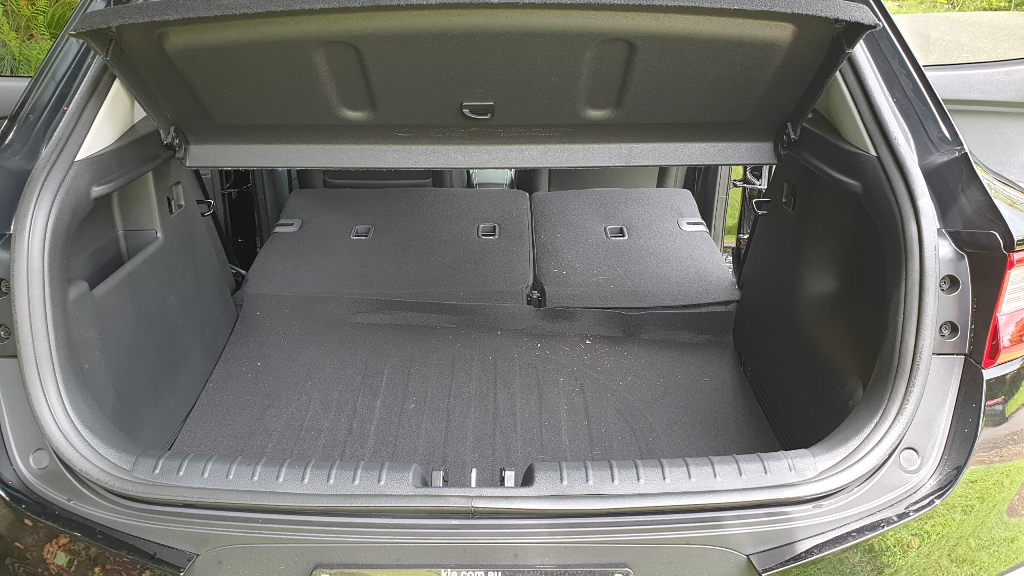
Kia’s design team have given the Stonic its own distinctive face, with Cerato-like LED blades in the slimmer than Rio’s headlight cluster. There’s more Cerato in the front bumpers outermost inserts, whilst there’s a bespoke chin plate that houses the driving lights and a grille for a forward reading sensor. 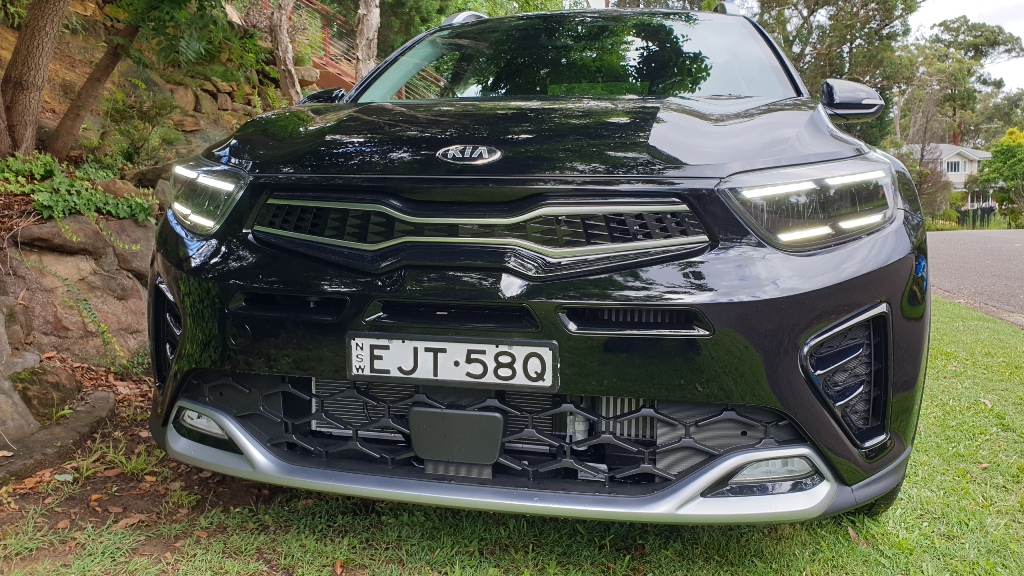 LEDs power the rear lights either side of an easy to lift tailgate. This reveals a modestly sized boot at 352L, expanding to 1,155L, while the rear seats fold to an almost but not quite level pegging with the boot floor itself. Underneath the carpet is a space saver spare. Rolling on stylish 17 inch machined and painted alloys, Kia have opted for grippy Continental ContiSport rubber at 205/55 profile.
 Up front and it’s faux-leather bolsters on the cloth covered pews, a rough finish to the carbon-fibre look trim across the dash, and an otherwise Kia looking cabin with a glossier than expected upper dash. This, though, may be down to the prep work at the pick-up and drop-off location. The aircon is single, not dual zone, the controls are the basic button and dial type, which doesn’t shout range topping, but they are intuitive to use. The hard press buttons below the 8.0 inch touchscreen are the same, and the DAB tuner exhibited the same excess signal loss as experienced in other Kia and Hyundai cars.
 For the driver its the standard pair of analogue dials and 4.3 inch info screen as seen elsewhere in Kia’s cars, plus the slightly flat bottomed tiller complete with the tabs familiar to Kia drivers. The rear seats have a single USB port to access at the rear of the centre console, with one up front along with a pair of 12V sockets, and only the driver’s window is one touch up and down. There are heating elements for the Stonic’s wing mirrors, a handy touch for some areas.
 Safety-wise there is Kia’s overeager Lane Keep Assist, with its staccato audio warning, Forward Collision Alert, and Blind Spot Assist. Autonomous Emergency Braking and Lane Follow Assist are also standard. Rain sensing wipers and solar glass for the main screen and side windows ease the UV rays.Behind the scenes is Kia’s seven year warranty and capped price service scheme.
At The End Of The Drive. For what the Stonic is intended for, and intended to do, it does it well enough. Clearly aimed at younger buyers, and likely the DINK crowd, it lobs into a relatively newish segment but one already visited by the likes of Audi, VW, and Mazda.
There’s internal competition from Seltos, and from sister brand Hyundai’s Kona, and Venue. In its early days as an offering, it’s the well worn “only time will tell” in how it stands up and stands out in an increasingly crowded segment.
2021 Kia Stonic Readies For Release.
Kia’s curiously named Stonic is being advertised on Australian TV for sale. The brand’s answer to the Kona, Stonic will have sharp pricing, a choice of three models (Stonic S, Sport, and Stonic GT-Line) with sub-2.0L engines, and a seven speed DCT for the GT-Line. The base model has a six speed manual or auto. Pricing starts from $22,990 for the Stonic S in manual guise, with a $1,000 premium for the auto. Sport starts at $24,990 and $25,990 for manual and auto, with GT-Line from $29,990. All prices are drive-away.
The engines are a 1.4L non-turbo four, or a 1.0L three cylinder. Power and torque figures are 74kW and 133Nm for the four, 74kW and 172Nm for the turbo three. It’s front wheel drive for the four cylinder, AWD for the turbo three potter.
The standard equipment for the S includes six airbags, car/pedestrian/cyclist detection AEB, Lane Following Assist, reversing camera with dynamic parking guidelines, rear parking sensors, driver attention alert, cruise control, idle stop and go (also in Sport), wireless Apple Carplay and Android Auto (S trim only), multi-connection Bluetooth, 8-inch Multimedia touchscreen, 6-speaker sound system, 4.2-inch TFT LCD driver’s cluster, 15-inch steel wheels and auto headlights.
Step up to the Sport and there is 17-inch alloy wheels, smart key with push button start, 8-inch multimedia touchscreen with navigation, 10-year Mapcare updates with SUNA Traffic, electric folding mirrors and premium steering wheel and shifter. GT-Line adds in 17 inch alloys, idle-stop-and-go, a bespoke body package, MFR LED headlights, two tone colour or a sunroof, cloth and artificial leather seats, climate control air conditioning, privacy glass, and an electrochromic mirror.
Exterior colour choices are broad. There will be seven available for the 1.4L version, with Clear White, Silky Silver, Perennial Grey, Aurora Black Pearl, Signal Red, Mighty Yellow, and Sport Blue. The GT-Line has a choice of four exclusive two-tone treatments. There is Clear white with an Aurora Black Pearl roof, Mighty Yellow and Aurora Black Pearl roof, Sporty Blue with Aura Black Pearl Roof, and Signal Red with Aurora Black Pearl Roof. Silky Silver is not available on GT-Line. Premium paints have a $520 impost.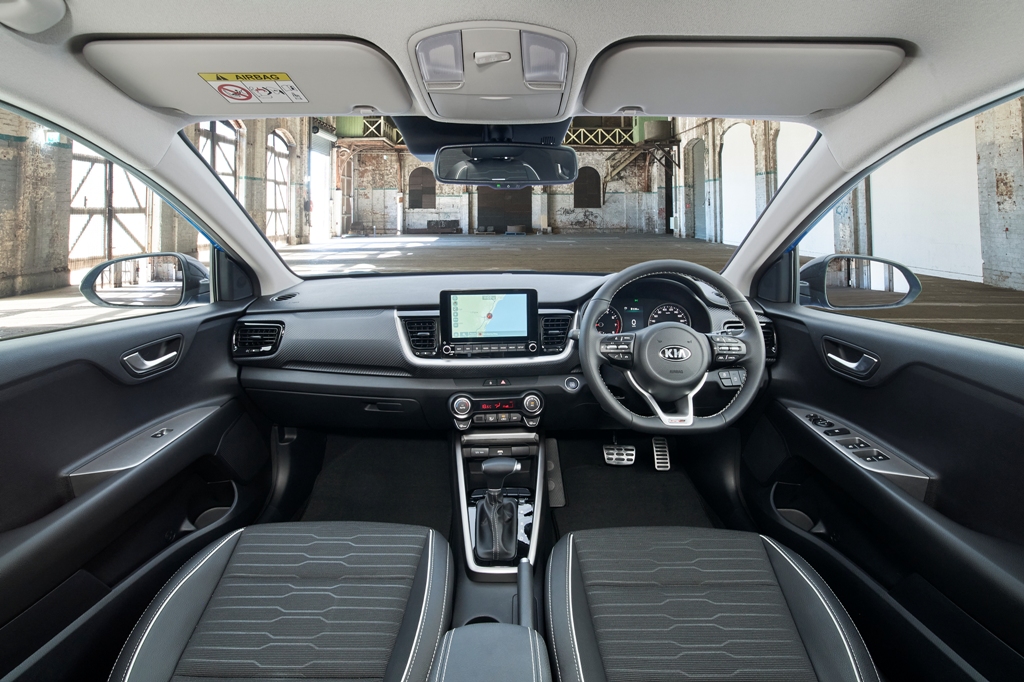
 Based on the Rio’s platform, the Stonic has had the gearbox moved forward by 28mm, and their is an increase of caster angle from 4.1 degrees to 4.6 degrees, Shock absorbers have been specified as the high performance RS-valve types. the rear shocks have been given a more upright stance, with 8.4 degrees off vertical, whilst Rio has 25 degrees.
Interior features include dual channel Bluetooth for two phones to connect for music streaming. The S has wireless connection for Apple CarPlay and Android Auto via the 8.0 inch however it’s not available on the Sport and GT-Line trims. Satnav has a 10-year Mapcare and SUNA traffic services support included.
Safety is high, of course, with camera and radar AEB across the three, with car, pedestrian, and cyclist recognition across an activation spread ranging from 5km/h to 180km/h for vehicles and 5km/h to 85km/h for pedestrian and cyclists. DAA or Driver Attention Alert is standard, along with Lane Keep Assist and Lane Following Assist. Parking Distance Warning connects to the rear sensors to monitor and alert for objects around the vehicle when reversing whilst the Rear Occupant Alert is a class leading inclusion which monitors rear door opening and closing to assist the driver about rear seat passengers when exiting the vehicle. Packaging has the Stonic at a length of 4140mm, width of 1760mm, height with roof racks 1520mm, wheelbase of 2580mm and minimum ground clearance of 165mm in S trim and 183mm for Sport and GT-Line, a maximum of 1,155L for the cargo, whilst towing is up to 1,000kg braked with the manual.
Check with your Kia dealer for a test drive.
 Level 2, 9 Help Street